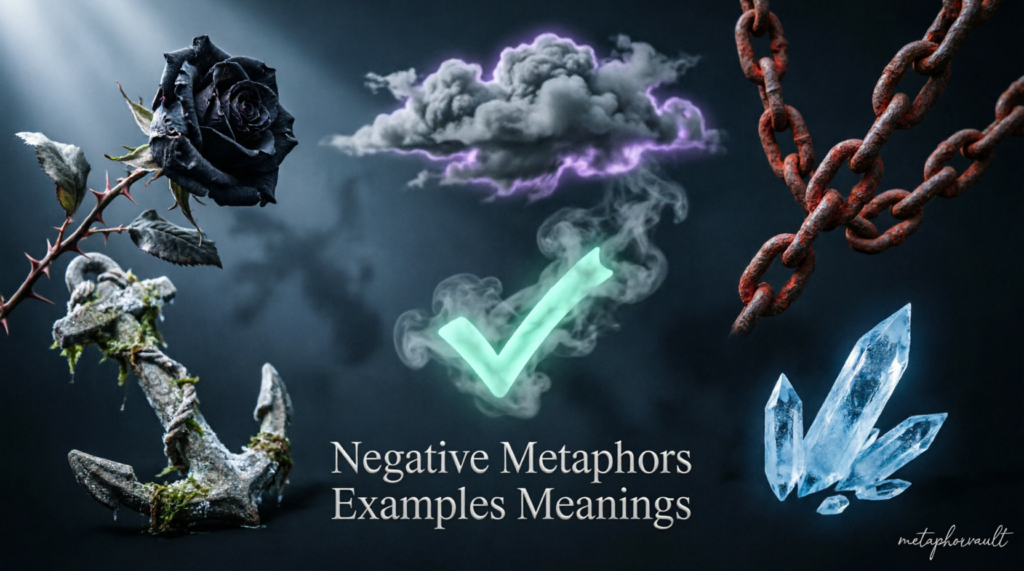
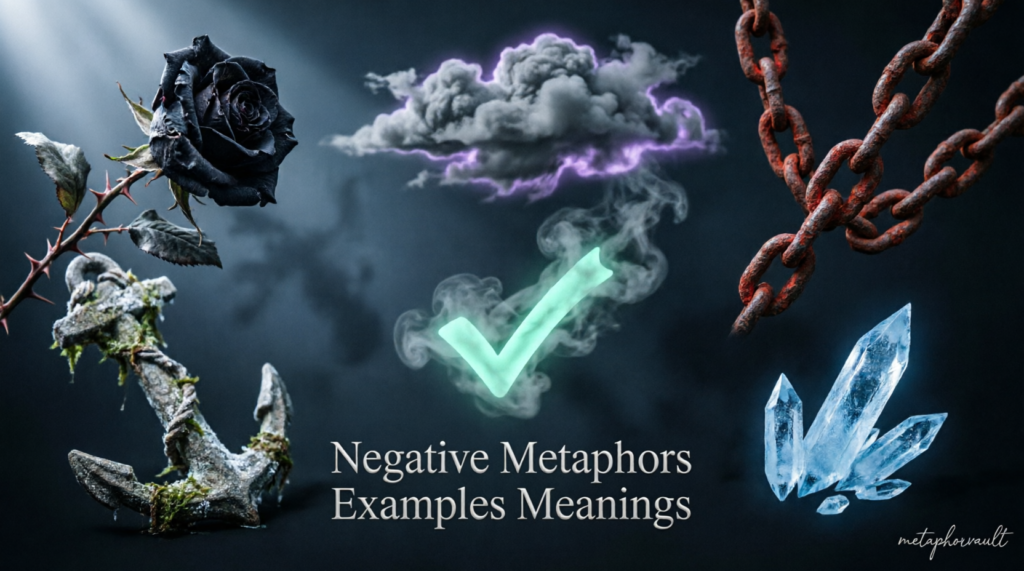
Negative metaphors are comparisons that describe people, feelings, situations, or ideas in an unpleasant, harmful, dark, or critical way. They do not mean the subject is literally what the metaphor says. Instead, they create a strong mental picture. People use negative metaphors in everyday speech, school writing, books, movies, poetry, social media, and professional communication. This guide, for 2026, explains what negative metaphors mean, why people use them, and how to recognize or write them correctly.
You will find more than 60 examples, including their meanings, sample sentences, tones, and suitable situations. You will also learn when a negative metaphor sounds natural and when it may sound too harsh. The main goal is simple: help you understand how negative comparisons work and choose words that match the situation. A metaphor can make criticism clearer, but the wrong metaphor can make a message insulting or confusing. By the end, you will be able to identify negative metaphors quickly and use them with greater control.
Definition & Meaning
A negative metaphor is a figure of speech that compares something to an unpleasant, harmful, difficult, or undesirable thing without using “like” or “as.” It creates an emotional picture rather than giving a literal description. For example, “Fear is a prison” suggests that fear limits a person’s freedom.
Simple Definition
A negative metaphor describes something by comparing it directly to something negative.
Example: “His anger was a volcano.”
The person is not literally a volcano. The metaphor suggests that his anger was powerful, dangerous, and ready to erupt.
Quick Explanation
Negative metaphors are useful because one short comparison can communicate an entire idea.
Instead of saying:
“She felt trapped by her responsibilities and could not see a way out.”
A writer might say:
“Her responsibilities were a cage.”
The second version creates a stronger image.
| Term | Meaning | Example |
|---|---|---|
| Metaphor | Direct comparison | “Life is a journey.” |
| Negative metaphor | Comparison with a negative image | “Fear is a prison.” |
| Positive metaphor | Comparison with a positive image | “Hope is a light.” |
| Simile | Comparison using “like” or “as” | “He was like a storm.” |
| Literal statement | Exact meaning | “He was very angry.” |
Why We Use Negative Metaphors
Negative metaphors help people express difficult ideas in a short, memorable way. They are common when someone wants to describe danger, sadness, failure, conflict, fear, confusion, pressure, or harmful behavior. Writers use them to create emotion, while speakers use them to make criticism or personal experiences easier to understand.
Practical Purpose
A negative metaphor can make an abstract problem easier to picture.
For example:
“Stress is a heavy backpack.”
This suggests that stress is something a person carries and that the weight becomes tiring over time.
Everyday Usage
People naturally use negative metaphors in conversation:
- “That job is a nightmare.”
- “He is a snake.”
- “My mind is a mess.”
- “The argument opened an old wound.”
- “Debt is a chain.”
These expressions often make everyday speech more vivid.
Writing
Authors use negative metaphors to build mood, reveal character, and create strong descriptions.
Example:
“The city was a machine that never slept.”
The metaphor can suggest pressure, noise, exhaustion, and a lack of rest.
Speaking
A metaphor can make an opinion easier to remember.
Instead of saying, “The new rule creates many problems,” someone might say:
“The new rule is a roadblock.”
School
Students can use negative metaphors in essays, literary analysis, creative writing, and speeches.
Example:
“The character’s guilt became a shadow that followed him everywhere.”
Social Media
Negative metaphors are especially common in short posts because they communicate emotion quickly.
Example:
“Monday is a thief stealing my energy.”
Professional Communication
Metaphors can also work at work, but they should be chosen carefully.
Better: “The outdated process is a roadblock.”
Too harsh: “The entire department is a disaster.”
Main Section
The following negative metaphors cover common ideas such as fear, failure, sadness, anger, stress, dishonesty, conflict, and difficult situations. Each example includes its meaning, a natural sentence, appropriate use, an unsuitable use, alternatives, difficulty, and tone.
1. Fear Is a Prison
Meaning: Fear prevents someone from acting freely.
Explanation: The metaphor compares fear to a place that holds someone inside.
Sentence: “His fear became a prison.”
Use: Personal writing or emotional discussion.
Not for: Formal factual reports.
Alternatives: fear is a cage; fear holds him back.
Difficulty: Easy. Tone: Neutral.
2. Anger Is a Volcano
Meaning: Anger can build and suddenly explode.
Sentence: “Her anger was a volcano waiting to erupt.”
Use: Stories and emotional descriptions.
Not for: Calm professional criticism.
Alternatives: anger is a storm; anger is boiling.
Difficulty: Easy. Tone: Neutral.
3. Stress Is a Heavy Backpack
Meaning: Stress feels like a weight someone carries.
Sentence: “Every problem added another book to his heavy backpack.”
Use: Personal or educational writing.
Not for: Highly formal reports.
Alternatives: stress is a burden; stress weighs me down.
Difficulty: Easy. Tone: Neutral.
4. Guilt Is a Shadow
Meaning: Guilt stays with someone and is difficult to escape.
Sentence: “Guilt followed him like a dark shadow.”
Use: Stories and reflective writing.
Not for: Casual business messages.
Alternatives: guilt follows him; guilt is a burden.
Difficulty: Easy. Tone: Neutral.
5. Failure Is a Dead End
Meaning: Failure appears to leave no path forward.
Sentence: “He thought the failed project was a dead end.”
Use: Essays and motivational discussions.
Not for: Situations where solutions are known.
Alternatives: failure is a wall; failure blocks the road.
Difficulty: Easy. Tone: Neutral.
6. Depression Is a Dark Cloud
Meaning: Deep sadness can seem to cover a person’s life.
Sentence: “A dark cloud seemed to follow him.”
Use: Literary or personal writing.
Not for: Making casual judgments about another person.
Alternatives: sadness is a cloud; darkness surrounds him.
Difficulty: Easy. Tone: Serious.
7. Lies Are Poison
Meaning: Lies can harm relationships or people.
Sentence: “Small lies became poison in their friendship.”
Use: Essays and relationship discussions.
Not for: Making accusations without evidence.
Alternatives: lies are toxic; lies damage trust.
Difficulty: Easy. Tone: Strong.
8. Debt Is a Chain
Meaning: Debt can limit freedom.
Sentence: “Years of debt felt like a chain around his future.”
Use: Financial writing and personal stories.
Not for: Neutral financial advice.
Alternatives: debt is a burden; debt holds you back.
Difficulty: Easy. Tone: Serious.
9. Jealousy Is a Monster
Meaning: Jealousy can control destructive behavior.
Sentence: “Jealousy became a monster inside him.”
Use: Fiction and emotional writing.
Not for: Diagnosing someone’s behavior.
Alternatives: jealousy consumes him; jealousy takes control.
Difficulty: Easy. Tone: Dramatic.
10. Hate Is a Fire
Meaning: Hatred can grow and cause destruction.
Sentence: “Years of hate became a fire between the families.”
Use: Stories and social commentary.
Not for: Light conversation.
Alternatives: hate burns; hatred spreads.
Difficulty: Easy. Tone: Strong.
11. A Problem Is a Roadblock
Meaning: A problem prevents progress.
Sentence: “The missing data became a roadblock.”
Use: School and workplace communication.
Not for: Problems that do not affect progress.
Alternatives: obstacle; barrier.
Difficulty: Easy. Tone: Neutral.
12. A Difficult Life Is a Battlefield
Meaning: Life feels like constant struggle.
Sentence: “For him, every day felt like a battlefield.”
Use: Creative writing.
Not for: Minor everyday inconveniences.
Alternatives: life is a struggle; life is a fight.
Difficulty: Easy. Tone: Dramatic.
13. Sadness Is an Anchor
Meaning: Sadness prevents emotional movement or progress.
Sentence: “Her sadness was an anchor pulling her down.”
Use: Poetry and reflective writing.
Not for: Casual descriptions.
Alternatives: sadness weighs her down; grief holds her back.
Difficulty: Medium. Tone: Serious.
14. Confusion Is a Maze
Meaning: Confusion makes it difficult to find a clear answer.
Sentence: “The instructions turned into a maze.”
Use: School and workplace writing.
Not for: Very simple problems.
Alternatives: confusion is a puzzle; the issue is tangled.
Difficulty: Easy. Tone: Neutral.
15. Time Is a Thief
Meaning: Time takes away opportunities or youth.
Sentence: “Time is a thief that never stops.”
Use: Poetry and social media.
Not for: Technical writing.
Alternatives: time slips away; time steals opportunities.
Difficulty: Easy. Tone: Reflective.
16. Regret Is an Old Wound
Meaning: Regret can continue to hurt long after an event.
Sentence: “The decision remained an old wound.”
Use: Stories and personal essays.
Not for: Casual workplace speech.
Alternatives: regret still hurts; regret leaves a scar.
Difficulty: Medium. Tone: Serious.
17. Anger Is a Storm
Meaning: Anger can become powerful and difficult to control.
Sentence: “A storm of anger swept through the meeting.”
Use: Creative writing.
Not for: Small disagreements.
Alternatives: anger erupted; emotions raged.
Difficulty: Easy. Tone: Dramatic.
18. A Bad Habit Is a Trap
Meaning: A habit can become difficult to escape.
Sentence: “His late-night routine became a trap.”
Use: Advice and personal writing.
Not for: Harmless habits.
Alternatives: habit holds him back; habit becomes a cycle.
Difficulty: Easy. Tone: Neutral.
19. Addiction Is a Cage
Meaning: Addiction can restrict a person’s freedom.
Sentence: “He described addiction as a cage.”
Use: Serious personal or educational writing.
Not for: Joking about addiction.
Alternatives: addiction traps people; addiction controls him.
Difficulty: Easy. Tone: Serious.
20. Failure Is a Wall
Meaning: Failure can feel like an obstacle that cannot be passed.
Sentence: “The failed exam felt like a wall.”
Use: Student writing.
Not for: Predicting permanent failure.
Alternatives: failure is an obstacle; failure blocks progress.
Difficulty: Easy. Tone: Neutral.
21. Criticism Is a Knife
Meaning: Harsh criticism can cause emotional pain.
Sentence: “His words felt like a knife.”
Use: Personal writing.
Not for: Routine constructive feedback.
Alternatives: words cut deeply; criticism hurts.
Difficulty: Easy. Tone: Strong.
22. Betrayal Is a Knife in the Back
Meaning: Betrayal causes deep emotional pain from someone trusted.
Sentence: “The betrayal felt like a knife in the back.”
Use: Informal speech and stories.
Not for: Formal workplace writing.
Alternatives: betrayal shattered trust; trust was broken.
Difficulty: Easy. Tone: Strong.
23. Loneliness Is a Desert
Meaning: Loneliness can feel empty and isolated.
Sentence: “After moving away, the city felt like a desert.”
Use: Poetry and personal writing.
Not for: Literally describing a location.
Alternatives: loneliness is emptiness; isolation is a desert.
Difficulty: Medium. Tone: Reflective.
24. Anxiety Is a Storm
Meaning: Anxiety can create overwhelming thoughts and emotions.
Sentence: “A storm of anxiety filled her mind.”
Use: Creative writing.
Not for: Making medical claims about someone.
Alternatives: anxiety overwhelms her; worry is swirling.
Difficulty: Easy. Tone: Serious.
25. Rumors Are Weeds
Meaning: Rumors spread quickly and are difficult to remove.
Sentence: “Rumors grew like weeds around the office.”
Use: Social commentary and stories.
Not for: Unverified accusations.
Alternatives: rumors spread; gossip grows.
Difficulty: Easy. Tone: Negative.
26. Gossip Is a Disease
Meaning: Gossip can spread through a group and cause harm.
Sentence: “Gossip became a disease in the workplace.”
Use: Opinion writing.
Not for: Sensitive real-life accusations.
Alternatives: gossip spreads; gossip is harmful.
Difficulty: Easy. Tone: Strong.
27. A Toxic Relationship Is a Prison
Meaning: A harmful relationship can make someone feel trapped.
Sentence: “She felt the relationship had become a prison.”
Use: Personal or creative writing.
Not for: Judging someone else’s private relationship without context.
Alternatives: relationship is a cage; relationship feels suffocating.
Difficulty: Medium. Tone: Serious.
28. A Bad Friend Is an Anchor
Meaning: A harmful friendship can prevent progress.
Sentence: “That friendship became an anchor.”
Use: Personal essays.
Not for: Casual disagreements.
Alternatives: friend holds him back; friendship weighs him down.
Difficulty: Easy. Tone: Serious.
29. Fear Is a Shadow
Meaning: Fear can follow someone everywhere.
Sentence: “Fear was a shadow behind every decision.”
Use: Stories and essays.
Not for: Technical writing.
Alternatives: fear follows him; fear hangs over him.
Difficulty: Easy. Tone: Reflective.
30. A Secret Is a Burden
Meaning: Keeping a secret can create emotional pressure.
Sentence: “The secret became a burden she could no longer carry.”
Use: Stories and personal writing.
Not for: Claiming every secret is harmful.
Alternatives: secret weighs on her; secret is heavy.
Difficulty: Easy. Tone: Neutral.
31. Poverty Is a Cage
Meaning: Poverty can restrict choices and opportunities.
Sentence: “For many families, poverty can feel like a cage.”
Use: Social essays.
Not for: Simplifying complex economic issues.
Alternatives: poverty limits choices; poverty creates barriers.
Difficulty: Medium. Tone: Serious.
32. War Is a Monster
Meaning: War causes destruction and suffering on a large scale.
Sentence: “War became a monster that consumed the town.”
Use: Literature and historical writing.
Not for: Casual conversation.
Alternatives: war destroys; war consumes lives.
Difficulty: Easy. Tone: Dramatic.
33. Corruption Is a Disease
Meaning: Corruption can spread through an organization or society.
Sentence: “Corruption became a disease within the system.”
Use: Formal essays and commentary.
Not for: Unsupported accusations against individuals.
Alternatives: corruption spreads; corruption weakens the system.
Difficulty: Medium. Tone: Formal.
34. Ignorance Is a Blindfold
Meaning: Lack of knowledge prevents someone from seeing clearly.
Sentence: “Ignorance can act like a blindfold.”
Use: Educational writing.
Not for: Insulting someone who lacks information.
Alternatives: ignorance limits understanding; lack of knowledge blocks awareness.
Difficulty: Easy. Tone: Neutral.
35. Anger Is a Fire
Meaning: Anger can grow and cause damage.
Sentence: “His anger was a fire he could not control.”
Use: Stories and essays.
Not for: Minor irritation.
Alternatives: anger burns; anger grows.
Difficulty: Easy. Tone: Strong.
36. Shame Is a Weight
Meaning: Shame can feel emotionally heavy.
Sentence: “Shame sat on his shoulders like a heavy weight.”
Use: Personal writing.
Not for: Mocking someone’s feelings.
Alternatives: shame weighs on him; shame is a burden.
Difficulty: Easy. Tone: Serious.
37. A Mistake Is a Stain
Meaning: A mistake can leave a lasting negative mark.
Sentence: “He treated the mistake as a stain on his record.”
Use: Reflective writing.
Not for: Saying one mistake permanently defines someone.
Alternatives: mistake leaves a mark; error damages the record.
Difficulty: Medium. Tone: Serious.
38. A Lie Is a Web
Meaning: One lie can lead to more lies and become complicated.
Sentence: “One small lie became a web of excuses.”
Use: Stories and essays.
Not for: Calling someone dishonest without proof.
Alternatives: lies become tangled; deception grows.
Difficulty: Easy. Tone: Neutral.
39. A Difficult Task Is a Mountain
Meaning: A difficult task requires major effort.
Sentence: “Finishing the project felt like climbing a mountain.”
Use: School and work.
Not for: Very easy tasks.
Alternatives: task is a challenge; task is an uphill climb.
Difficulty: Easy. Tone: Neutral.
40. Failure Is a Storm
Meaning: Failure can create a period of difficulty.
Sentence: “The failed launch brought a storm of problems.”
Use: Business writing.
Not for: Small mistakes.
Alternatives: problems erupted; difficulties followed.
Difficulty: Easy. Tone: Neutral.
41. A Bad Memory Is a Ghost
Meaning: A painful memory can return unexpectedly.
Sentence: “The old memory was a ghost that kept returning.”
Use: Creative writing.
Not for: Casual professional communication.
Alternatives: memory haunts him; past returns.
Difficulty: Easy. Tone: Dramatic.
42. Grief Is an Ocean
Meaning: Grief can feel vast and overwhelming.
Sentence: “Grief felt like an ocean with no shore.”
Use: Poetry and personal writing.
Not for: Casual remarks about someone else’s loss.
Alternatives: grief overwhelms her; grief feels endless.
Difficulty: Medium. Tone: Serious.
43. A Broken Promise Is a Crack
Meaning: A broken promise damages trust.
Sentence: “The broken promise was the first crack in their friendship.”
Use: Relationship writing.
Not for: Minor promises with little impact.
Alternatives: trust was damaged; promise weakened the relationship.
Difficulty: Easy. Tone: Neutral.
44. Conflict Is a Wall
Meaning: Conflict can separate people.
Sentence: “Anger built a wall between them.”
Use: Essays and conversations.
Not for: Friendly disagreements.
Alternatives: conflict divides them; anger creates distance.
Difficulty: Easy. Tone: Neutral.
45. Silence Is a Wall
Meaning: Silence can prevent communication.
Sentence: “Their silence became a wall.”
Use: Relationships and stories.
Not for: Situations where silence is peaceful.
Alternatives: silence creates distance; silence blocks communication.
Difficulty: Easy. Tone: Reflective.
46. Pressure Is a Vice
Meaning: Pressure can make someone feel squeezed or trapped.
Sentence: “The pressure of deadlines felt like a vice.”
Use: Workplace or academic writing.
Not for: Small amounts of pressure.
Alternatives: pressure squeezes; deadlines weigh heavily.
Difficulty: Medium. Tone: Serious.
47. A Difficult Situation Is a Quicksand
Meaning: A problem can become worse the more someone struggles without a plan.
Sentence: “The argument became quicksand.”
Use: Informal and creative writing.
Not for: Simple problems.
Alternatives: situation traps them; problem gets deeper.
Difficulty: Medium. Tone: Dramatic.
48. A Bad Decision Is a Wrong Turn
Meaning: A decision can lead someone away from the desired result.
Sentence: “Leaving the course was a wrong turn.”
Use: Everyday conversation.
Not for: Blaming someone harshly.
Alternatives: poor choice; bad direction.
Difficulty: Easy. Tone: Neutral.
49. Anger Is a Bomb
Meaning: Anger may suddenly explode and hurt others.
Sentence: “His anger was a bomb waiting to go off.”
Use: Fiction and strong descriptions.
Not for: Professional feedback.
Alternatives: anger may explode; emotions are volatile.
Difficulty: Medium. Tone: Strong.
50. A Bad Situation Is a Nightmare
Meaning: A situation is extremely unpleasant or difficult.
Sentence: “The delayed flight was a nightmare.”
Use: Everyday speech.
Not for: Serious tragedies when the phrase may sound insensitive.
Alternatives: terrible situation; awful experience.
Difficulty: Easy. Tone: Informal.
51. A Difficult Person Is a Thorn
Meaning: Someone creates repeated trouble or irritation.
Sentence: “The constant complaint became a thorn in the team’s side.”
Use: Informal writing.
Not for: Directly insulting a coworker.
Alternatives: difficult person; ongoing problem.
Difficulty: Medium. Tone: Negative.
52. Betrayal Is a Broken Bridge
Meaning: Betrayal can make rebuilding a relationship difficult.
Sentence: “The betrayal left a broken bridge between them.”
Use: Creative writing.
Not for: Quick disagreements.
Alternatives: trust was destroyed; relationship was damaged.
Difficulty: Medium. Tone: Serious.
53. A Bad Reputation Is a Shadow
Meaning: A reputation can continue affecting someone.
Sentence: “The scandal became a shadow over his career.”
Use: Journalism or essays.
Not for: Spreading unverified claims.
Alternatives: reputation follows him; past affects his image.
Difficulty: Easy. Tone: Serious.
54. A Problem Is a Thorn
Meaning: A problem causes repeated discomfort.
Sentence: “The outdated software was a thorn in the team’s side.”
Use: Workplace communication.
Not for: Major emergencies.
Alternatives: nuisance; obstacle.
Difficulty: Easy. Tone: Informal.
55. A Broken System Is a Crumbling House
Meaning: A system may look functional while its foundation is failing.
Sentence: “The department was becoming a crumbling house.”
Use: Opinion writing.
Not for: Unsupported claims about real organizations.
Alternatives: system is weakening; structure is failing.
Difficulty: Medium. Tone: Strong.
56. Hopelessness Is a Dark Room
Meaning: Hopelessness can make the future seem invisible.
Sentence: “Hopelessness felt like sitting in a dark room.”
Use: Poetry and reflective writing.
Not for: Casual descriptions.
Alternatives: hope disappears; future feels dark.
Difficulty: Easy. Tone: Serious.
57. A Secret Is a Stone
Meaning: A secret can feel heavy to carry.
Sentence: “The secret was a stone in her chest.”
Use: Fiction and personal writing.
Not for: Literal descriptions.
Alternatives: secret weighs on her; hidden truth feels heavy.
Difficulty: Medium. Tone: Emotional.
58. Fear Is a Cage
Meaning: Fear can stop people from taking action.
Sentence: “Fear became a cage around his dreams.”
Use: Motivational or creative writing.
Not for: Making fear sound like a permanent condition.
Alternatives: fear limits him; fear holds him back.
Difficulty: Easy. Tone: Neutral.
59. Failure Is a Shadow
Meaning: Past failure can continue affecting confidence.
Sentence: “His first failure became a shadow over every new project.”
Use: Essays and stories.
Not for: Suggesting failure always follows someone.
Alternatives: past failure affects him; failure lingers.
Difficulty: Easy. Tone: Reflective.
60. A Toxic Workplace Is a Battlefield
Meaning: A workplace can feel like constant conflict and competition.
Sentence: “The office had become a battlefield.”
Use: Informal workplace commentary or creative writing.
Not for: Formal complaints where precise facts are needed.
Alternatives: workplace is hostile; office is full of conflict.
Difficulty: Easy. Tone: Strong.
61. A Difficult Past Is an Open Wound
Meaning: Past pain can still affect the present.
Sentence: “The old argument remained an open wound.”
Use: Literary and personal writing.
Not for: Casual discussion of someone’s trauma.
Alternatives: past still hurts; old pain remains.
Difficulty: Medium. Tone: Serious.
62. A Harmful Idea Is a Seed of Destruction
Meaning: A small harmful idea can grow into a larger problem.
Sentence: “That decision planted a seed of destruction.”
Use: Fiction and social commentary.
Not for: Ordinary mistakes.
Alternatives: idea creates problems; harmful thinking spreads.
Difficulty: Medium. Tone: Dramatic.
63. Confusion Is Fog
Meaning: Confusion makes the correct path difficult to see.
Sentence: “The conflicting instructions created a fog of confusion.”
Use: School and workplace writing.
Not for: Simple questions.
Alternatives: confusion clouds judgment; the issue is unclear.
Difficulty: Easy. Tone: Neutral.
64. A Broken Relationship Is a Ruined House
Meaning: A relationship can lose the structure that once supported it.
Sentence: “Their friendship felt like a ruined house.”
Use: Creative writing.
Not for: Sensitive real-life conversations where direct language is better.
Alternatives: friendship fell apart; relationship was damaged.
Difficulty: Medium. Tone: Serious.
Quick Reference Table
| # | Negative Metaphor | Main Meaning | Tone |
|---|---|---|---|
| 1 | Fear is a prison | Fear limits freedom | Neutral |
| 2 | Anger is a volcano | Anger may erupt | Neutral |
| 3 | Stress is a heavy backpack | Stress feels burdensome | Neutral |
| 4 | Guilt is a shadow | Guilt follows you | Serious |
| 5 | Failure is a dead end | Failure feels final | Neutral |
| 6 | Sadness is a dark cloud | Sadness covers life | Serious |
| 7 | Lies are poison | Lies cause harm | Strong |
| 8 | Debt is a chain | Debt limits freedom | Serious |
| 9 | Jealousy is a monster | Jealousy controls behavior | Dramatic |
| 10 | Hate is a fire | Hate can spread | Strong |
| 11 | Problem is a roadblock | Problem stops progress | Neutral |
| 12 | Life is a battlefield | Life feels like struggle | Dramatic |
| 13 | Sadness is an anchor | Sadness pulls you down | Serious |
| 14 | Confusion is a maze | Confusion blocks direction | Neutral |
| 15 | Time is a thief | Time takes opportunities | Reflective |
| 16 | Regret is an old wound | Past choices still hurt | Serious |
| 17 | Anger is a storm | Anger becomes powerful | Dramatic |
| 18 | Bad habit is a trap | Habit is hard to escape | Neutral |
| 19 | Addiction is a cage | Addiction restricts freedom | Serious |
| 20 | Failure is a wall | Failure blocks progress | Neutral |
| 21 | Criticism is a knife | Words can hurt | Strong |
| 22 | Betrayal is a knife in the back | Betrayal causes pain | Strong |
| 23 | Loneliness is a desert | Loneliness feels empty | Reflective |
| 24 | Anxiety is a storm | Worry feels overwhelming | Serious |
| 25 | Rumors are weeds | Rumors spread | Negative |
| 26 | Gossip is a disease | Gossip spreads harm | Strong |
| 27 | Toxic relationship is a prison | Relationship feels trapping | Serious |
| 28 | Bad friend is an anchor | Friend holds you back | Serious |
| 29 | Fear is a shadow | Fear follows you | Reflective |
| 30 | Secret is a burden | Secret creates pressure | Neutral |
| 31 | Poverty is a cage | Poverty limits choices | Serious |
| 32 | War is a monster | War destroys | Dramatic |
| 33 | Corruption is a disease | Corruption spreads | Formal |
| 34 | Ignorance is a blindfold | Lack of knowledge limits sight | Neutral |
| 35 | Anger is a fire | Anger can grow | Strong |
| 36 | Shame is a weight | Shame feels heavy | Serious |
| 37 | Mistake is a stain | Mistake leaves a mark | Serious |
| 38 | Lie is a web | Lies become complicated | Neutral |
| 39 | Difficult task is a mountain | Task requires effort | Neutral |
| 40 | Failure is a storm | Failure creates trouble | Neutral |
| 41 | Bad memory is a ghost | Memory returns | Dramatic |
| 42 | Grief is an ocean | Grief feels overwhelming | Serious |
| 43 | Broken promise is a crack | Trust is damaged | Neutral |
| 44 | Conflict is a wall | Conflict separates people | Neutral |
| 45 | Silence is a wall | Silence blocks connection | Reflective |
| 46 | Pressure is a vice | Pressure squeezes | Serious |
| 47 | Situation is quicksand | Problem becomes harder | Dramatic |
| 48 | Bad decision is a wrong turn | Choice leads away | Neutral |
| 49 | Anger is a bomb | Anger may explode | Strong |
| 50 | Bad situation is a nightmare | Situation is awful | Informal |
| 51 | Difficult person is a thorn | Person causes trouble | Negative |
| 52 | Betrayal is a broken bridge | Trust is hard to rebuild | Serious |
| 53 | Bad reputation is a shadow | Reputation lingers | Serious |
| 54 | Problem is a thorn | Problem causes irritation | Informal |
| 55 | Broken system is a crumbling house | System is weakening | Strong |
| 56 | Hopelessness is a dark room | Future seems invisible | Serious |
| 57 | Secret is a stone | Secret feels heavy | Emotional |
| 58 | Fear is a cage | Fear restricts action | Neutral |
| 59 | Failure is a shadow | Past failure lingers | Reflective |
| 60 | Toxic workplace is a battlefield | Workplace has conflict | Strong |
| 61 | Difficult past is an open wound | Past pain remains | Serious |
| 62 | Harmful idea is a seed of destruction | Small idea can grow | Dramatic |
| 63 | Confusion is fog | Situation lacks clarity | Neutral |
| 64 | Broken relationship is a ruined house | Relationship has collapsed | Serious |
Real-Life Conversations
Negative metaphors sound most natural when they match the emotion and situation. In everyday speech, people usually use shorter metaphors than they would in an essay.
Conversation 1: Friends
Sam: “How’s the new job?”
Alex: “Honestly, it’s a battlefield.”
Sam: “That bad?”
Alex: “Everyone is competing with everyone. I feel like I have to watch my back.”
Sam: “Then maybe the problem isn’t you. Maybe the workplace is just too stressful.”
Here, “battlefield” describes constant conflict without literally saying the office is a war zone.
Conversation 2: Student and Teacher
Student: “I don’t think I can finish this essay.”
Teacher: “Why?”
Student: “The research is a maze. Every source leads somewhere else.”
Teacher: “Then make the question smaller. Don’t try to solve the whole maze at once.”
The metaphor makes the student’s confusion easy to understand.
Conversation 3: Family
Daughter: “Dad hasn’t talked to Uncle Mike for months.”
Mother: “That argument built a wall between them.”
Daughter: “Do you think they’ll talk again?”
Mother: “I hope so. Walls can come down.”
The metaphor describes emotional distance without explaining every detail.
Conversation 4: Dating
Friend 1: “Are you going to text him?”
Friend 2: “I don’t know. The last conversation left an old wound.”
Friend 1: “Then don’t rush. Give yourself some time.”
Here, “old wound” expresses emotional pain from a past event.
Conversation 5: Office
Manager: “Why is the project behind schedule?”
Employee: “The old software is a roadblock.”
Manager: “Can we replace it?”
Employee: “Yes. That would remove the biggest obstacle.”
The metaphor is useful because it identifies a problem without attacking a person.
Everyday Usage
Negative metaphors appear in almost every form of communication, but the best metaphor depends on the audience and purpose.
Conversation
People often use familiar metaphors without thinking about them.
Examples include:
- “I’m drowning in work.”
- “This problem is a headache.”
- “He’s a snake.”
- “That mistake came back to haunt me.”
- “We’re stuck in a rut.”
These are usually informal and easy to understand.
Writing
In essays, metaphors help explain abstract ideas.
Example:
“Fear became a wall between the student and her goals.”
This is more vivid than simply saying fear prevented her from succeeding.
Books
Fiction writers use negative metaphors to create atmosphere and reveal character.
A dark metaphor can make a scene feel tense, lonely, frightening, or hopeless without explaining every emotion directly.
Movies
Characters often use metaphors in emotional dialogue.
For example:
“This place is a prison.”
The speaker may mean that the place feels restrictive, not that it is literally a prison.
Poetry
Poetry often uses stronger and more unusual metaphors.
Example:
“Grief was an ocean beneath my feet.”
The image suggests depth, uncertainty, and emotional danger.
Emails
Use negative metaphors carefully in professional email.
Too dramatic:
“The new system is a nightmare.”
Better:
“The new system has become a major roadblock for the team.”
The second version sounds professional and focuses on the problem.
Text Messages
Informal metaphors are common in texts.
Example:
“That exam was a mountain 😭”
The speaker means that the exam felt extremely difficult.
Short metaphors work well in captions.
Example:
“Some memories are ghosts.”
This creates an emotional message without a long explanation.
People may use familiar metaphors when discussing life experiences.
Example:
“Sometimes failure is a wall, but sometimes it is a door.”
This combines a negative metaphor with a hopeful idea.
X
Short, sharp metaphors are common because posts have limited space.
Example:
“Bad information is wildfire. Check the source before you share it.”
Professional metaphors should focus on problems, systems, or progress rather than insulting people.
Better:
“Outdated processes are roadblocks to growth.”
Less appropriate:
“Our management team is a disaster.”
School Assignments
Students should use metaphors to support an idea rather than fill space.
Weak:
“The character is sad.”
Stronger:
“His sadness became a shadow that followed him through the story.”
A good metaphor adds meaning. It should not simply make a sentence sound fancy.
Choosing the Right Negative Metaphor
The strongest metaphor depends on what you want the reader to feel.
Use a cage when you want to show restriction.
Use a storm when you want to show emotional force.
Use a shadow when something continues to follow someone.
Use a wall when something creates separation.
Use a chain when something limits freedom.
Use a wound when something causes lasting emotional pain.
Use a maze when something creates confusion.
Use a roadblock when something stops progress.
Use a mountain when something requires great effort.
Use a fire when something grows or spreads.
Negative Metaphor vs. Negative Simile
A metaphor says one thing is another thing:
“Fear is a cage.”
A simile uses like or as:
“Fear is like a cage.”
Both create a comparison, but the metaphor is usually more direct and forceful.
How to Create Your Own Negative Metaphors
Start with the problem you want to describe.
Ask:
- What does this problem do?
- Does it trap, block, follow, burn, weigh down, divide, or spread?
- What real object behaves that way?
- Can the comparison be understood quickly?
- Does the tone fit the audience?
For example, suppose you want to describe overwhelming homework.
The problem weighs you down.
A heavy object also weighs you down.
So you could write:
“Homework was a heavy backpack.”
That metaphor is simple, clear, and easy for most readers to understand.
Common Mistakes
One common mistake is making a metaphor too extreme.
Calling a small inconvenience “a nightmare” may sound dramatic.
Another mistake is mixing metaphors.
For example:
“We need to climb the roadblock before the storm catches fire.”
The images do not work well together.
A cleaner sentence would be:
“The roadblock is slowing the project.”
Another mistake is using a metaphor when direct language would be safer. In professional communication, facts often matter more than dramatic comparisons.
Final Takeaway
Negative metaphors give unpleasant experiences a clear shape. Fear can become a cage, stress can become a heavy backpack, confusion can become fog, conflict can become a wall, and failure can become a dead end. These comparisons help readers understand feelings and situations quickly.
The best negative metaphor is not always the darkest one. It is the one that matches the exact idea, audience, and tone. Use simple metaphors for everyday speech, stronger images for creative writing, and measured language for school or professional communication. When used well, negative metaphors can make an ordinary sentence more vivid without making it confusing or unnecessarily harsh.
descover more post
30+Metaphors in Nature Meaning Uses and Beautiful …
Metaphors We Live By Summary Simple Chapter …
25+Personal Metaphors Ways to Describe Yourself 2026

Kovien is an experienced English language researcher, editor, and digital content strategist at MetaphorVault.com. He earned a Bachelor’s degree in English Language and Literature and has spent more than 5 years creating educational resources that simplify figurative language, metaphors, idioms, and modern English usage. His expertise combines linguistic knowledge with practical SEO writing, allowing him to produce content that is both informative and engaging. Kovien enjoys transforming complex language concepts into clear, relatable explanations supported by real-world examples. His work is driven by a commitment to accuracy, originality, and continuous learning. Through MetaphorVault.com, he aims to help readers build stronger communication skills and gain greater confidence in understanding and using the English language.