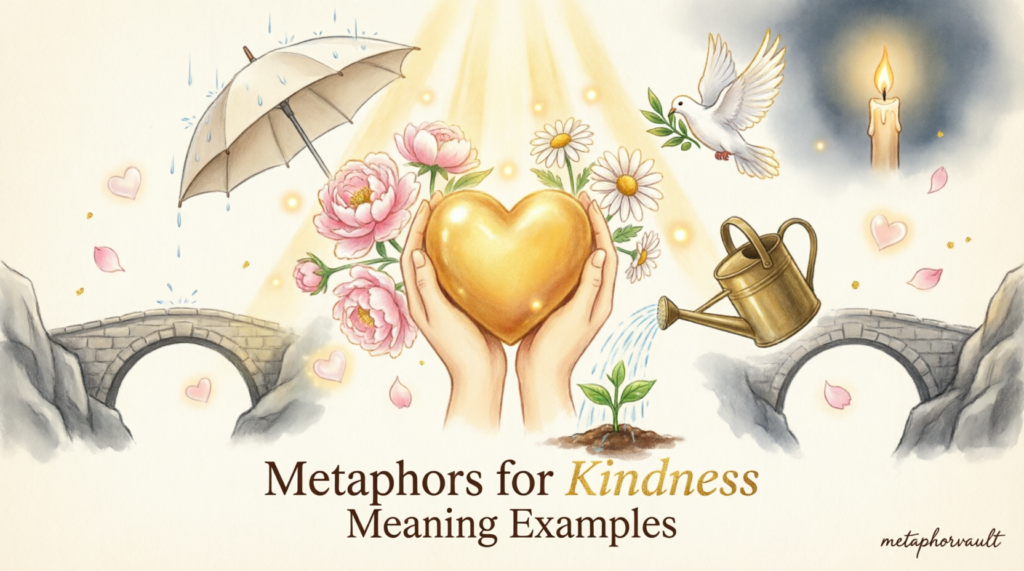
Metaphors for kindness are creative expressions that describe a caring person, gentle action, or helpful behavior by comparing it to something warm, bright, safe, or valuable. Instead of simply saying “she is kind,” a metaphor can say “she is a ray of sunshine,” helping the reader picture how that kindness feels.
People search for these expressions because ordinary words such as kind, caring, and helpful can feel too plain. A good metaphor adds emotion and color to a sentence. You may find these expressions in school writing, poems, novels, speeches, social media captions, personal messages, and everyday conversations. Some sound natural and casual, while others are better for creative writing.
This 2026 guide explains the meaning behind more than 60 useful expressions, shows them in real sentences, and explains when each one works best. You will also see which expressions sound formal, informal, or neutral, so you can choose one that fits the situation.
| Expression | Simple meaning | Tone | Best use |
|---|---|---|---|
| A ray of sunshine | Someone who brings happiness | Neutral | Conversation, writing |
| A warm blanket | Someone who provides comfort | Neutral | Personal writing |
| A guiding light | Someone who gives support or direction | Neutral | Speeches, writing |
| A safe harbor | Someone who offers safety and comfort | Neutral | Emotional writing |
| A gentle breeze | A person whose presence feels calming | Poetic | Creative writing |
| A helping hand | Someone who helps others | Neutral | Everyday speech |
| A bridge | Someone who brings people together | Neutral | School, work |
| A shelter from the storm | Someone who protects or comforts | Poetic | Personal writing |
Why We Use Metaphors for Kindness
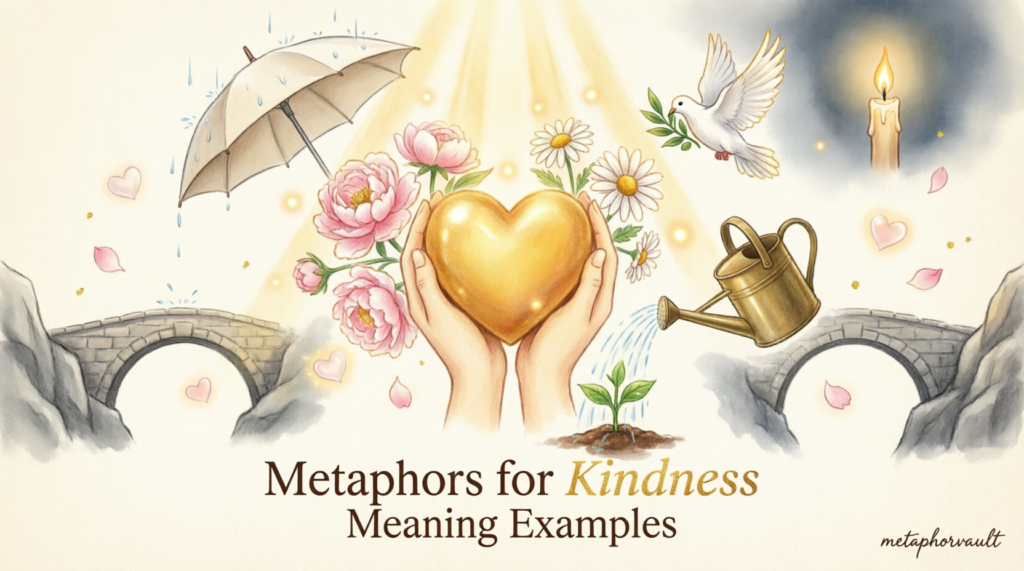
People use these comparisons because kindness is often easier to feel than to define. A metaphor turns an abstract quality into a clear image. Calling someone “a warm blanket” suggests comfort, while calling them “a guiding light” suggests help and direction. These expressions make conversations, stories, poems, speeches, captions, and school assignments more vivid without needing complicated vocabulary.
Practical purpose
A simple sentence tells the reader what happened:
Maria helped me when I was struggling.
A metaphor adds feeling:
Maria was a guiding light when I was struggling.
The second sentence gives the reader an image of someone who helped another person find a way forward.
Everyday usage
You can use these expressions when thanking someone, describing a friend, praising a teacher, writing a birthday message, or talking about a person who helped you.
Writing
Metaphors are useful in essays, stories, poems, personal statements, speeches, and descriptions. They can make emotional writing stronger without adding many words.
Speaking
In conversation, simple expressions such as “a helping hand” or “a ray of sunshine” sound natural.
School
Students can use them in descriptive writing, creative writing, speeches, and assignments about friendship, kindness, character, or community.
Social media
Short metaphors work well in captions:
“Some people are little rays of sunshine on difficult days.”
Professional communication
Workplace writing usually benefits from simple, clear metaphors. For example:
“Her support was a bridge between two teams.”
Avoid very dramatic metaphors in formal emails unless the situation calls for a warm or personal tone.
60+ Metaphors for Kindness
1. A Ray of Sunshine
Meaning: A person who brings happiness, warmth, or hope to others.
Real explanation: Sunshine makes a dark or gloomy day feel brighter. Calling a kind person a “ray of sunshine” suggests that their presence makes life feel better.
Sample sentence:
“Her kindness was a ray of sunshine during a difficult week.”
When to use it: Use it for cheerful, caring people who make others feel happier.
When NOT to use it: Avoid it when you need a very formal or technical description.
Alternatives: bright spot, source of joy, breath of fresh air
Difficulty: Easy
Tone: Neutral
2. A Helping Hand
Meaning: Someone who offers practical help.
Real explanation: A hand represents assistance. The expression is especially useful when someone steps in and makes a difficult task easier.
Sample sentence:
“Whenever I need help, Sara is always a helping hand.”
When to use it: Everyday conversation, writing, thank-you messages.
When NOT to use it: It may sound too simple for highly literary writing.
Alternatives: source of help, support system, helping force
Difficulty: Easy
Tone: Neutral
3. A Warm Blanket
Meaning: Someone who makes you feel safe, cared for, and comfortable.
Real explanation: A blanket protects us from cold and gives physical comfort. As a metaphor, it describes emotional comfort.
Sample sentence:
“Her gentle words felt like a warm blanket after a painful day.”
When to use it: Personal writing, poetry, emotional descriptions.
When NOT to use it: Avoid it in formal business writing.
Alternatives: source of comfort, safe place, soft landing
Difficulty: Easy
Tone: Poetic
4. A Guiding Light
Meaning: Someone who gives support, wisdom, or direction.
Real explanation: A light helps people see where they are going. The metaphor suggests that a kind person helps others through uncertainty.
Sample sentence:
“My teacher became a guiding light when I lost confidence.”
When to use it: Teachers, parents, mentors, friends, and leaders.
When NOT to use it: Avoid using it repeatedly in the same piece because it is a familiar expression.
Alternatives: beacon of hope, compass, source of direction
Difficulty: Easy
Tone: Neutral
5. A Safe Harbor
Meaning: A person or place where someone feels protected and accepted.
Real explanation: A harbor gives ships shelter from rough water. The metaphor compares emotional safety with physical safety.
Sample sentence:
“Her home was a safe harbor for anyone who needed support.”
When to use it: Emotional writing and descriptions of trusted people.
When NOT to use it: It may sound too poetic for a short business message.
Alternatives: refuge, sanctuary, safe place
Difficulty: Medium
Tone: Poetic
6. A Gentle Breeze
Meaning: Someone whose presence feels calm and pleasant.
Real explanation: A gentle breeze does not force its way into a space. It simply brings relief and freshness. This makes it a useful image for quiet kindness.
Sample sentence:
“His kindness moved through the room like a gentle breeze.”
When to use it: Poetry, stories, reflective writing.
When NOT to use it: Do not use it when describing strong, active help.
Alternatives: calming presence, breath of fresh air, quiet comfort
Difficulty: Medium
Tone: Poetic
7. A Bridge
Meaning: Someone who connects people or helps solve conflict.
Real explanation: A bridge connects two places that would otherwise be separated. A kind person can play the same role between people.
Sample sentence:
“Her patience became a bridge between the two angry teams.”
When to use it: Teamwork, friendship, conflict resolution, community.
When NOT to use it: It does not clearly express kindness unless the surrounding sentence gives context.
Alternatives: connection, link, peacemaker
Difficulty: Easy
Tone: Neutral
8. A Shelter from the Storm
Meaning: Someone who provides comfort during hard times.
Real explanation: A storm represents trouble, stress, or pain. A shelter protects people while the storm passes.
Sample sentence:
“During my hardest year, my sister was a shelter from the storm.”
When to use it: Emotional stories and personal essays.
When NOT to use it: Avoid it for small acts of everyday politeness.
Alternatives: refuge, safe harbor, place of comfort
Difficulty: Medium
Tone: Poetic
9. A Beacon of Hope
Meaning: Someone who gives people hope during difficult times.
Real explanation: A beacon is a strong light used to guide people. The metaphor suggests that kindness can help someone believe that things will improve.
Sample sentence:
“Her kindness was a beacon of hope for the new students.”
When to use it: Speeches, essays, serious writing.
When NOT to use it: It can sound too dramatic for a minor favor.
Alternatives: source of hope, guiding light, light in the darkness
Difficulty: Medium
Tone: Formal/Neutral
10. A Soft Place to Land
Meaning: Someone who offers emotional support after a difficult experience.
Real explanation: Landing can be painful if the ground is hard. A soft place makes the landing safer. The metaphor describes a person who makes difficult moments easier.
Sample sentence:
“Whenever life overwhelms me, my best friend is a soft place to land.”
When to use it: Personal writing and conversations about emotional support.
When NOT to use it: Avoid it in highly formal reports.
Alternatives: source of comfort, safe person, emotional refuge
Difficulty: Medium
Tone: Informal/Poetic
11. A Cup of Warm Tea
Meaning: A person or gesture that provides simple comfort.
Real explanation: Warm tea is often linked with rest, care, and hospitality. The image works well for small acts of kindness.
Sample sentence:
“Her thoughtful message was like a cup of warm tea on a cold morning.”
When to use it: Creative writing and social media.
When NOT to use it: It is not suitable for technical or formal documents.
Alternatives: little comfort, warm gesture, small kindness
Difficulty: Medium
Tone: Poetic
12. A Light in the Darkness
Meaning: Someone who brings hope or kindness during a difficult period.
Sample sentence:
“His simple kindness was a light in the darkness.”
When to use it: Serious personal writing, speeches, stories.
When NOT to use it: Avoid overusing it because it is a common metaphor.
Alternatives: ray of hope, guiding light, bright spot
Difficulty: Easy
Tone: Neutral/Poetic
13. A Gentle Anchor
Meaning: Someone who helps another person remain calm and steady.
Sample sentence:
“Her calm advice was a gentle anchor during the crisis.”
When to use it: Describing dependable friends, family members, or mentors.
When NOT to use it: Avoid it when describing someone who only provides brief practical help.
Alternatives: steady support, grounding force, source of stability
Difficulty: Medium
Tone: Poetic
14. A Compass
Meaning: Someone who helps another person choose the right direction.
Sample sentence:
“My grandfather was a compass who taught me to treat people with respect.”
When to use it: Mentors, parents, teachers, and role models.
When NOT to use it: It suggests guidance more than simple kindness.
Alternatives: guide, moral guide, guiding light
Difficulty: Easy
Tone: Neutral
15. A Garden of Peace
Meaning: A person or place filled with calm, care, and emotional safety.
Sample sentence:
“Her classroom felt like a garden of peace.”
When to use it: Poetry and descriptive writing.
When NOT to use it: Avoid it in normal professional communication.
Alternatives: peaceful refuge, calm haven, sanctuary
Difficulty: Medium
Tone: Poetic
16. A Safe Haven
Meaning: Someone who provides protection, acceptance, or comfort.
Sample sentence:
“For many students, the counselor became a safe haven.”
When to use it: Serious or emotional situations.
When NOT to use it: It may be too strong for a small favor.
Alternatives: refuge, sanctuary, safe harbor
Difficulty: Easy
Tone: Neutral
17. A Handrail on a Steep Staircase
Meaning: Someone who gives support while another person faces difficulty.
Sample sentence:
“Her encouragement was a handrail on a steep staircase.”
When to use it: Creative writing about challenges and support.
When NOT to use it: Avoid it when you want a short, natural phrase.
Alternatives: steady support, helping hand, safety net
Difficulty: Medium
Tone: Poetic
18. A Safety Net
Meaning: Someone who is ready to help when things go wrong.
Sample sentence:
“My family has always been my safety net.”
When to use it: Family, friendship, teamwork, and support.
When NOT to use it: It emphasizes protection more than warmth.
Alternatives: backup, support system, safety cushion
Difficulty: Easy
Tone: Neutral
19. A Spring of Fresh Water
Meaning: A person who continually gives comfort, energy, or goodness.
Sample sentence:
“Her kindness was a spring of fresh water for everyone around her.”
When to use it: Poetry and creative writing.
When NOT to use it: Avoid it in everyday professional speech.
Alternatives: source of goodness, well of kindness, source of comfort
Difficulty: Medium
Tone: Poetic
20. A Well of Kindness
Meaning: A person who seems to have a deep supply of compassion.
Sample sentence:
“He seemed to draw from a well of kindness whenever someone needed help.”
When to use it: Descriptive and reflective writing.
When NOT to use it: It can sound literary in casual conversation.
Alternatives: heart full of care, source of compassion, reservoir of goodwill
Difficulty: Medium
Tone: Poetic
21. A Heart of Gold
Meaning: A person who is deeply good, caring, and generous.
Sample sentence:
“Mr. Ahmed has a heart of gold and never ignores someone in need.”
When to use it: Everyday speech, stories, compliments.
When NOT to use it: Avoid it in formal academic analysis unless you are discussing language itself.
Alternatives: kind heart, generous spirit, good soul
Difficulty: Easy
Tone: Informal/Neutral
22. A Golden Thread
Meaning: A quiet quality of goodness that connects people or events.
Sample sentence:
“Kindness was the golden thread running through her life.”
When to use it: Essays, speeches, biographies, creative writing.
When NOT to use it: Too abstract for simple everyday speech.
Alternatives: common bond, connecting force, thread of compassion
Difficulty: Medium
Tone: Poetic
23. A Flower in a Concrete City
Meaning: A gentle or caring presence in a harsh environment.
Sample sentence:
“Her kindness was a flower in a concrete city.”
When to use it: Creative writing about kindness in difficult places.
When NOT to use it: Avoid it if the reader needs a very direct meaning.
Alternatives: bright spot, gentle presence, breath of fresh air
Difficulty: Medium
Tone: Poetic
24. A Candle
Meaning: Someone whose kindness provides a small but meaningful amount of hope or warmth.
Sample sentence:
“Even a small act of kindness can be a candle in a difficult night.”
When to use it: Speeches, essays, poems, inspirational writing.
When NOT to use it: It may sound dramatic in casual conversation.
Alternatives: little light, spark of hope, small beacon
Difficulty: Easy
Tone: Neutral/Poetic
25. A Campfire
Meaning: A person whose presence brings warmth and people together.
Sample sentence:
“Grandma was the campfire of our family gatherings.”
When to use it: Family stories and creative descriptions.
When NOT to use it: Avoid it when the person is quiet and distant.
Alternatives: source of warmth, gathering place, warm presence
Difficulty: Medium
Tone: Poetic
26. A Fire in Winter
Meaning: Someone who brings warmth and comfort when life feels cold.
Sample sentence:
“His kindness was a fire in winter.”
When to use it: Emotional writing.
When NOT to use it: It can sound too dramatic for routine praise.
Alternatives: source of warmth, comforting presence, warm light
Difficulty: Easy
Tone: Poetic
27. A Sheltering Tree
Meaning: Someone who protects and supports others.
Sample sentence:
“My mother was a sheltering tree when I was afraid.”
When to use it: Family writing, poetry, personal essays.
When NOT to use it: Avoid it for a very small act of kindness.
Alternatives: protector, safe haven, source of comfort
Difficulty: Medium
Tone: Poetic
28. A Shade Tree on a Hot Day
Meaning: Someone who gives relief when another person is under pressure.
Sample sentence:
“Her kindness was like a shade tree on a hot day.”
When to use it: Personal stories and descriptive writing.
When NOT to use it: It is not a common business expression.
Alternatives: source of relief, safe place, cooling presence
Difficulty: Easy
Tone: Poetic
29. A Door Left Open
Meaning: Someone who remains welcoming and willing to help.
Sample sentence:
“His friendship was a door left open when I had nowhere else to go.”
When to use it: Stories about acceptance and belonging.
When NOT to use it: It may not clearly communicate active help.
Alternatives: open invitation, welcome mat, open arms
Difficulty: Medium
Tone: Poetic
30. An Open Door
Meaning: A welcoming opportunity or person.
Sample sentence:
“Her kindness was an open door for students who felt left out.”
When to use it: School, community, friendship, and social situations.
When NOT to use it: Avoid it if you specifically mean emotional comfort.
Alternatives: warm welcome, invitation, place of acceptance
Difficulty: Easy
Tone: Neutral
31. Open Arms
Meaning: A warm and accepting welcome.
Sample sentence:
“They welcomed the new student with open arms.”
When to use it: Welcoming someone, friendship, family, community.
When NOT to use it: It focuses on welcome rather than general kindness.
Alternatives: warm welcome, friendly reception, kind embrace
Difficulty: Easy
Tone: Neutral
32. A Welcome Mat
Meaning: A person who makes others feel accepted and comfortable.
Sample sentence:
“Her friendly smile was a welcome mat for nervous visitors.”
When to use it: Informal and creative writing.
When NOT to use it: Avoid it in formal academic work.
Alternatives: warm welcome, open door, friendly face
Difficulty: Easy
Tone: Informal/Poetic
33. A Listening Ear
Meaning: Someone who is willing to listen and understand.
Sample sentence:
“Sometimes kindness is simply being a listening ear.”
When to use it: Conversations, advice, emotional writing.
When NOT to use it: It is not ideal when the person also provides practical assistance.
Alternatives: attentive listener, sympathetic ear, supportive listener
Difficulty: Easy
Tone: Neutral
34. A Shoulder to Lean On
Meaning: Someone who provides emotional support.
Sample sentence:
“When life became stressful, he was always a shoulder to lean on.”
When to use it: Friendship, family, emotional conversations.
When NOT to use it: It can sound too personal for formal workplace writing.
Alternatives: support system, safe person, source of comfort
Difficulty: Easy
Tone: Informal/Neutral
35. A Pillar of Strength
Meaning: Someone who remains strong and supports others.
Sample sentence:
“Her kindness and courage made her a pillar of strength for the team.”
When to use it: Serious praise, speeches, workplace recognition.
When NOT to use it: It emphasizes strength more than gentle kindness.
Alternatives: strong support, dependable person, steady presence
Difficulty: Medium
Tone: Formal/Neutral
36. A Steady Hand
Meaning: Someone who calmly helps or guides others.
Sample sentence:
“During the crisis, our manager was a steady hand.”
When to use it: Professional settings, leadership, difficult situations.
When NOT to use it: It does not necessarily imply emotional warmth.
Alternatives: calm guide, dependable support, stabilizing force
Difficulty: Medium
Tone: Neutral
37. A Calm Harbor
Meaning: A peaceful person or place where someone can rest emotionally.
Sample sentence:
“Her friendship became a calm harbor during my first year at college.”
When to use it: Personal writing and emotional descriptions.
When NOT to use it: Avoid it in short professional messages.
Alternatives: safe haven, peaceful refuge, quiet shelter
Difficulty: Medium
Tone: Poetic
38. A Quiet Gift
Meaning: A small act of kindness that may not receive attention.
Sample sentence:
“His daily greetings were a quiet gift to everyone in the office.”
When to use it: Writing about small, unnoticed acts of kindness.
When NOT to use it: It does not fit dramatic acts of generosity as well.
Alternatives: small blessing, thoughtful gesture, simple kindness
Difficulty: Easy
Tone: Neutral/Poetic
39. A Gift That Keeps Giving
Meaning: Kindness that continues to benefit people over time.
Sample sentence:
“Her advice was a gift that kept giving long after graduation.”
When to use it: Teachers, mentors, parents, and lasting lessons.
When NOT to use it: Avoid it when describing a one-time favor.
Alternatives: lasting gift, lasting impact, enduring support
Difficulty: Easy
Tone: Neutral
40. A Seed of Kindness
Meaning: A small kind act that can grow into something larger.
Sample sentence:
“One kind word can be a seed of kindness that spreads through a whole classroom.”
When to use it: Speeches, essays, school writing, inspirational messages.
When NOT to use it: It may sound overly inspirational in formal reports.
Alternatives: spark of kindness, small beginning, first step
Difficulty: Easy
Tone: Neutral/Poetic
41. A Seed of Hope
Meaning: A small action or person that creates hope.
Sample sentence:
“Her encouraging note planted a seed of hope in him.”
When to use it: Emotional and inspirational writing.
When NOT to use it: It focuses more on hope than kindness.
Alternatives: spark of hope, ray of hope, small encouragement
Difficulty: Easy
Tone: Poetic
42. A Ripple in a Pond
Meaning: A small kind action that spreads to other people.
Sample sentence:
“Her kindness was a ripple in a pond, reaching people she never met.”
When to use it: Essays and speeches about the wider effect of kindness.
When NOT to use it: It does not describe a person’s character directly.
Alternatives: chain reaction, spreading light, wave of kindness
Difficulty: Easy
Tone: Neutral/Poetic
43. A Wave of Warmth
Meaning: A strong feeling of care or kindness that spreads through a group.
Sample sentence:
“A wave of warmth filled the room when everyone welcomed the new student.”
When to use it: Groups, gatherings, events, and emotional scenes.
When NOT to use it: Avoid it when describing one small action.
Alternatives: feeling of warmth, wave of compassion, shared kindness
Difficulty: Easy
Tone: Poetic
44. A Drop of Rain
Meaning: A small act that can bring relief.
Sample sentence:
“Her short message was a drop of rain after weeks of stress.”
When to use it: Creative writing.
When NOT to use it: It may make the act of kindness sound very small.
Alternatives: little relief, small comfort, refreshing moment
Difficulty: Medium
Tone: Poetic
45. A Breath of Fresh Air
Meaning: Someone whose kindness and positive attitude make a situation feel better.
Sample sentence:
“His friendly attitude was a breath of fresh air in a tense meeting.”
When to use it: Conversation, workplace writing, reviews, social situations.
When NOT to use it: It does not always mean kindness; context matters.
Alternatives: bright spot, refreshing presence, ray of sunshine
Difficulty: Easy
Tone: Neutral
46. A Bright Spot
Meaning: Something good in an otherwise difficult situation.
Sample sentence:
“Her kindness was the bright spot in an exhausting day.”
When to use it: Everyday conversation and writing.
When NOT to use it: Avoid it if you want to describe someone who consistently supports others.
Alternatives: ray of sunshine, silver lining, source of joy
Difficulty: Easy
Tone: Neutral
47. A Silver Lining
Meaning: Something positive found inside a difficult situation.
Sample sentence:
“Meeting such caring classmates was the silver lining of a difficult semester.”
When to use it: Talking about positive outcomes from difficult experiences.
When NOT to use it: It does not directly describe a kind person.
Alternatives: bright side, positive side, blessing in disguise
Difficulty: Easy
Tone: Neutral
48. A Breath of Calm
Meaning: Someone or something that reduces stress.
Sample sentence:
“Her calm voice was a breath of calm during the argument.”
When to use it: Creative descriptions and personal writing.
When NOT to use it: It is less natural in everyday speech than “calming presence.”
Alternatives: calming presence, peaceful influence, quiet comfort
Difficulty: Medium
Tone: Poetic
49. A Gentle Touch
Meaning: A small, caring action.
Sample sentence:
“His thoughtful note added a gentle touch to her difficult morning.”
When to use it: Personal writing and descriptions of thoughtful actions.
When NOT to use it: Avoid it if physical touch could be misunderstood in the context.
Alternatives: thoughtful gesture, caring act, tender gesture
Difficulty: Easy
Tone: Neutral/Poetic
50. A Soft Voice in the Crowd
Meaning: A calm and caring person who offers kindness without demanding attention.
Sample sentence:
“She was a soft voice in the crowd, always reminding people to be patient.”
When to use it: Creative writing and descriptions of quiet kindness.
When NOT to use it: It is too indirect for a simple conversation.
Alternatives: quiet influence, gentle presence, calm voice
Difficulty: Medium
Tone: Poetic
51. A Quiet Light
Meaning: A person whose kindness is gentle and not attention-seeking.
Sample sentence:
“He was a quiet light in the lives of many students.”
When to use it: Essays, tributes, and reflective writing.
When NOT to use it: Avoid it if the person is openly energetic and expressive.
Alternatives: gentle light, quiet inspiration, subtle influence
Difficulty: Medium
Tone: Poetic
52. A Treasure
Meaning: Someone whose kindness makes them deeply valuable.
Sample sentence:
“Friends like her are treasures.”
When to use it: Compliments, cards, social media, personal messages.
When NOT to use it: It can sound too personal in formal business writing.
Alternatives: gem, blessing, precious friend
Difficulty: Easy
Tone: Informal/Neutral
53. A Gem
Meaning: A wonderful person who is especially kind or valuable.
Sample sentence:
“Our new colleague is a gem; she helped everyone settle in.”
When to use it: Casual conversation and friendly writing.
When NOT to use it: Avoid it in formal academic writing.
Alternatives: treasure, wonderful person, good soul
Difficulty: Easy
Tone: Informal
54. A Golden Heart
Meaning: A deeply caring and generous personality.
Sample sentence:
“Despite his tough appearance, he has a golden heart.”
When to use it: Casual descriptions and personal stories.
When NOT to use it: It may sound too informal for professional reports.
Alternatives: heart of gold, kind heart, generous spirit
Difficulty: Easy
Tone: Informal
55. A Fountain of Compassion
Meaning: Someone who seems to have a constant supply of care for others.
Sample sentence:
“The nurse was a fountain of compassion for frightened patients.”
When to use it: Tributes, essays, speeches, and literary writing.
When NOT to use it: It can sound exaggerated for ordinary situations.
Alternatives: source of compassion, well of kindness, caring presence
Difficulty: Medium
Tone: Formal/Poetic
56. A Reservoir of Goodwill
Meaning: A large amount of goodwill, trust, and positive feeling.
Sample sentence:
“Years of generous service created a reservoir of goodwill in the community.”
When to use it: Professional, community, academic, or formal writing.
When NOT to use it: Avoid it in casual conversation with young learners.
Alternatives: store of goodwill, source of trust, deep goodwill
Difficulty: Advanced
Tone: Formal
57. A Tree with Deep Roots
Meaning: A person whose kindness is stable, strong, and lasting.
Sample sentence:
“Her compassion was like a tree with deep roots; it remained strong through every challenge.”
When to use it: Essays, biographies, and reflective writing.
When NOT to use it: It is too long for simple praise.
Alternatives: steady foundation, rooted kindness, lasting strength
Difficulty: Medium
Tone: Poetic
58. A Lantern on the Path
Meaning: Someone who helps others move through uncertainty.
Sample sentence:
“My mentor was a lantern on the path when I did not know what to do.”
When to use it: Teachers, mentors, parents, and leaders.
When NOT to use it: It suggests guidance more than basic kindness.
Alternatives: guiding light, beacon, compass
Difficulty: Medium
Tone: Poetic
59. A Bridge Over Troubled Water
Meaning: Someone who helps another person through a difficult period.
Sample sentence:
“Her friendship became a bridge over troubled water.”
When to use it: Personal essays, speeches, and emotional writing.
When NOT to use it: Avoid using it if you need completely original wording because it is a well-known expression.
Alternatives: source of support, safe passage, helping hand
Difficulty: Medium
Tone: Poetic
60. A Patch of Shade
Meaning: A small source of relief during a difficult experience.
Sample sentence:
“His kindness gave me a patch of shade during a stressful week.”
When to use it: Creative and reflective writing.
When NOT to use it: Avoid it when describing major long-term support.
Alternatives: moment of relief, small comfort, safe pause
Difficulty: Medium
Tone: Poetic
61. A Stitch That Holds Things Together
Meaning: Someone whose kindness helps maintain relationships.
Sample sentence:
“Her patience was the stitch that held our family together.”
When to use it: Family stories, teamwork, and relationship writing.
When NOT to use it: Avoid it if the person did not actually help repair or maintain a relationship.
Alternatives: binding force, connecting thread, glue
Difficulty: Medium
Tone: Poetic
62. The Glue That Holds People Together
Meaning: Someone whose kindness and understanding keep a group connected.
Sample sentence:
“Mr. Khan was the glue that held the team together.”
When to use it: Teams, families, friendships, and workplaces.
When NOT to use it: It describes a connecting role, not kindness alone.
Alternatives: connecting force, common bond, unifying presence
Difficulty: Easy
Tone: Neutral
63. A Soft Landing
Meaning: A person or response that makes a difficult experience easier.
Sample sentence:
“Her kindness gave the new employee a soft landing.”
When to use it: New situations, mistakes, stressful changes.
When NOT to use it: Avoid it if you mean long-term emotional support.
Alternatives: gentle welcome, safe start, warm reception
Difficulty: Easy
Tone: Neutral
64. A Warm Hearth
Meaning: A person or place that creates a feeling of warmth, belonging, and comfort.
Sample sentence:
“Her home felt like a warm hearth for everyone who needed a place to rest.”
When to use it: Poetry, stories, family descriptions.
When NOT to use it: It is too literary for most business communication.
Alternatives: warm home, safe haven, source of comfort
Difficulty: Medium
Tone: Poetic
65. A Light That Spreads
Meaning: Kindness that encourages more kindness in others.
Sample sentence:
“His generosity was a light that spread from one person to another.”
When to use it: Speeches, essays, campaigns, and inspirational writing.
When NOT to use it: Avoid it when discussing one isolated act with no wider effect.
Alternatives: ripple effect, spreading kindness, chain of goodwill
Difficulty: Easy
Tone: Neutral/Poetic
Quick Reference Table
| # | Metaphor | Main idea | Tone |
|---|---|---|---|
| 1 | Ray of sunshine | Happiness | Neutral |
| 2 | Helping hand | Practical help | Neutral |
| 3 | Warm blanket | Comfort | Poetic |
| 4 | Guiding light | Guidance | Neutral |
| 5 | Safe harbor | Safety | Neutral |
| 6 | Gentle breeze | Calmness | Poetic |
| 7 | Bridge | Connection | Neutral |
| 8 | Shelter from the storm | Protection | Poetic |
| 9 | Beacon of hope | Hope | Formal/Neutral |
| 10 | Soft place to land | Emotional support | Informal/Poetic |
| 11 | Cup of warm tea | Simple comfort | Poetic |
| 12 | Light in the darkness | Hope | Poetic |
| 13 | Gentle anchor | Stability | Poetic |
| 14 | Compass | Direction | Neutral |
| 15 | Garden of peace | Calm | Poetic |
| 16 | Safe haven | Protection | Neutral |
| 17 | Handrail | Support | Poetic |
| 18 | Safety net | Protection | Neutral |
| 19 | Spring of fresh water | Renewal | Poetic |
| 20 | Well of kindness | Deep compassion | Poetic |
| 21 | Heart of gold | Good character | Informal/Neutral |
| 22 | Golden thread | Connection | Poetic |
| 23 | Flower in a concrete city | Goodness in hardship | Poetic |
| 24 | Candle | Small hope | Poetic |
| 25 | Campfire | Warmth and belonging | Poetic |
| 26 | Fire in winter | Comfort | Poetic |
| 27 | Sheltering tree | Protection | Poetic |
| 28 | Shade tree | Relief | Poetic |
| 29 | Door left open | Acceptance | Poetic |
| 30 | Open door | Welcome | Neutral |
| 31 | Open arms | Acceptance | Neutral |
| 32 | Welcome mat | Hospitality | Informal |
| 33 | Listening ear | Understanding | Neutral |
| 34 | Shoulder to lean on | Emotional support | Informal |
| 35 | Pillar of strength | Dependability | Formal/Neutral |
| 36 | Steady hand | Calm support | Neutral |
| 37 | Calm harbor | Peace | Poetic |
| 38 | Quiet gift | Small kindness | Neutral |
| 39 | Gift that keeps giving | Lasting benefit | Neutral |
| 40 | Seed of kindness | Growth | Neutral/Poetic |
| 41 | Seed of hope | Encouragement | Poetic |
| 42 | Ripple in a pond | Spreading effect | Neutral |
| 43 | Wave of warmth | Shared care | Poetic |
| 44 | Drop of rain | Small relief | Poetic |
| 45 | Breath of fresh air | Positive presence | Neutral |
| 46 | Bright spot | Something good | Neutral |
| 47 | Silver lining | Positive side | Neutral |
| 48 | Breath of calm | Peace | Poetic |
| 49 | Gentle touch | Thoughtful action | Neutral |
| 50 | Soft voice in the crowd | Quiet influence | Poetic |
| 51 | Quiet light | Gentle influence | Poetic |
| 52 | Treasure | Valuable person | Informal/Neutral |
| 53 | Gem | Wonderful person | Informal |
| 54 | Golden heart | Generosity | Informal |
| 55 | Fountain of compassion | Deep care | Formal/Poetic |
| 56 | Reservoir of goodwill | Strong goodwill | Formal |
| 57 | Tree with deep roots | Lasting character | Poetic |
| 58 | Lantern on the path | Guidance | Poetic |
| 59 | Bridge over troubled water | Help through hardship | Poetic |
| 60 | Patch of shade | Relief | Poetic |
| 61 | Stitch that holds things together | Relationship support | Poetic |
| 62 | Glue that holds people together | Unity | Neutral |
| 63 | Soft landing | Gentle support | Neutral |
| 64 | Warm hearth | Belonging | Poetic |
| 65 | Light that spreads | Kindness spreading | Neutral/Poetic |
Real-Life Conversations
1. Friends
A: You seemed really upset yesterday.
B: I was. I had a terrible day at work.
A: I’m glad you called me.
B: Honestly, talking to you felt like a soft place to land.
A: You don’t have to handle everything alone.
B: Thanks. You’re always a helping hand when I need one.
2. Teacher and Student
Student: I don’t think I can finish this project.
Teacher: You can. Let’s take it one step at a time.
Student: I was really nervous about asking for help.
Teacher: There is nothing wrong with asking.
Student: Thank you. You’ve been a guiding light this year.
Teacher: I’m happy to help you find your way.
3. Family
Daughter: Mom, I don’t know what to do.
Mother: You don’t have to decide tonight.
Daughter: I just feel lost.
Mother: Come sit with me. We’ll work through it together.
Daughter: You’re my safe harbor.
Mother: And you can always come home.
4. Office
Manager: How is the new project going?
Employee: Better now. I was struggling with the first stage.
Manager: What changed?
Employee: James helped me understand the process.
Manager: That’s good to hear.
Employee: He was a steady hand when I needed one.
5. Social Media
Friend 1: Your caption about your grandmother was beautiful.
Friend 2: Thanks. She has always been my ray of sunshine.
Friend 1: You can really feel how much she means to you.
Friend 2: She taught me that small acts can become ripples in a pond.
Friend 1: That’s a lovely way to describe kindness.
Everyday Usage
In conversation
Simple metaphors usually work best when speaking. Expressions such as “helping hand,” “ray of sunshine,” “heart of gold,” and “shoulder to lean on” are easy for most people to understand.
Example:
“You have a heart of gold.”
In writing
Creative comparisons can make descriptions more memorable.
“Her kindness was a quiet light in a noisy world.”
This style works especially well in personal essays and stories.
In books
Novelists use metaphors to reveal personality without directly listing qualities. Instead of writing:
“He was kind, patient, and comforting.”
a writer might describe him as:
“He was a warm hearth in a cold room.”
The image lets the reader experience the character’s personality.
In movies
Dialogue often uses familiar expressions because audiences understand them quickly. A character might describe a parent as “a rock,” a friend as “a shoulder to lean on,” or a supportive person as “a light in the darkness.”
In poetry
Poetry gives writers more freedom to create unusual images. Expressions such as “a garden of peace,” “a lantern on the path,” or “a golden thread” can create strong emotional pictures.
In emails
Use simple metaphors carefully. A workplace thank-you email could say:
“Your support was a steady hand during a busy week.”
This sounds warmer than simply saying:
“Thank you for your support.”
For highly formal business emails, however, direct language is usually safer.
In text messages
Short expressions work well:
“You’re honestly a ray of sunshine ❤️”
or:
“Thanks for being my shoulder to lean on.”
On Instagram
Visual metaphors fit naturally with captions:
“Be someone’s little ray of sunshine today.”
On Facebook
Longer, personal metaphors can work well:
“Some people enter your life like a warm blanket on a cold day. They don’t solve every problem, but they make the hard days easier.”
On X
Short expressions are more effective because space and attention are limited:
“Kindness is a ripple. You never know how far it will travel.”
On LinkedIn
Professional metaphors should be clear rather than overly poetic:
“Great leaders can become a bridge between people, ideas, and teams.”
In school assignments
Students should choose metaphors that match the topic. For a paragraph about a caring teacher, “guiding light,” “steady hand,” or “lantern on the path” can work well.
For an essay about the effect of kindness, “seed of kindness,” “ripple in a pond,” or “light that spreads” can help explain how one small action can influence others.
How to Choose the Right Metaphor
The best expression depends on what kind of kindness you want to describe.
If the person makes you happy, choose “ray of sunshine.”
If the person helps you with a task, choose “helping hand.”
If the person comforts you emotionally, choose “warm blanket,” “safe harbor,” or “shoulder to lean on.”
If the person gives advice or direction, choose “guiding light,” “compass,” or “lantern on the path.”
If the person brings people together, choose “bridge” or “glue that holds people together.”
If the kindness spreads from one person to another, choose “ripple in a pond” or “light that spreads.”
If you are writing formally, favor clear expressions such as “guiding light,” “steady hand,” “pillar of strength,” or “bridge.”
If you are writing poetry, you have more freedom to use images such as “warm hearth,” “garden of peace,” “gentle breeze,” or “golden thread.”
Metaphor vs. Simile: What’s the Difference?
A metaphor directly says that one thing is another thing.
“She is a ray of sunshine.”
A simile uses like or as.
“She is like a ray of sunshine.”
Both create an image, but the grammar is different. Metaphors tend to sound stronger and more direct, while similes often make the comparison clearer.
Another example:
Metaphor:
“His kindness was a warm blanket.”
Simile:
“His kindness was like a warm blanket.”
Both are useful. The better choice depends on the style of your writing.
Common Mistakes to Avoid
Using too many metaphors
One strong comparison is usually better than five weak ones.
Instead of:
“She was a candle, a flower, a river, a bridge, and sunshine.”
choose the image that best fits the situation.
Choosing a metaphor that does not match the meaning
A compass suggests guidance. A warm blanket suggests comfort. A bridge suggests connection.
Choose based on the action or feeling you want to communicate.
Using poetic language in a formal setting
A phrase such as “fountain of compassion” may work in a tribute but sound unusual in a business report.
Clear writing should come first.
Mixing metaphors
Avoid combinations such as:
“She was a lighthouse that planted seeds and built bridges of sunshine.”
Each image points in a different direction. A single, focused metaphor is usually stronger.
Treating every kind expression as a true metaphor
Some expressions are idioms or figurative phrases rather than strict, textbook metaphors. In everyday English, however, people often group these figurative comparisons together because they perform the same job: they make an idea more vivid.
Metaphors for a Kind Person
When describing a person rather than an act, these choices are especially natural:
For a cheerful person:
“She is a ray of sunshine.”
For a helpful person:
“He is always a helping hand.”
For a supportive person:
“She is a shoulder to lean on.”
For a wise person:
“He is a guiding light.”
For a protective person:
“She is a safe harbor.”
For a generous person:
“He has a heart of gold.”
For a calming person:
“She is a gentle breeze.”
For a person who brings people together:
“He is a bridge between people.”
Metaphors for Small Acts of Kindness
Kindness does not have to be dramatic. Small actions can also be described creatively.
“Her smile was a little ray of sunshine.”
“His note was a quiet gift.”
“That kind word planted a seed of hope.”
“The invitation was an open door.”
“Her help was a soft landing.”
“His encouragement was a spark of light.”
These examples work well because they show that kindness can be small while still having a meaningful effect.
Metaphors for Kindness in School
Students can use figurative language to make school writing more vivid.
Example:
“Our teacher was a guiding light who helped us find confidence.”
Another option:
“One kind word can be a seed that grows into friendship.”
For younger students, the clearest choices are usually ray of sunshine, helping hand, guiding light, heart of gold, bridge, and seed of kindness.
Metaphors for Kindness in the Workplace
Workplace writing should balance warmth with clarity.
Useful choices include:
- A steady hand
- A bridge
- A guiding light
- A pillar of strength
- A safety net
- A connecting thread
- The glue that holds a team together
- A breath of fresh air
Example:
“Her calm leadership was a steady hand during a challenging project.”
This sounds more professional than a highly poetic expression.
Metaphors for Kindness in a Speech
Speeches benefit from images that an audience can understand quickly.
For example:
“Kindness is a seed. We may not see its roots, but one small act can grow into something much bigger.”
Or:
“A kind word can be a light in someone’s darkest hour.”
The second sentence is especially effective when discussing empathy, community, or helping people through difficult times.
Final Takeaway
The strongest way to describe kindness is not always to use the word kind. A well-chosen metaphor can show what kindness actually does: it comforts, guides, protects, connects, welcomes, and gives hope.
For everyday English, start with familiar expressions such as “ray of sunshine,” “helping hand,” “heart of gold,” “guiding light,” and “shoulder to lean on.” For creative writing, you can reach for more vivid images such as “warm hearth,” “golden thread,” “lantern on the path,” or “seed of kindness.”
The key is not to use the fanciest metaphor. Choose the image that matches the feeling you want the reader to see.
FAQs
What is a metaphor for kindness?
A metaphor for kindness describes caring behavior by comparing it to something that gives comfort, light, safety, warmth, or support. Examples include “a ray of sunshine,” “a helping hand,” and “a guiding light.”
What is a good metaphor for a kind person?
“A ray of sunshine” is a natural choice for a cheerful kind person. “A heart of gold” works well for someone who is generous, while “a guiding light” fits someone who offers wisdom and support.
What is a metaphor for a small act of kindness?
“A seed of kindness” is a strong metaphor because it suggests that one small action can grow and influence other people.
What metaphor describes someone who helps others?
“A helping hand” is one of the clearest choices. “A safety net,” “a steady hand,” and “a guiding light” can also work depending on the type of help.
What is a metaphor for kindness in school?
“Kindness is a seed” works well for school writing because it shows how a small kind action can grow into friendship, trust, or a larger positive change.
What is a metaphor for kindness in difficult times?
“A light in the darkness,” “a safe harbor,” and “a shelter from the storm” describe kindness that gives hope, protection, or comfort during hard times.
Can metaphors for kindness be used in formal writing?
Yes. Choose clear expressions such as “guiding light,” “steady hand,” “bridge,” or “pillar of strength.” Very poetic expressions may be better suited to creative or personal writing.
What is the difference between a metaphor and a simile?
A metaphor makes a direct comparison, such as “She is a ray of sunshine.” A simile uses “like” or “as,” such as “She is like a ray of sunshine.”
How do I choose the best expression?
Think about the kind of kindness you want to show. Use “helping hand” for practical help, “warm blanket” for comfort, “guiding light” for advice, “bridge” for connection, and “ray of sunshine” for happiness.
descover more post
29+ River Metaphors and What They Really Mean 2026
30+Quiet Metaphors Powerful Examples and How to Use …
26+ Creative Metaphors for Wind With Meanings & …

Celorita is a professional language writer and the creative voice behind MetaphorVault.com, where she transforms complex language concepts into engaging and easy-to-understand content. With over 6 years of experience in content writing, figurative language, and educational publishing, she specializes in metaphors, idioms, similes, and modern English expressions. Her mission is to help students, writers, educators, and English learners communicate with greater confidence through practical, well-researched resources. Every article she publishes is crafted with accuracy, clarity, and real value for readers. Through MetaphorVault.com, Celorita is dedicated to making language learning both enjoyable and accessible for a global audience.