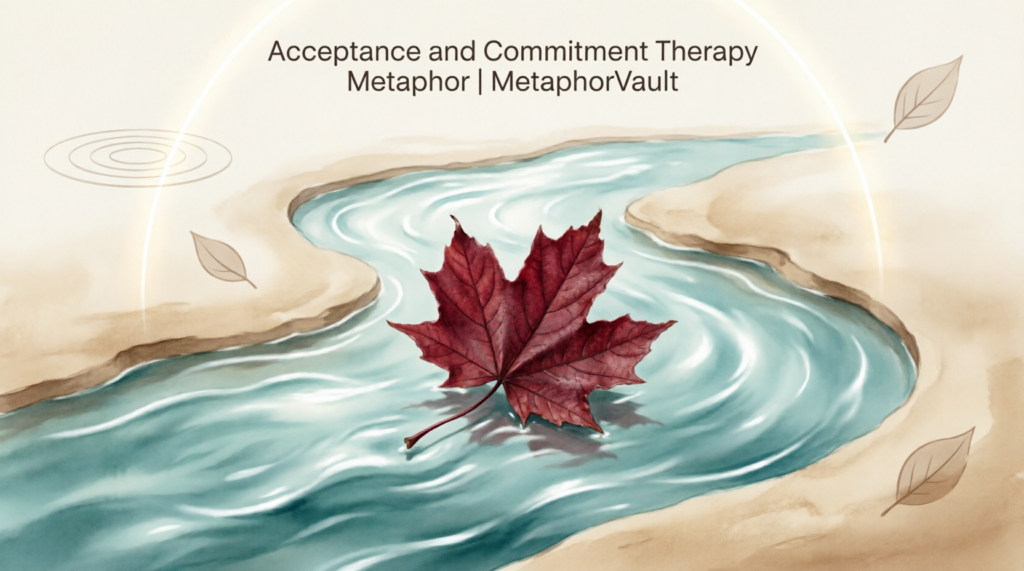
Acceptance and Commitment Therapy, often called ACT, uses simple stories, images, and experiences to explain ideas that can feel hard to put into words. Instead of telling someone, “Stop fighting your thoughts,” an ACT therapist might describe a tug-of-war with a monster. Instead of saying, “Your thoughts are not commands,” they might use the image of passengers on a bus.
These metaphors help turn an abstract psychological idea into something you can picture.
People search for acceptance and commitment therapy metaphors because ACT language can sound technical at first. Terms such as cognitive defusion, acceptance, psychological flexibility, values, and self-as-context may be easier to understand when connected to everyday experiences.
This guide explains more than 60 ACT metaphors and ACT-aligned teaching images in simple English. You will learn what each metaphor means, how it connects to ACT, when it can help, and when it may not fit. You will also see examples from therapy conversations, school settings, relationships, work, writing, and everyday life.
The guide is for 2026 and is written for beginners, students, educators, writers, and anyone who wants a clearer picture of ACT.
Definition & Meaning
Acceptance and Commitment Therapy metaphors are simple stories or images that help people understand ACT ideas such as acceptance, cognitive defusion, values, mindfulness, and committed action. They do not magically solve a problem; they give people a memorable way to notice their experience and choose actions that fit what matters to them.
What Is Acceptance and Commitment Therapy?
Acceptance and Commitment Therapy is a psychological approach designed to increase psychological flexibility.
In simple terms, psychological flexibility means being able to notice what is happening inside you, stay connected with the present, and take useful action based on your values even when difficult thoughts or feelings are present.
ACT does not treat every unpleasant thought or emotion as something that must disappear.
Instead, ACT often asks questions such as:
- Can you make room for this feeling?
- Can you notice the thought without automatically obeying it?
- What matters to you right now?
- What small action would move you in that direction?
Metaphors are useful because they make these questions easier to picture.
Why Does ACT Use Metaphors?
Some psychological ideas are difficult to explain with definitions alone.
For example, telling someone that thoughts are not commands may make sense intellectually. But imagining thoughts as noisy passengers on a bus can make the idea much easier to remember.
Research and clinical descriptions of ACT commonly include metaphors such as Passengers on the Bus, Leaves on a Stream, Tug-of-War With a Monster, the Man in the Hole, and the Chessboard.
A metaphor can help a person:
- Notice a mental pattern.
- Step back from a thought.
- Understand the cost of struggling with an experience.
- Identify what matters.
- Consider a different response.
- Remember an ACT skill outside therapy.
Quick Summary Table
| ACT idea | Simple meaning | Common metaphor |
|---|---|---|
| Acceptance | Making room for difficult experiences | Tug-of-war |
| Cognitive defusion | Seeing thoughts as thoughts | Passengers on a bus |
| Present moment | Paying attention to what is happening now | Leaves on a stream |
| Values | Choosing the direction you want your life to move | Compass |
| Committed action | Taking useful steps toward values | Hiking a trail |
| Self-as-context | Noticing that you are more than your thoughts | Chessboard |
| Experiential avoidance | Trying hard to escape inner experiences | Quicksand |
| Psychological flexibility | Adjusting your response while staying connected to values | Sailboat |
| Control | Trying to force private experiences to change | Control switch |
| Willingness | Opening up to experience while moving forward | Door |
A Key Point About ACT Metaphors
A metaphor is not a diagnosis, treatment plan, or universal rule.
A therapist may choose one metaphor because it fits a particular person’s situation. Another person may find the same metaphor confusing or unhelpful.
That flexibility matters. ACT is focused on whether a response works in a person’s life and helps them move toward valued action, rather than simply whether a metaphor sounds clever.
1. Passengers on the Bus
Meaning: Your thoughts and feelings are passengers, while you choose where the bus goes.
Real explanation: Difficult thoughts may shout, complain, or predict failure. You can notice them without handing them control of your actions. The metaphor is widely used in ACT to explain defusion and values-based action.
Sample sentence: “My anxious thoughts can ride with me without deciding where I go.”
When to use: Defusion, anxiety, self-doubt, values.
When NOT to use: When the person feels the bus image is confusing or invalidating.
Alternatives: Inner radio; noisy passengers; back-seat thoughts.
Difficulty: Easy.
Tone: Neutral.
2. Tug-of-War With a Monster
Meaning: Fighting an unwanted inner experience can keep you stuck with it.
Real explanation: Imagine holding one end of a rope while a monster pulls from the other side. Pulling harder may keep you locked in the struggle. ACT uses this image to explore acceptance as an alternative to endless internal fighting.
Sample sentence: “I may not win by pulling harder on this emotional rope.”
When to use: Control struggles and acceptance.
When NOT to use: When monster imagery could increase fear.
Alternatives: Internal wrestling match; endless battle; pulling contest.
Difficulty: Easy.
Tone: Neutral.
3. Leaves on a Stream
Meaning: Thoughts can be noticed as they come and go, like leaves floating downstream.
Real explanation: The exercise encourages observing thoughts rather than grabbing onto each one. ACT programs commonly use Leaves on a Stream as a mindfulness and defusion exercise.
Sample sentence: “I noticed the thought and let it float past.”
When to use: Mindfulness and defusion.
When NOT to use: When someone dislikes nature imagery.
Alternatives: Clouds in the sky; passing cars; bubbles.
Difficulty: Easy.
Tone: Calm.
4. The Man in the Hole
Meaning: Sometimes struggling harder with a problem does not solve the problem.
Real explanation: The classic image describes someone who falls into a hole and keeps digging, hoping the shovel will help. The metaphor can open discussion about ineffective control strategies and the search for another response.
Sample sentence: “Maybe my usual shovel is making the hole deeper.”
When to use: Exploring ineffective coping.
When NOT to use: When the person needs immediate practical safety support.
Alternatives: Digging deeper; wrong tool; endless fixing.
Difficulty: Medium.
Tone: Neutral.
5. The Chessboard
Meaning: You can notice thoughts and feelings without being completely defined by them.
Real explanation: In the chessboard metaphor, emotional states and thoughts are compared with pieces on a board. The board can hold different pieces without becoming one of them. ACT literature uses this image when discussing self-as-context.
Sample sentence: “Anger is on the board, but anger is not the whole board.”
When to use: Self-as-context.
When NOT to use: If chess imagery creates confusion.
Alternatives: Stage and actors; sky and weather; container and contents.
Difficulty: Medium.
Tone: Neutral.
6. The Sky and the Weather
Meaning: Thoughts and feelings can change like weather while awareness remains.
Real explanation: Storms come and go. So do many internal experiences. The metaphor encourages people to notice changing emotional weather without assuming that every storm will last forever.
Sample sentence: “Today feels like an emotional storm, but I am still here.”
When to use: Emotional awareness and self-as-context.
When NOT to use: When it sounds like promising that distress will always pass quickly.
Alternatives: Ocean and waves; sky and clouds; seasons.
Difficulty: Easy.
Tone: Calm.
7. The Control Knob
Meaning: Trying to force distress to disappear can sometimes create another struggle.
Real explanation: ACT teaching materials have used a two-knob image involving distress and willingness. The point is to explore what happens when a person focuses entirely on turning emotional discomfort down.
Sample sentence: “I keep turning the distress knob, but maybe I also need to change my relationship with it.”
When to use: Acceptance and control.
When NOT to use: When it sounds like people can simply control severe symptoms.
Alternatives: Volume dial; thermostat; settings panel.
Difficulty: Easy.
Tone: Neutral.
8. Quicksand
Meaning: Fighting quicksand can make you sink further; a different response may be needed.
Real explanation: This metaphor illustrates how struggling against an internal problem can sometimes increase the struggle. It is often used to introduce acceptance.
Sample sentence: “I am fighting the feeling so hard that the fight has become another problem.”
When to use: Experiential avoidance.
When NOT to use: As literal advice about real quicksand.
Alternatives: Sticky mud; sinking sand; wrestling with a net.
Difficulty: Easy.
Tone: Neutral.
9. The Radio in the Background
Meaning: Thoughts can be present without becoming instructions.
Real explanation: Imagine a radio playing while you work. You hear it, but you do not have to follow every message.
Sample sentence: “My mind is broadcasting fear again, and I can still finish my work.”
When to use: Defusion.
When NOT to use: If sound imagery is distracting.
Alternatives: Podcast; announcer; background noise.
Difficulty: Easy.
Tone: Informal.
10. The Mind as a Storyteller
Meaning: The mind creates stories to explain what happens.
Real explanation: Some stories are useful. Others may be frightening, critical, or incomplete. ACT encourages noticing the story rather than automatically treating it as fact.
Sample sentence: “My mind is telling the failure story again.”
When to use: Self-criticism and defusion.
When NOT to use: When a real external problem needs factual investigation.
Alternatives: Inner narrator; storyteller; commentator.
Difficulty: Easy.
Tone: Neutral.
11. The Passerby
Meaning: A thought can pass through awareness without requiring action.
Real explanation: Picture yourself sitting outside while people walk past. You notice each person without chasing them.
Sample sentence: “I noticed the thought and let it pass.”
When to use: Brief mindfulness exercises.
When NOT to use: When someone needs to examine a thought carefully for practical reasons.
Alternatives: Passing train; passing car; passing cloud.
Difficulty: Easy.
Tone: Neutral.
12. Clouds in the Sky
Meaning: Thoughts and feelings can be observed without being held onto.
Real explanation: Clouds constantly change shape. Some are light and some are dark. The sky does not need to chase them away.
Sample sentence: “That worry is a dark cloud, not a permanent forecast.”
When to use: Mindfulness and defusion.
When NOT to use: If weather imagery is culturally or personally unhelpful.
Alternatives: Leaves; bubbles; waves.
Difficulty: Easy.
Tone: Calm.
13. Waves on the Ocean
Meaning: Feelings rise and fall like waves.
Real explanation: A wave can be intense without lasting forever. The image can help people observe emotional movement instead of demanding immediate emotional silence.
Sample sentence: “I can ride this wave without letting it choose my destination.”
When to use: Strong emotions.
When NOT to use: As a promise that every feeling will quickly disappear.
Alternatives: Tide; wind; weather.
Difficulty: Easy.
Tone: Calm.
14. The Sailboat
Meaning: Values act like a direction while changing conditions affect the journey.
Real explanation: A sailor cannot control every wave or gust of wind. The sailor can still adjust the sails and continue toward a chosen direction.
Sample sentence: “I cannot control the wind, but I can adjust my sails.”
When to use: Values and committed action.
When NOT to use: When someone needs concrete problem-solving first.
Alternatives: Compass; navigation; journey.
Difficulty: Easy.
Tone: Inspirational.
15. The Compass
Meaning: Values give direction rather than a final destination.
Real explanation: A value such as kindness, honesty, learning, or connection is something you can express repeatedly. It is different from a single goal that can be completed.
Sample sentence: “Kindness is my compass, not a box I check once.”
When to use: Values clarification.
When NOT to use: When the person needs a specific measurable goal.
Alternatives: North Star; map; guiding principle.
Difficulty: Easy.
Tone: Neutral.
16. The Mountain Climb
Meaning: Meaningful action can involve effort, setbacks, and difficult terrain.
Real explanation: A mountain trail may include steep sections and wrong turns. The difficulty does not automatically mean the destination lacks value.
Sample sentence: “This part of the climb is hard, but I still care about where I am going.”
When to use: Committed action.
When NOT to use: When someone interprets suffering as proof they must continue an unhealthy situation.
Alternatives: Trail; journey; long road.
Difficulty: Easy.
Tone: Inspirational.
17. The Hiking Trail
Meaning: Values guide direction while individual actions create movement.
Real explanation: A value is not the same as reaching a final place. A person can take small steps that express the value today.
Sample sentence: “Being a supportive friend is the trail; calling today is one step.”
When to use: Turning values into action.
When NOT to use: When goals require a different planning framework.
Alternatives: Road; path; route.
Difficulty: Easy.
Tone: Neutral.
18. The GPS
Meaning: Values can help guide choices when the exact route changes.
Real explanation: A GPS may recalculate after a missed turn. Similarly, committed action can involve adjusting behavior without abandoning what matters.
Sample sentence: “I can change the route without changing the destination.”
When to use: Setbacks and flexibility.
When NOT to use: When the metaphor implies that life has one objectively correct destination.
Alternatives: Navigation system; map; route planner.
Difficulty: Easy.
Tone: Informal.
19. The Open Door
Meaning: Acceptance can mean making room for an experience rather than locking it out.
Real explanation: The door image can represent willingness. You do not have to invite an emotion to stay forever. You simply stop spending all your energy trying to force it outside.
Sample sentence: “I can leave the door open for this feeling while continuing with my day.”
When to use: Acceptance.
When NOT to use: When “open door” could be misunderstood as accepting harmful behavior.
Alternatives: Open window; making room; welcoming space.
Difficulty: Easy.
Tone: Neutral.
20. The Backpack
Meaning: People may carry painful memories, thoughts, or emotions while continuing their journey.
Real explanation: The goal is not necessarily to pretend the backpack is empty. The person can learn how to carry what is present while choosing meaningful movement.
Sample sentence: “I can carry this sadness and still visit my friend.”
When to use: Grief, difficult memories, values.
When NOT to use: If it suggests people should simply tolerate preventable harm.
Alternatives: Luggage; suitcase; load.
Difficulty: Easy.
Tone: Neutral.
21. The Heavy Backpack
Meaning: Avoidance can sometimes make an emotional burden feel heavier.
Real explanation: Imagine carrying a heavy pack while spending energy fighting the fact that it exists. Acceptance may involve acknowledging its weight and choosing where to walk.
Sample sentence: “I cannot pretend the backpack is light, but I can decide where to walk.”
When to use: Acceptance and willingness.
When NOT to use: For medical claims about physical symptoms.
Alternatives: Heavy suitcase; burden; load.
Difficulty: Easy.
Tone: Neutral.
22. The Unwanted Guest
Meaning: An unwanted thought or feeling can be present without controlling the whole home.
Real explanation: The unwanted guest metaphor is used in ACT-oriented work to discuss acceptance. The person can acknowledge the guest without allowing it to decide every action.
Sample sentence: “Anxiety is visiting today, but it does not get to plan my entire day.”
When to use: Acceptance.
When NOT to use: When the situation involves an actual unsafe person.
Alternatives: Visitor; house guest; unexpected caller.
Difficulty: Easy.
Tone: Neutral.
23. The House
Meaning: Your internal experience can contain many different thoughts and feelings.
Real explanation: Imagine your mind as a house with many rooms. Happiness, fear, anger, memories, and hope may all appear at different times.
Sample sentence: “Fear is in one room, but it is not the whole house.”
When to use: Self-as-context.
When NOT to use: If architectural imagery is distracting.
Alternatives: Home; building; rooms.
Difficulty: Easy.
Tone: Neutral.
24. Furniture in the House
Meaning: Thoughts and feelings can be present without defining the whole person.
Real explanation: A house contains furniture, but the furniture is not the house itself. This can help illustrate the difference between inner experiences and a broader sense of self.
Sample sentence: “This thought is part of my experience, not the whole of who I am.”
When to use: Self-as-context.
When NOT to use: If the person finds the image too abstract.
Alternatives: Room contents; objects; belongings.
Difficulty: Medium.
Tone: Neutral.
25. The Movie Screen
Meaning: Thoughts and feelings can appear on awareness like images on a screen.
Real explanation: The screen provides space for many scenes. A frightening scene can appear without becoming the entire story.
Sample sentence: “I am noticing the fear scene on the screen.”
When to use: Defusion and observing self.
When NOT to use: If visual imagery increases distress.
Alternatives: Theater screen; television; projection.
Difficulty: Easy.
Tone: Neutral.
26. The Theater
Meaning: Different thoughts and emotions can appear like actors on a stage.
Real explanation: One scene may be sad and another funny. The stage remains available for both.
Sample sentence: “Anger is on the stage right now, but it does not have to direct the whole play.”
When to use: Self-as-context.
When NOT to use: When theater imagery feels artificial.
Alternatives: Stage; play; performance.
Difficulty: Medium.
Tone: Neutral.
27. Actors and the Stage
Meaning: You can observe changing inner experiences without becoming identical to them.
Real explanation: The actors change from scene to scene, while the stage provides the setting. The image can help explain observing awareness.
Sample sentence: “The thought is an actor in this scene, not my entire identity.”
When to use: Self-as-context.
When NOT to use: When identity concerns require more direct discussion.
Alternatives: Stage and actors; screen and images; sky and weather.
Difficulty: Medium.
Tone: Neutral.
28. The River
Meaning: Inner experiences can keep moving rather than needing to be stopped.
Real explanation: A river carries many things downstream. You can observe its movement without trying to hold every object.
Sample sentence: “I can watch the thought move through rather than grabbing it.”
When to use: Mindfulness.
When NOT to use: When flowing imagery suggests passivity in a situation that needs action.
Alternatives: Stream; current; moving water.
Difficulty: Easy.
Tone: Calm.
29. The Riverbank
Meaning: You can observe mental events from a little distance.
Real explanation: Imagine sitting safely beside a river and watching the current. The image creates space between the observer and what is moving.
Sample sentence: “I am sitting by the river of thoughts rather than jumping into every thought.”
When to use: Defusion.
When NOT to use: If the person prefers active metaphors.
Alternatives: Observer seat; viewpoint; lookout.
Difficulty: Easy.
Tone: Calm.
30. The Traffic
Meaning: Thoughts can be like passing vehicles.
Real explanation: Some thoughts arrive quickly, some slowly, and some repeatedly. You do not have to chase every car.
Sample sentence: “That ‘I am failing’ thought just drove past again.”
When to use: Brief everyday defusion.
When NOT to use: During situations requiring actual driving attention.
Alternatives: Passing cars; train station; airport.
Difficulty: Easy.
Tone: Informal.
31. The Train Station
Meaning: Thoughts may arrive and leave like trains.
Real explanation: A person can notice a train without boarding it. Likewise, noticing a thought does not require following it.
Sample sentence: “The worry train arrived, but I do not have to get on.”
When to use: Defusion.
When NOT to use: Around people with train-related trauma.
Alternatives: Bus stop; airport gate; passing vehicle.
Difficulty: Easy.
Tone: Informal.
32. The Thought Train
Meaning: Thoughts can form a long chain that pulls attention away.
Real explanation: One thought can lead to another and another. The metaphor helps people notice when they have climbed onto a chain of mental predictions.
Sample sentence: “I started with one worry and ended up on a whole thought train.”
When to use: Rumination awareness.
When NOT to use: As a diagnosis of rumination.
Alternatives: Thought chain; mental spiral; story chain.
Difficulty: Easy.
Tone: Informal.
33. The Mental Tug-of-War
Meaning: Inner conflict can consume energy without moving life forward.
Real explanation: A person may argue internally with fear, shame, anger, or uncertainty for hours. The metaphor asks whether continuing the struggle is helping.
Sample sentence: “I have been pulling against this thought all morning.”
When to use: Control strategies.
When NOT to use: When the problem requires external action.
Alternatives: Inner argument; wrestling match; struggle.
Difficulty: Easy.
Tone: Neutral.
34. The Finger Trap
Meaning: Pulling harder can sometimes make the trap tighter.
Real explanation: The Chinese finger trap is commonly used in ACT-oriented teaching to illustrate how fighting an unwanted experience can create a tighter struggle.
Sample sentence: “The harder I fight the feeling, the tighter the struggle becomes.”
When to use: Acceptance.
When NOT to use: If the physical object is unfamiliar.
Alternatives: Tight knot; trap; stuck zipper.
Difficulty: Medium.
Tone: Neutral.
35. The Bouncing Ball
Meaning: Trying to force a difficult feeling away can sometimes make it return.
Real explanation: ACT-oriented programs have used a bouncing-ball image to discuss control and avoidance.
Sample sentence: “I keep pushing the feeling away, and it keeps bouncing back.”
When to use: Experiential avoidance.
When NOT to use: If the person interprets it as a guarantee.
Alternatives: Rubber ball; rebound; boomerang.
Difficulty: Easy.
Tone: Neutral.
36. The Boomerang
Meaning: Attempts to push an experience away may bring attention back to it.
Real explanation: The image captures the idea that mental struggle can keep an unwanted experience at the center of attention.
Sample sentence: “Every time I try not to think about it, my attention comes back.”
When to use: Exploring avoidance.
When NOT to use: As a universal psychological law.
Alternatives: Rebound; echo; rubber band.
Difficulty: Easy.
Tone: Informal.
37. The Rubber Band
Meaning: Constantly pushing against an experience can create tension.
Real explanation: Pulling a rubber band creates tension. The metaphor can help someone notice the cost of constant internal resistance.
Sample sentence: “I feel like I have been stretching myself against this thought all day.”
When to use: Stress and control.
When NOT to use: When physical tension needs medical assessment.
Alternatives: Spring; stretched rope; elastic band.
Difficulty: Easy.
Tone: Neutral.
38. The Backpack and the Trail
Meaning: A person can carry difficult experiences while still taking meaningful steps.
Real explanation: The backpack represents pain or difficult thoughts. The trail represents valued living. The goal is not to pretend the backpack is empty.
Sample sentence: “The backpack is heavy, but the trail still matters.”
When to use: Acceptance and committed action.
When NOT to use: When the person needs immediate relief from an unsafe environment.
Alternatives: Journey; luggage; hiking pack.
Difficulty: Easy.
Tone: Inspirational.
39. The Map and the Territory
Meaning: A thought about reality is not identical to reality itself.
Real explanation: A map is useful, but it is not the actual land. Likewise, a thought can provide information without being a perfect description of what is happening.
Sample sentence: “My mind’s map says I will fail, but I still need to look at the actual road.”
When to use: Cognitive defusion.
When NOT to use: When the metaphor becomes too philosophical.
Alternatives: Blueprint; photograph; model.
Difficulty: Medium.
Tone: Neutral.
40. The Story on the Label
Meaning: A label can influence how you see an experience.
Real explanation: Words such as “failure,” “weak,” or “bad” may become powerful labels. ACT encourages noticing the label rather than automatically treating it as the whole truth.
Sample sentence: “I am noticing the ‘I am a failure’ label.”
When to use: Self-judgment.
When NOT to use: When factual labels are necessary and accurate.
Alternatives: Tag; sticker; headline.
Difficulty: Easy.
Tone: Neutral.
41. The Name Tag
Meaning: A label is something you can notice rather than something you must become.
Real explanation: Imagine someone places a name tag on you. The tag contains words, but it does not contain everything about you.
Sample sentence: “That is a label I am carrying, not the complete story of me.”
When to use: Self-concept and defusion.
When NOT to use: When discussing actual legal or professional labels.
Alternatives: Sticker; badge; label.
Difficulty: Easy.
Tone: Neutral.
42. The Computer Screen
Meaning: Thoughts can be viewed as information appearing on a screen.
Real explanation: An ACT exercise may ask people to imagine thoughts on a screen rather than treating them as commands. Clinical ACT work includes exercises that place thoughts at a distance.
Sample sentence: “The thought is on the screen; I can decide what action comes next.”
When to use: Defusion.
When NOT to use: If technology imagery is distracting.
Alternatives: Message board; display; notification.
Difficulty: Easy.
Tone: Neutral.
43. The Notification
Meaning: A thought can be treated like a mental notification.
Real explanation: A phone notification gets your attention, but you do not always need to open it immediately.
Sample sentence: “My mind sent me a danger notification, but I can check the facts before reacting.”
When to use: Modern defusion examples.
When NOT to use: When someone interprets every thought as meaningless noise.
Alternatives: Alert; message; reminder.
Difficulty: Easy.
Tone: Informal.
44. The Mind’s Alarm
Meaning: The mind may produce warnings even when immediate action is not required.
Real explanation: An alarm can be useful, but an alarm is not the same thing as a command.
Sample sentence: “My mind’s alarm is loud, but I can pause before deciding what to do.”
When to use: Anxiety and worry discussions.
When NOT to use: When there is a genuine emergency.
Alternatives: Warning light; alarm bell; alert.
Difficulty: Easy.
Tone: Neutral.
45. The Smoke Alarm
Meaning: An alarm signal can be real without accurately identifying the source or level of danger.
Real explanation: A smoke alarm is designed to catch possible danger. In the metaphor, an internal alarm can be noticed without assuming that every signal requires the same response.
Sample sentence: “My anxiety alarm is ringing; I can check what is actually happening.”
When to use: Anxiety education.
When NOT to use: To dismiss genuine danger.
Alternatives: Warning light; security alarm; alert.
Difficulty: Easy.
Tone: Neutral.
46. The Radio Host
Meaning: Your mind can comment on your life without becoming your boss.
Real explanation: Imagine a talk-radio host giving constant opinions. You can hear the commentary while continuing with your chosen activity.
Sample sentence: “My mind is criticizing me again, but I do not have to argue with the host.”
When to use: Defusion.
When NOT to use: If someone finds talking-radio imagery annoying.
Alternatives: Commentator; announcer; narrator.
Difficulty: Easy.
Tone: Informal.
47. The Inner Commentator
Meaning: The mind often evaluates what happens.
Real explanation: The commentator may say, “That was embarrassing,” “You should be better,” or “This will go badly.” ACT encourages noticing commentary without automatically obeying it.
Sample sentence: “The commentator has an opinion, not necessarily an order.”
When to use: Self-criticism.
When NOT to use: When factual feedback is needed.
Alternatives: Narrator; critic; commentator.
Difficulty: Easy.
Tone: Neutral.
48. The Two Scales
Meaning: Pain and willingness can be considered as separate experiences.
Real explanation: ACT teaching materials have used two-scale imagery to discuss distress and willingness rather than treating willingness as the same thing as feeling good.
Sample sentence: “I can feel strong discomfort and still choose willingness.”
When to use: Acceptance.
When NOT to use: If the person hears it as a demand to tolerate everything.
Alternatives: Two dials; two meters; two sliders.
Difficulty: Medium.
Tone: Neutral.
49. The Glass of Water
Meaning: A difficult experience can become harder when additional struggle is added.
Real explanation: ACT-oriented programs have used the glass-of-water exercise when discussing pain and suffering.
Sample sentence: “The first problem is painful; my struggle with it may add another layer.”
When to use: Acceptance and pain education.
When NOT to use: As a medical explanation for chronic pain.
Alternatives: Extra weight; second burden; added layer.
Difficulty: Medium.
Tone: Neutral.
50. The Backpack Full of Rocks
Meaning: Avoiding painful experiences can feel like carrying extra weight.
Real explanation: Picture each avoided issue as another rock in a backpack. The image can help discuss the cost of constant avoidance.
Sample sentence: “Every avoided conversation feels like another rock in the bag.”
When to use: Avoidance and relationships.
When NOT to use: To blame someone for their coping strategies.
Alternatives: Heavy luggage; stones; burden.
Difficulty: Easy.
Tone: Neutral.
51. The Locked Door
Meaning: Trying to keep every unwanted feeling outside can require constant effort.
Real explanation: Imagine guarding a door all day so a feeling cannot enter. The effort itself becomes exhausting.
Sample sentence: “I spend so much energy keeping sadness outside that I have little energy left for living.”
When to use: Experiential avoidance.
When NOT to use: When emotional boundaries need to be distinguished from acceptance.
Alternatives: Gatekeeper; wall; barrier.
Difficulty: Easy.
Tone: Neutral.
52. The Garden
Meaning: Values are like things you choose to care for over time.
Real explanation: A garden needs repeated attention. One action does not finish the work forever. Values can also be expressed through many small actions.
Sample sentence: “My relationship is a garden, so I need to keep showing up.”
When to use: Values and relationships.
When NOT to use: When the metaphor suggests relationships are solely one person’s responsibility.
Alternatives: Garden; tree; field.
Difficulty: Easy.
Tone: Warm.
53. Planting Seeds
Meaning: Small valued actions can grow into meaningful patterns.
Real explanation: A seed does not become a tree in one day. The metaphor emphasizes repeated action rather than instant results.
Sample sentence: “Calling my parents today is one small seed of connection.”
When to use: Committed action.
When NOT to use: When someone expects guaranteed results.
Alternatives: Building blocks; small steps; practice.
Difficulty: Easy.
Tone: Encouraging.
54. The Garden Weeds
Meaning: Difficult thoughts and emotions can exist alongside valued parts of life.
Real explanation: A garden can contain weeds without becoming only weeds. The image can help people notice that painful experiences do not erase everything else.
Sample sentence: “There are weeds in my garden, but there are still flowers.”
When to use: Balanced perspective.
When NOT to use: When someone feels pressured to “find the positive.”
Alternatives: Storm clouds; rough patches; weeds and flowers.
Difficulty: Easy.
Tone: Warm.
55. The Tree With Deep Roots
Meaning: Values can provide stability while life changes around you.
Real explanation: Wind may move branches, but deep roots provide a sense of grounding. The metaphor can represent values during uncertain periods.
Sample sentence: “My situation changed, but honesty is still one of my roots.”
When to use: Values clarification.
When NOT to use: If it suggests that values prevent emotional pain.
Alternatives: Roots; foundation; anchor.
Difficulty: Easy.
Tone: Inspirational.
56. The Anchor
Meaning: Values can help you stay connected to what matters during emotional storms.
Real explanation: An anchor does not stop the ocean from moving. It provides stability while the water changes.
Sample sentence: “Family is one of my anchors when everything feels uncertain.”
When to use: Values and grounding.
When NOT to use: When someone needs practical safety planning.
Alternatives: Roots; compass; foundation.
Difficulty: Easy.
Tone: Calm.
57. The Lighthouse
Meaning: A value can provide direction without removing the storm.
Real explanation: A lighthouse does not calm the sea. It gives sailors a visible point of reference.
Sample sentence: “My value of honesty is a lighthouse when I am unsure what to say.”
When to use: Values.
When NOT to use: When the metaphor is interpreted as guaranteed guidance.
Alternatives: Beacon; compass; North Star.
Difficulty: Easy.
Tone: Inspirational.
58. The North Star
Meaning: A value can guide choices without being a final goal.
Real explanation: A traveler can use a star to keep direction while taking many different routes.
Sample sentence: “Being a caring parent is a direction I can practice every day.”
When to use: Values clarification.
When NOT to use: If the person interprets values as rigid rules.
Alternatives: Compass; beacon; guiding light.
Difficulty: Easy.
Tone: Inspirational.
59. The Garden Path
Meaning: Values become meaningful through repeated actions.
Real explanation: A path becomes clearer as it is used. Likewise, valued behavior becomes part of daily life through practice.
Sample sentence: “I build the path by taking one honest action at a time.”
When to use: Committed action.
When NOT to use: When progress is being measured only by outcomes.
Alternatives: Trail; road; practice path.
Difficulty: Easy.
Tone: Neutral.
60. The Doorway Between Thoughts and Actions
Meaning: There can be space between having a thought and acting on it.
Real explanation: The metaphor highlights choice. A thought can appear before action without automatically determining what happens next.
Sample sentence: “The thought came through the doorway, but I still chose my response.”
When to use: Defusion and behavior choice.
When NOT to use: When the person needs urgent behavioral intervention.
Alternatives: Pause; gap; crossroads.
Difficulty: Medium.
Tone: Neutral.
61. The Crossroads
Meaning: A difficult moment can contain more than one possible response.
Real explanation: At a crossroads, the person may have competing directions. ACT can use values to explore which path fits what matters.
Sample sentence: “Fear points one way, while my values point another.”
When to use: Values and decision-making.
When NOT to use: When there is only one safe immediate action.
Alternatives: Fork in the road; junction; choice point.
Difficulty: Easy.
Tone: Neutral.
62. The Choice Point
Meaning: A choice point is a moment when behavior can move toward or away from values.
Real explanation: Instead of focusing only on how a person feels, the metaphor asks what action comes next.
Sample sentence: “This argument is a choice point: I can react automatically or act according to my value of respect.”
When to use: Committed action.
When NOT to use: When it creates blame for automatic reactions.
Alternatives: Fork in the road; decision point; crossroads.
Difficulty: Easy.
Tone: Neutral.
63. The Smallest Step
Meaning: Meaningful change can begin with one realistic action.
Real explanation: A huge goal can feel impossible. A small action may be easier to begin and repeat.
Sample sentence: “Today, my committed action is only one phone call.”
When to use: Behavioral planning.
When NOT to use: When a larger action is required for immediate safety.
Alternatives: First step; tiny action; next move.
Difficulty: Easy.
Tone: Encouraging.
64. The Door-to-Door Journey
Meaning: Values-based living happens through repeated daily choices.
Real explanation: A journey is made from many steps. One difficult day does not have to erase the direction of the journey.
Sample sentence: “I do not need the whole journey figured out before taking today’s step.”
When to use: Long-term committed action.
When NOT to use: When a specific immediate plan is required.
Alternatives: Journey; route; path.
Difficulty: Easy.
Tone: Encouraging.
65. The Musical Thought
Meaning: Changing how a thought sounds can create distance from its content.
Real explanation: ACT defusion exercises can involve saying a thought in a funny voice or changing how it is repeated. Clinical descriptions include such exercises as ways to reduce the thought’s automatic impact.
Sample sentence: “When I hear the thought in a cartoon voice, I notice it as words rather than a command.”
When to use: Defusion practice.
When NOT to use: When humor could feel disrespectful or upsetting.
Alternatives: Singing a thought; silly voice; repeated phrase.
Difficulty: Medium.
Tone: Playful.
Quick Reference Table
| # | Metaphor | Main ACT idea | Difficulty | Tone |
|---|---|---|---|---|
| 1 | Passengers on the Bus | Defusion | Easy | Neutral |
| 2 | Tug-of-War With a Monster | Acceptance | Easy | Neutral |
| 3 | Leaves on a Stream | Mindfulness | Easy | Calm |
| 4 | Man in the Hole | Control | Medium | Neutral |
| 5 | Chessboard | Self-as-context | Medium | Neutral |
| 6 | Sky and Weather | Self-as-context | Easy | Calm |
| 7 | Control Knob | Acceptance | Easy | Neutral |
| 8 | Quicksand | Acceptance | Easy | Neutral |
| 9 | Background Radio | Defusion | Easy | Informal |
| 10 | Mind as Storyteller | Defusion | Easy | Neutral |
| 11 | Passerby | Mindfulness | Easy | Neutral |
| 12 | Clouds | Defusion | Easy | Calm |
| 13 | Waves | Acceptance | Easy | Calm |
| 14 | Sailboat | Values | Easy | Inspirational |
| 15 | Compass | Values | Easy | Neutral |
| 16 | Mountain Climb | Committed action | Easy | Inspirational |
| 17 | Hiking Trail | Values | Easy | Neutral |
| 18 | GPS | Flexibility | Easy | Informal |
| 19 | Open Door | Acceptance | Easy | Neutral |
| 20 | Backpack | Acceptance | Easy | Neutral |
| 21 | Heavy Backpack | Willingness | Easy | Neutral |
| 22 | Unwanted Guest | Acceptance | Easy | Neutral |
| 23 | House | Self-as-context | Easy | Neutral |
| 24 | Furniture | Self-as-context | Medium | Neutral |
| 25 | Movie Screen | Defusion | Easy | Neutral |
| 26 | Theater | Self-as-context | Medium | Neutral |
| 27 | Actors and Stage | Self-as-context | Medium | Neutral |
| 28 | River | Mindfulness | Easy | Calm |
| 29 | Riverbank | Defusion | Easy | Calm |
| 30 | Traffic | Defusion | Easy | Informal |
| 31 | Train Station | Defusion | Easy | Informal |
| 32 | Thought Train | Defusion | Easy | Informal |
| 33 | Mental Tug-of-War | Acceptance | Easy | Neutral |
| 34 | Finger Trap | Acceptance | Medium | Neutral |
| 35 | Bouncing Ball | Avoidance | Easy | Neutral |
| 36 | Boomerang | Avoidance | Easy | Informal |
| 37 | Rubber Band | Control | Easy | Neutral |
| 38 | Backpack and Trail | Acceptance/action | Easy | Inspirational |
| 39 | Map and Territory | Defusion | Medium | Neutral |
| 40 | Story Label | Defusion | Easy | Neutral |
| 41 | Name Tag | Self-concept | Easy | Neutral |
| 42 | Computer Screen | Defusion | Easy | Neutral |
| 43 | Notification | Defusion | Easy | Informal |
| 44 | Mind’s Alarm | Defusion | Easy | Neutral |
| 45 | Smoke Alarm | Awareness | Easy | Neutral |
| 46 | Radio Host | Defusion | Easy | Informal |
| 47 | Inner Commentator | Defusion | Easy | Neutral |
| 48 | Two Scales | Acceptance | Medium | Neutral |
| 49 | Glass of Water | Acceptance | Medium | Neutral |
| 50 | Backpack of Rocks | Avoidance | Easy | Neutral |
| 51 | Locked Door | Avoidance | Easy | Neutral |
| 52 | Garden | Values | Easy | Warm |
| 53 | Planting Seeds | Committed action | Easy | Encouraging |
| 54 | Garden Weeds | Acceptance | Easy | Warm |
| 55 | Deep Roots | Values | Easy | Inspirational |
| 56 | Anchor | Values | Easy | Calm |
| 57 | Lighthouse | Values | Easy | Inspirational |
| 58 | North Star | Values | Easy | Inspirational |
| 59 | Garden Path | Action | Easy | Neutral |
| 60 | Doorway | Defusion | Medium | Neutral |
| 61 | Crossroads | Choice | Easy | Neutral |
| 62 | Choice Point | Action | Easy | Neutral |
| 63 | Smallest Step | Action | Easy | Encouraging |
| 64 | Door-to-Door Journey | Action | Easy | Encouraging |
| 65 | Musical Thought | Defusion | Medium | Playful |
Real-Life Conversations
ACT metaphors work best when they sound natural rather than like a memorized therapy speech. The following conversations show how ACT ideas can appear in everyday language among friends, students, teachers, coworkers, and partners. They are educational examples, not scripts that every therapist should use.
Conversation 1: Two Friends
Sam: I keep thinking I’m going to mess up tomorrow.
Maya: Is your brain doing the prediction thing again?
Sam: Pretty much.
Maya: Imagine that thought is just a passenger on your bus.
Sam: The loud passenger?
Maya: Very loud passenger.
Sam: And I’m still the driver?
Maya: Exactly. You can hear it and still decide where you’re going.
Sam: So I can be nervous and still go?
Maya: Yep. Nervous can come along.
Conversation 2: Student and Teacher
Student: I can’t write this paper because I keep thinking it’s going to be terrible.
Teacher: What if you treated that thought like a radio playing in the background?
Student: I can hear it, but I don’t have to turn it off?
Teacher: Right. You can write while the radio is on.
Student: That feels easier than trying to prove the thought wrong.
Teacher: Sometimes noticing the thought is more useful than arguing with it.
Conversation 3: Family
Aisha: I feel guilty every time I say no.
Brother: Maybe guilt can sit in the passenger seat.
Aisha: You mean I don’t have to wait until I feel no guilt?
Brother: Exactly.
Aisha: I can still say no and care about people?
Brother: Those things can happen at the same time.
Conversation 4: Office
Daniel: I keep replaying that meeting.
Chris: Your mind is probably running the meeting again.
Daniel: With better insults this time.
Chris: Sounds like an expensive radio station.
Daniel: So what do I do?
Chris: Notice the broadcast. Then ask what matters for the next five minutes.
Daniel: I need to finish the report.
Chris: There you go.
Frequently Asked Questions
What are acceptance and commitment therapy metaphors?
Acceptance and Commitment Therapy metaphors are simple stories or images used to explain ACT ideas such as acceptance, cognitive defusion, mindfulness, values, self-as-context, and committed action. Examples include Passengers on the Bus, Leaves on a Stream, Tug-of-War With a Monster, and the Chessboard.
What is the most common ACT metaphor?
One of the best-known ACT metaphors is Passengers on the Bus. It presents thoughts and feelings as passengers while the person remains responsible for choosing the direction of the bus. It is often used to explain cognitive defusion and values-based action.
What is the ACT metaphor for acceptance?
Several ACT metaphors can explain acceptance, including Tug-of-War With a Monster, Quicksand, the Finger Trap, the Unwanted Guest, and the Open Door. They illustrate different versions of the idea that fighting an unwanted internal experience is not always the most useful response.
What is the ACT metaphor for thoughts?
Common ACT images for thoughts include Passengers on the Bus, Leaves on a Stream, Clouds, Traffic, the Radio Host, the Thought Train, and the Computer Screen. These images encourage people to notice thoughts without automatically treating them as commands.
What is the ACT metaphor for values?
Common values metaphors include the Compass, Lighthouse, North Star, Sailboat, Garden, and Roots. They show that values provide direction for action rather than acting like a single goal that can simply be completed.
What is the ACT metaphor for cognitive defusion?
Cognitive defusion is often explained with images such as Passengers on the Bus, Leaves on a Stream, Clouds, the Radio Host, and the Thought Train. The basic idea is to notice thoughts as mental events rather than becoming completely caught up in them.
What is the ACT metaphor for self-as-context?
The Chessboard, Sky and Weather, Theater, House, and Movie Screen can help explain self-as-context. They show how thoughts and feelings may change while a person can still observe those experiences from a broader perspective.
Are ACT metaphors only for therapists?
No. ACT metaphors can also be used in psychology education, books, classroom discussions, personal reflection, and general explanations. However, a metaphor should not be presented as a substitute for professional assessment or individualized therapy.
Can ACT metaphors help with anxiety?
ACT uses metaphors and experiential exercises to help people change how they relate to difficult thoughts and feelings. ACT is intended to build psychological flexibility rather than simply eliminate every uncomfortable emotion.
Does acceptance mean accepting everything that happens?
No. In ACT, acceptance concerns one’s relationship with internal experiences. It does not mean approving harmful behavior, ignoring danger, or refusing to solve practical problems.
Does ACT teach people to stop having negative thoughts?
No. ACT does not require people to eliminate every unwanted thought. Defusion focuses on changing the relationship with thoughts so that thoughts have less automatic control over behavior.
Can I use these metaphors by myself?
Some ACT exercises can be used for personal reflection, but people experiencing significant distress may benefit from working with a qualified mental health professional. A metaphor should not be used to diagnose or treat a serious condition on its own.
Final Takeaway
Acceptance and Commitment Therapy metaphors make difficult psychological ideas easier to see and remember. Their central lesson is not “get rid of bad thoughts.” Instead, ACT uses images to help people notice thoughts and feelings, make room for difficult experiences, clarify what matters, and choose useful actions in that direction.
The most useful metaphors are often the simplest:
- Passengers on the Bus — thoughts and feelings can ride with you.
- Leaves on a Stream — thoughts can be noticed and allowed to move.
- Tug-of-War — endless struggle can keep you stuck.
- Chessboard — you are more than any single thought or feeling.
- Compass — values give direction.
- Lighthouse — values can guide you during difficult conditions.
- Smallest Step — meaningful action can begin with something small.
- Crossroads — difficult moments can become opportunities to choose a response.
A good ACT metaphor does not tell a person what they must feel.
It gives them another way to look.
And sometimes that small change in perspective makes it easier to notice the next step that matters.
descover more post
60+ Metaphors for Spring Beautiful Examples Meanings …
60+ Metaphors for Patience Meaning Examples and How …
30+Metaphors in Nature Meaning Uses and Beautiful Examples …

Celorita is a professional language writer and the creative voice behind MetaphorVault.com, where she transforms complex language concepts into engaging and easy-to-understand content. With over 6 years of experience in content writing, figurative language, and educational publishing, she specializes in metaphors, idioms, similes, and modern English expressions. Her mission is to help students, writers, educators, and English learners communicate with greater confidence through practical, well-researched resources. Every article she publishes is crafted with accuracy, clarity, and real value for readers. Through MetaphorVault.com, Celorita is dedicated to making language learning both enjoyable and accessible for a global audience.