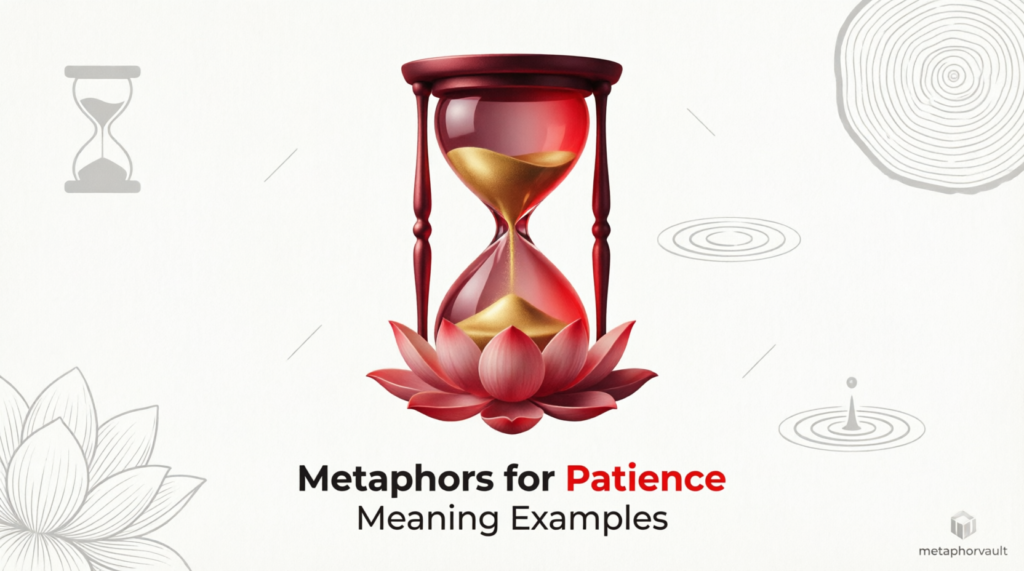
Patience is easy to praise but hard to practice. When life moves slowly, we often need a better way to describe the calm strength it takes to wait. Metaphors for patience make that feeling easier to understand by comparing patience to familiar things such as a tree, a river, a seed, a candle, or a long road. These comparisons turn an abstract quality into a picture people can see.
People search for metaphors for patience for many reasons. A student may need one for a school assignment. A writer may want a stronger image for a poem or story. Someone writing a social media caption may want a short phrase that feels meaningful. Teachers, parents, speakers, and professionals can also use patience metaphors when talking about growth, relationships, success, or difficult seasons.
You may see these expressions in books, movies, speeches, poems, personal essays, motivational posts, and everyday conversations. Some sound gentle and hopeful, while others suggest endurance, discipline, or quiet strength.
This guide explains more than 60 metaphors for patience, with simple meanings, natural examples, usage advice, tone, and difficulty levels. It is for 2026 and is designed to help you choose the right metaphor instead of simply collecting a long list of phrases.
1. Patience Is a Seed
Meaning: Patience allows something valuable to grow over time.
Real explanation: A seed needs time before its growth becomes visible. This makes it a strong metaphor for goals, relationships, skills, and personal development.
Sample sentence: “Patience is a seed; give your dreams time to grow.”
When to use it: Use it when talking about growth and future results.
When NOT to use it: Avoid it when the situation requires immediate action.
Alternatives:
- Patience is a garden.
- Time helps good things grow.
- Growth takes time.
Difficulty: Easy
Tone: Neutral
2. Patience Is a Tree
Meaning: Patience is strong because it develops slowly and becomes rooted.
Real explanation: A tree may take years to become tall and strong. Its slow growth represents steady progress.
Sample sentence: “Her patience was a tree with deep roots.”
When to use it: Use it for long-term strength and personal growth.
When NOT to use it: Avoid it if you need to describe a very short wait.
Alternatives:
- Patience has deep roots.
- Patience grows slowly.
- Patience is a rooted strength.
Difficulty: Easy
Tone: Poetic
3. Patience Is a River
Meaning: Patience means continuing calmly without forcing the journey.
Real explanation: A river keeps moving even when it encounters rocks, bends, and obstacles.
Sample sentence: “His patience was a river flowing around every obstacle.”
When to use it: Use it for calm persistence.
When NOT to use it: Avoid it when you need to emphasize complete stillness.
Alternatives:
- Patience is steady water.
- Patience flows around obstacles.
- Patience keeps moving.
Difficulty: Easy
Tone: Reflective
4. Patience Is a Bridge
Meaning: Patience helps you move from a difficult present to a better future.
Real explanation: A bridge connects two places. Patience can similarly connect where you are now with where you want to be.
Sample sentence: “Patience is the bridge between effort and achievement.”
When to use it: Excellent for motivational writing.
When NOT to use it: Avoid it when the main idea is natural growth rather than transition.
Alternatives:
- Patience connects today and tomorrow.
- Patience is a path forward.
- Patience carries us across hard times.
Difficulty: Easy
Tone: Neutral
5. Patience Is a Candle
Meaning: Patience provides quiet strength while you wait.
Real explanation: A candle burns steadily rather than explosively. It creates an image of calm endurance.
Sample sentence: “Her patience was a candle glowing through the long night.”
When to use it: Use it for emotional or poetic writing.
When NOT to use it: Avoid it in very technical or formal writing.
Alternatives:
- Patience is a quiet flame.
- Patience is a steady light.
- Patience keeps the light alive.
Difficulty: Easy
Tone: Poetic
6. Patience Is a Slow Sunrise
Meaning: Some good things arrive gradually.
Real explanation: Sunrise does not appear all at once. Darkness slowly gives way to light.
Sample sentence: “Patience is a slow sunrise after a difficult night.”
When to use it: Use it for hope after hardship.
When NOT to use it: Avoid it when discussing something that needs a quick solution.
Alternatives:
- Hope is morning light.
- Better days are a sunrise.
- Patience waits for the light.
Difficulty: Easy
Tone: Hopeful
7. Patience Is a Long Road
Meaning: Patience means accepting that progress may take time.
Real explanation: A long road cannot be crossed in one step. You must continue one part at a time.
Sample sentence: “Patience is a long road walked one step at a time.”
When to use it: Great for goals and achievement.
When NOT to use it: Avoid it for very short-term waiting.
Alternatives:
- Patience is a long journey.
- Progress is a slow road.
- Keep walking.
Difficulty: Easy
Tone: Motivational
8. Patience Is a Deep Well
Meaning: Patience is a quiet reserve of strength.
Real explanation: A deep well contains water beneath the surface. The metaphor suggests that patience comes from an inner source.
Sample sentence: “She drew patience from a deep well of calm.”
When to use it: Use it for emotional strength.
When NOT to use it: Avoid it with very young audiences unless you explain the image.
Alternatives:
- Patience is an inner reservoir.
- Calm runs deep.
- Patience is a hidden strength.
Difficulty: Medium
Tone: Reflective
9. Patience Is a Slow-Burning Fire
Meaning: Patience can be powerful without being sudden or aggressive.
Real explanation: A slow fire continues burning over time. It represents controlled strength.
Sample sentence: “His patience was a slow-burning fire that never went out.”
When to use it: Use it when patience includes determination.
When NOT to use it: Avoid it when you want a completely gentle image.
Alternatives:
- Patience is a steady flame.
- Quiet strength keeps burning.
- Endurance is a lasting fire.
Difficulty: Medium
Tone: Strong
10. Patience Is a Mountain
Meaning: Patience is stable and unmoved by temporary pressure.
Real explanation: Mountains remain in place while weather changes around them. The image suggests emotional steadiness.
Sample sentence: “She stood like a mountain when everything around her changed.”
When to use it: Use it for resilience.
When NOT to use it: Avoid it when the idea involves flexibility.
Alternatives:
- Patience is solid ground.
- Patience stands firm.
- Calm is a mountain.
Difficulty: Easy
Tone: Powerful
11. Patience Is a Clock
Meaning: Patience accepts that things happen according to their own timing.
Real explanation: A clock moves second by second. You cannot make an hour arrive by demanding it.
Sample sentence: “Patience is a clock that refuses to rush.”
When to use it: Use it when discussing timing.
When NOT to use it: Avoid it if the metaphor could imply passive waiting only.
Alternatives:
- Time has its rhythm.
- Patience follows the clock.
- Everything has its hour.
Difficulty: Easy
Tone: Neutral
12. Patience Is a Slow-Cooking Meal
Meaning: Some results become better when they are given enough time.
Real explanation: Food cooked slowly often needs time for flavors to develop. This makes the metaphor useful for skills, relationships, and success.
Sample sentence: “Trust is a slow-cooking meal; rushing it ruins the flavor.”
When to use it: Great for casual communication.
When NOT to use it: Avoid it in serious emotional situations where humor may feel inappropriate.
Alternatives:
- Good things need time.
- Success needs slow preparation.
- Let the process develop.
Difficulty: Easy
Tone: Informal
13. Patience Is a Garden
Meaning: Patience means giving growth the care and time it needs.
Real explanation: A garden cannot be rushed. Plants need repeated care before they produce flowers or fruit.
Sample sentence: “Patience is a garden that rewards steady care.”
When to use it: Use it for personal development and relationships.
When NOT to use it: Avoid it when the focus is endurance without growth.
Alternatives:
- Patience is careful gardening.
- Growth is a garden.
- Good results must be cultivated.
Difficulty: Easy
Tone: Warm
14. Patience Is a Lighthouse
Meaning: Patience helps you remain steady during uncertain times.
Real explanation: A lighthouse stays in place and provides guidance while the sea changes around it.
Sample sentence: “Her patience was a lighthouse during the storm.”
When to use it: Use it for difficult emotional situations.
When NOT to use it: Avoid it if the subject is simply waiting for a routine event.
Alternatives:
- Patience is a guiding light.
- Calm is a beacon.
- Patience guides us through storms.
Difficulty: Medium
Tone: Poetic
15. Patience Is a Compass
Meaning: Patience helps you stay on the right path instead of reacting too quickly.
Real explanation: A compass gives direction. Patience can help a person make better decisions when emotions are strong.
Sample sentence: “When anger rose, patience became her compass.”
When to use it: Use it for decision-making.
When NOT to use it: Avoid it when direction is not part of the idea.
Alternatives:
- Patience gives direction.
- Calm keeps you on course.
- Patience is a guide.
Difficulty: Medium
Tone: Neutral
16. Patience Is an Anchor
Meaning: Patience keeps you emotionally steady.
Real explanation: An anchor stops a boat from drifting. In the same way, patience can prevent impulsive reactions.
Sample sentence: “Patience was his anchor when the meeting became tense.”
When to use it: Excellent for stress and conflict.
When NOT to use it: Avoid it if you want to show movement or progress.
Alternatives:
- Patience keeps me grounded.
- Calm is an anchor.
- Patience holds you steady.
Difficulty: Easy
Tone: Strong
17. Patience Is a Shield
Meaning: Patience protects you from impulsive reactions.
Real explanation: A shield blocks something harmful. Patience can protect relationships and decisions from anger or frustration.
Sample sentence: “Her patience was a shield against unnecessary arguments.”
When to use it: Use it for emotional control.
When NOT to use it: Avoid it when patience is about waiting for growth.
Alternatives:
- Patience protects peace.
- Calm is a shield.
- Patience guards your words.
Difficulty: Easy
Tone: Strong
18. Patience Is a Bridge Over Trouble
Meaning: Patience helps someone get through a difficult period.
Real explanation: The bridge image suggests that hardship is temporary and patience provides a way across it.
Sample sentence: “Patience became a bridge over months of uncertainty.”
When to use it: Use it for long challenges.
When NOT to use it: Avoid it for simple everyday delays.
Alternatives:
- Patience carries us through trouble.
- Calm crosses difficult waters.
- Time helps us through.
Difficulty: Easy
Tone: Hopeful
19. Patience Is a Quiet Ocean
Meaning: Patience can contain great depth while appearing calm.
Real explanation: A calm ocean may look peaceful on the surface while remaining deep underneath.
Sample sentence: “His patience was a quiet ocean, deep and steady.”
When to use it: Use it in poetry and reflective writing.
When NOT to use it: Avoid it for simple business communication.
Alternatives:
- Patience runs deep.
- Calm is an ocean.
- A quiet mind is deep water.
Difficulty: Medium
Tone: Poetic
20. Patience Is a Nest
Meaning: Patience creates a safe space for something to develop.
Real explanation: A nest protects young birds while they grow strong enough to leave.
Sample sentence: “Patience was a nest where confidence could grow.”
When to use it: Use it for parenting, learning, and personal growth.
When NOT to use it: Avoid it when describing aggressive persistence.
Alternatives:
- Patience gives growth shelter.
- Time creates room to grow.
- Patience is a safe place.
Difficulty: Medium
Tone: Gentle
21. Patience Is a Door That Opens Slowly
Meaning: Some opportunities reveal themselves only with time.
Real explanation: A slowly opening door suggests that the future cannot always be forced open.
Sample sentence: “Patience is a door that opens when the time is right.”
When to use it: Use it for opportunities and life changes.
When NOT to use it: Avoid it if action is clearly required.
Alternatives:
- Time opens doors.
- Opportunity arrives gradually.
- Let the door open.
Difficulty: Easy
Tone: Hopeful
22. Patience Is a Puzzle
Meaning: Understanding and progress may require time.
Real explanation: A puzzle becomes clear one piece at a time.
Sample sentence: “Healing was a puzzle, and patience helped her place each piece.”
When to use it: Use it for complex problems or learning.
When NOT to use it: Avoid it when the idea is purely emotional endurance.
Alternatives:
- Life is a puzzle.
- Progress comes piece by piece.
- Time reveals the picture.
Difficulty: Easy
Tone: Neutral
23. Patience Is a Staircase
Meaning: Patience allows progress to happen one step at a time.
Real explanation: A staircase represents gradual movement toward a higher place.
Sample sentence: “Patience is the staircase between effort and mastery.”
When to use it: Excellent for education and career goals.
When NOT to use it: Avoid it when there is no sense of progress.
Alternatives:
- Progress is a staircase.
- Success comes one step at a time.
- Patience builds each step.
Difficulty: Easy
Tone: Motivational
24. Patience Is a Long Breath
Meaning: Patience gives you space to pause before reacting.
Real explanation: Taking a slow breath can create a moment between emotion and action.
Sample sentence: “Before answering, he treated patience as a long breath.”
When to use it: Great for conversations and conflict.
When NOT to use it: Avoid it for long-term goals.
Alternatives:
- Patience is a pause.
- Take a breath.
- Calm gives you time.
Difficulty: Easy
Tone: Informal
25. Patience Is a Pause Button
Meaning: Patience gives you time before you act.
Real explanation: A pause button temporarily stops a process. The metaphor highlights self-control.
Sample sentence: “Patience is the pause button between anger and action.”
When to use it: Use it for modern, conversational writing.
When NOT to use it: Avoid it in highly poetic writing.
Alternatives:
- Patience is a pause.
- Stop before reacting.
- Calm gives you a moment.
Difficulty: Easy
Tone: Informal
26. Patience Is a Safety Net
Meaning: Patience gives you room to handle mistakes and uncertainty.
Real explanation: A safety net reduces the danger of falling. Patience can similarly prevent one bad moment from becoming a major mistake.
Sample sentence: “Patience was a safety net when the plan began to fail.”
When to use it: Use it for uncertainty and problem-solving.
When NOT to use it: Avoid it when describing growth itself.
Alternatives:
- Patience gives us room.
- Calm protects us from mistakes.
- Time creates breathing space.
Difficulty: Easy
Tone: Neutral
27. Patience Is a Slow Dance
Meaning: Patience means moving carefully instead of rushing.
Real explanation: A slow dance requires attention, rhythm, and awareness of another person.
Sample sentence: “Building trust is a slow dance between two people.”
When to use it: Excellent for relationships.
When NOT to use it: Avoid it in highly formal reports.
Alternatives:
- Trust grows slowly.
- Relationships need rhythm.
- Love takes gentle steps.
Difficulty: Medium
Tone: Romantic
28. Patience Is a Marathon
Meaning: Patience is needed for long-term effort.
Real explanation: A marathon cannot be completed by sprinting from the beginning. It requires pacing and endurance.
Sample sentence: “Learning a language is a marathon, not a sprint.”
When to use it: Use it for education, careers, fitness, and goals.
When NOT to use it: Avoid it when the task is genuinely short.
Alternatives:
- Success is a long race.
- Progress requires endurance.
- Pace yourself.
Difficulty: Easy
Tone: Motivational
29. Patience Is a Slow Train
Meaning: Progress may be slow, but it is still progress.
Real explanation: A train takes time to reach its destination and cannot simply jump ahead.
Sample sentence: “Recovery felt like a slow train, but at least it was moving.”
When to use it: Use it for gradual progress.
When NOT to use it: Avoid it for elegant or highly emotional writing.
Alternatives:
- Progress is moving slowly.
- The journey takes time.
- Slow progress is still progress.
Difficulty: Easy
Tone: Informal
30. Patience Is a Clockwork Heart
Meaning: Patience creates steady emotional rhythm.
Real explanation: Clockwork suggests consistent movement. The heart adds an emotional dimension.
Sample sentence: “She faced each setback with a clockwork heart.”
When to use it: Use it for creative writing.
When NOT to use it: Avoid it for simple beginner writing.
Alternatives:
- Her heart stayed steady.
- Calm kept its rhythm.
- Patience beats steadily.
Difficulty: Advanced
Tone: Poetic
31. Patience Is a Reservoir
Meaning: Patience is an inner supply of calm that can be drawn upon.
Real explanation: A reservoir stores water for later use. The metaphor presents patience as stored emotional strength.
Sample sentence: “He drew from a reservoir of patience during the crisis.”
When to use it: Use it for professional or reflective writing.
When NOT to use it: Avoid it with very young readers.
Alternatives:
- Patience is a reserve.
- Calm is stored strength.
- Inner peace runs deep.
Difficulty: Medium
Tone: Formal
32. Patience Is a Blanket
Meaning: Patience provides comfort during difficult waiting periods.
Real explanation: A blanket gives warmth and protection. Patience can create a similar sense of emotional safety.
Sample sentence: “Patience wrapped around her like a blanket during the long wait.”
When to use it: Use it for emotional writing.
When NOT to use it: Avoid it when emphasizing toughness.
Alternatives:
- Patience gives comfort.
- Calm is a warm shelter.
- Time can soften pain.
Difficulty: Easy
Tone: Gentle
33. Patience Is a Harbor
Meaning: Patience provides a safe place during emotional storms.
Real explanation: Ships enter a harbor to find protection from rough water.
Sample sentence: “His calm became a harbor for everyone around him.”
When to use it: Use it for relationships and leadership.
When NOT to use it: Avoid it for very basic writing unless explained.
Alternatives:
- Patience is a safe harbor.
- Calm gives shelter.
- Patience protects peace.
Difficulty: Medium
Tone: Poetic
34. Patience Is a Fence
Meaning: Patience creates a boundary between emotion and action.
Real explanation: A fence separates one space from another. Patience can prevent frustration from immediately becoming words or behavior.
Sample sentence: “His patience was a fence between anger and action.”
When to use it: Use it for self-control.
When NOT to use it: Avoid it when patience is about positive growth.
Alternatives:
- Patience creates distance.
- Calm sets a boundary.
- Wait before reacting.
Difficulty: Medium
Tone: Neutral
35. Patience Is a Net
Meaning: Patience catches you when uncertainty makes you stumble.
Real explanation: A net can prevent a fall. The metaphor emphasizes protection during difficult periods.
Sample sentence: “Patience was a net beneath every uncertain decision.”
When to use it: Use it for uncertainty.
When NOT to use it: Avoid it when you want to show forward movement.
Alternatives:
- Patience gives support.
- Calm catches mistakes.
- Time gives us room.
Difficulty: Easy
Tone: Reflective
36. Patience Is a Slow-Blooming Flower
Meaning: Some beautiful results need time before they appear.
Real explanation: A flower may spend a long time developing before it blooms.
Sample sentence: “Confidence is a slow-blooming flower.”
When to use it: Excellent for personal growth.
When NOT to use it: Avoid it for urgent matters.
Alternatives:
- Growth blooms slowly.
- Good things take root first.
- Success unfolds like a flower.
Difficulty: Easy
Tone: Poetic
37. Patience Is a Potter’s Wheel
Meaning: Patience allows something valuable to be shaped gradually.
Real explanation: Clay must be carefully shaped rather than forced into its final form.
Sample sentence: “Time was the potter’s wheel shaping her character.”
When to use it: Use it for personal development.
When NOT to use it: Avoid it if your readers are unfamiliar with pottery.
Alternatives:
- Character is shaped over time.
- Patience forms strength.
- Growth is carefully molded.
Difficulty: Medium
Tone: Reflective
38. Patience Is a Sculptor
Meaning: Time and patience gradually shape a person or result.
Real explanation: A sculptor works slowly, removing or changing small parts until the desired form appears.
Sample sentence: “Patience was the sculptor of his character.”
When to use it: Use it in essays and inspirational writing.
When NOT to use it: Avoid it if you need a very simple metaphor.
Alternatives:
- Time shapes us.
- Patience molds character.
- Growth is carved slowly.
Difficulty: Medium
Tone: Formal
39. Patience Is a Potter’s Clay
Meaning: Patience allows a person to be shaped by experience.
Real explanation: Clay changes form gradually under careful hands.
Sample sentence: “Her patience was clay, shaped by years of experience.”
When to use it: Use it for character development.
When NOT to use it: Avoid it when the person is meant to appear completely independent of outside influence.
Alternatives:
- Experience shapes patience.
- Time molds character.
- Life slowly forms us.
Difficulty: Medium
Tone: Poetic
40. Patience Is a Snowflake
Meaning: Some results cannot be rushed because they develop naturally.
Real explanation: A snowflake forms under specific conditions and follows its own natural process.
Sample sentence: “Every lesson arrived like a snowflake, slowly and in its own form.”
When to use it: Use it for uniqueness and natural development.
When NOT to use it: Avoid it when describing something requiring active effort.
Alternatives:
- Growth has its own rhythm.
- Some things cannot be hurried.
- Nature keeps its own time.
Difficulty: Medium
Tone: Poetic
41. Patience Is a Season
Meaning: Patience means accepting that life has different periods.
Real explanation: Seasons change according to natural cycles. Not every season produces the same result.
Sample sentence: “Waiting was simply another season of her life.”
When to use it: Use it for life changes and difficult periods.
When NOT to use it: Avoid it for tiny everyday delays.
Alternatives:
- Life has seasons.
- Every season has its time.
- Some seasons are for waiting.
Difficulty: Easy
Tone: Reflective
42. Patience Is Winter Before Spring
Meaning: A difficult waiting period may come before renewal.
Real explanation: Winter can represent stillness, while spring represents growth and new beginnings.
Sample sentence: “Patience carried him through the winter before his spring arrived.”
When to use it: Use it for hope after hardship.
When NOT to use it: Avoid it if the subject is not about change.
Alternatives:
- Hard times can precede renewal.
- Spring follows winter.
- Wait for the next season.
Difficulty: Easy
Tone: Hopeful
43. Patience Is a Tortoise
Meaning: Slow progress can still lead to success.
Real explanation: The tortoise is widely associated with steady movement and the familiar lesson that consistent progress can beat speed.
Sample sentence: “Her patience was the tortoise that kept moving when others rushed ahead.”
When to use it: Use it for perseverance.
When NOT to use it: Avoid it when describing sophisticated professional communication.
Alternatives:
- Slow and steady wins.
- Keep moving at your pace.
- Steady progress matters.
Difficulty: Easy
Tone: Informal
44. Patience Is a Turtle
Meaning: Patience is steady movement without unnecessary speed.
Real explanation: A turtle moves slowly but continues toward its destination.
Sample sentence: “His progress was a turtle, slow but dependable.”
When to use it: Use it with children or in casual writing.
When NOT to use it: Avoid it in formal business writing.
Alternatives:
- Slow progress still counts.
- Move at a steady pace.
- Keep going slowly.
Difficulty: Easy
Tone: Informal
45. Patience Is a Seedling
Meaning: Patience protects early growth until it becomes stronger.
Real explanation: A seedling is young and fragile. It needs care before it can survive on its own.
Sample sentence: “Their new friendship was a seedling that needed patience.”
When to use it: Great for relationships and new skills.
When NOT to use it: Avoid it for situations where strength is already established.
Alternatives:
- New things need care.
- Growth begins small.
- Give it room to develop.
Difficulty: Easy
Tone: Gentle
46. Patience Is a Thread
Meaning: Patience holds things together over time.
Real explanation: A thread may look small, but it can connect pieces and keep fabric together.
Sample sentence: “Patience was the thread holding their friendship together.”
When to use it: Excellent for relationships.
When NOT to use it: Avoid it when patience is about physical endurance.
Alternatives:
- Patience connects us.
- Time holds the pieces together.
- Patience is a bond.
Difficulty: Medium
Tone: Poetic
47. Patience Is a Chain
Meaning: Patience is built from many small acts of self-control.
Real explanation: A chain is made of individual links. One patient decision can connect to another.
Sample sentence: “Every calm response became another link in the chain of patience.”
When to use it: Use it when describing repeated behavior.
When NOT to use it: Avoid it if “chain” could suggest restriction or imprisonment.
Alternatives:
- Patience is built link by link.
- Small choices build endurance.
- Calm grows through practice.
Difficulty: Medium
Tone: Neutral
48. Patience Is a Rope
Meaning: Patience gives you something to hold onto during difficult times.
Real explanation: A rope provides support when the ground is uncertain.
Sample sentence: “Patience was the rope she held while crossing an uncertain season.”
When to use it: Use it for hardship and resilience.
When NOT to use it: Avoid it when the situation has no sense of struggle.
Alternatives:
- Patience gives support.
- Calm is something to hold.
- Endurance keeps us steady.
Difficulty: Medium
Tone: Strong
49. Patience Is a Bridge Under Construction
Meaning: Patience is part of a process that is not finished yet.
Real explanation: A bridge under construction represents gradual work toward future connection.
Sample sentence: “Their trust was a bridge under construction.”
When to use it: Excellent for relationships and long projects.
When NOT to use it: Avoid it if the subject is already complete.
Alternatives:
- Trust is still being built.
- Progress is under construction.
- Give the process time.
Difficulty: Easy
Tone: Neutral
50. Patience Is a Slow Elevator
Meaning: You may be moving toward your goal even when progress feels slow.
Real explanation: An elevator takes you upward floor by floor rather than instantly.
Sample sentence: “Learning was a slow elevator, but every floor brought her closer.”
When to use it: Use it for education and career development.
When NOT to use it: Avoid it in poetic writing where the image may feel too ordinary.
Alternatives:
- Progress moves upward slowly.
- Each step brings you closer.
- Growth takes time.
Difficulty: Easy
Tone: Informal
51. Patience Is a Quiet Warrior
Meaning: Patience can be a form of strength rather than weakness.
Real explanation: A warrior suggests courage, while “quiet” changes that strength from aggression to self-control.
Sample sentence: “Patience was her quiet warrior.”
When to use it: Use it for resilience and emotional strength.
When NOT to use it: Avoid it when you want a soft or peaceful image.
Alternatives:
- Patience is quiet strength.
- Calm can be courageous.
- Self-control is strength.
Difficulty: Medium
Tone: Powerful
52. Patience Is Armor
Meaning: Patience protects you from emotional reactions.
Real explanation: Armor protects the body. Patience can protect the mind from anger, fear, and impulsive decisions.
Sample sentence: “He wore patience as armor during the argument.”
When to use it: Use it for conflict and emotional control.
When NOT to use it: Avoid it if you want to emphasize vulnerability or openness.
Alternatives:
- Patience protects the heart.
- Calm is emotional armor.
- Self-control is protection.
Difficulty: Easy
Tone: Strong
53. Patience Is a Quiet Garden Path
Meaning: Patience creates a calm way forward.
Real explanation: A garden path suggests slow movement, peace, and thoughtful progress.
Sample sentence: “Patience was a quiet garden path through a confusing time.”
When to use it: Use it in reflective writing.
When NOT to use it: Avoid it in short practical messages.
Alternatives:
- Patience is a peaceful path.
- Calm creates a way forward.
- Take the quiet road.
Difficulty: Medium
Tone: Poetic
54. Patience Is a Metronome
Meaning: Patience keeps a steady rhythm.
Real explanation: A metronome produces a regular beat. It represents consistency instead of sudden bursts of effort.
Sample sentence: “Patience kept his work moving like a steady metronome.”
When to use it: Good for music, learning, and disciplined work.
When NOT to use it: Avoid it if your audience may not know what a metronome is.
Alternatives:
- Patience keeps a steady beat.
- Consistency sets the rhythm.
- Progress needs a steady pace.
Difficulty: Medium
Tone: Creative
55. Patience Is a Steady Drumbeat
Meaning: Patience is consistent rather than dramatic.
Real explanation: A drumbeat continues at a regular pace. It suggests dependable effort.
Sample sentence: “Her patience was a steady drumbeat beneath every success.”
When to use it: Use it in speeches and creative writing.
When NOT to use it: Avoid it when silence is the main image.
Alternatives:
- Patience keeps the rhythm.
- Consistency is the beat.
- Steady effort carries us.
Difficulty: Easy
Tone: Motivational
56. Patience Is a Quiet Harbor
Meaning: Patience gives the mind a safe place to rest before making a decision.
Real explanation: A harbor offers protection from rough seas. The metaphor connects patience with emotional safety.
Sample sentence: “When everything became uncertain, patience was her quiet harbor.”
When to use it: Use it for emotional writing.
When NOT to use it: Avoid it when talking about fast-paced action.
Alternatives:
- Patience is a safe harbor.
- Calm gives shelter.
- Patience creates peace.
Difficulty: Easy
Tone: Poetic
57. Patience Is a Well-Worn Path
Meaning: Patience becomes stronger through repeated practice.
Real explanation: A path becomes worn when people walk it again and again. Similarly, patience grows when we practice it repeatedly.
Sample sentence: “Years of experience turned patience into a well-worn path.”
When to use it: Use it for personal growth.
When NOT to use it: Avoid it when describing a person’s first experience with patience.
Alternatives:
- Patience grows with practice.
- Calm becomes a habit.
- Experience teaches patience.
Difficulty: Medium
Tone: Reflective
58. Patience Is a Brick Wall
Meaning: Patience can remain firm under pressure.
Real explanation: A strong wall does not move easily when pressure is placed against it.
Sample sentence: “His patience stood like a brick wall against the pressure.”
When to use it: Use it for resilience.
When NOT to use it: Avoid it when patience should sound flexible or warm.
Alternatives:
- Patience stands firm.
- Calm is solid ground.
- Patience does not easily break.
Difficulty: Easy
Tone: Strong
59. Patience Is a Slow Tide
Meaning: Change may happen gradually but still have great power.
Real explanation: A tide moves slowly, yet over time it can reshape a shoreline.
Sample sentence: “Patience was a slow tide changing her life one day at a time.”
When to use it: Excellent for long-term transformation.
When NOT to use it: Avoid it for situations where patience produces no change.
Alternatives:
- Small changes create big results.
- Time reshapes us.
- Progress comes in waves.
Difficulty: Medium
Tone: Poetic
60. Patience Is a Clock Without Hands
Meaning: Patience can mean accepting that you cannot control exactly when something will happen.
Real explanation: A clock without hands gives no exact time. The image captures uncertainty and surrendering control.
Sample sentence: “Waiting for the answer felt like holding a clock without hands.”
When to use it: Use it for uncertain waiting.
When NOT to use it: Avoid it when a clear deadline exists.
Alternatives:
- The timing is unknown.
- Some answers take time.
- You cannot force the moment.
Difficulty: Medium
Tone: Poetic
61. Patience Is a Bridge to Tomorrow
Meaning: Patience helps you tolerate the present while working toward the future.
Real explanation: The bridge connects today’s situation with a later outcome.
Sample sentence: “Patience was her bridge to tomorrow.”
When to use it: Use it in motivational writing.
When NOT to use it: Avoid it when there is no future goal.
Alternatives:
- Patience carries us forward.
- Tomorrow grows from today’s effort.
- Time connects the present to the future.
Difficulty: Easy
Tone: Hopeful
62. Patience Is a Lantern
Meaning: Patience gives enough light to continue when the future is unclear.
Real explanation: A lantern does not illuminate an entire road at once. It simply gives enough light for the next few steps.
Sample sentence: “Patience was a lantern in a season of uncertainty.”
When to use it: Use it for uncertainty, change, and hope.
When NOT to use it: Avoid it if the situation is completely clear.
Alternatives:
- Patience is a small light.
- Calm lights the next step.
- Hope is a lantern.
Difficulty: Easy
Tone: Poetic
63. Patience Is a Garden Gate
Meaning: Patience allows you to enter growth at the right time.
Real explanation: A gate separates one space from another and opens when someone chooses to enter.
Sample sentence: “Patience was the garden gate to a better season.”
When to use it: Use it for transformation and opportunities.
When NOT to use it: Avoid it for simple delays.
Alternatives:
- Patience opens the way.
- Time is a doorway.
- Growth waits beyond the gate.
Difficulty: Medium
Tone: Poetic
64. Patience Is a Slow River Stone
Meaning: Patience becomes smooth and strong through long exposure to life.
Real explanation: Water gradually shapes stones. The metaphor suggests that time can soften rough edges.
Sample sentence: “Years of patience made her like a river stone—smooth, strong, and calm.”
When to use it: Use it for character and emotional maturity.
When NOT to use it: Avoid it if you want to emphasize active movement.
Alternatives:
- Time smooths rough edges.
- Patience shapes character.
- Experience makes us steadier.
Difficulty: Medium
Tone: Reflective
65. Patience Is a Slow-Building Fire
Meaning: Patience can create strength through steady accumulation.
Real explanation: A fire built carefully can become strong over time instead of burning out quickly.
Sample sentence: “His confidence was a slow-building fire.”
When to use it: Use it for ambition and long-term effort.
When NOT to use it: Avoid it when the subject is complete stillness.
Alternatives:
- Strength builds slowly.
- Small efforts create momentum.
- Patience feeds persistence.
Difficulty: Easy
Tone: Motivational
Quick Reference Table
The table below gives a fast way to compare the 65 metaphors and choose one based on the message, tone, and situation.
| # | Metaphor | Main Idea | Best Use | Tone |
|---|---|---|---|---|
| 1 | Patience is a seed | Growth takes time | Goals | Hopeful |
| 2 | Patience is a tree | Deep strength | Character | Poetic |
| 3 | Patience is a river | Calm persistence | Obstacles | Reflective |
| 4 | Patience is a bridge | Connects present and future | Motivation | Neutral |
| 5 | Patience is a candle | Quiet endurance | Poetry | Poetic |
| 6 | Patience is a slow sunrise | Hope arrives gradually | Hard times | Hopeful |
| 7 | Patience is a long road | Long-term progress | Goals | Motivational |
| 8 | Patience is a deep well | Inner strength | Emotions | Reflective |
| 9 | Patience is a slow-burning fire | Controlled strength | Determination | Strong |
| 10 | Patience is a mountain | Stability | Resilience | Powerful |
| 11 | Patience is a clock | Respect for timing | Waiting | Neutral |
| 12 | Patience is a slow-cooking meal | Time improves results | Casual advice | Informal |
| 13 | Patience is a garden | Care creates growth | Relationships | Warm |
| 14 | Patience is a lighthouse | Guidance in trouble | Difficult times | Poetic |
| 15 | Patience is a compass | Helps guide choices | Decisions | Neutral |
| 16 | Patience is an anchor | Emotional stability | Conflict | Strong |
| 17 | Patience is a shield | Protects from reactions | Arguments | Strong |
| 18 | Patience is a bridge over trouble | Helps cross hardship | Challenges | Hopeful |
| 19 | Patience is a quiet ocean | Deep calm | Poetry | Poetic |
| 20 | Patience is a nest | Protects growth | Learning | Gentle |
| 21 | Patience is a slowly opening door | Timing matters | Opportunities | Hopeful |
| 22 | Patience is a puzzle | Progress takes pieces | Learning | Neutral |
| 23 | Patience is a staircase | One step at a time | Achievement | Motivational |
| 24 | Patience is a long breath | Pause before action | Conflict | Informal |
| 25 | Patience is a pause button | Delay reaction | Everyday life | Informal |
| 26 | Patience is a safety net | Creates room for mistakes | Uncertainty | Neutral |
| 27 | Patience is a slow dance | Gentle progress | Relationships | Romantic |
| 28 | Patience is a marathon | Endurance | Long goals | Motivational |
| 29 | Patience is a slow train | Slow but real progress | Recovery | Informal |
| 30 | Patience is a clockwork heart | Steady emotions | Creative writing | Poetic |
| 31 | Patience is a reservoir | Stored calm | Professional writing | Formal |
| 32 | Patience is a blanket | Emotional comfort | Hard times | Gentle |
| 33 | Patience is a harbor | Emotional safety | Relationships | Poetic |
| 34 | Patience is a fence | Separates emotion from action | Self-control | Neutral |
| 35 | Patience is a net | Provides support | Uncertainty | Reflective |
| 36 | Patience is a slow-blooming flower | Beauty takes time | Growth | Poetic |
| 37 | Patience is a potter’s wheel | Gradual shaping | Character | Reflective |
| 38 | Patience is a sculptor | Time shapes us | Development | Formal |
| 39 | Patience is potter’s clay | Experience shapes us | Character | Poetic |
| 40 | Patience is a snowflake | Natural timing | Growth | Poetic |
| 41 | Patience is a season | Life changes in phases | Life lessons | Reflective |
| 42 | Patience is winter before spring | Hardship before renewal | Hope | Hopeful |
| 43 | Patience is a tortoise | Slow persistence | Perseverance | Informal |
| 44 | Patience is a turtle | Steady progress | Children/casual | Informal |
| 45 | Patience is a seedling | Early growth needs care | Relationships | Gentle |
| 46 | Patience is a thread | Holds things together | Relationships | Poetic |
| 47 | Patience is a chain | Built through repeated choices | Habits | Neutral |
| 48 | Patience is a rope | Provides support | Hardship | Strong |
| 49 | Patience is a bridge under construction | Progress is unfinished | Projects | Neutral |
| 50 | Patience is a slow elevator | Gradual advancement | Learning | Informal |
| 51 | Patience is a quiet warrior | Calm is strength | Resilience | Powerful |
| 52 | Patience is armor | Emotional protection | Conflict | Strong |
| 53 | Patience is a quiet garden path | Peaceful progress | Reflection | Poetic |
| 54 | Patience is a metronome | Steady rhythm | Discipline | Creative |
| 55 | Patience is a steady drumbeat | Consistency | Motivation | Motivational |
| 56 | Patience is a quiet harbor | Peace during uncertainty | Emotions | Poetic |
| 57 | Patience is a well-worn path | Practice builds patience | Experience | Reflective |
| 58 | Patience is a brick wall | Firmness | Resilience | Strong |
| 59 | Patience is a slow tide | Gradual transformation | Life changes | Poetic |
| 60 | Patience is a clock without hands | Uncertain timing | Waiting | Poetic |
| 61 | Patience is a bridge to tomorrow | Present-to-future connection | Motivation | Hopeful |
| 62 | Patience is a lantern | Light for the next step | Uncertainty | Poetic |
| 63 | Patience is a garden gate | Entry into growth | Change | Poetic |
| 64 | Patience is a slow river stone | Time shapes character | Maturity | Reflective |
| 65 | Patience is a slow-building fire | Strength grows gradually | Ambition | Motivational |
Real-Life Conversations
Patience metaphors sound most natural when they match the situation. In conversation, a good metaphor should feel helpful rather than forced. Friends may use simple images such as roads or seeds, while teachers and writers may choose bridges, rivers, gardens, or seasons. The following conversations show how these expressions can fit real situations.
Conversation 1: Two Friends
Maya: I feel like I’ve been working on this project forever.
Sara: I know. But remember, patience is a seed.
Maya: Meaning?
Sara: You don’t see the tree right away. You keep watering it.
Maya: So you’re saying I should stop checking the results every day?
Sara: Exactly. Keep doing the work. Give it time.
Maya: I needed to hear that.
Conversation 2: Student and Teacher
Student: I’ve practiced English for months, but I still make mistakes.
Teacher: That’s normal. Learning a language is a staircase.
Student: A staircase?
Teacher: Yes. You improve one step at a time. Patience matters because you cannot jump to the top.
Student: So mistakes are part of the steps?
Teacher: Exactly. Keep climbing.
Conversation 3: Family
Son: Mom, Grandma still hasn’t recovered. I’m worried.
Mother: I understand. Healing can take time.
Son: I wish there was something we could do faster.
Mother: Sometimes patience is a quiet harbor. We do what we can and give the process room.
Son: I guess rushing it won’t help.
Mother: Right. Being there for her is already important.
Conversation 4: Office
Manager: The new system isn’t producing results yet.
Employee: Should we change the whole plan?
Manager: Not necessarily. Building a good system is a long road.
Employee: So we need more time?
Manager: We need time, testing, and careful adjustments. Patience doesn’t mean doing nothing. It means not abandoning good work too quickly.
Employee: That makes sense.
Conversation 5: Relationship
Alex: I don’t know where this relationship is going.
Jordan: Maybe we don’t need to know everything yet.
Alex: I’m just afraid of wasting time.
Jordan: Trust can be a slow dance. Both people need time to find the rhythm.
Alex: So you think we should stop forcing an answer?
Jordan: I think we should keep talking and let trust grow naturally.
Everyday Usage
Patience metaphors appear in conversation, books, movies, poetry, emails, text messages, social media, and schoolwork because they turn an abstract quality into an image people can quickly understand. The best expression depends on the audience: simple metaphors work well in conversation, while richer images often suit poetry, essays, and creative writing.
Patience metaphors in conversation
In everyday speech, keep the metaphor short.
Instead of:
“The process of emotional development resembles an extended botanical cycle.”
Say:
“Some things are seeds. They need time.”
Natural speech usually favors simple images.
Patience metaphors in writing
Writers can use metaphors to give a paragraph emotional depth.
For example:
“Her patience was a river. It did not fight every rock in its path. It simply found another way forward.”
This works because the image does more than define patience. It shows how patience behaves.
Patience metaphors in books
Fiction writers often use patience metaphors to reveal character.
A patient character might be described as:
“a mountain in a room full of storms.”
This tells the reader that the character remains calm while everyone else is reacting.
The metaphor can also help establish setting, mood, and personality.
Patience metaphors in movies
Screenwriters generally need shorter expressions because dialogue must sound natural.
A character might say:
“Let it grow.”
Or:
“We’re building this one brick at a time.”
These lines communicate patience without sounding like a dictionary definition.
Patience metaphors in poetry
Poetry gives metaphors more room to become imaginative.
For example:
“Patience is a lantern,
not a sunrise.
It does not show the whole road,
only enough for the next step.”
The metaphor works because the image develops across several lines.
Patience metaphors in emails
Professional emails usually need simple, respectful metaphors.
For example:
“Building trust with the new team will be a gradual process, so I think we should give the relationship time to develop.”
If the workplace culture is informal, you might write:
“Good results take time to grow.”
Avoid overly dramatic metaphors in serious business communication.
Patience metaphors in text messages
Text messages can be short and personal.
Examples:
“Patience is a seed. Give it time 🌱”
“Slow progress is still progress.”
“We’re on a long road. We’ll get there.”
“Let it grow naturally.”
These expressions work because they communicate an idea quickly.
Patience metaphors on Instagram
Instagram captions often favor short, emotional images.
Examples:
“Patience is planting today for a tomorrow you cannot see.”
“Some flowers bloom late. Keep growing.”
“Trust the slow season.”
“A quiet river still reaches the sea.”
“Slow does not mean stuck.”
A visual image of a flower, road, sunrise, river, or tree can reinforce the metaphor.
Patience metaphors on Facebook
Facebook posts can use slightly longer reflections.
For example:
“Patience is a garden. You cannot pull a flower open and expect it to bloom. Some things become beautiful only when you give them time.”
This works well for personal reflections and encouraging posts.
Patience metaphors on X
Shorter expressions are usually more effective:
“Patience is quiet strength.”
“Slow progress is still progress.”
“Some seasons are for planting, not harvesting.”
“Patience is a bridge between effort and results.”
Patience metaphors on LinkedIn
Professional audiences usually respond better to metaphors connected with growth, consistency, leadership, and long-term results.
For example:
“Building a strong career is less like a sprint and more like planting a tree. The work may be invisible at first, but consistent effort creates roots before results become visible.”
Another option:
“Trust is a bridge under construction. It is built through small actions repeated over time.”
Patience metaphors in school assignments
For a school assignment, choose a metaphor that is easy to explain.
Good choices include:
- Patience is a seed.
- Patience is a tree.
- Patience is a river.
- Patience is a staircase.
- Patience is a garden.
- Patience is a long road.
- Patience is a mountain.
Example paragraph:
“Patience is a seed because good things need time to grow. A seed does not become a tree in one day. It needs water, sunlight, and care. In the same way, people need patience when they are learning, growing, or working toward a goal.”
This is clear, direct, and easy for a reader to understand.
How to Choose the Best Metaphor for Patience
The best metaphor depends on what kind of patience you want to describe. Choose a seed or garden for growth, a river for persistence, an anchor for emotional control, a marathon for endurance, and a sunrise or spring for hope. A metaphor becomes stronger when its image matches the exact situation.
For patience with success
Choose:
“Patience is a seed.”
It shows that today’s effort may produce tomorrow’s result.
For patience during hardship
Choose:
“Patience is a lighthouse.”
It suggests stability when everything feels uncertain.
For patience in relationships
Choose:
“Trust is a slow dance.”
It emphasizes cooperation, timing, and mutual understanding.
For patience while learning
Choose:
“Learning is a staircase.”
It makes gradual progress easy to understand.
For patience during conflict
Choose:
“Patience is an anchor.”
It shows emotional stability.
For patience with long-term goals
Choose:
“Patience is a marathon.”
It emphasizes endurance and pacing.
For patience and hope
Choose:
“Patience is a slow sunrise.”
It suggests that light and improvement will arrive gradually.
For patience and personal growth
Choose:
“Patience is a tree with deep roots.”
It connects slow development with lasting strength.
What Makes a Good Metaphor for Patience?
A good patience metaphor should be easy to picture, closely connected to the idea of waiting or endurance, and appropriate for its audience. The strongest metaphors usually show more than slowness: they explain growth, stability, hope, self-control, or persistence. A simple image that fits the situation is usually stronger than an impressive but confusing comparison.
A strong metaphor usually has four qualities:
1. It creates a clear picture
“Patience is a seed” is easy to imagine.
2. It has a logical connection
A seed needs time to grow, just as many goals need time to develop.
3. It fits the situation
A lighthouse works well for uncertainty, while a staircase works better for learning.
4. It sounds natural
A metaphor should feel like something a person might actually say or write.
Common Mistakes When Using Patience Metaphors
The most common mistakes are choosing an image that does not match the situation, mixing several metaphors together, explaining the metaphor too heavily, or using language that sounds unnatural. A patience metaphor should clarify an idea rather than make the reader work harder to understand it.
Mixing metaphors
Avoid sentences such as:
“Patience is a seed that sails across a mountain and climbs the staircase of the ocean.”
The images compete with each other.
Choose one main picture.
Making the metaphor too complicated
You do not need five sentences to explain:
“Patience is a seed.”
Sometimes the simple image is enough.
Using a metaphor in the wrong setting
“Patience is a slow dance” may work beautifully in a relationship discussion but sound strange in a formal financial report.
Confusing patience with doing nothing
Patience does not always mean sitting still.
A person can be patient while:
- Practicing
- Planning
- Working
- Learning
- Communicating
- Waiting
- Improving
The strongest patience metaphors often show calm action, not passive waiting.
Metaphors for Patience vs. Metaphors for Perseverance
Patience and perseverance are closely related, but they are not exactly the same. Patience focuses on waiting calmly and allowing time to pass, while perseverance focuses on continuing despite difficulty. A river is a strong patience metaphor, while a marathon or climbing mountain often emphasizes perseverance.
| Patience | Perseverance |
|---|---|
| Waiting calmly | Continuing despite difficulty |
| Accepting timing | Refusing to give up |
| Emotional control | Determination |
| “Patience is a seed.” | “Perseverance is a mountain climb.” |
| “Patience is a quiet river.” | “Perseverance is a runner.” |
Some metaphors can describe both.
For example:
“Patience is a long road.”
It can mean waiting for a result, but it can also suggest continuing until the destination is reached.
Short Metaphors for Patience
If you need a quick phrase for a caption, speech, essay, or message, these are among the easiest choices:
- Patience is a seed.
- Patience is a river.
- Patience is a tree.
- Patience is a bridge.
- Patience is an anchor.
- Patience is a garden.
- Patience is a candle.
- Patience is a mountain.
- Patience is a long road.
- Patience is a slow sunrise.
- Patience is a lantern.
- Patience is a quiet harbor.
- Patience is a staircase.
- Patience is a marathon.
- Patience is a deep well.
- Patience is a steady drumbeat.
- Patience is a slow tide.
- Patience is a lighthouse.
- Patience is a pause button.
- Patience is a quiet warrior.
Best Metaphors for Patience in Different Situations
The best metaphor changes with the situation. Use growth images such as seeds and gardens when patience is about development; use anchors and shields when it is about self-control; use roads and marathons for long goals; and use sunrise, spring, or lanterns when the message centers on hope.
| Situation | Best metaphor |
|---|---|
| Learning | Patience is a staircase |
| Career growth | Patience is a long road |
| Friendship | Patience is a thread |
| Romantic relationship | Trust is a slow dance |
| Parenting | Patience is a garden |
| Healing | Patience is a slow sunrise |
| Difficult times | Patience is a lighthouse |
| Anger | Patience is an anchor |
| Decision-making | Patience is a compass |
| Success | Patience is a seed |
| Personal growth | Patience is a tree |
| Long-term goals | Patience is a marathon |
| Uncertainty | Patience is a lantern |
| Resilience | Patience is a mountain |
| Emotional protection | Patience is armor |
| Consistency | Patience is a metronome |
Final Thoughts
Patience can be difficult to explain because it is not something we can hold, see, or measure directly. Metaphors give patience a shape. A seed shows growth. A river shows steady movement. A mountain shows strength. A lantern shows hope. A bridge shows the connection between where we are and where we want to be.
The most effective metaphor is not necessarily the most unusual one. It is the one that makes the reader immediately understand your meaning.
For a simple school assignment, “Patience is a seed” is a strong choice.
For a relationship, “Trust is a slow dance” can express gradual connection.
For a difficult season, “Patience is a lighthouse” creates a feeling of stability.
For long-term success, “Patience is a marathon” emphasizes endurance.
And for quiet emotional strength, “Patience is an anchor” says a great deal with very few words.
In the end, patience is not simply about waiting. It is about how we behave while we wait. A good metaphor captures that difference—and turns an ordinary idea into an image readers can remember.
descover more post
27+Metaphors Describing Yourself Creative Examples 2026
28+Metaphors in Art Examples That Reveal Hidden …
29+ River Metaphors and What They Really Mean 2026

Kovien is an experienced English language researcher, editor, and digital content strategist at MetaphorVault.com. He earned a Bachelor’s degree in English Language and Literature and has spent more than 5 years creating educational resources that simplify figurative language, metaphors, idioms, and modern English usage. His expertise combines linguistic knowledge with practical SEO writing, allowing him to produce content that is both informative and engaging. Kovien enjoys transforming complex language concepts into clear, relatable explanations supported by real-world examples. His work is driven by a commitment to accuracy, originality, and continuous learning. Through MetaphorVault.com, he aims to help readers build stronger communication skills and gain greater confidence in understanding and using the English language.