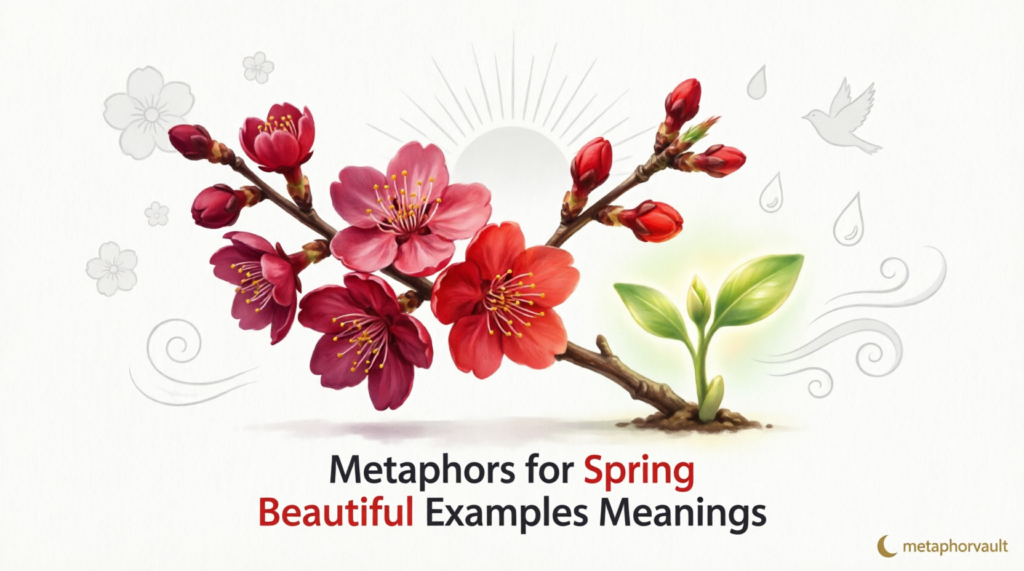
Spring is more than a season. It often feels like a fresh start, which is why writers use metaphors for spring to describe hope, growth, beauty, change, youth, and new beginnings. A spring metaphor compares the season to something else without using “like” or “as.” For example, “Spring is a doorway to new beginnings” turns the season into a symbol of opportunity.
People search for spring metaphors for many reasons. Students may need them for a school assignment, while writers use them in poems, stories, essays, and greeting cards. They also appear in songs, novels, social media captions, speeches, and everyday conversations.
The tricky part is choosing a metaphor that matches the feeling you want. A cheerful spring morning may be a “golden awakening,” while a rainy spring day may be a “soft curtain of tears.”
This guide, for 2026, gives you more than 60 spring metaphors with clear meanings, natural sentences, tone guidance, and practical advice. You will learn which metaphors fit poetry, school writing, casual speech, social posts, and more.
Definition & Meaning
Metaphors for spring are creative comparisons that describe spring as another person, place, object, force, or idea. They help readers imagine what the season feels like rather than simply describing its weather. Common spring metaphors connect the season with rebirth, hope, childhood, flowers, light, doors, journeys, and new life.
A metaphor does not say that spring is literally a flower, book, or sunrise. It uses that image to express an idea.
For example:
“Spring is a blank page.”
Spring is not actually paper. The metaphor suggests that the season gives us a chance to begin again.
Simple meaning
Spring metaphors are imaginative ways to describe spring and the feelings connected to it.
Quick Summary Table
| Term | Simple Meaning | Example |
|---|---|---|
| Metaphor | A direct comparison | “Spring is a doorway.” |
| Spring metaphor | A metaphor connected to spring | “Spring is nature’s rebirth.” |
| Main idea | Fresh starts and growth | “Spring is a second chance.” |
| Common feelings | Hope, joy, renewal, peace | “Spring is a breath of hope.” |
| Common uses | Poetry, school, stories, captions | “Spring is a colorful song.” |
Spring metaphors can describe the weather, plants, sunlight, rain, animals, human emotions, or the larger idea of starting over.
Why We Use Metaphors for Spring
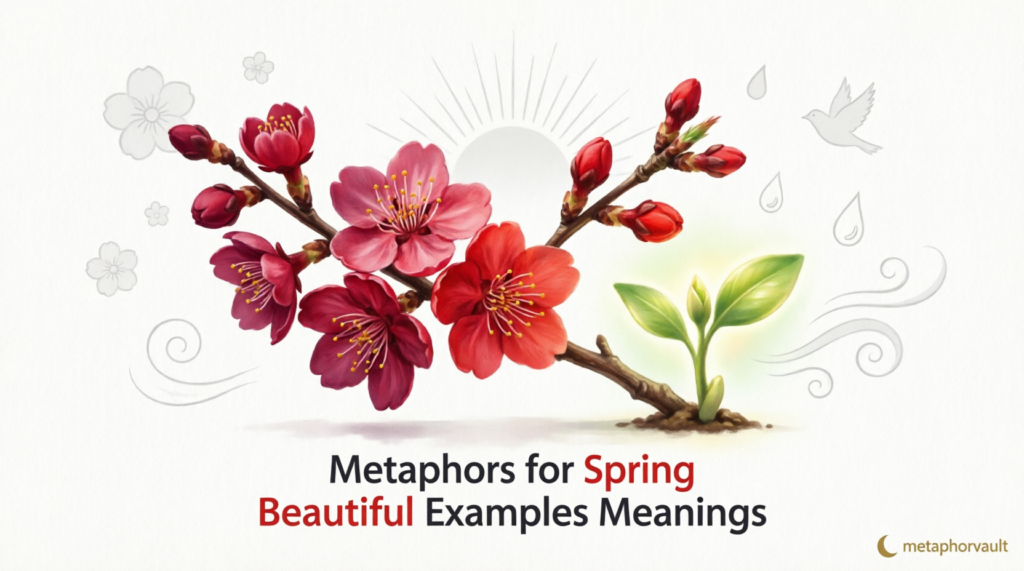
We use metaphors for spring because they make ordinary descriptions more vivid, emotional, and memorable. They turn seasonal changes into ideas people understand, such as hope, freedom, growth, healing, youth, and fresh starts. In writing and speech, a strong spring metaphor can communicate a feeling in only a few powerful words.
Practical purpose
Instead of saying:
“The weather is getting warmer and flowers are growing.”
You could write:
“Spring is waking the sleeping earth.”
The second sentence creates a picture in the reader’s mind.
Everyday usage
People use spring metaphors when talking about:
- New opportunities
- Personal growth
- Happy changes
- Better times
- Nature
- Youth
- Love
- Hope
- Recovery
- Fresh starts
Writing
Metaphors can make essays, stories, poems, and descriptions more interesting.
Plain:
“Spring brings new life.”
Metaphorical:
“Spring unlocks the earth’s hidden treasures.”
Speaking
A metaphor can make everyday speech more expressive.
“After that difficult year, this spring feels like a new chapter.”
School
Students can use spring metaphors in:
- Creative writing
- Poetry
- Essays
- Descriptive paragraphs
- Journal entries
- Graduation speeches
- Presentations
Social media
Short metaphors work especially well in captions.
“Spring is proof that starting over can be beautiful.”
Professional communication
Spring metaphors can also work in speeches, presentations, newsletters, and inspirational messages.
For formal writing, choose clear metaphors rather than overly dramatic ones.
Main Section
The best metaphors for spring connect visible seasonal changes with deeper ideas such as renewal, hope, growth, beauty, freedom, and transformation. The 60+ examples below cover flowers, rain, sunshine, nature, time, emotions, childhood, love, and new beginnings, so you can choose an expression that fits your exact purpose.
1. Spring Is a New Beginning
Meaning: Spring represents a fresh start after a cold or difficult period.
Real explanation: Nature begins again, making spring a natural symbol of starting over.
Sample sentence: “Spring is a new beginning, opening the door to brighter days.”
When to use it: Essays, speeches, cards, personal writing.
When NOT to use it: Avoid it when you need a highly unusual or poetic image.
Alternatives:
- Spring is a fresh start.
- Spring is a second chance.
- Spring is a clean slate.
Difficulty: Easy
Tone: Neutral
2. Spring Is a Doorway to Hope
Meaning: Spring creates a path toward better days.
Real explanation: A doorway suggests movement from one place or stage to another.
Sample sentence: “The first warm morning felt like a doorway to hope.”
When to use it: Inspirational writing and speeches.
When NOT to use it: Avoid if your sentence is meant to be strictly factual.
Alternatives:
- Spring is a path to hope.
- Spring opens the door to joy.
- Spring leads us forward.
Difficulty: Easy
Tone: Inspirational
3. Spring Is Nature’s Alarm Clock
Meaning: Spring wakes nature after winter.
Real explanation: Flowers bloom, animals become active, and trees grow new leaves.
Sample sentence: “Spring is nature’s alarm clock, ringing across every garden.”
When to use it: Children’s writing, blogs, creative descriptions.
When NOT to use it: Avoid in highly formal scientific writing.
Alternatives:
- Spring wakes the earth.
- Spring is nature’s wake-up call.
- Spring awakens the world.
Difficulty: Easy
Tone: Playful
4. Spring Is a Sleeping Giant Awakening
Meaning: Spring brings a powerful world back to life.
Real explanation: Winter can make nature appear still, while spring releases its energy.
Sample sentence: “Spring was a sleeping giant awakening beneath the trees.”
When to use it: Stories and dramatic poetry.
When NOT to use it: Avoid if you want a soft, delicate mood.
Alternatives:
- Spring is a giant coming alive.
- Nature is rising.
- The earth is awakening.
Difficulty: Medium
Tone: Dramatic
5. Spring Is a Blank Page
Meaning: Spring gives us a chance to begin again.
Real explanation: A blank page represents possibilities and a future that has not yet been written.
Sample sentence: “With spring came a blank page for my life.”
When to use it: Personal essays, journals, speeches.
When NOT to use it: Avoid if you have already used several writing-related metaphors nearby.
Alternatives:
- Spring is a fresh chapter.
- Spring is an unwritten story.
- Spring is a clean slate.
Difficulty: Easy
Tone: Reflective
6. Spring Is a Second Chance
Meaning: Spring represents another opportunity.
Real explanation: The return of life after winter can symbolize recovery and another try.
Sample sentence: “Spring arrived like a second chance.”
When to use it: Inspirational writing.
When NOT to use it: Avoid when discussing spring only as a weather event.
Alternatives:
- Spring is another beginning.
- Spring is a fresh opportunity.
- Spring offers another chance.
Difficulty: Easy
Tone: Hopeful
7. Spring Is a Green Blanket
Meaning: New grass and leaves cover the land.
Real explanation: The image compares fresh greenery to a soft blanket spread across the earth.
Sample sentence: “A green blanket of spring covered the hills.”
When to use it: Nature writing and children’s descriptions.
When NOT to use it: Avoid when the landscape is mostly dry or bare.
Alternatives:
- Green carpet
- Emerald cover
- Living blanket
Difficulty: Easy
Tone: Descriptive
8. Spring Is a Painter
Meaning: Spring fills nature with color.
Real explanation: Flowers and new leaves make the landscape look freshly painted.
Sample sentence: “Spring is a painter with a brush full of pink and yellow.”
When to use it: Poetry, stories, captions.
When NOT to use it: Avoid repetitive use of art metaphors.
Alternatives:
- Spring paints the earth.
- Spring is an artist.
- Nature becomes a canvas.
Difficulty: Easy
Tone: Creative
9. Spring Is Nature’s Artist
Meaning: Spring creates beauty across the natural world.
Real explanation: Flowers, trees, sunlight, and landscapes appear newly arranged.
Sample sentence: “Nature’s artist returned with every April morning.”
When to use it: Descriptive writing.
When NOT to use it: Avoid if you need a very simple literal sentence.
Alternatives:
- Spring is a master painter.
- Spring designs the landscape.
- Spring creates a living painting.
Difficulty: Easy
Tone: Poetic
10. Spring Is a Color Explosion
Meaning: Spring brings many bright colors.
Real explanation: Flowers, leaves, and clear skies create a sudden visual change.
Sample sentence: “The garden became a color explosion when spring arrived.”
When to use it: Casual writing and social media.
When NOT to use it: Avoid for calm, quiet scenes.
Alternatives:
- A burst of color
- A rainbow of life
- A festival of colors
Difficulty: Easy
Tone: Energetic
11. Spring Is a Flowering Book
Meaning: Spring reveals new stories through nature.
Real explanation: Each blooming flower can seem like a new page opening.
Sample sentence: “The garden became a flowering book in spring.”
When to use it: Poetry and creative essays.
When NOT to use it: Avoid if the book metaphor is already overused.
Alternatives:
- A blooming story
- A book of blossoms
- A garden of stories
Difficulty: Medium
Tone: Poetic
12. Spring Is a Fresh Breath
Meaning: Spring brings relief and renewed energy.
Real explanation: After winter, warm air can feel like a deep breath of life.
Sample sentence: “Spring was a fresh breath after months of cold.”
When to use it: Personal writing and inspirational captions.
When NOT to use it: Avoid in technical writing.
Alternatives:
- Breath of renewal
- Breath of hope
- Fresh air of change
Difficulty: Easy
Tone: Calm
13. Spring Is a Breath of Hope
Meaning: Spring makes people feel hopeful.
Real explanation: Growing plants and brighter days naturally suggest a better future.
Sample sentence: “The first flowers were a breath of hope.”
When to use it: Emotional writing and speeches.
When NOT to use it: Avoid if you want a humorous tone.
Alternatives:
- A spark of hope
- A sign of hope
- A breeze of optimism
Difficulty: Easy
Tone: Inspirational
14. Spring Is a Healing Hand
Meaning: Spring can symbolize recovery.
Real explanation: The season appears to soothe the harshness left by winter.
Sample sentence: “Spring laid a healing hand across the tired landscape.”
When to use it: Reflective and emotional writing.
When NOT to use it: Avoid if the subject requires literal medical language.
Alternatives:
- Spring heals the earth.
- Spring soothes the land.
- Spring brings renewal.
Difficulty: Medium
Tone: Gentle
15. Spring Is a Sunrise
Meaning: Spring marks the beginning of something bright.
Real explanation: A sunrise represents light after darkness.
Sample sentence: “Spring was a sunrise after a long winter.”
When to use it: Poems, speeches, personal essays.
When NOT to use it: Avoid using too many light metaphors together.
Alternatives:
- Spring is a new dawn.
- Spring is morning for the earth.
- Spring brings the light.
Difficulty: Easy
Tone: Hopeful
16. Spring Is a New Dawn
Meaning: Spring represents a brighter period.
Real explanation: Dawn marks the beginning of a new day.
Sample sentence: “The arrival of spring felt like a new dawn.”
When to use it: Inspirational writing.
When NOT to use it: Avoid if you need an original metaphor because this phrase is common.
Alternatives:
- A fresh morning
- A brighter chapter
- A new light
Difficulty: Easy
Tone: Inspirational
17. Spring Is a Key
Meaning: Spring unlocks nature.
Real explanation: A key opens something that was closed.
Sample sentence: “Spring is the key that unlocks the sleeping garden.”
When to use it: Creative descriptions.
When NOT to use it: Avoid if the sentence already has several object metaphors.
Alternatives:
- Spring unlocks nature.
- Spring opens the earth.
- Spring is an unlocking force.
Difficulty: Easy
Tone: Creative
18. Spring Is Nature’s Curtain Call
Meaning: Spring brings nature back onto the stage.
Real explanation: A curtain call happens when performers return before an audience.
Sample sentence: “Spring was nature’s curtain call after winter’s long performance.”
When to use it: Humorous or artistic writing.
When NOT to use it: Avoid in simple school work for young readers unless explained.
Alternatives:
- Nature takes the stage.
- Spring is nature’s return.
- The earth steps back into the spotlight.
Difficulty: Medium
Tone: Playful
19. Spring Is a Symphony
Meaning: Spring creates many sounds and sights together.
Real explanation: Birds, rain, wind, insects, and rustling leaves can feel like music.
Sample sentence: “Spring became a symphony of birds, rain, and buzzing bees.”
When to use it: Poetry and nature writing.
When NOT to use it: Avoid when the focus is purely visual.
Alternatives:
- Spring is a song.
- Nature plays its music.
- The season is an orchestra.
Difficulty: Medium
Tone: Poetic
20. Spring Is a Song
Meaning: Spring feels joyful and alive.
Real explanation: Birds and natural sounds reinforce the image of music.
Sample sentence: “Every bird seemed to sing the song of spring.”
When to use it: Poems, captions, stories.
When NOT to use it: Avoid if the writing already contains many musical metaphors.
Alternatives:
- Spring sings.
- Spring is a melody.
- Nature is singing again.
Difficulty: Easy
Tone: Poetic
21. Spring Is a Celebration
Meaning: Spring feels like nature is celebrating life.
Real explanation: Flowers, birds, sunshine, and warmer weather create a festive mood.
Sample sentence: “The garden was a celebration of spring.”
When to use it: Descriptive and cheerful writing.
When NOT to use it: Avoid for lonely or stormy scenes.
Alternatives:
- Spring is a festival.
- Nature is celebrating.
- The earth is throwing a party.
Difficulty: Easy
Tone: Joyful
22. Spring Is a Festival of Life
Meaning: Spring displays new life everywhere.
Real explanation: Plants grow, animals become active, and nature changes quickly.
Sample sentence: “The meadow became a festival of life.”
When to use it: Nature essays and poetry.
When NOT to use it: Avoid if your subject is a small, quiet spring scene.
Alternatives:
- Celebration of life
- Feast of life
- Parade of new life
Difficulty: Easy
Tone: Inspirational
23. Spring Is a Garden Waking Up
Meaning: Spring brings nature out of dormancy.
Real explanation: The garden seems to wake as plants begin growing.
Sample sentence: “Spring was a garden waking up from a long sleep.”
When to use it: Children’s writing and stories.
When NOT to use it: Avoid if the setting has no plants.
Alternatives:
- The earth wakes.
- The garden comes alive.
- Nature opens its eyes.
Difficulty: Easy
Tone: Gentle
24. Spring Is the Earth’s Smile
Meaning: Spring makes the earth look happy and beautiful.
Real explanation: Flowers can look like a smile spread across the landscape.
Sample sentence: “Wildflowers were the earth’s smile after winter.”
When to use it: Poems and captions.
When NOT to use it: Avoid for formal scientific descriptions.
Alternatives:
- The earth is smiling.
- Flowers are nature’s smile.
- Spring gives the earth a smile.
Difficulty: Easy
Tone: Warm
25. Spring Is a Rainbow After Winter
Meaning: Spring represents beauty after hardship.
Real explanation: A rainbow appears after rain and often symbolizes hope.
Sample sentence: “Spring was a rainbow after a long winter.”
When to use it: Inspirational writing.
When NOT to use it: Avoid if you want to avoid familiar clichés.
Alternatives:
- Beauty after hardship
- Light after darkness
- Color after grayness
Difficulty: Easy
Tone: Hopeful
26. Spring Is a Phoenix
Meaning: Spring rises again after winter.
Real explanation: The phoenix is commonly associated with rebirth and renewal.
Sample sentence: “Spring rose like a phoenix from winter’s ashes.”
When to use it: Dramatic poetry and powerful writing.
When NOT to use it: Avoid for very young readers who may not know the phoenix image.
Alternatives:
- Spring is rebirth.
- Nature rises again.
- The earth is reborn.
Difficulty: Medium
Tone: Dramatic
27. Spring Is a Rebirth
Meaning: Spring represents new life.
Real explanation: Plants return, flowers open, and landscapes become green again.
Sample sentence: “Spring is the rebirth of the sleeping earth.”
When to use it: Essays, poetry, speeches.
When NOT to use it: Avoid repeating it with several similar renewal metaphors.
Alternatives:
- A renewal
- A resurrection of nature
- A return to life
Difficulty: Easy
Tone: Formal
28. Spring Is a Seed of Possibility
Meaning: Spring contains the promise of future growth.
Real explanation: Seeds represent potential because they can become plants.
Sample sentence: “Every spring morning carries a seed of possibility.”
When to use it: Inspirational writing.
When NOT to use it: Avoid if your writing is focused only on weather.
Alternatives:
- A seed of hope
- A seed of change
- A beginning of possibility
Difficulty: Medium
Tone: Inspirational
29. Spring Is a Ladder
Meaning: Spring suggests movement upward and forward.
Real explanation: A ladder represents progress toward a higher place.
Sample sentence: “Spring became a ladder leading us toward brighter days.”
When to use it: Motivational writing.
When NOT to use it: Avoid when you want a natural landscape image.
Alternatives:
- Spring is a path upward.
- Spring lifts the spirit.
- Spring leads us forward.
Difficulty: Medium
Tone: Motivational
30. Spring Is a Bridge
Meaning: Spring connects winter with summer.
Real explanation: A bridge joins two different places.
Sample sentence: “Spring is the bridge between winter and summer.”
When to use it: Essays and educational writing.
When NOT to use it: Avoid if the transition is not your main idea.
Alternatives:
- Spring connects the seasons.
- Spring is a passage.
- Spring links cold and warmth.
Difficulty: Easy
Tone: Neutral
31. Spring Is a Messenger
Meaning: Spring brings news that warmer days are coming.
Real explanation: A messenger delivers information.
Sample sentence: “The first robin was a messenger of spring.”
When to use it: Stories and nature writing.
When NOT to use it: Avoid if there is no sign announcing the season.
Alternatives:
- Spring sends a message.
- Birds announce spring.
- Flowers carry spring’s news.
Difficulty: Easy
Tone: Poetic
32. Spring Is a Letter From Nature
Meaning: Spring communicates through changes in nature.
Real explanation: Flowers, birds, rain, and sunlight can feel like messages from the natural world.
Sample sentence: “Every blossom was a letter from nature.”
When to use it: Poetry and creative writing.
When NOT to use it: Avoid in highly technical communication.
Alternatives:
- Nature sends a message.
- Spring writes to us.
- The earth speaks through flowers.
Difficulty: Medium
Tone: Poetic
33. Spring Is a Gift
Meaning: Spring is something beautiful to appreciate.
Real explanation: The season can feel like a gift after winter.
Sample sentence: “The warm afternoon was a gift from spring.”
When to use it: Gratitude posts, cards, essays.
When NOT to use it: Avoid when the writing requires a more dramatic image.
Alternatives:
- Spring is a blessing.
- Spring is nature’s present.
- Spring gives us beauty.
Difficulty: Easy
Tone: Warm
34. Spring Is a Treasure Chest
Meaning: Spring contains many beautiful discoveries.
Real explanation: Flowers, birds, colors, and fresh smells become nature’s treasures.
Sample sentence: “The forest became a treasure chest when spring arrived.”
When to use it: Children’s stories and imaginative writing.
When NOT to use it: Avoid for minimalist or formal prose.
Alternatives:
- Spring is full of treasures.
- Nature is a treasure box.
- The garden holds hidden jewels.
Difficulty: Easy
Tone: Imaginative
35. Spring Is a Jewel Box
Meaning: Spring is filled with precious colors and beauty.
Real explanation: Flowers can resemble colorful jewels.
Sample sentence: “The meadow looked like a jewel box of spring.”
When to use it: Poetry and descriptive writing.
When NOT to use it: Avoid if the landscape is mostly green without much color.
Alternatives:
- A box of colors
- A garden of jewels
- A treasure of blossoms
Difficulty: Medium
Tone: Elegant
36. Spring Is a Young Child
Meaning: Spring is energetic, playful, and full of curiosity.
Real explanation: The season’s fresh energy resembles childhood.
Sample sentence: “Spring ran through the fields like a joyful child.”
When to use it: Personification and creative stories.
When NOT to use it: Avoid when writing about serious or solemn themes.
Alternatives:
- Spring is youthful energy.
- Spring is nature’s childhood.
- Spring is young and playful.
Difficulty: Easy
Tone: Playful
37. Spring Is Youth
Meaning: Spring symbolizes youth and energy.
Real explanation: Both spring and youth suggest freshness, possibility, and growth.
Sample sentence: “Spring is the youth of the year.”
When to use it: Poetry, essays, speeches.
When NOT to use it: Avoid if your subject does not involve growth or energy.
Alternatives:
- Spring is the year’s childhood.
- Spring is youthful energy.
- Spring is nature’s youth.
Difficulty: Easy
Tone: Reflective
38. Spring Is Childhood
Meaning: Spring represents innocence and discovery.
Real explanation: The season can remind people of playful, carefree times.
Sample sentence: “Spring was childhood returning to the garden.”
When to use it: Nostalgic writing.
When NOT to use it: Avoid if your audience expects a strictly literal interpretation.
Alternatives:
- Spring is innocence.
- Spring is a childhood memory.
- Spring brings back youth.
Difficulty: Medium
Tone: Nostalgic
39. Spring Is a Child’s Laughter
Meaning: Spring feels joyful and lively.
Real explanation: The image connects spring with pure happiness.
Sample sentence: “The birdsong sounded like a child’s laughter.”
When to use it: Poetry and emotional descriptions.
When NOT to use it: Avoid for quiet, serious scenes.
Alternatives:
- Spring is laughter.
- Nature is laughing.
- The garden is full of joy.
Difficulty: Easy
Tone: Joyful
40. Spring Is a Warm Embrace
Meaning: Spring provides comfort after winter.
Real explanation: Warmer air and sunshine can feel like being hugged.
Sample sentence: “The warm breeze was spring’s gentle embrace.”
When to use it: Emotional writing and captions.
When NOT to use it: Avoid if the scene is cold or stormy.
Alternatives:
- Spring is a hug.
- Spring wraps the earth in warmth.
- Spring holds the world gently.
Difficulty: Easy
Tone: Gentle
41. Spring Is a Kiss From the Sun
Meaning: Spring sunlight feels warm and loving.
Real explanation: The sun’s warmth is described as a gentle kiss.
Sample sentence: “The meadow glowed beneath the sun’s kiss.”
When to use it: Poetry and romantic writing.
When NOT to use it: Avoid in formal reports.
Alternatives:
- A touch of sunlight
- The sun’s warm touch
- Sunshine’s gentle greeting
Difficulty: Easy
Tone: Romantic
42. Spring Is a Lover’s Arrival
Meaning: Spring is welcomed with excitement and affection.
Real explanation: The return of spring can be compared with the arrival of someone deeply loved.
Sample sentence: “Spring entered the garden like a long-awaited lover.”
When to use it: Romantic poetry.
When NOT to use it: Avoid in children’s or formal school writing.
Alternatives:
- Spring is a beloved guest.
- Spring is a welcome visitor.
- Spring is love returning.
Difficulty: Medium
Tone: Romantic
43. Spring Is a Welcome Guest
Meaning: People are happy when spring arrives.
Real explanation: The season behaves like a guest whose arrival is eagerly expected.
Sample sentence: “Spring was a welcome guest at every window.”
When to use it: General creative writing.
When NOT to use it: Avoid if you want a very fresh metaphor.
Alternatives:
- Spring is a visitor.
- Spring comes knocking.
- The season arrives like a friend.
Difficulty: Easy
Tone: Friendly
44. Spring Is a Friendly Neighbor
Meaning: Spring brings warmth and pleasant energy.
Real explanation: A friendly neighbor is comforting and familiar.
Sample sentence: “Spring returned like a friendly neighbor.”
When to use it: Casual stories and children’s writing.
When NOT to use it: Avoid for grand or dramatic poetry.
Alternatives:
- Spring is an old friend.
- Spring is a kind visitor.
- Spring feels like home.
Difficulty: Easy
Tone: Warm
45. Spring Is an Old Friend
Meaning: Spring feels familiar and comforting.
Real explanation: The season returns every year, creating a sense of recognition.
Sample sentence: “When spring returned, it felt like meeting an old friend.”
When to use it: Nostalgic writing and captions.
When NOT to use it: Avoid if you want to emphasize change rather than familiarity.
Alternatives:
- Spring is a familiar friend.
- Spring comes home.
- Spring returns to us.
Difficulty: Easy
Tone: Nostalgic
46. Spring Is a Thief of Winter
Meaning: Spring takes away winter’s cold.
Real explanation: The metaphor presents spring as a force that steals winter’s power.
Sample sentence: “Spring was a thief, stealing winter’s frost.”
When to use it: Creative and playful writing.
When NOT to use it: Avoid if the tone needs to be peaceful.
Alternatives:
- Spring defeats winter.
- Spring steals the cold.
- Warmth drives winter away.
Difficulty: Medium
Tone: Playful
47. Spring Is a Warrior
Meaning: Spring defeats winter and brings life back.
Real explanation: The season can be imagined as fighting cold and darkness.
Sample sentence: “Spring marched across the fields like a warrior of light.”
When to use it: Dramatic poetry and stories.
When NOT to use it: Avoid when you want a gentle mood.
Alternatives:
- Spring battles winter.
- Spring is a force of life.
- Warmth conquers the cold.
Difficulty: Medium
Tone: Dramatic
48. Spring Is a Fire of Color
Meaning: Spring spreads bright colors quickly.
Real explanation: Flowers can make the landscape appear to burn with color.
Sample sentence: “A fire of color swept through the garden.”
When to use it: Vivid poetry.
When NOT to use it: Avoid if the scene should feel peaceful rather than intense.
Alternatives:
- A blaze of color
- A burst of color
- A flame of blossoms
Difficulty: Medium
Tone: Vivid
49. Spring Is a Green Flame
Meaning: New plant growth spreads with strong energy.
Real explanation: The flame image suggests movement and power, while green represents new life.
Sample sentence: “Green flames climbed the hills as spring arrived.”
When to use it: Creative poetry.
When NOT to use it: Avoid for very literal writing.
Alternatives:
- A wave of green
- A rush of growth
- A living flame
Difficulty: Medium
Tone: Poetic
50. Spring Is a River of Light
Meaning: Sunshine seems to flow across the landscape.
Real explanation: Light is compared to moving water.
Sample sentence: “A river of light poured through the spring trees.”
When to use it: Poetry and visual descriptions.
When NOT to use it: Avoid when the scene is dark or heavily overcast.
Alternatives:
- Stream of sunlight
- Flood of light
- Flow of sunshine
Difficulty: Medium
Tone: Poetic
51. Spring Is a Sea of Flowers
Meaning: Flowers spread widely across the landscape.
Real explanation: A large field of flowers can look like a colorful sea.
Sample sentence: “The meadow became a sea of flowers.”
When to use it: Nature descriptions and captions.
When NOT to use it: Avoid if only a few flowers are present.
Alternatives:
- Ocean of blossoms
- Field of color
- Wave of flowers
Difficulty: Easy
Tone: Descriptive
52. Spring Is a Carpet of Blossoms
Meaning: Flowers cover the ground.
Real explanation: The flowers resemble a colorful carpet spread across the earth.
Sample sentence: “A carpet of blossoms covered the hillside.”
When to use it: Travel writing, stories, nature essays.
When NOT to use it: Avoid when the flowers are sparse.
Alternatives:
- Blanket of flowers
- Floral carpet
- Blossoming ground
Difficulty: Easy
Tone: Descriptive
53. Spring Is a Garden of Dreams
Meaning: Spring creates a beautiful world full of possibilities.
Real explanation: A garden represents beauty, while dreams represent hope and imagination.
Sample sentence: “The quiet park became a garden of dreams.”
When to use it: Poetry and inspirational writing.
When NOT to use it: Avoid if the writing needs a very concrete image.
Alternatives:
- Garden of hope
- Garden of possibilities
- Dreaming landscape
Difficulty: Medium
Tone: Dreamy
54. Spring Is a Window Opening
Meaning: Spring lets fresh energy into life.
Real explanation: Opening a window brings fresh air and a new view.
Sample sentence: “Spring was a window opening after months of cold.”
When to use it: Personal essays and reflective writing.
When NOT to use it: Avoid if you have already used several doorway metaphors.
Alternatives:
- Spring opens the world.
- Spring lets in the light.
- Spring opens a new view.
Difficulty: Easy
Tone: Reflective
55. Spring Is a Light Switch
Meaning: Spring seems to turn nature back on.
Real explanation: The landscape changes quickly from dull and quiet to bright and active.
Sample sentence: “Spring flipped the light switch on the sleeping garden.”
When to use it: Casual, humorous, modern writing.
When NOT to use it: Avoid in serious poetry unless the contrast is intentional.
Alternatives:
- Spring turns nature on.
- Spring switches on life.
- Spring brings the lights back.
Difficulty: Easy
Tone: Playful
56. Spring Is a Fountain of Life
Meaning: Spring seems to pour new life into the world.
Real explanation: A fountain constantly releases water, making it a useful image for renewal.
Sample sentence: “Spring became a fountain of life across the valley.”
When to use it: Inspirational writing and poetry.
When NOT to use it: Avoid if the writing already uses several water metaphors.
Alternatives:
- Source of life
- River of renewal
- Well of new life
Difficulty: Medium
Tone: Inspirational
57. Spring Is a Fountain of Youth
Meaning: Spring makes the world feel young again.
Real explanation: The traditional idea of a fountain of youth connects with spring’s fresh energy.
Sample sentence: “The garden looked as though it had found spring’s fountain of youth.”
When to use it: Creative writing and playful descriptions.
When NOT to use it: Avoid if the audience may not understand the cultural reference.
Alternatives:
- Spring restores youth.
- Spring makes nature young.
- Spring renews the earth.
Difficulty: Medium
Tone: Playful
58. Spring Is a Clock Resetting
Meaning: Spring represents a new cycle.
Real explanation: Each year, spring returns and begins another natural cycle.
Sample sentence: “Spring is the earth’s clock resetting for another year.”
When to use it: Essays and reflective writing.
When NOT to use it: Avoid when your topic is romantic or highly emotional.
Alternatives:
- Spring resets the year.
- Nature starts again.
- The seasonal clock begins anew.
Difficulty: Medium
Tone: Reflective
59. Spring Is a Turning Page
Meaning: Spring marks a transition.
Real explanation: Turning a page moves a story forward.
Sample sentence: “Spring was a turning page in the story of the year.”
When to use it: Essays, speeches, personal writing.
When NOT to use it: Avoid if you have already used several book metaphors.
Alternatives:
- Spring is a new chapter.
- Spring turns the story forward.
- The year enters a new chapter.
Difficulty: Easy
Tone: Reflective
60. Spring Is a New Chapter
Meaning: Spring begins a new period of life.
Real explanation: A chapter represents a new stage in a story.
Sample sentence: “Spring opened a new chapter for the garden.”
When to use it: Personal writing, graduation messages, inspirational posts.
When NOT to use it: Avoid if you want a nature-focused image.
Alternatives:
- Spring is a fresh chapter.
- Spring begins a new story.
- Spring turns the page.
Difficulty: Easy
Tone: Inspirational
61. Spring Is a Promise
Meaning: Spring promises warmer weather and new life.
Real explanation: A promise suggests something good is expected to happen.
Sample sentence: “Every green leaf was a promise of summer.”
When to use it: Poetry and inspirational writing.
When NOT to use it: Avoid if you need to describe spring without looking ahead.
Alternatives:
- Spring is a promise of warmth.
- Spring promises renewal.
- Spring carries hope.
Difficulty: Easy
Tone: Hopeful
62. Spring Is a Seedling
Meaning: Spring represents something small that can grow into something greater.
Real explanation: A seedling symbolizes early growth and potential.
Sample sentence: “Spring was a seedling of hope growing inside the year.”
When to use it: Motivational and reflective writing.
When NOT to use it: Avoid if the metaphor needs to describe the whole season visually.
Alternatives:
- Spring is a beginning.
- Spring is young growth.
- Spring is potential.
Difficulty: Medium
Tone: Inspirational
63. Spring Is a Rising Tide
Meaning: Spring brings a growing wave of life and energy.
Real explanation: A rising tide suggests something increasing and spreading.
Sample sentence: “A rising tide of green swept across the countryside.”
When to use it: Vivid descriptions.
When NOT to use it: Avoid if there is no sense of gradual growth.
Alternatives:
- Wave of life
- Surge of growth
- Flood of green
Difficulty: Medium
Tone: Powerful
64. Spring Is a Wave of Renewal
Meaning: New life seems to move across the land.
Real explanation: The wave image suggests that renewal spreads from one place to another.
Sample sentence: “A wave of renewal moved through the trees.”
When to use it: Essays, poetry, motivational writing.
When NOT to use it: Avoid when describing only one small flower.
Alternatives:
- Wave of new life
- Rush of renewal
- Current of change
Difficulty: Medium
Tone: Inspirational
65. Spring Is a Whisper of Change
Meaning: Spring begins with small signs before becoming obvious.
Real explanation: Early buds, mild air, and birds can quietly signal seasonal change.
Sample sentence: “The first green bud was a whisper of change.”
When to use it: Subtle, emotional writing.
When NOT to use it: Avoid when describing a loud, colorful spring scene.
Alternatives:
- Hint of spring
- Sign of change
- Quiet promise
Difficulty: Easy
Tone: Gentle
66. Spring Is a Burst of Joy
Meaning: Spring brings sudden happiness.
Real explanation: Warm weather, flowers, and sunlight can create an energetic mood.
Sample sentence: “The garden was a burst of joy after the gray winter.”
When to use it: Captions, cards, cheerful writing.
When NOT to use it: Avoid for quiet or melancholic spring scenes.
Alternatives:
- Burst of happiness
- Explosion of joy
- Wave of delight
Difficulty: Easy
Tone: Cheerful
67. Spring Is a Smile After Tears
Meaning: Spring represents happiness after sadness.
Real explanation: Winter can symbolize hardship, while spring becomes the emotional recovery afterward.
Sample sentence: “Spring was a smile after winter’s tears.”
When to use it: Emotional poetry and inspirational writing.
When NOT to use it: Avoid if you need a completely neutral tone.
Alternatives:
- Joy after sadness
- Hope after hardship
- Light after tears
Difficulty: Easy
Tone: Emotional
68. Spring Is the Earth Breathing Again
Meaning: Spring makes nature seem alive and active again.
Real explanation: The metaphor gives the earth human qualities and connects growth with breathing.
Sample sentence: “With every new leaf, the earth seemed to breathe again.”
When to use it: Poetry and descriptive prose.
When NOT to use it: Avoid in technical or scientific writing.
Alternatives:
- The earth comes alive.
- Nature breathes again.
- Life returns to the land.
Difficulty: Easy
Tone: Poetic
69. Spring Is Nature’s Rebirth Certificate
Meaning: Spring proves that life has returned.
Real explanation: A birth certificate records a beginning, while spring visibly announces renewal.
Sample sentence: “Every blossom was nature’s rebirth certificate.”
When to use it: Creative and humorous writing.
When NOT to use it: Avoid in formal essays unless the style is playful.
Alternatives:
- Proof of renewal
- Record of new life
- Certificate of spring
Difficulty: Medium
Tone: Playful
70. Spring Is a Door Left Open
Meaning: Spring creates possibilities for what comes next.
Real explanation: An open door represents freedom, opportunity, and movement into something new.
Sample sentence: “Spring was a door left open to possibility.”
When to use it: Inspirational writing, speeches, captions.
When NOT to use it: Avoid if the subject is specifically about flowers or weather.
Alternatives:
- Open door to change
- Door to possibility
- Path into summer
Difficulty: Easy
Tone: Inspirational
Quick Reference Table
This table gives a fast overview of all 70 spring metaphors, their central meanings, and the best situations for using them. It is useful when you need to choose a metaphor quickly for an essay, poem, speech, story, classroom activity, caption, or creative project.
| # | Spring Metaphor | Main Meaning | Best Use | Tone |
|---|---|---|---|---|
| 1 | Spring is a new beginning | Fresh start | Essays | Neutral |
| 2 | Spring is a doorway to hope | Opportunity | Speeches | Inspirational |
| 3 | Spring is nature’s alarm clock | Awakening | Kids’ writing | Playful |
| 4 | Spring is a sleeping giant awakening | Powerful renewal | Stories | Dramatic |
| 5 | Spring is a blank page | Possibility | Personal writing | Reflective |
| 6 | Spring is a second chance | Renewal | Inspirational writing | Hopeful |
| 7 | Spring is a green blanket | New greenery | Nature writing | Descriptive |
| 8 | Spring is a painter | Color | Poetry | Creative |
| 9 | Spring is nature’s artist | Beauty | Descriptions | Poetic |
| 10 | Spring is a color explosion | Brightness | Captions | Energetic |
| 11 | Spring is a flowering book | Discovery | Poetry | Poetic |
| 12 | Spring is a fresh breath | Relief | Personal writing | Calm |
| 13 | Spring is a breath of hope | Optimism | Speeches | Inspirational |
| 14 | Spring is a healing hand | Recovery | Reflection | Gentle |
| 15 | Spring is a sunrise | New light | Poetry | Hopeful |
| 16 | Spring is a new dawn | New period | Speeches | Inspirational |
| 17 | Spring is a key | Unlocking | Creative writing | Creative |
| 18 | Spring is nature’s curtain call | Return | Poetry | Playful |
| 19 | Spring is a symphony | Natural sounds | Poetry | Poetic |
| 20 | Spring is a song | Joy | Captions | Poetic |
| 21 | Spring is a celebration | Happiness | Descriptions | Joyful |
| 22 | Spring is a festival of life | New life | Essays | Inspirational |
| 23 | Spring is a garden waking up | Awakening | Stories | Gentle |
| 24 | Spring is the earth’s smile | Beauty | Poetry | Warm |
| 25 | Spring is a rainbow after winter | Hope | Speeches | Hopeful |
| 26 | Spring is a phoenix | Rebirth | Poetry | Dramatic |
| 27 | Spring is a rebirth | Renewal | Essays | Formal |
| 28 | Spring is a seed of possibility | Potential | Motivation | Inspirational |
| 29 | Spring is a ladder | Progress | Motivation | Motivational |
| 30 | Spring is a bridge | Transition | Essays | Neutral |
| 31 | Spring is a messenger | Arrival | Stories | Poetic |
| 32 | Spring is a letter from nature | Communication | Poetry | Poetic |
| 33 | Spring is a gift | Appreciation | Cards | Warm |
| 34 | Spring is a treasure chest | Discovery | Children’s writing | Imaginative |
| 35 | Spring is a jewel box | Beauty | Poetry | Elegant |
| 36 | Spring is a young child | Energy | Stories | Playful |
| 37 | Spring is youth | Freshness | Essays | Reflective |
| 38 | Spring is childhood | Innocence | Nostalgia | Nostalgic |
| 39 | Spring is a child’s laughter | Joy | Poetry | Joyful |
| 40 | Spring is a warm embrace | Comfort | Captions | Gentle |
| 41 | Spring is a kiss from the sun | Warmth | Romantic poetry | Romantic |
| 42 | Spring is a lover’s arrival | Love | Poetry | Romantic |
| 43 | Spring is a welcome guest | Arrival | Stories | Friendly |
| 44 | Spring is a friendly neighbor | Familiarity | Casual writing | Warm |
| 45 | Spring is an old friend | Familiarity | Personal writing | Nostalgic |
| 46 | Spring is a thief of winter | Change | Creative writing | Playful |
| 47 | Spring is a warrior | Victory | Dramatic poetry | Dramatic |
| 48 | Spring is a fire of color | Vivid beauty | Poetry | Vivid |
| 49 | Spring is a green flame | Growth | Poetry | Poetic |
| 50 | Spring is a river of light | Sunshine | Descriptions | Poetic |
| 51 | Spring is a sea of flowers | Abundance | Nature writing | Descriptive |
| 52 | Spring is a carpet of blossoms | Flowers | Descriptions | Descriptive |
| 53 | Spring is a garden of dreams | Imagination | Poetry | Dreamy |
| 54 | Spring is a window opening | New view | Essays | Reflective |
| 55 | Spring is a light switch | Activation | Casual writing | Playful |
| 56 | Spring is a fountain of life | Renewal | Poetry | Inspirational |
| 57 | Spring is a fountain of youth | Youth | Creative writing | Playful |
| 58 | Spring is a clock resetting | New cycle | Essays | Reflective |
| 59 | Spring is a turning page | Transition | Personal writing | Reflective |
| 60 | Spring is a new chapter | New stage | Speeches | Inspirational |
| 61 | Spring is a promise | Future hope | Poetry | Hopeful |
| 62 | Spring is a seedling | Potential | Motivation | Inspirational |
| 63 | Spring is a rising tide | Growing energy | Descriptions | Powerful |
| 64 | Spring is a wave of renewal | Renewal | Poetry | Inspirational |
| 65 | Spring is a whisper of change | Subtle change | Poetry | Gentle |
| 66 | Spring is a burst of joy | Happiness | Captions | Cheerful |
| 67 | Spring is a smile after tears | Recovery | Poetry | Emotional |
| 68 | Spring is the earth breathing again | Life | Poetry | Poetic |
| 69 | Spring is nature’s rebirth certificate | Renewal | Creative writing | Playful |
| 70 | Spring is a door left open | Possibility | Speeches | Inspirational |
Real-Life Conversations
Spring metaphors sound most natural when they match the situation and the speaker’s personality. In everyday conversation, people often use short spring comparisons to describe weather, moods, relationships, school projects, or personal change. These examples show how the expressions can fit naturally into conversations without sounding forced.
Conversation 1: Friends
Maya: The weather today is perfect.
Lena: I know. It finally feels like spring.
Maya: It feels like a fresh breath after all that cold weather.
Lena: Exactly. I want to sit outside all afternoon.
Maya: Same. Spring is basically nature’s alarm clock.
Lena: And apparently it woke me up too!
Conversation 2: Student and Teacher
Student: I need a metaphor for my spring poem.
Teacher: What feeling are you trying to show?
Student: Hope. I want spring to feel like starting over.
Teacher: Then try, “Spring is a blank page.”
Student: I like that.
Teacher: You could also write, “Spring is a new chapter.”
Student: The blank page feels more personal.
Teacher: Then use that one and explain what the blank page represents.
Conversation 3: Family
Mother: Look at the garden. The flowers are finally opening.
Son: It looks completely different.
Mother: Spring is nature’s artist.
Son: I think it looks like a rainbow.
Mother: That works too.
Son: Can we plant more flowers?
Mother: Of course. Let’s add some color to the garden.
Conversation 4: Dating
Alex: You seem really happy lately.
Jordan: I am. This year feels different.
Alex: In a good way?
Jordan: Definitely. It feels like spring.
Alex: Meaning?
Jordan: Like everything is starting again. New plans, new energy, new memories.
Alex: So spring is your metaphor for a fresh start?
Jordan: Exactly.
Conversation 5: Social Media
Nora: I need a short caption for this garden photo.
Sam: How about, “Spring is a burst of joy”?
Nora: Nice, but I want something softer.
Sam: “Spring is a whisper of change.”
Nora: Perfect. That sounds calm.
Sam: Then post it.
Nora: Done.
Everyday Usage
Spring metaphors appear in many forms of communication because spring naturally connects with familiar human ideas such as growth, hope, beauty, love, and change. The best expression depends on the setting: casual conversations can be playful, school writing should be clear, poetry can be imaginative, and professional writing should use simple metaphors that support the main message.
1. Conversation
In casual speech, short metaphors work best.
“This weather is a breath of fresh air.”
“Spring feels like a new beginning.”
“The garden is waking up.”
You do not need a complicated metaphor to sound expressive.
2. Writing
Descriptive writing benefits from strong visual images.
“A green blanket covered the hills.”
This is more vivid than:
“The hills became green.”
3. Books
Authors often use spring as a symbol of:
- New life
- Youth
- Love
- Hope
- Recovery
- Change
- Freedom
A character who experiences personal growth may enter a story’s “spring” period, even when the actual season is not mentioned.
4. Movies
Films often use spring-like imagery to show emotional changes.
A character may walk through a blooming garden after overcoming a difficult experience. The changing landscape silently suggests that life is improving.
5. Poetry
Poetry gives you the most freedom.
You can combine several images:
“Spring is a river of light,
a green flame across the hills,
a blank page waiting for rain.”
The metaphors create a feeling rather than simply reporting facts.
6. Emails
Spring metaphors can work in friendly or inspirational emails, but keep them simple.
For example:
“I hope this spring brings you fresh energy and new opportunities.”
For business communication, avoid using too many poetic expressions.
7. Text Messages
Short metaphors work well in texts.
“Spring finally feels like a second chance.”
“The weather is giving me new-life energy.”
“This sunshine is a warm embrace.”
8. Instagram
Instagram captions can be short and emotional.
Examples:
“Spring is a burst of joy.”
“A sea of flowers.”
“Spring is the earth’s smile.”
“New season. New chapter.”
9. Facebook
Facebook posts often allow slightly longer reflections.
“Spring reminds me that starting over does not have to be scary. Sometimes it is simply a new chapter waiting to be written.”
10. X
Short metaphors are especially useful when space is limited.
“Spring is proof that the world knows how to begin again.”
11. LinkedIn
Use professional spring metaphors carefully.
For example:
“Spring reminds us that growth often begins quietly before it becomes visible.”
This connects seasonal growth with professional development without sounding overly poetic.
12. School Assignments
For school writing, choose metaphors that are easy to explain.
Good examples include:
- Spring is a new beginning.
- Spring is a blank page.
- Spring is nature’s alarm clock.
- Spring is a green blanket.
- Spring is a new chapter.
After the metaphor, explain what it means.
Example:
“Spring is a blank page because it gives nature a fresh chance to grow.”
This shows that you understand both the metaphor and its meaning.
13. Creative Writing
Creative writers can combine spring metaphors with personification.
“Spring knocked on every door, slipped sunlight through the windows, and painted the sleeping hills green.”
Here, spring acts like a person while also functioning as a larger metaphor for renewal.
14. Romantic Writing
Spring is naturally useful when writing about love.
“Your arrival was spring after a long winter.”
The metaphor suggests that the person brought warmth, happiness, and new life.
15. Inspirational Writing
Spring can represent personal change.
“You are not starting from nothing. You are entering a new spring.”
This works because spring suggests that growth can return after difficult periods.
How to Choose the Best Spring Metaphor
Choose a spring metaphor based on the exact feeling or image you want the reader to experience. Use renewal metaphors for new beginnings, nature metaphors for scenery, light metaphors for hope, growth metaphors for progress, and relationship metaphors for love. A simple, relevant metaphor is usually stronger than an overly complicated one.
For hope
Use:
- Spring is a new dawn.
- Spring is a breath of hope.
- Spring is a promise.
- Spring is a second chance.
For growth
Use:
- Spring is a seedling.
- Spring is a rising tide.
- Spring is a wave of renewal.
- Spring is a fountain of life.
For beauty
Use:
- Spring is a painter.
- Spring is a jewel box.
- Spring is a sea of flowers.
- Spring is a carpet of blossoms.
For happiness
Use:
- Spring is a celebration.
- Spring is a burst of joy.
- Spring is a child’s laughter.
- Spring is the earth’s smile.
For change
Use:
- Spring is a turning page.
- Spring is a bridge.
- Spring is a doorway.
- Spring is a clock resetting.
For love
Use:
- Spring is a warm embrace.
- Spring is a kiss from the sun.
- Spring is a lover’s arrival.
- Spring is love returning.
Spring Metaphors vs. Spring Similes
A spring metaphor directly says that one thing is another, while a spring simile compares two things using “like” or “as.” For example, “Spring is a painter” is a metaphor, while “Spring is like a painter” is a simile. Both create images, but metaphors usually sound more direct and powerful.
| Metaphor | Simile |
|---|---|
| Spring is a painter. | Spring is like a painter. |
| Spring is a new chapter. | Spring is like a new chapter. |
| Spring is a breath of hope. | Spring is like a breath of hope. |
| Spring is a green blanket. | Spring is like a green blanket. |
| Spring is a symphony. | Spring sounds like a symphony. |
A simple rule helps:
Metaphor = says it is.
Simile = says it is like.
Common Mistakes When Using Spring Metaphors
The most common mistakes are using a metaphor that does not match the scene, mixing several unrelated images, explaining the metaphor too much, or choosing a cliché when a simpler original image would work better. Good spring metaphors should make the writing clearer and more vivid rather than making readers stop to decode the sentence.
1. Mixing unrelated metaphors
Avoid:
“Spring is a ship, a green blanket, and a roaring dragon opening a book.”
The images compete with one another.
2. Using too many metaphors
One strong metaphor can be enough.
3. Choosing the wrong tone
A dramatic metaphor may not fit a cheerful classroom paragraph.
4. Making the metaphor too difficult
Simple images often work best.
5. Forgetting the context
“Spring is a warrior” works well in dramatic writing but may sound strange in a business email.
6. Explaining too much
If you write:
“Spring is a blank page, meaning that it is not literally a page but represents a new opportunity…”
in a poem, you may weaken the effect.
Explain metaphors in school assignments when necessary, but let creative writing breathe.
Final Thoughts
Metaphors for spring turn a familiar season into something more meaningful: a beginning, a promise, a painting, a song, a doorway, or a return to life. The best metaphor depends on what you want to express. For simple writing, choose clear images such as “spring is a new beginning.” For poetry, experiment with richer ideas such as “spring is a river of light.”
Spring naturally gives writers a powerful language for change.
It reminds us that quiet periods do not always last, growth can return, and a new beginning can appear after a long season of waiting.
Whether you are writing a poem, school assignment, story, speech, social media caption, or personal reflection, the right spring metaphor can turn a simple sentence into an image readers remember.
Spring is not only a season. In writing, it can become a symbol of everything beginning again.
descover more post
25+Personal Metaphors Ways to Describe Yourself 2026
27+Metaphors Describing Yourself Creative Examples 2026
28+Metaphors in Art Examples That Reveal Hidden …

Kovien is an experienced English language researcher, editor, and digital content strategist at MetaphorVault.com. He earned a Bachelor’s degree in English Language and Literature and has spent more than 5 years creating educational resources that simplify figurative language, metaphors, idioms, and modern English usage. His expertise combines linguistic knowledge with practical SEO writing, allowing him to produce content that is both informative and engaging. Kovien enjoys transforming complex language concepts into clear, relatable explanations supported by real-world examples. His work is driven by a commitment to accuracy, originality, and continuous learning. Through MetaphorVault.com, he aims to help readers build stronger communication skills and gain greater confidence in understanding and using the English language.