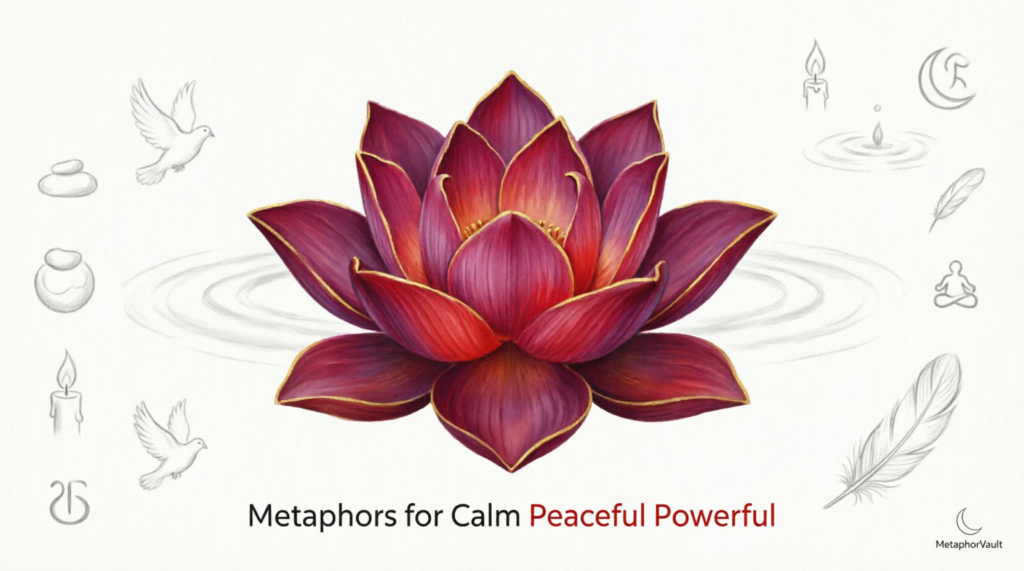
Metaphors for calm are creative comparisons that describe peace, quietness, emotional control, or a relaxed state without using the words “calm” or “peace” directly. They compare calm feelings to things such as still water, soft clouds, quiet gardens, gentle rain, or a safe harbor.
A metaphor helps readers feel calm instead of simply being told that someone is calm.
For example:
“Her mind was a quiet lake.”
This does not mean her mind was actually a lake. It means her thoughts were still, peaceful, and free from much disturbance.
Metaphors for calm are useful in stories, poems, speeches, conversations, social media posts, school writing, and personal messages. They can describe a peaceful person, a quiet place, a relaxed moment, or the feeling that comes after stress fades.
Quick Explanation
A calm metaphor takes an ordinary peaceful idea and turns it into a picture.
Compare these sentences:
- Simple: He felt calm.
- Metaphorical: His mind was a quiet lake.
- Simple: The room was peaceful.
- Metaphorical: The room was a sleeping garden.
The second versions create stronger images and emotions.
Summary Table
| Metaphor | Basic Meaning | Best Use | Tone |
|---|---|---|---|
| A quiet lake | A peaceful mind | Writing, poetry | Neutral |
| A gentle breeze | Soft, relaxing calm | Conversation, writing | Neutral |
| A safe harbor | Security and peace | Emotional writing | Warm |
| A still pond | Deep inner peace | Poetry, stories | Calm |
| A soft blanket | Comfort and relaxation | Personal writing | Warm |
| A peaceful garden | A quiet environment | Descriptions | Neutral |
| A sleeping cloud | Gentle stillness | Poetry | Creative |
| A calm sea | Emotional balance | Writing, speech | Neutral |
| A silent forest | Deep quiet | Nature writing | Peaceful |
| A warm candle | Comfort and peace | Personal writing | Warm |
Why We Use Metaphors for Calm
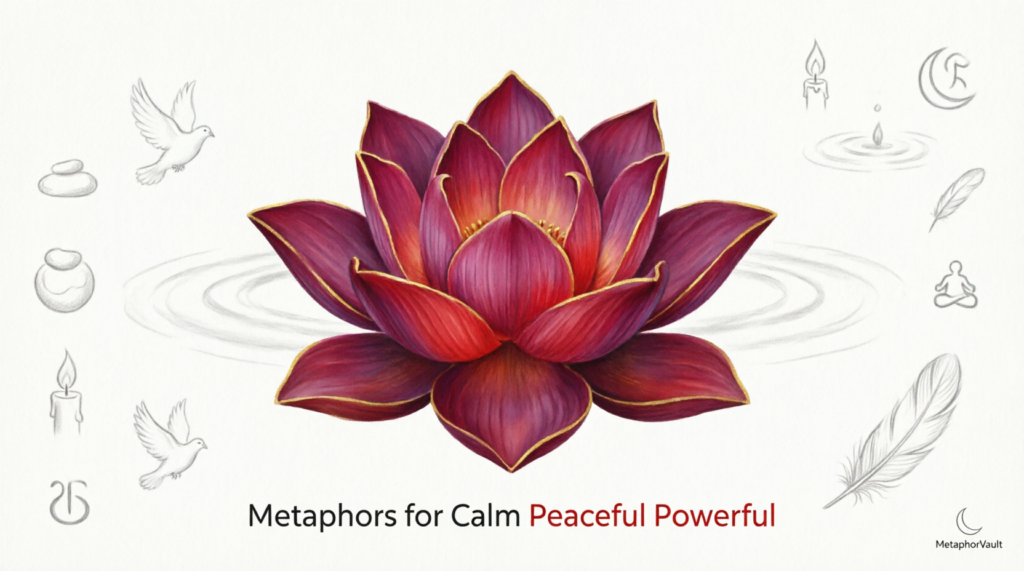
We use metaphors for calm because they make peaceful feelings easier to picture, understand, and remember. They give an abstract feeling a clear image, helping people describe relaxation, emotional control, quiet places, or peaceful moments in a more vivid and meaningful way.
1. A Quiet Lake
Meaning: A quiet lake represents a peaceful and undisturbed mind.
Real explanation: Still water creates an image of thoughts that have stopped racing. It works especially well when describing emotional peace.
Sample sentence:
“After the long walk, her mind became a quiet lake.”
When to use it: Use it for inner peace, reflection, meditation, or emotional rest.
When NOT to use it: Avoid it when describing intense excitement or active energy.
Alternatives: Still water, peaceful pond, quiet mind.
Difficulty level: Easy
Tone: Neutral
2. A Gentle Breeze
Meaning: A gentle breeze represents soft, relaxing calm.
Real explanation: A light breeze feels natural and soothing without being completely still.
Sample sentence:
“His words moved through the room like a gentle breeze.”
When to use it: Use it for soothing speech, people, places, or moments.
When NOT to use it: Avoid it when you need to describe complete silence.
Alternatives: Soft wind, cool breeze, gentle air.
Difficulty level: Easy
Tone: Neutral
3. A Safe Harbor
Meaning: A safe harbor represents a place or person that provides peace and security.
Real explanation: Ships enter harbors to escape rough water. The metaphor suggests emotional safety after a difficult time.
Sample sentence:
“Her friendship was a safe harbor during a difficult year.”
When to use it: Use it for supportive people, relationships, homes, and emotional comfort.
When NOT to use it: Avoid it for temporary excitement or unstable situations.
Alternatives: Safe haven, shelter, peaceful refuge.
Difficulty level: Easy
Tone: Warm
4. A Still Pond
Meaning: A still pond represents deep and quiet peace.
Real explanation: The image of water without ripples suggests a mind without disturbance.
Sample sentence:
“His thoughts rested like a still pond.”
When to use it: Use it in poetry, reflection, meditation, and emotional descriptions.
When NOT to use it: Avoid it when describing a lively or energetic mood.
Alternatives: Still lake, quiet water, peaceful pool.
Difficulty level: Easy
Tone: Neutral
5. A Soft Blanket
Meaning: A soft blanket represents comfort, warmth, and relaxation.
Real explanation: A blanket makes people think of safety and rest.
Sample sentence:
“Grandmother’s voice was a soft blanket around my tired heart.”
When to use it: Use it for comforting people, memories, music, or words.
When NOT to use it: Avoid it when you need a formal or businesslike metaphor.
Alternatives: Warm embrace, gentle shelter, comforting cloak.
Difficulty level: Easy
Tone: Warm
6. A Peaceful Garden
Meaning: A peaceful garden represents a quiet place where the mind can rest.
Real explanation: Gardens often suggest beauty, nature, silence, and slow growth.
Sample sentence:
“Her bedroom became a peaceful garden after she removed all the noise.”
When to use it: Use it for peaceful spaces or a person’s inner world.
When NOT to use it: Avoid it for sudden moments of danger or conflict.
Alternatives: Quiet sanctuary, calm oasis, green refuge.
Difficulty level: Easy
Tone: Peaceful
7. A Calm Sea
Meaning: A calm sea represents emotional balance and peace.
Real explanation: The sea can be rough or gentle. When it is calm, it creates a powerful image of stability.
Sample sentence:
“After the argument, his heart slowly became a calm sea.”
When to use it: Use it for emotional recovery and peaceful states.
When NOT to use it: Avoid it if the situation is still chaotic.
Alternatives: Peaceful ocean, quiet water, still sea.
Difficulty level: Easy
Tone: Neutral
8. A Silent Forest
Meaning: A silent forest represents deep, natural quiet.
Real explanation: A forest can feel removed from the noise of daily life.
Sample sentence:
“Her mind felt like a silent forest at sunrise.”
When to use it: Use it for deep solitude and reflection.
When NOT to use it: Avoid it when describing a busy social setting.
Alternatives: Quiet woods, sleeping forest, peaceful wilderness.
Difficulty level: Medium
Tone: Poetic
9. A Warm Candle
Meaning: A warm candle represents gentle comfort and peaceful light.
Real explanation: Candlelight is soft and quiet, making it useful for emotional descriptions.
Sample sentence:
“His kindness was a warm candle on a difficult night.”
When to use it: Use it for kindness, hope, comfort, and emotional support.
When NOT to use it: Avoid it when describing loud or powerful energy.
Alternatives: Gentle light, soft flame, quiet glow.
Difficulty level: Easy
Tone: Warm
10. A Quiet Morning
Meaning: A quiet morning represents a fresh, peaceful beginning.
Real explanation: Early mornings often suggest slow movement, fresh air, and fewer distractions.
Sample sentence:
“Her mind was a quiet morning after weeks of stress.”
When to use it: Use it for new beginnings and emotional relief.
When NOT to use it: Avoid it when describing pressure or chaos.
Alternatives: Fresh dawn, peaceful sunrise, silent beginning.
Difficulty level: Easy
Tone: Peaceful
11. A Deep Breath
Meaning: A deep breath represents relief and emotional release.
Real explanation: Taking a deep breath is closely connected with slowing down and settling yourself.
Sample sentence:
“The weekend was a deep breath after a hard month.”
When to use it: Use it for relief, rest, and recovery.
When NOT to use it: Avoid it when describing a long-lasting peaceful environment.
Alternatives: Breath of fresh air, moment of relief, exhale.
Difficulty level: Easy
Tone: Neutral
12. A Sleeping Cloud
Meaning: A sleeping cloud represents soft, gentle stillness.
Real explanation: The image combines clouds with sleep to create a dreamy feeling.
Sample sentence:
“Her thoughts floated like a sleeping cloud.”
When to use it: Use it in poetry and creative writing.
When NOT to use it: Avoid it in highly formal writing.
Alternatives: Dreamy cloud, soft cloud, drifting cloud.
Difficulty level: Medium
Tone: Poetic
13. A Steady Anchor
Meaning: A steady anchor represents emotional stability.
Real explanation: An anchor keeps a ship from drifting away. It therefore represents control and steadiness.
Sample sentence:
“Her calm voice was a steady anchor during the crisis.”
When to use it: Use it for dependable people and strong leadership.
When NOT to use it: Avoid it when you want to describe gentle softness rather than stability.
Alternatives: Rock, foundation, steady hand.
Difficulty level: Easy
Tone: Strong
14. A Quiet River
Meaning: A quiet river represents peaceful movement.
Real explanation: Unlike a still lake, a river suggests that life continues while remaining gentle.
Sample sentence:
“His thoughts flowed like a quiet river.”
When to use it: Use it for peaceful progress and emotional balance.
When NOT to use it: Avoid it when describing complete stillness.
Alternatives: Gentle stream, slow river, peaceful current.
Difficulty level: Easy
Tone: Neutral
15. A Calm Harbor
Meaning: A calm harbor represents emotional safety after difficulty.
Real explanation: It combines the peacefulness of calm water with the security of a harbor.
Sample sentence:
“Home became a calm harbor after a stressful day.”
When to use it: Use it for homes, relationships, and safe places.
When NOT to use it: Avoid it for dangerous or unstable settings.
Alternatives: Safe harbor, peaceful haven, quiet refuge.
Difficulty level: Easy
Tone: Warm
16. A Feather Falling
Meaning: A falling feather represents softness and gentle movement.
Real explanation: A feather moves slowly and quietly through the air.
Sample sentence:
“Her worries fell away like a feather.”
When to use it: Use it for peaceful release and light emotions.
When NOT to use it: Avoid it when you need to show strength or firmness.
Alternatives: Soft landing, drifting leaf, gentle fall.
Difficulty level: Medium
Tone: Poetic
17. A Sleeping Cat
Meaning: A sleeping cat represents complete relaxation.
Real explanation: A sleeping cat creates an everyday image of comfort and ease.
Sample sentence:
“On Sunday afternoon, he was as peaceful as a sleeping cat.”
When to use it: Use it for casual writing and humor.
When NOT to use it: Avoid it in formal business communication.
Alternatives: Resting animal, sleeping kitten, relaxed creature.
Difficulty level: Easy
Tone: Informal
18. A Quiet Room
Meaning: A quiet room represents a mind free from distraction.
Real explanation: The image connects physical silence with mental peace.
Sample sentence:
“After the meeting, her mind felt like a quiet room.”
When to use it: Use it for reflection and emotional rest.
When NOT to use it: Avoid it when describing excitement.
Alternatives: Silent space, peaceful room, empty room.
Difficulty level: Easy
Tone: Neutral
19. A Soft Sunset
Meaning: A soft sunset represents peaceful closure.
Real explanation: Sunset often marks the end of a busy day and creates a slow, gentle mood.
Sample sentence:
“The evening settled over the town like a soft sunset.”
When to use it: Use it for endings, rest, and peaceful moments.
When NOT to use it: Avoid it for energetic beginnings.
Alternatives: Gentle dusk, quiet twilight, peaceful evening.
Difficulty level: Easy
Tone: Poetic
20. A Resting Bird
Meaning: A resting bird represents freedom from pressure.
Real explanation: A bird that has stopped flying creates an image of taking a break.
Sample sentence:
“After finishing the project, she felt like a resting bird.”
When to use it: Use it for relief and recovery.
When NOT to use it: Avoid it when describing active ambition.
Alternatives: Resting wing, quiet bird, settled sparrow.
Difficulty level: Medium
Tone: Poetic
21. A Gentle Rain
Meaning: Gentle rain represents soothing and quiet comfort.
Real explanation: Light rain can create a peaceful background sound and a slower mood.
Sample sentence:
“Music fell over the room like gentle rain.”
When to use it: Use it for soothing sounds, writing, and peaceful environments.
When NOT to use it: Avoid it if the rain is meant to symbolize danger or sadness.
Alternatives: Soft rain, light drizzle, quiet shower.
Difficulty level: Easy
Tone: Peaceful
22. A Calm Flame
Meaning: A calm flame represents controlled energy.
Real explanation: A flame can be strong without being wild, making it useful for emotional control.
Sample sentence:
“Her courage burned like a calm flame.”
When to use it: Use it when calmness and strength exist together.
When NOT to use it: Avoid it if you need an image of complete stillness.
Alternatives: Steady flame, quiet fire, gentle fire.
Difficulty level: Medium
Tone: Strong
23. A Quiet Shore
Meaning: A quiet shore represents a peaceful place of rest.
Real explanation: The shore is where moving water meets land, creating a natural image of pause.
Sample sentence:
“His heart found a quiet shore.”
When to use it: Use it for emotional recovery and peaceful destinations.
When NOT to use it: Avoid it for fast-moving situations.
Alternatives: Peaceful coast, calm beach, silent shoreline.
Difficulty level: Easy
Tone: Poetic
24. A Gentle Stream
Meaning: A gentle stream represents peaceful movement.
Real explanation: A stream flows without the force associated with a storm or waterfall.
Sample sentence:
“Conversation between them became a gentle stream.”
When to use it: Use it for easy conversations and smooth progress.
When NOT to use it: Avoid it for conflict or sudden change.
Alternatives: Quiet river, soft current, peaceful flow.
Difficulty level: Easy
Tone: Neutral
25. A Safe Nest
Meaning: A safe nest represents comfort, protection, and peace.
Real explanation: A nest is associated with shelter and security.
Sample sentence:
“Her home was a safe nest after a difficult day.”
When to use it: Use it for homes, families, and close relationships.
When NOT to use it: Avoid it in formal technical writing.
Alternatives: Safe haven, shelter, warm home.
Difficulty level: Easy
Tone: Warm
26. A Sleeping Garden
Meaning: A sleeping garden represents deep quiet.
Real explanation: A garden that appears still creates a peaceful picture of nature at rest.
Sample sentence:
“At midnight, the yard was a sleeping garden.”
When to use it: Use it in descriptive and creative writing.
When NOT to use it: Avoid it when the setting is crowded or loud.
Alternatives: Resting garden, silent garden, quiet grove.
Difficulty level: Medium
Tone: Poetic
27. A Gentle Hand
Meaning: A gentle hand represents a soothing influence.
Real explanation: The metaphor suggests someone or something that reduces stress without force.
Sample sentence:
“Her advice was a gentle hand on my worried heart.”
When to use it: Use it for comfort and emotional support.
When NOT to use it: Avoid it when describing aggressive action.
Alternatives: Soft touch, helping hand, comforting presence.
Difficulty level: Easy
Tone: Warm
28. A Soft Pillow
Meaning: A soft pillow represents comfort and rest.
Real explanation: A pillow is connected with sleep and relaxation.
Sample sentence:
“His music was a soft pillow for my tired thoughts.”
When to use it: Use it for music, words, memories, or places that comfort you.
When NOT to use it: Avoid it in serious professional reports.
Alternatives: Cushion, soft bed, place of rest.
Difficulty level: Easy
Tone: Informal
29. A Quiet Corner
Meaning: A quiet corner represents a private place to relax.
Real explanation: A corner gives the feeling of stepping away from noise.
Sample sentence:
“She found a quiet corner inside her busy mind.”
When to use it: Use it for solitude and personal reflection.
When NOT to use it: Avoid it if the person wants social energy.
Alternatives: Peaceful space, private refuge, silent spot.
Difficulty level: Easy
Tone: Neutral
30. A Sleeping Ocean
Meaning: A sleeping ocean represents deep and powerful calm.
Real explanation: The ocean is huge and powerful, so calling it “sleeping” creates a strong contrast.
Sample sentence:
“By dawn, the storm had become a sleeping ocean.”
When to use it: Use it after describing conflict or a storm.
When NOT to use it: Avoid it if you need a simple everyday expression.
Alternatives: Resting sea, quiet ocean, peaceful waters.
Difficulty level: Medium
Tone: Poetic
31. A Calm Compass
Meaning: A calm compass represents clear direction during uncertainty.
Real explanation: A compass gives direction, while “calm” suggests thoughtful decision-making.
Sample sentence:
“Her patience became a calm compass during the crisis.”
When to use it: Use it for leadership and decision-making.
When NOT to use it: Avoid it for simple descriptions of physical quiet.
Alternatives: Steady guide, clear direction, inner compass.
Difficulty level: Medium
Tone: Professional
32. A Quiet Anchor
Meaning: A quiet anchor represents silent emotional stability.
Real explanation: Some people provide support without saying much.
Sample sentence:
“His presence was a quiet anchor in her life.”
When to use it: Use it for dependable friends, family members, or leaders.
When NOT to use it: Avoid it if the person is unreliable.
Alternatives: Silent support, steady presence, firm foundation.
Difficulty level: Medium
Tone: Warm
33. A Peaceful Island
Meaning: A peaceful island represents a place away from stress.
Real explanation: An island can symbolize separation from noise and pressure.
Sample sentence:
“Her reading chair was a peaceful island in the busy house.”
When to use it: Use it for personal spaces and emotional escape.
When NOT to use it: Avoid it when isolation has a negative meaning.
Alternatives: Private haven, quiet island, safe refuge.
Difficulty level: Easy
Tone: Neutral
34. A Slow Sunrise
Meaning: A slow sunrise represents gentle beginnings.
Real explanation: Sunrise happens gradually, making it a useful image for peaceful change.
Sample sentence:
“Hope returned like a slow sunrise.”
When to use it: Use it for recovery, hope, and fresh starts.
When NOT to use it: Avoid it for sudden change.
Alternatives: Gentle dawn, quiet sunrise, new light.
Difficulty level: Easy
Tone: Hopeful
35. A Clear Sky
Meaning: A clear sky represents freedom from worry.
Real explanation: Clouds often symbolize problems or sadness, so a clear sky suggests relief.
Sample sentence:
“After the decision, his mind was a clear sky.”
When to use it: Use it for mental clarity and relief.
When NOT to use it: Avoid it when uncertainty remains.
Alternatives: Open sky, bright horizon, cloudless mind.
Difficulty level: Easy
Tone: Neutral
36. A Quiet Bell
Meaning: A quiet bell represents a gentle reminder to slow down.
Real explanation: The metaphor combines sound with unusual quietness.
Sample sentence:
“Her words were a quiet bell reminding me to breathe.”
When to use it: Use it in reflective writing.
When NOT to use it: Avoid it when the metaphor needs immediate clarity.
Alternatives: Gentle reminder, soft signal, peaceful call.
Difficulty level: Medium
Tone: Poetic
37. A Floating Leaf
Meaning: A floating leaf represents effortless, peaceful movement.
Real explanation: A leaf carried by water or air does not appear to struggle.
Sample sentence:
“She moved through the afternoon like a floating leaf.”
When to use it: Use it for relaxed behavior.
When NOT to use it: Avoid it if you want to suggest strong control or determination.
Alternatives: Drifting leaf, falling leaf, floating feather.
Difficulty level: Easy
Tone: Poetic
38. A Resting Mountain
Meaning: A resting mountain represents quiet strength.
Real explanation: Mountains are powerful and solid, yet they appear still.
Sample sentence:
“He stood like a resting mountain while everyone else panicked.”
When to use it: Use it for people who remain calm under pressure.
When NOT to use it: Avoid it when describing softness.
Alternatives: Silent mountain, steady rock, solid wall.
Difficulty level: Easy
Tone: Strong
39. A Quiet Moon
Meaning: A quiet moon represents peaceful solitude.
Real explanation: The moon often creates a slow, reflective nighttime mood.
Sample sentence:
“Her thoughts were a quiet moon above the noise.”
When to use it: Use it in poetry and emotional writing.
When NOT to use it: Avoid it in highly practical communication.
Alternatives: Silent moon, peaceful moonlight, night glow.
Difficulty level: Medium
Tone: Poetic
40. A Soft Horizon
Meaning: A soft horizon represents a peaceful future.
Real explanation: The horizon creates an image of distance, possibility, and calm.
Sample sentence:
“After leaving the stressful job, she saw a soft horizon ahead.”
When to use it: Use it for hope and new beginnings.
When NOT to use it: Avoid it for immediate situations.
Alternatives: Peaceful future, open horizon, gentle outlook.
Difficulty level: Medium
Tone: Hopeful
41. A Silent Snowfall
Meaning: Silent snowfall represents gentle, deep quiet.
Real explanation: Snow often reduces sound and creates a peaceful landscape.
Sample sentence:
“The town rested beneath a silent snowfall.”
When to use it: Use it for peaceful scenes and winter descriptions.
When NOT to use it: Avoid it when describing warm, energetic settings.
Alternatives: Falling snow, quiet winter, soft snow.
Difficulty level: Easy
Tone: Poetic
42. A Sleeping Village
Meaning: A sleeping village represents complete nighttime peace.
Real explanation: A village that has gone quiet creates an image of people resting together.
Sample sentence:
“The valley became a sleeping village after sunset.”
When to use it: Use it for nighttime descriptions.
When NOT to use it: Avoid it when describing busy daytime activity.
Alternatives: Resting town, quiet village, sleeping town.
Difficulty level: Easy
Tone: Neutral
43. A Gentle Tide
Meaning: A gentle tide represents emotions that move naturally without becoming overwhelming.
Real explanation: Tides move in and out slowly, making them a good image for balanced feelings.
Sample sentence:
“Peace returned in a gentle tide.”
When to use it: Use it for gradual emotional change.
When NOT to use it: Avoid it for instant relief.
Alternatives: Soft current, slow wave, peaceful flow.
Difficulty level: Medium
Tone: Poetic
44. A Quiet Garden Path
Meaning: A quiet garden path represents a peaceful journey.
Real explanation: A path suggests movement, while the garden adds calmness.
Sample sentence:
“Recovery became a quiet garden path rather than a race.”
When to use it: Use it for personal growth and healing.
When NOT to use it: Avoid it when the situation requires speed.
Alternatives: Peaceful road, gentle path, quiet journey.
Difficulty level: Medium
Tone: Reflective
45. A Glassy Lake
Meaning: A glassy lake represents complete stillness.
Real explanation: Water that looks like glass has almost no visible movement.
Sample sentence:
“Her thoughts were a glassy lake after meditation.”
When to use it: Use it for deep mental stillness.
When NOT to use it: Avoid it when the person is still anxious.
Alternatives: Mirror-like water, still lake, smooth water.
Difficulty level: Easy
Tone: Poetic
46. A Quiet Flame in the Dark
Meaning: This metaphor represents calm hope during difficult times.
Real explanation: The flame is small but steady, suggesting peace that survives trouble.
Sample sentence:
“His kindness was a quiet flame in the dark.”
When to use it: Use it for hope, support, and emotional strength.
When NOT to use it: Avoid it for ordinary relaxation.
Alternatives: Small light, steady hope, gentle glow.
Difficulty level: Medium
Tone: Emotional
47. A Sleeping Storm
Meaning: A sleeping storm represents powerful emotions that have become controlled.
Real explanation: The storm remains powerful, but it is no longer active.
Sample sentence:
“His anger was a sleeping storm.”
When to use it: Use it when calmness hides strong feelings.
When NOT to use it: Avoid it when the person is completely free of anger.
Alternatives: Resting storm, quiet thunder, settled anger.
Difficulty level: Medium
Tone: Strong
48. A Closed Door to Noise
Meaning: This metaphor represents protecting yourself from distractions.
Real explanation: A closed door separates a peaceful space from outside noise.
Sample sentence:
“Her morning routine was a closed door to noise.”
When to use it: Use it for boundaries, focus, and quiet time.
When NOT to use it: Avoid it when connection with others is the main goal.
Alternatives: Shield from noise, quiet boundary, peaceful barrier.
Difficulty level: Medium
Tone: Neutral
49. A Cushion Against Chaos
Meaning: This metaphor represents something that protects a person from stress.
Real explanation: A cushion softens impact, making it a useful image for emotional support.
Sample sentence:
“Her family was a cushion against chaos.”
When to use it: Use it for support systems and comforting relationships.
When NOT to use it: Avoid it if the support is weak or unreliable.
Alternatives: Buffer, shield, emotional support.
Difficulty level: Medium
Tone: Informal
50. A Peaceful Breath of Air
Meaning: This metaphor represents relief and renewed energy.
Real explanation: Fresh air can feel refreshing after being in a stressful environment.
Sample sentence:
“The weekend was a peaceful breath of air.”
When to use it: Use it for vacations, breaks, and refreshing experiences.
When NOT to use it: Avoid it when describing long-term stability.
Alternatives: Breath of fresh air, refreshing break, welcome relief.
Difficulty level: Easy
Tone: Neutral
51. A Quiet Shelter
Meaning: A quiet shelter represents emotional protection and peace.
Real explanation: Shelter protects people from difficult outside conditions.
Sample sentence:
“Books became a quiet shelter from her worries.”
When to use it: Use it for hobbies, places, people, and activities that reduce stress.
When NOT to use it: Avoid it when the experience is not actually comforting.
Alternatives: Safe haven, refuge, sanctuary.
Difficulty level: Easy
Tone: Warm
52. A Smooth Road
Meaning: A smooth road represents an easy and peaceful period.
Real explanation: Roads can be rough or smooth. A smooth road suggests fewer obstacles.
Sample sentence:
“After months of struggle, life finally felt like a smooth road.”
When to use it: Use it for progress and easier periods.
When NOT to use it: Avoid it when challenges are still severe.
Alternatives: Easy path, clear road, peaceful journey.
Difficulty level: Easy
Tone: Neutral
53. A Gentle Meadow
Meaning: A gentle meadow represents natural peace and openness.
Real explanation: A meadow creates an image of open space, grass, sunlight, and quiet.
Sample sentence:
“Her mind felt like a gentle meadow.”
When to use it: Use it for peaceful inner states and nature writing.
When NOT to use it: Avoid it in formal technical writing.
Alternatives: Quiet field, peaceful meadow, green refuge.
Difficulty level: Medium
Tone: Poetic
54. A Resting Wave
Meaning: A resting wave represents a powerful emotion that has settled.
Real explanation: A wave is normally active, so a resting wave suggests the end of emotional movement.
Sample sentence:
“Her sadness became a resting wave.”
When to use it: Use it for emotional recovery.
When NOT to use it: Avoid it if emotions are still intense.
Alternatives: Settled wave, quiet water, resting tide.
Difficulty level: Medium
Tone: Poetic
55. A Still Candle Flame
Meaning: A still candle flame represents quiet concentration and peace.
Real explanation: A steady flame creates an image of controlled energy.
Sample sentence:
“His attention was a still candle flame.”
When to use it: Use it for focus and peaceful concentration.
When NOT to use it: Avoid it when describing distraction.
Alternatives: Steady flame, quiet light, fixed glow.
Difficulty level: Medium
Tone: Neutral
56. A Gentle Shadow
Meaning: A gentle shadow represents quiet protection and comfort.
Real explanation: A shadow can provide relief from bright sunlight, creating a softer image.
Sample sentence:
“Her presence was a gentle shadow on a hot afternoon.”
When to use it: Use it for subtle comfort.
When NOT to use it: Avoid it if darkness has a negative meaning in your context.
Alternatives: Soft shade, quiet cover, cool shelter.
Difficulty level: Medium
Tone: Poetic
57. A Quiet Clock
Meaning: A quiet clock represents a slow sense of time.
Real explanation: The clock continues working while the world around it feels still.
Sample sentence:
“Sunday morning felt like a quiet clock.”
When to use it: Use it for slow mornings and peaceful routines.
When NOT to use it: Avoid it for fast-paced situations.
Alternatives: Slow time, peaceful hour, gentle rhythm.
Difficulty level: Medium
Tone: Creative
58. A Soft Landing
Meaning: A soft landing represents relief after stress or difficulty.
Real explanation: A soft landing means arriving safely instead of experiencing a hard impact.
Sample sentence:
“Her family gave her a soft landing after a difficult week.”
When to use it: Use it for emotional support and recovery.
When NOT to use it: Avoid it when the person is still in the middle of a crisis.
Alternatives: Safe landing, gentle recovery, peaceful arrival.
Difficulty level: Easy
Tone: Warm
59. A Quiet Room Inside
Meaning: This metaphor represents an inner place of peace.
Real explanation: It suggests that a person can create mental space even when the outside world is noisy.
Sample sentence:
“She carried a quiet room inside her.”
When to use it: Use it for mindfulness, emotional strength, and self-control.
When NOT to use it: Avoid it if you mean physical silence.
Alternatives: Inner sanctuary, peaceful mind, private calm.
Difficulty level: Medium
Tone: Reflective
60. A Calm Center
Meaning: A calm center represents stability in the middle of difficulty.
Real explanation: Imagine a spinning storm with a quiet center. The metaphor suggests remaining peaceful while problems happen around you.
Sample sentence:
“She found a calm center in the middle of the crisis.”
When to use it: Use it for leadership, emotional control, and stressful situations.
When NOT to use it: Avoid it when there is no surrounding pressure.
Alternatives: Center of peace, steady core, inner balance.
Difficulty level: Easy
Tone: Professional
61. An Oasis of Peace
Meaning: An oasis of peace represents a small place of comfort surrounded by stress.
Real explanation: An oasis provides relief in a harsh environment, making it a strong metaphor for emotional rest.
Sample sentence:
“The library was an oasis of peace in the noisy school.”
When to use it: Use it for peaceful places surrounded by activity.
When NOT to use it: Avoid it if the entire environment is already peaceful.
Alternatives: Peaceful refuge, calm haven, quiet sanctuary.
Difficulty level: Easy
Tone: Warm
62. A Slow River of Thought
Meaning: This metaphor represents thoughts that move peacefully and without pressure.
Real explanation: The river continues moving, but its slow pace suggests a relaxed mind.
Sample sentence:
“After meditation, her thoughts became a slow river.”
When to use it: Use it for reflection and mindfulness.
When NOT to use it: Avoid it when thoughts are racing.
Alternatives: Gentle stream of thought, peaceful flow, quiet current.
Difficulty level: Medium
Tone: Reflective
63. A Pillow for the Mind
Meaning: A pillow for the mind represents something that gives emotional rest.
Real explanation: Just as a pillow supports the head, comforting activities can support a tired mind.
Sample sentence:
“Reading before bed became a pillow for my mind.”
When to use it: Use it for books, music, hobbies, people, or routines.
When NOT to use it: Avoid it in highly formal writing.
Alternatives: Mental rest, comfort zone, peaceful retreat.
Difficulty level: Easy
Tone: Warm
64. A Harbor After the Storm
Meaning: This metaphor represents peace after hardship.
Real explanation: A ship reaching a harbor after a storm suggests safety, relief, and recovery.
Sample sentence:
“Her new home felt like a harbor after the storm.”
When to use it: Use it after conflict, stress, grief, or major change.
When NOT to use it: Avoid it when the difficult period has not ended.
Alternatives: Safe haven, peaceful arrival, refuge after hardship.
Difficulty level: Easy
Tone: Emotional
65. The Silence After Rain
Meaning: This metaphor represents the peaceful feeling that follows trouble.
Real explanation: Rain can be noisy and heavy. The quiet that follows creates a strong image of relief.
Sample sentence:
“His mind was the silence after rain.”
When to use it: Use it for emotional recovery and peaceful endings.
When NOT to use it: Avoid it if you need to describe calm before a problem.
Alternatives: Peace after trouble, quiet after the storm, calm after rain.
Difficulty level: Easy
Tone: Poetic
Quick Reference Table
The table below gives a fast way to choose the right metaphor based on the kind of calm you want to express.
| # | Metaphor | Main Meaning | Best For | Tone |
|---|---|---|---|---|
| 1 | A quiet lake | Peaceful mind | Reflection | Neutral |
| 2 | A gentle breeze | Soft calm | Speech, people | Neutral |
| 3 | A safe harbor | Safety | Relationships | Warm |
| 4 | A still pond | Deep peace | Poetry | Neutral |
| 5 | A soft blanket | Comfort | Feelings | Warm |
| 6 | A peaceful garden | Quiet environment | Description | Peaceful |
| 7 | A calm sea | Emotional balance | Writing | Neutral |
| 8 | A silent forest | Deep quiet | Nature writing | Poetic |
| 9 | A warm candle | Comfort and hope | Personal writing | Warm |
| 10 | A quiet morning | Fresh peace | New beginnings | Peaceful |
| 11 | A deep breath | Relief | Recovery | Neutral |
| 12 | A sleeping cloud | Dreamy calm | Poetry | Poetic |
| 13 | A steady anchor | Stability | Leadership | Strong |
| 14 | A quiet river | Peaceful movement | Reflection | Neutral |
| 15 | A calm harbor | Emotional safety | Home | Warm |
| 16 | A feather falling | Gentle release | Poetry | Poetic |
| 17 | A sleeping cat | Relaxation | Casual writing | Informal |
| 18 | A quiet room | Mental peace | Reflection | Neutral |
| 19 | A soft sunset | Peaceful ending | Stories | Poetic |
| 20 | A resting bird | Freedom from pressure | Recovery | Poetic |
| 21 | Gentle rain | Soothing calm | Description | Peaceful |
| 22 | A calm flame | Controlled strength | Character writing | Strong |
| 23 | A quiet shore | Rest | Emotional writing | Poetic |
| 24 | A gentle stream | Smooth progress | Conversation | Neutral |
| 25 | A safe nest | Protection | Family | Warm |
| 26 | A sleeping garden | Deep quiet | Poetry | Poetic |
| 27 | A gentle hand | Comfort | Relationships | Warm |
| 28 | A soft pillow | Rest | Casual writing | Informal |
| 29 | A quiet corner | Solitude | Personal writing | Neutral |
| 30 | A sleeping ocean | Deep calm | Poetry | Poetic |
| 31 | A calm compass | Clear direction | Leadership | Professional |
| 32 | A quiet anchor | Silent support | Relationships | Warm |
| 33 | A peaceful island | Escape from stress | Personal space | Neutral |
| 34 | A slow sunrise | Gentle beginning | Hope | Hopeful |
| 35 | A clear sky | Mental clarity | Relief | Neutral |
| 36 | A quiet bell | Gentle reminder | Reflection | Poetic |
| 37 | A floating leaf | Effortless movement | Creative writing | Poetic |
| 38 | A resting mountain | Quiet strength | Character | Strong |
| 39 | A quiet moon | Solitude | Poetry | Poetic |
| 40 | A soft horizon | Peaceful future | Hope | Hopeful |
| 41 | Silent snowfall | Deep quiet | Nature | Poetic |
| 42 | A sleeping village | Nighttime peace | Stories | Neutral |
| 43 | A gentle tide | Gradual peace | Emotions | Poetic |
| 44 | A quiet garden path | Peaceful journey | Growth | Reflective |
| 45 | A glassy lake | Complete stillness | Meditation | Poetic |
| 46 | A quiet flame in the dark | Hope | Difficult times | Emotional |
| 47 | A sleeping storm | Controlled emotion | Character | Strong |
| 48 | A closed door to noise | Protection from distractions | Boundaries | Neutral |
| 49 | A cushion against chaos | Emotional support | Relationships | Informal |
| 50 | A peaceful breath of air | Relief | Breaks | Neutral |
| 51 | A quiet shelter | Protection | Hobbies | Warm |
| 52 | A smooth road | Easy period | Life progress | Neutral |
| 53 | A gentle meadow | Natural peace | Poetry | Poetic |
| 54 | A resting wave | Settled emotion | Recovery | Poetic |
| 55 | A still candle flame | Focus | Concentration | Neutral |
| 56 | A gentle shadow | Subtle comfort | Relationships | Poetic |
| 57 | A quiet clock | Slow time | Relaxed moments | Creative |
| 58 | A soft landing | Safe recovery | Emotional support | Warm |
| 59 | A quiet room inside | Inner peace | Mindfulness | Reflective |
| 60 | A calm center | Stability | Stressful situations | Professional |
| 61 | An oasis of peace | Refuge | Busy environments | Warm |
| 62 | A slow river of thought | Peaceful thinking | Reflection | Reflective |
| 63 | A pillow for the mind | Mental rest | Books, music | Warm |
| 64 | A harbor after the storm | Peace after hardship | Recovery | Emotional |
| 65 | The silence after rain | Relief after trouble | Endings | Poetic |
Real-Life Conversations
Metaphors for calm sound most natural when they match the situation. Friends may use simple expressions such as “a breath of fresh air,” while writers may choose images such as “a sleeping ocean.” The best metaphor should fit the relationship, setting, and emotion instead of sounding forced.
Everyday Usage
Metaphors for calm appear in everyday conversation, books, movies, poetry, emails, text messages, social media, and school writing. The strongest choice depends on the audience: simple metaphors work best in conversation, while more imaginative images usually fit poetry and creative writing.
Calm Metaphors in Conversation
In everyday speech, choose metaphors that are easy to understand.
Examples:
“That vacation was a breath of fresh air.”
“Her voice is so calming.”
“Home feels like a safe harbor.”
“My mind finally feels clear.”
These expressions sound natural because people understand the images quickly.
Calm Metaphors in Writing
Writers can use stronger images to create atmosphere.
Instead of:
The house was quiet.
Try:
The house was a sleeping garden.
Instead of:
He felt peaceful.
Try:
His mind was a glassy lake.
The metaphor gives the reader an emotional picture.
Calm Metaphors in Movies
Movies often communicate calm visually rather than through direct explanation.
A peaceful character might be shown beside:
- still water
- a quiet window
- soft morning light
- a slow-moving river
- an empty beach
- falling snow
When writing a movie review or describing a scene, metaphors can explain the mood.
For example:
“The quiet beach becomes a safe harbor for the character.”
Calm Metaphors in Poetry
Poetry gives metaphors more freedom.
A poet might write:
My mind is a sleeping sea.
Or:
Peace is a candle that refuses to shake.
Or:
I found a quiet room inside myself.
Poetry does not always need a literal explanation. The image itself can carry the emotion.
Calm Metaphors in Emails
Professional emails should use simple metaphors sparingly.
Good:
“Thank you for helping us find a calm center during a difficult project.”
Less suitable:
“Your soul was a moonlit river dancing beneath a sleeping sky.”
The second example may be beautiful, but it is too poetic for most workplace emails.
Calm Metaphors in Text Messages
Text messages usually work best with short expressions.
Examples:
“Today feels like a deep breath.”
“Finally found my quiet corner.”
“My brain is a calm lake again 😂”
“This weekend was an oasis.”
The metaphor should sound like something a real person would type.
Calm Metaphors on Instagram
Instagram captions allow more creativity.
Examples:
“A quiet lake kind of morning.”
“Finding my calm center.”
“Peace feels like sunlight after rain.”
“My soul needed this quiet shore.”
“Slow mornings. Soft skies. Quiet thoughts.”
Short metaphors work particularly well when the photograph already shows the mood.
Calm Metaphors on Facebook
Facebook posts can use conversational metaphors.
Example:
“After a long week, sitting outside with coffee felt like reaching a safe harbor.”
This feels personal without being overly poetic.
Calm Metaphors on X
Short metaphors are usually strongest because the message must communicate quickly.
Examples:
“Protect your quiet harbor.”
“Be the calm center.”
“Some days, peace is simply a deep breath.”
Calm Metaphors on LinkedIn
Professional metaphors should focus on stability, leadership, teamwork, and decision-making.
Examples:
“Strong leaders can become anchors when teams face uncertainty.”
“Clear communication can be a calm center during change.”
“Good planning gives a team a smoother road.”
These metaphors support a professional message without making the writing sound overly dramatic.
Calm Metaphors in School Assignments
Students can use metaphors to improve descriptive writing.
Basic:
The lake was calm.
Better:
The lake was a sheet of glass.
Basic:
She felt peaceful.
Better:
Her mind was a quiet garden.
Basic:
The village was quiet at night.
Better:
The village became a sleeping world.
A good school metaphor should be clear enough that the reader understands the comparison.
The Difference Between Calm, Quiet, Peaceful, and Relaxed
These words are related, but they are not exactly the same.
Calm usually means free from strong excitement, fear, anger, or stress.
Quiet usually focuses on a lack of sound or activity.
Peaceful suggests a pleasant absence of conflict or disturbance.
Relaxed often describes a person who is physically or mentally free from tension.
For example:
“The room was quiet.”
This focuses on sound.
“Her mind was calm.”
This focuses on emotion and thought.
“The garden was peaceful.”
This focuses on the overall atmosphere.
“He looked relaxed.”
This focuses on a person’s state.
A strong metaphor should match the exact meaning you want.
How to Make a Calm Metaphor Sound Natural
The best metaphors do not feel like they were added just to make a sentence fancy.
Instead of forcing a complicated image, choose something familiar.
Weak:
“Her emotional equilibrium resembled a multidimensional atmospheric phenomenon.”
Natural:
“Her mind was a quiet lake.”
Simple images are often stronger because readers understand them immediately.
Conclusion
Metaphors for calm and peace help describe quiet feelings in a vivid and memorable way. Images such as a still lake, gentle breeze, quiet harbor, or soft morning light can express peace, comfort, balance, and inner calm. The best metaphor is simple, natural, and matched to the feeling you want to share.
descover more post
60+ Inspiring Metaphors Powerful Examples Meanings How to …
60+Poker Metaphors Powerful Examples Meanings and …
60+ Bridge Metaphors Powerful Examples Meanings and …

Kovien is an experienced English language researcher, editor, and digital content strategist at MetaphorVault.com. He earned a Bachelor’s degree in English Language and Literature and has spent more than 5 years creating educational resources that simplify figurative language, metaphors, idioms, and modern English usage. His expertise combines linguistic knowledge with practical SEO writing, allowing him to produce content that is both informative and engaging. Kovien enjoys transforming complex language concepts into clear, relatable explanations supported by real-world examples. His work is driven by a commitment to accuracy, originality, and continuous learning. Through MetaphorVault.com, he aims to help readers build stronger communication skills and gain greater confidence in understanding and using the English language.