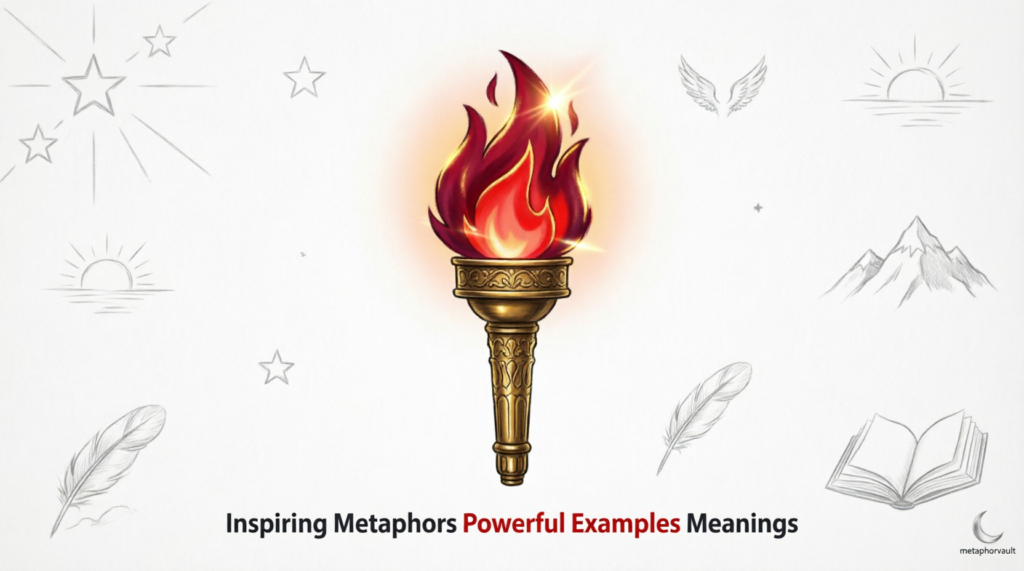
Some words do more than describe an idea—they help us feel it. That is what inspiring metaphors do. They turn hope into a light, courage into a shield, life into a journey, and a difficult moment into a storm that will eventually pass.
An inspiring metaphor compares one thing with another without using “like” or “as.” The comparison is not meant to be literal. Instead, it creates a clear picture that makes an idea easier to understand and remember.
People search for inspiring metaphors when they need the right words for a speech, essay, classroom activity, social media post, personal message, poem, or moment of encouragement. They are also useful when ordinary words feel too flat to express hope, strength, growth, success, or resilience.
You may hear them in conversations, books, movies, graduation speeches, motivational talks, songs, and social posts.
In this guide, for 2026, you will find more than 60 inspiring metaphors with simple meanings, real explanations, sample sentences, usage advice, alternative expressions, difficulty levels, and tones. You will also learn how to choose a metaphor that sounds natural instead of forced.
Definition & Meaning
An inspiring metaphor is a creative comparison that describes a positive idea, quality, person, experience, or goal in a vivid way. It connects an abstract idea—such as hope, courage, success, or personal growth—to something concrete that people can easily picture.
For example, “Hope is a light in the darkness” does not mean hope is an actual lamp. It means hope can guide and comfort someone during a difficult time.
Simple Definition
An inspiring metaphor is a comparison used to make a positive or encouraging idea stronger, clearer, and more memorable.
Quick Explanation
Instead of saying:
“She remained hopeful during a difficult time.”
You could say:
“She was a light in the darkness.”
The second sentence creates an image. Readers can picture light pushing away darkness, so the message feels more powerful.
Quick Summary Table
| Feature | Inspiring Metaphor |
|---|---|
| Purpose | Encourage, motivate, explain, or create emotion |
| Comparison | Usually indirect |
| Uses “like” or “as”? | No |
| Common themes | Hope, courage, growth, success, strength |
| Used in | Speech, writing, school, social media, poetry |
| Main benefit | Makes ideas vivid and memorable |
| Example | “Hope is a candle in the dark.” |
| Literal? | No |
| Tone | Often positive, warm, or motivational |
A metaphor becomes inspiring because of the idea behind the comparison, not simply because the sentence sounds poetic.
Why We Use Inspiring Metaphors
We use inspiring metaphors because they make abstract ideas easier to see and feel. A phrase such as “You can overcome this” is clear, but “You are climbing a mountain” gives the listener an image of effort, progress, and reaching a higher place.
Inspiring metaphors are useful in everyday conversations, writing, speeches, teaching, school assignments, professional communication, and social media.
In Everyday Life
People naturally use metaphors when talking about challenges and goals.
You might say:
“This difficult period is only one chapter of your story.”
The metaphor helps someone understand that the current situation is not the whole of their life.
In Writing
Metaphors can make an essay, article, story, or personal reflection more memorable.
Instead of:
“Education gives people opportunities.”
You could write:
“Education is a key that opens new doors.”
The second version creates a stronger mental picture.
In Speaking
Speakers often use metaphors because listeners remember images more easily than abstract explanations.
A coach might say:
“Every mistake is a stepping stone.”
The message is simple: mistakes can help you move forward.
In School
Students can use metaphors in:
- Essays
- Creative writing
- Poems
- Speeches
- Book reports
- Personal narratives
- Graduation messages
The key is to use them naturally. One strong metaphor is usually better than five unrelated ones.
On Social Media
A short metaphor can turn an ordinary caption into something memorable.
For example:
“Small steps are seeds of big change.”
It is short enough for a social post but still communicates a meaningful idea.
In Professional Communication
Metaphors can also work in presentations, leadership messages, and workplace writing.
For example:
“This project is a bridge between our current system and our future goals.”
This sounds more concrete than simply saying the project is “important.”
1. Hope Is a Light in the Darkness
Meaning: Hope gives people direction and comfort during difficult times.
Real explanation: Darkness represents confusion, fear, or hardship. Light represents hope and a possible way forward.
Sample sentence: “Even during the hardest months, hope was a light in the darkness.”
When to use it: Use it when encouraging someone who is facing a difficult situation.
When NOT to use it: Avoid it if the situation is purely factual and does not need emotional language.
Alternatives:
- Hope is a guiding star.
- Hope lights the way.
- Hope is a candle in the dark.
Difficulty: Beginner
Tone: Warm, Neutral
2. Life Is a Journey
Meaning: Life consists of different experiences, changes, choices, and destinations.
Real explanation: The journey represents the path of life. Roads, turns, stops, and destinations represent experiences and decisions.
Sample sentence: “Life is a journey, and every mistake teaches us something about the road.”
When to use it: Personal essays, speeches, conversations, and motivational writing.
When NOT to use it: Avoid repeating it when a more original comparison would add value.
Alternatives:
- Life is a winding road.
- Life is an adventure.
- We are travelers through life.
Difficulty: Beginner
Tone: Neutral
3. Challenges Are Stepping Stones
Meaning: Difficult experiences can help us move toward growth and success.
Real explanation: A stepping stone helps a person cross a difficult path. The metaphor suggests that problems can become part of our progress.
Sample sentence: “Every failure became a stepping stone toward her success.”
When to use it: Motivation, education, personal growth, and coaching.
When NOT to use it: Do not use it to dismiss serious problems or someone’s pain.
Alternatives:
- Challenges build strength.
- Failures can become lessons.
- Hard times can shape us.
Difficulty: Beginner
Tone: Neutral
4. Courage Is a Shield
Meaning: Courage can protect people from fear and help them face difficult situations.
Real explanation: A shield protects a person physically. Here, courage provides emotional protection against fear.
Sample sentence: “Her courage was a shield when everything around her seemed uncertain.”
When to use it: Speeches, stories, motivational writing.
When NOT to use it: Avoid suggesting courage makes someone completely immune to fear.
Alternatives:
- Courage is armor.
- Bravery is a strong defense.
- Courage protects the heart.
Difficulty: Intermediate
Tone: Powerful
5. Dreams Are Seeds
Meaning: Dreams need time, care, effort, and patience before they can grow.
Real explanation: A seed does not become a plant instantly. Likewise, a goal often needs consistent work.
Sample sentence: “Your dreams are seeds; your daily actions help them grow.”
When to use it: Goal setting, education, speeches, social media.
When NOT to use it: Avoid it when discussing goals that require a more precise explanation.
Alternatives:
- Dreams are beginnings.
- Goals are seeds of the future.
- Ideas can grow.
Difficulty: Beginner
Tone: Inspirational
6. Knowledge Is a Key
Meaning: Knowledge can give people access to opportunities and solutions.
Real explanation: A key opens a locked door. Knowledge can similarly open doors to understanding, education, and opportunity.
Sample sentence: “Knowledge is a key that can open doors no one can close.”
When to use it: Education, school essays, speeches.
When NOT to use it: Avoid claiming that knowledge alone guarantees success.
Alternatives:
- Knowledge opens doors.
- Learning is a passport to opportunity.
- Education unlocks potential.
Difficulty: Beginner
Tone: Neutral
7. Failure Is a Teacher
Meaning: Failure can teach valuable lessons.
Real explanation: A teacher provides knowledge. Failure can also reveal mistakes, weaknesses, and better ways to act.
Sample sentence: “Failure is a strict teacher, but its lessons can be valuable.”
When to use it: Personal growth and motivational writing.
When NOT to use it: Do not use it to blame someone for a failure.
Alternatives:
- Failure is a lesson.
- Mistakes are teachers.
- Setbacks teach us.
Difficulty: Beginner
Tone: Neutral
8. Success Is a Mountain
Meaning: Success may require effort, patience, planning, and persistence.
Real explanation: Climbing a mountain takes preparation and endurance. The metaphor compares that process with achieving a difficult goal.
Sample sentence: “Success is a mountain, and every small effort takes you higher.”
When to use it: Goal-setting speeches and motivational content.
When NOT to use it: Avoid implying that everyone’s success follows the same path.
Alternatives:
- Success is a climb.
- Achievement is a long road.
- Goals are peaks to reach.
Difficulty: Beginner
Tone: Motivational
9. Kindness Is a Seed
Meaning: A small act of kindness can grow into something much larger.
Real explanation: Seeds can grow into plants. A kind action can similarly influence other people and encourage more kindness.
Sample sentence: “A kind word is a seed that can grow into a better day.”
When to use it: School writing, social media, speeches.
When NOT to use it: Avoid it in highly technical communication.
Alternatives:
- Kindness spreads.
- Kindness creates ripples.
- Good deeds grow.
Difficulty: Beginner
Tone: Warm
10. Friendship Is an Anchor
Meaning: A good friend can provide stability during difficult times.
Real explanation: An anchor keeps a ship from drifting away. A supportive friend can give someone emotional stability.
Sample sentence: “Her friendship was an anchor during one of the hardest years of my life.”
When to use it: Personal writing, messages, speeches.
When NOT to use it: Avoid suggesting that one friend should carry all of another person’s emotional needs.
Alternatives:
- Friendship is a safe harbor.
- A friend is a steady hand.
- Friendship is a support system.
Difficulty: Intermediate
Tone: Warm
11. Your Mind Is a Garden
Meaning: Your thoughts and beliefs need care and attention.
Real explanation: A garden grows according to what is planted and how it is cared for. The metaphor encourages people to pay attention to their thoughts.
Sample sentence: “Your mind is a garden, so choose carefully what you allow to grow.”
When to use it: Personal development, education, motivational writing.
When NOT to use it: Do not use it to imply that people can simply think their way out of serious problems.
Alternatives:
- Thoughts are seeds.
- The mind is fertile ground.
- Ideas can take root.
Difficulty: Beginner
Tone: Reflective
12. Time Is a River
Meaning: Time keeps moving forward and cannot easily be stopped.
Real explanation: A river flows continuously. The comparison highlights the movement of time.
Sample sentence: “Time is a river; we cannot step into the same moment twice.”
When to use it: Poetry, reflection, essays.
When NOT to use it: Avoid it when the subject requires precise literal language.
Alternatives:
- Time keeps flowing.
- Time is always moving.
- The years flow by.
Difficulty: Intermediate
Tone: Reflective
13. Resilience Is a Rubber Band
Meaning: Resilient people can bend under pressure and recover.
Real explanation: A rubber band stretches but can return toward its original shape. The metaphor focuses on flexibility and recovery.
Sample sentence: “Her resilience was like a rubber band that refused to stay broken.”
When to use it: Personal growth and motivational writing.
When NOT to use it: Avoid it for situations where the comparison could make serious suffering sound trivial.
Alternatives:
- Resilience is a spring.
- Strength bends but does not break.
- Resilience is flexible strength.
Difficulty: Intermediate
Tone: Encouraging
14. Patience Is a Bridge
Meaning: Patience helps people move from a difficult present toward a better future.
Real explanation: A bridge connects two places. Patience can connect today’s effort with tomorrow’s result.
Sample sentence: “Patience is the bridge between effort and achievement.”
When to use it: Advice, speeches, education.
When NOT to use it: Avoid using patience as an excuse for unnecessary delay.
Alternatives:
- Patience connects effort to results.
- Waiting can build strength.
- Progress takes time.
Difficulty: Intermediate
Tone: Neutral
15. A New Beginning Is a Sunrise
Meaning: A new beginning brings fresh hope and possibility.
Real explanation: Sunrise marks the beginning of a new day. It therefore works well as a symbol of renewal.
Sample sentence: “After a painful year, the new job felt like a sunrise.”
When to use it: Life changes, fresh starts, recovery, speeches.
When NOT to use it: Avoid overusing sunrise imagery in the same piece.
Alternatives:
- A fresh start is a new chapter.
- Tomorrow is a blank page.
- A new beginning is a doorway.
Difficulty: Beginner
Tone: Hopeful
16. Education Is a Ladder
Meaning: Education can help people rise toward greater opportunities.
Real explanation: A ladder lets someone climb higher. Education can similarly provide skills that help a person progress.
Sample sentence: “Education is a ladder that can help students reach new opportunities.”
When to use it: School essays, educational speeches.
When NOT to use it: Avoid implying that education is the only path to success.
Alternatives:
- Education opens doors.
- Learning builds a pathway.
- Knowledge helps us climb.
Difficulty: Beginner
Tone: Formal
17. Curiosity Is a Compass
Meaning: Curiosity can guide people toward discovery and learning.
Real explanation: A compass helps travelers find direction. Curiosity can guide the mind toward questions and new ideas.
Sample sentence: “Curiosity became her compass as she explored a new field.”
When to use it: Education, creativity, leadership.
When NOT to use it: Avoid it when discussing a situation where curiosity is clearly harmful or inappropriate.
Alternatives:
- Curiosity guides discovery.
- Questions are signposts.
- Wonder leads the way.
Difficulty: Intermediate
Tone: Professional
18. Creativity Is a Spark
Meaning: Creativity can begin suddenly and lead to new ideas.
Real explanation: A spark can start a fire. One creative thought can similarly begin a larger project.
Sample sentence: “That small idea was the spark that started the entire campaign.”
When to use it: Work, writing, art, brainstorming.
When NOT to use it: Avoid it when you need to explain the detailed creative process.
Alternatives:
- Creativity is a flame.
- An idea can ignite change.
- Inspiration is a spark.
Difficulty: Beginner
Tone: Neutral
19. Leadership Is a Lighthouse
Meaning: Good leadership provides direction and helps others navigate uncertainty.
Real explanation: A lighthouse guides ships away from danger. A leader can provide clarity without controlling every decision.
Sample sentence: “During the crisis, her leadership was a lighthouse for the entire team.”
When to use it: Workplace writing, speeches, leadership discussions.
When NOT to use it: Avoid suggesting leaders always know the correct answer.
Alternatives:
- Leadership provides direction.
- A leader can be a guiding light.
- Leadership is a compass.
Difficulty: Intermediate
Tone: Professional
20. A Goal Is a Destination
Meaning: A goal is an outcome toward which a person is moving.
Real explanation: A destination gives travelers somewhere to go. A goal provides direction for effort.
Sample sentence: “The destination was clear, even though the road was difficult.”
When to use it: Planning, coaching, school, business.
When NOT to use it: Avoid treating every goal as a fixed endpoint.
Alternatives:
- A goal is a target.
- Goals are milestones.
- A dream is a destination.
Difficulty: Beginner
Tone: Neutral
21. Discipline Is an Engine
Meaning: Discipline provides the steady force needed to keep moving.
Real explanation: An engine powers movement. Discipline can provide the consistent effort behind long-term progress.
Sample sentence: “Talent gave him speed, but discipline was the engine behind his success.”
When to use it: Sports, education, work, personal development.
When NOT to use it: Avoid using it to shame people who are struggling.
Alternatives:
- Discipline drives progress.
- Discipline is fuel.
- Consistency keeps you moving.
Difficulty: Intermediate
Tone: Motivational
22. Confidence Is a Muscle
Meaning: Confidence can become stronger through practice and experience.
Real explanation: Muscles develop with repeated use and training. Confidence can similarly grow through repeated action.
Sample sentence: “Confidence is a muscle; speaking up gets easier with practice.”
When to use it: Public speaking, education, career advice.
When NOT to use it: Avoid suggesting confidence always grows at the same speed.
Alternatives:
- Confidence grows with practice.
- Courage gets stronger through use.
- Confidence is built, not found.
Difficulty: Beginner
Tone: Encouraging
23. Wisdom Is a Lantern
Meaning: Wisdom can help people see situations more clearly.
Real explanation: A lantern provides light in darkness. Wisdom can provide understanding when a decision is unclear.
Sample sentence: “Her experience became a lantern for younger members of the team.”
When to use it: Speeches, reflective writing, education.
When NOT to use it: Avoid presenting one person’s opinion as universal wisdom.
Alternatives:
- Wisdom is a guiding light.
- Experience illuminates the path.
- Knowledge lights the way.
Difficulty: Intermediate
Tone: Reflective
24. Life’s Lessons Are Footprints
Meaning: Past experiences leave marks that can guide future decisions.
Real explanation: Footprints show where someone has walked. Lessons can similarly show where we have been and what we have learned.
Sample sentence: “Our mistakes are footprints along the road of growth.”
When to use it: Personal essays and reflection.
When NOT to use it: Avoid it when the writing needs technical precision.
Alternatives:
- Experiences leave marks.
- The past leaves lessons.
- Memories shape our path.
Difficulty: Intermediate
Tone: Reflective
25. Opportunity Is a Door
Meaning: An opportunity can provide access to something new.
Real explanation: A door can lead into a new place. An opportunity can similarly lead to a new experience, role, or possibility.
Sample sentence: “The internship was a door to a career she had only imagined.”
When to use it: Career advice, education, motivational writing.
When NOT to use it: Do not imply that every opportunity should be accepted.
Alternatives:
- Opportunity opens a path.
- Opportunity is an opening.
- A chance can unlock possibilities.
Difficulty: Beginner
Tone: Neutral
26. Change Is a Wind
Meaning: Change can move through life in ways that are difficult to control.
Real explanation: Wind changes direction and affects everything around it. Change can similarly reshape plans.
Sample sentence: “Change is a wind that can push us toward places we never expected.”
When to use it: Essays, speeches, personal reflections.
When NOT to use it: Avoid it when discussing specific changes that require exact details.
Alternatives:
- Change is a current.
- Change reshapes the landscape.
- Change is a moving force.
Difficulty: Intermediate
Tone: Reflective
27. Hope Is an Open Door
Meaning: Hope creates a sense that possibilities still exist.
Real explanation: An open door suggests access and possibility. Hope can make someone believe another path remains available.
Sample sentence: “Even after the rejection, hope was still an open door.”
When to use it: Encouragement and emotional writing.
When NOT to use it: Avoid giving false hope about outcomes you cannot predict.
Alternatives:
- Hope leaves a window open.
- Possibility remains.
- Hope creates another path.
Difficulty: Beginner
Tone: Warm
28. Kind Words Are Medicine
Meaning: Caring words can provide comfort during emotional pain.
Real explanation: Medicine helps physical illness. Kind words cannot literally cure illness, but they can offer emotional comfort.
Sample sentence: “Her kind words were medicine after a difficult day.”
When to use it: Messages, poetry, personal writing.
When NOT to use it: Do not suggest words replace professional medical care.
Alternatives:
- Kind words can heal the heart.
- Encouragement brings comfort.
- Compassion soothes pain.
Difficulty: Beginner
Tone: Emotional
29. Love Is a Shelter
Meaning: Loving relationships can provide comfort, safety, and support.
Real explanation: A shelter protects people from harsh conditions. Love can provide emotional protection and belonging.
Sample sentence: “Her family was a shelter during a season of uncertainty.”
When to use it: Personal writing and poetry.
When NOT to use it: Avoid suggesting love alone solves every problem.
Alternatives:
- Love is a safe harbor.
- Love is a refuge.
- Love provides a home.
Difficulty: Intermediate
Tone: Warm
30. A Good Friend Is a Safe Harbor
Meaning: A trusted friend can provide comfort when life becomes difficult.
Real explanation: Ships seek safe harbors during storms. People may similarly turn to trusted friends during stressful periods.
Sample sentence: “Whenever life became overwhelming, my closest friend felt like a safe harbor.”
When to use it: Friendship messages, speeches, essays.
When NOT to use it: Avoid making friendship sound one-sided.
Alternatives:
- A friend is a steady anchor.
- Friendship is a refuge.
- Friends give us shelter.
Difficulty: Intermediate
Tone: Warm
31. Memories Are Photographs
Meaning: Memories preserve moments from the past.
Real explanation: Photographs capture images. Memories can preserve emotional snapshots of experiences.
Sample sentence: “Childhood memories are photographs kept in the mind.”
When to use it: Personal essays, poetry, storytelling.
When NOT to use it: Avoid implying that memories are always perfectly accurate.
Alternatives:
- Memories are snapshots.
- The past lives in our minds.
- Memories are windows to yesterday.
Difficulty: Beginner
Tone: Reflective
32. The Future Is a Blank Page
Meaning: The future contains possibilities that have not yet been decided.
Real explanation: A blank page has not been written. The metaphor suggests that future choices can shape what comes next.
Sample sentence: “The future is a blank page, and she was ready to write a new chapter.”
When to use it: Graduation, new beginnings, personal development.
When NOT to use it: Avoid implying people have unlimited control over the future.
Alternatives:
- The future is unwritten.
- Tomorrow is a new chapter.
- The next chapter has yet to be written.
Difficulty: Beginner
Tone: Hopeful
33. Growth Is a Garden
Meaning: Personal growth takes time, care, patience, and consistent effort.
Real explanation: Gardens need attention before plants can thrive. Human growth also develops gradually.
Sample sentence: “Personal growth is a garden that needs patience.”
When to use it: Self-improvement and education.
When NOT to use it: Avoid suggesting growth is always smooth.
Alternatives:
- Growth takes root.
- Character develops over time.
- Progress is something we cultivate.
Difficulty: Beginner
Tone: Reflective
34. Problems Are Puzzles
Meaning: Some problems can be solved by examining their pieces and finding connections.
Real explanation: A puzzle contains separate pieces that must fit together. A difficult situation can sometimes be understood in the same way.
Sample sentence: “Instead of fearing the problem, she treated it like a puzzle.”
When to use it: Education, problem-solving, workplace communication.
When NOT to use it: Avoid reducing serious human problems to simple puzzles.
Alternatives:
- Problems are challenges to solve.
- Difficulties are pieces to understand.
- Challenges require new perspectives.
Difficulty: Beginner
Tone: Neutral
35. Courage Is a Flame
Meaning: Courage can continue burning even when fear is present.
Real explanation: A flame represents energy and persistence. Courage can similarly remain alive through difficult moments.
Sample sentence: “A small flame of courage kept her moving forward.”
When to use it: Inspirational speeches and stories.
When NOT to use it: Avoid using several fire metaphors together unless the theme calls for it.
Alternatives:
- Courage burns brightly.
- Bravery is a fire.
- Courage keeps the flame alive.
Difficulty: Beginner
Tone: Powerful
36. Dreams Are Wings
Meaning: Dreams can inspire people to reach beyond their current limits.
Real explanation: Wings allow birds to rise and travel. Dreams can give people a sense of possibility and ambition.
Sample sentence: “Her dreams were wings that carried her beyond what she thought possible.”
When to use it: Graduation, motivational writing, poetry.
When NOT to use it: Avoid suggesting dreams alone create results.
Alternatives:
- Dreams help us rise.
- Ambition gives us wings.
- Goals lift us higher.
Difficulty: Beginner
Tone: Inspirational
37. Experience Is a Map
Meaning: Past experience can help guide future choices.
Real explanation: A map helps travelers understand where they are going. Experience can provide useful knowledge about possible paths.
Sample sentence: “Experience is a map, but every person still has to choose the road.”
When to use it: Career advice, leadership, mentoring.
When NOT to use it: Avoid treating past experience as a guarantee about future outcomes.
Alternatives:
- Experience provides direction.
- Lessons become a guide.
- The past can guide the future.
Difficulty: Intermediate
Tone: Professional
38. A Mentor Is a Compass
Meaning: A mentor can help someone find direction without making every decision for them.
Real explanation: A compass gives direction but does not walk the journey. A mentor can provide guidance while allowing the learner to act.
Sample sentence: “My mentor was a compass when I was unsure which career path to take.”
When to use it: Professional and educational writing.
When NOT to use it: Avoid suggesting a mentor should control someone’s choices.
Alternatives:
- A mentor is a guide.
- A mentor provides direction.
- Good mentors light the way.
Difficulty: Intermediate
Tone: Professional
39. Hard Work Is the Engine of Success
Meaning: Consistent effort can drive progress toward a goal.
Real explanation: An engine provides power for movement. Hard work can provide the effort needed to keep progressing.
Sample sentence: “Talent may open the door, but hard work is often the engine that keeps progress moving.”
When to use it: Motivation and workplace writing.
When NOT to use it: Avoid implying effort is the only factor in success.
Alternatives:
- Effort drives progress.
- Persistence powers achievement.
- Consistency builds results.
Difficulty: Beginner
Tone: Motivational
40. Persistence Is a River
Meaning: Persistence keeps moving despite obstacles.
Real explanation: A river may encounter rocks but continues finding a path forward.
Sample sentence: “Her persistence was a river that kept moving around every obstacle.”
When to use it: Motivational stories and speeches.
When NOT to use it: Avoid romanticizing endless struggle.
Alternatives:
- Persistence keeps moving.
- Determination finds a way.
- Persistence wears down obstacles.
Difficulty: Intermediate
Tone: Powerful
41. Setbacks Are Detours
Meaning: A setback can change your route without necessarily ending your journey.
Real explanation: A detour takes travelers away from their planned route but can still lead toward the destination.
Sample sentence: “Losing the job felt like a detour, not the end of my career.”
When to use it: Career advice and personal growth.
When NOT to use it: Avoid minimizing major losses.
Alternatives:
- Setbacks change the route.
- Failure is a pause.
- A setback can redirect you.
Difficulty: Beginner
Tone: Encouraging
42. A Team Is a Bridge
Meaning: A strong team connects different skills, people, and ideas.
Real explanation: A bridge joins separate places. A team can bring different strengths together to reach a shared result.
Sample sentence: “Our team became a bridge between creative ideas and practical solutions.”
When to use it: Workplace presentations and leadership.
When NOT to use it: Avoid using it if the team lacks a genuine connecting role.
Alternatives:
- A team connects strengths.
- Collaboration builds bridges.
- Teamwork joins ideas.
Difficulty: Intermediate
Tone: Professional
43. A Teacher Is a Gardener
Meaning: A teacher helps students develop their knowledge and abilities.
Real explanation: A gardener creates conditions in which plants can grow. Teachers similarly guide learning rather than simply placing knowledge into students.
Sample sentence: “A great teacher is a gardener who helps curiosity grow.”
When to use it: Education writing and teacher appreciation.
When NOT to use it: Avoid suggesting students are passive plants.
Alternatives:
- Teachers nurture curiosity.
- A teacher lights a spark.
- Teachers help minds grow.
Difficulty: Intermediate
Tone: Warm
44. Learning Is a Journey
Meaning: Learning develops through exploration, practice, mistakes, and discovery.
Real explanation: A journey has stages and unexpected turns. Learning often works the same way.
Sample sentence: “Learning is a journey, and every question takes us somewhere new.”
When to use it: Education and classroom writing.
When NOT to use it: Avoid it when explaining a specific learning procedure.
Alternatives:
- Learning is an adventure.
- Education is a path.
- Knowledge grows step by step.
Difficulty: Beginner
Tone: Neutral
45. Ideas Are Seeds
Meaning: Ideas can develop into larger projects or changes.
Real explanation: A seed contains the potential for growth. An idea can similarly become something much larger when developed.
Sample sentence: “That conversation planted the seed for a new business idea.”
When to use it: Business, creativity, education.
When NOT to use it: Avoid implying every idea will grow successfully.
Alternatives:
- Ideas take root.
- Ideas can blossom.
- Thoughts can grow.
Difficulty: Beginner
Tone: Neutral
46. Inspiration Is a Spark
Meaning: Inspiration can suddenly begin a creative or meaningful process.
Real explanation: A spark can start a fire. Inspiration can similarly start writing, art, action, or change.
Sample sentence: “Her teacher’s advice was the spark that changed her approach to learning.”
When to use it: Creative writing and motivational content.
When NOT to use it: Avoid using it repeatedly in the same paragraph.
Alternatives:
- Inspiration ignites ideas.
- Inspiration lights a fire.
- Inspiration starts the journey.
Difficulty: Beginner
Tone: Inspirational
47. Your Voice Is a Bridge
Meaning: Speaking or writing can connect people and ideas.
Real explanation: A bridge connects two sides. Communication can connect people who have different experiences or opinions.
Sample sentence: “Her voice became a bridge between two communities.”
When to use it: Communication, leadership, social writing.
When NOT to use it: Avoid implying communication always resolves conflict.
Alternatives:
- Words connect people.
- Communication builds bridges.
- Your voice can create connection.
Difficulty: Intermediate
Tone: Professional
48. Wisdom Is a Compass
Meaning: Wisdom can help people make better decisions.
Real explanation: A compass provides direction. Wisdom can guide judgment when a person faces difficult choices.
Sample sentence: “Experience gave him a compass when he faced an unfamiliar problem.”
When to use it: Reflection and advice.
When NOT to use it: Avoid treating personal experience as universally correct.
Alternatives:
- Wisdom gives direction.
- Good judgment guides us.
- Experience points the way.
Difficulty: Beginner
Tone: Reflective
49. Confidence Is a Light
Meaning: Confidence can help people express themselves and act with greater certainty.
Real explanation: Light makes things easier to see. Confidence can make a person’s abilities and voice more visible.
Sample sentence: “With each presentation, her confidence became a brighter light.”
When to use it: Public speaking, education, career advice.
When NOT to use it: Avoid confusing confidence with arrogance.
Alternatives:
- Confidence shines.
- Self-belief lights the way.
- Confidence gives you a stronger voice.
Difficulty: Beginner
Tone: Encouraging
50. Gratitude Is a Lens
Meaning: Gratitude can change how people notice and interpret everyday experiences.
Real explanation: A lens changes how we see something. Gratitude can shift attention toward what is valuable or meaningful.
Sample sentence: “Gratitude is a lens that helped her notice the good in ordinary days.”
When to use it: Reflection, journaling, personal writing.
When NOT to use it: Do not use gratitude to dismiss genuine problems.
Alternatives:
- Gratitude changes perspective.
- Thankfulness brightens perspective.
- Appreciation changes what we notice.
Difficulty: Intermediate
Tone: Reflective
51. Forgiveness Is a Door
Meaning: Forgiveness can create a path toward emotional release or a new relationship.
Real explanation: A door provides an opening. Forgiveness can provide an opening toward moving forward.
Sample sentence: “Forgiveness became a door to a more peaceful future.”
When to use it: Personal essays and reflective writing.
When NOT to use it: Never use the metaphor to pressure someone into forgiving harmful behavior.
Alternatives:
- Forgiveness opens a path.
- Letting go creates freedom.
- Forgiveness releases the past.
Difficulty: Intermediate
Tone: Reflective
52. Peace Is an Oasis
Meaning: Peace can feel like a place of rest in the middle of difficulty.
Real explanation: An oasis provides water and relief in a desert. Peace can provide similar emotional relief during stressful periods.
Sample sentence: “The quiet garden became an oasis of peace.”
When to use it: Poetry, reflective writing, descriptions.
When NOT to use it: Avoid it when literal accuracy is required.
Alternatives:
- Peace is a refuge.
- Calm is a safe harbor.
- Silence can be a sanctuary.
Difficulty: Intermediate
Tone: Poetic
53. Adversity Is a Furnace
Meaning: Difficult conditions can test and sometimes strengthen a person’s character.
Real explanation: A furnace exposes materials to intense heat. The metaphor describes pressure and testing.
Sample sentence: “Adversity was a furnace that tested his patience and courage.”
When to use it: Serious motivational writing.
When NOT to use it: Avoid suggesting suffering is automatically beneficial.
Alternatives:
- Hard times test character.
- Adversity is a trial.
- Pressure reveals strength.
Difficulty: Advanced
Tone: Powerful
54. Character Is a Foundation
Meaning: Character supports the choices and actions that shape a person’s life.
Real explanation: A foundation supports a building. Strong character can provide a stable base for responsible behavior.
Sample sentence: “Character is the foundation on which lasting trust is built.”
When to use it: Leadership, education, professional writing.
When NOT to use it: Avoid making broad judgments about someone’s character from one mistake.
Alternatives:
- Character provides stability.
- Integrity is a foundation.
- Values shape our actions.
Difficulty: Intermediate
Tone: Professional
55. Integrity Is a North Star
Meaning: Integrity can provide a steady moral direction.
Real explanation: The North Star has traditionally served as a point of navigation. Integrity can similarly guide decisions.
Sample sentence: “Integrity was her North Star when the easier choice was not the right one.”
When to use it: Leadership, business, personal values.
When NOT to use it: Avoid using it to make yourself sound morally superior.
Alternatives:
- Integrity is a guide.
- Values point the way.
- Honesty is a compass.
Difficulty: Advanced
Tone: Professional
56. Life Is a Blank Canvas
Meaning: Life contains opportunities to create, change, and shape one’s future.
Real explanation: An artist begins with a blank canvas and creates something through choices and actions.
Sample sentence: “At graduation, life felt like a blank canvas waiting for new colors.”
When to use it: Graduation messages and creative writing.
When NOT to use it: Avoid implying that circumstances never limit choices.
Alternatives:
- Life is a canvas.
- The future is unwritten.
- Life is a story in progress.
Difficulty: Beginner
Tone: Inspirational
57. The Heart Is a Home
Meaning: A person’s heart can represent emotional belonging, love, and comfort.
Real explanation: A home is a place of belonging. The metaphor connects emotional security with the idea of home.
Sample sentence: “She carried her family’s love in her heart like a home.”
When to use it: Personal writing, poetry, romantic writing.
When NOT to use it: Avoid it in formal technical communication.
Alternatives:
- The heart is a sanctuary.
- Love feels like home.
- Home lives in the heart.
Difficulty: Beginner
Tone: Emotional
58. A Positive Attitude Is Sunshine
Meaning: A positive outlook can make difficult situations feel lighter and more manageable.
Real explanation: Sunshine creates brightness and warmth. A positive attitude can have a similar emotional effect.
Sample sentence: “Her positive attitude brought sunshine to the entire classroom.”
When to use it: Friendly writing, school, social media.
When NOT to use it: Avoid using positivity to dismiss genuine negative emotions.
Alternatives:
- Positivity brings light.
- A good attitude brightens the room.
- Optimism creates warmth.
Difficulty: Beginner
Tone: Friendly
59. A Difficult Season Is a Storm
Meaning: A difficult period can feel chaotic, stressful, and uncertain.
Real explanation: A storm represents temporary disruption and difficulty. The metaphor can also suggest that calmer conditions may eventually return.
Sample sentence: “That year was a storm, but she learned how to keep moving through it.”
When to use it: Personal stories and emotional writing.
When NOT to use it: Avoid promising that every difficult situation will quickly disappear.
Alternatives:
- A hard time is a storm.
- Life can become turbulent.
- Difficult periods are rough waters.
Difficulty: Beginner
Tone: Emotional
60. Progress Is a Staircase
Meaning: Progress often happens through a series of small steps.
Real explanation: A staircase is made of individual steps. Each step may seem small, but together they take someone to a higher level.
Sample sentence: “Progress is a staircase; you do not have to reach the top in one day.”
When to use it: Education, fitness, career growth, personal development.
When NOT to use it: Avoid implying progress is always steady and upward.
Alternatives:
- Progress happens step by step.
- Small actions build big results.
- Growth happens gradually.
Difficulty: Beginner
Tone: Encouraging
61. Small Actions Are Ripples
Meaning: Small actions can create effects that spread farther than expected.
Real explanation: A small object dropped into water creates ripples that travel outward. Similarly, a small action can influence other people.
Sample sentence: “Small acts of kindness are ripples that can travel far beyond us.”
When to use it: Kindness, leadership, social change, motivation.
When NOT to use it: Avoid promising that every small action will create a major result.
Alternatives:
- Small actions create waves.
- Little choices can spread.
- One act can influence many.
Difficulty: Beginner
Tone: Inspirational
62. A Positive Influence Is a Candle
Meaning: A good influence can help others find their own direction.
Real explanation: A candle provides light without becoming the path itself. A positive person can similarly encourage others.
Sample sentence: “Her teacher was a candle who helped many students find their confidence.”
When to use it: Tributes, education, appreciation posts.
When NOT to use it: Avoid idealizing someone unrealistically.
Alternatives:
- A mentor is a guiding light.
- Good people inspire others.
- Positive influence lights the way.
Difficulty: Beginner
Tone: Warm
63. Your Potential Is a Sleeping Giant
Meaning: A person may possess abilities that have not yet been fully developed.
Real explanation: A sleeping giant represents enormous strength that has not yet been activated.
Sample sentence: “Her potential was a sleeping giant waiting for the right opportunity.”
When to use it: Motivation, coaching, education.
When NOT to use it: Avoid making exaggerated claims about someone’s abilities.
Alternatives:
- Your potential is untapped power.
- Hidden abilities can emerge.
- You have room to grow.
Difficulty: Intermediate
Tone: Powerful
64. Determination Is an Arrow
Meaning: Determination gives a person focused direction toward a goal.
Real explanation: An arrow travels toward a target. Determination can similarly focus effort on a desired outcome.
Sample sentence: “Her determination was an arrow aimed directly at her goal.”
When to use it: Sports, competition, goal setting.
When NOT to use it: Avoid it when flexibility is more important than fixed direction.
Alternatives:
- Determination gives direction.
- Focus points toward the goal.
- Purpose guides action.
Difficulty: Intermediate
Tone: Strong
65. The Human Spirit Is a Flame
Meaning: The human spirit represents inner strength, hope, courage, and the ability to continue.
Real explanation: A flame can survive even when it is small. The metaphor presents inner strength as something that can continue burning during hard times.
Sample sentence: “Even after repeated setbacks, the human spirit remained a flame of hope.”
When to use it: Inspirational speeches, essays, stories.
When NOT to use it: Avoid using grand language when a simple statement would be more sincere.
Alternatives:
- The spirit remains strong.
- Hope keeps burning.
- Inner strength survives.
Difficulty: Intermediate
Tone: Inspirational
Quick Reference Table
| # | Inspiring Metaphor | Main Meaning | Tone |
|---|---|---|---|
| 1 | Hope is a light in the darkness | Hope guides us | Warm |
| 2 | Life is a journey | Life has a path | Neutral |
| 3 | Challenges are stepping stones | Problems can teach us | Motivational |
| 4 | Courage is a shield | Courage helps us face fear | Powerful |
| 5 | Dreams are seeds | Dreams need care | Inspirational |
| 6 | Knowledge is a key | Knowledge creates opportunities | Neutral |
| 7 | Failure is a teacher | Failure can teach lessons | Neutral |
| 8 | Success is a mountain | Success requires effort | Motivational |
| 9 | Kindness is a seed | Kindness can spread | Warm |
| 10 | Friendship is an anchor | Friends provide stability | Warm |
| 11 | Your mind is a garden | Thoughts need care | Reflective |
| 12 | Time is a river | Time keeps moving | Reflective |
| 13 | Resilience is a rubber band | Resilience involves recovery | Encouraging |
| 14 | Patience is a bridge | Patience connects effort and results | Neutral |
| 15 | A new beginning is a sunrise | Fresh starts bring hope | Hopeful |
| 16 | Education is a ladder | Learning creates progress | Formal |
| 17 | Curiosity is a compass | Curiosity guides discovery | Professional |
| 18 | Creativity is a spark | Ideas can begin suddenly | Neutral |
| 19 | Leadership is a lighthouse | Leaders provide direction | Professional |
| 20 | A goal is a destination | Goals provide direction | Neutral |
| 21 | Discipline is an engine | Discipline drives progress | Motivational |
| 22 | Confidence is a muscle | Confidence grows through practice | Encouraging |
| 23 | Wisdom is a lantern | Wisdom provides clarity | Reflective |
| 24 | Life’s lessons are footprints | Experience leaves guidance | Reflective |
| 25 | Opportunity is a door | Opportunities create access | Neutral |
| 26 | Change is a wind | Change moves through life | Reflective |
| 27 | Hope is an open door | Hope creates possibility | Warm |
| 28 | Kind words are medicine | Words can comfort | Emotional |
| 29 | Love is a shelter | Love can provide comfort | Warm |
| 30 | A good friend is a safe harbor | Friends offer support | Warm |
| 31 | Memories are photographs | Memories preserve moments | Reflective |
| 32 | The future is a blank page | Future possibilities remain open | Hopeful |
| 33 | Growth is a garden | Growth needs care | Reflective |
| 34 | Problems are puzzles | Problems can be explored | Neutral |
| 35 | Courage is a flame | Courage continues through fear | Powerful |
| 36 | Dreams are wings | Dreams inspire possibility | Inspirational |
| 37 | Experience is a map | Experience guides decisions | Professional |
| 38 | A mentor is a compass | Mentors provide direction | Professional |
| 39 | Hard work is the engine of success | Effort drives progress | Motivational |
| 40 | Persistence is a river | Persistence keeps moving | Powerful |
| 41 | Setbacks are detours | Setbacks can redirect us | Encouraging |
| 42 | A team is a bridge | Teams connect strengths | Professional |
| 43 | A teacher is a gardener | Teachers nurture growth | Warm |
| 44 | Learning is a journey | Learning develops over time | Neutral |
| 45 | Ideas are seeds | Ideas can grow | Neutral |
| 46 | Inspiration is a spark | Inspiration begins action | Inspirational |
| 47 | Your voice is a bridge | Communication creates connection | Professional |
| 48 | Wisdom is a compass | Wisdom guides choices | Reflective |
| 49 | Confidence is a light | Confidence helps us express ourselves | Encouraging |
| 50 | Gratitude is a lens | Gratitude changes perspective | Reflective |
| 51 | Forgiveness is a door | Forgiveness can open a new path | Reflective |
| 52 | Peace is an oasis | Peace provides relief | Poetic |
| 53 | Adversity is a furnace | Difficulty tests character | Powerful |
| 54 | Character is a foundation | Character supports trust | Professional |
| 55 | Integrity is a North Star | Integrity guides choices | Professional |
| 56 | Life is a blank canvas | Life offers possibilities | Inspirational |
| 57 | The heart is a home | Love creates belonging | Emotional |
| 58 | A positive attitude is sunshine | Positivity brings warmth | Friendly |
| 59 | A difficult season is a storm | Hard times can feel turbulent | Emotional |
| 60 | Progress is a staircase | Progress happens in steps | Encouraging |
| 61 | Small actions are ripples | Small actions can spread | Inspirational |
| 62 | A positive influence is a candle | Good influence guides others | Warm |
| 63 | Your potential is a sleeping giant | Potential may be undeveloped | Powerful |
| 64 | Determination is an arrow | Determination creates focus | Strong |
| 65 | The human spirit is a flame | Inner strength can continue | Inspirational |
Real-Life Conversations
Metaphors sound most natural when they fit the situation. People rarely stop a conversation to announce that they are using a metaphor. The comparison simply becomes part of what they say.
Conversation 1: Two Friends
Maya: “I don’t think I can handle another rejection.”
Sara: “I know it hurts, but this isn’t the end of your story.”
Maya: “It really feels like it.”
Sara: “Think of it as a detour. The road changed, but you are still moving.”
Maya: “A detour sounds better than a dead end.”
Sara: “Exactly. Keep going.”
Metaphor used: “This is a detour.”
Purpose: It changes the meaning of rejection from a final ending to a temporary change of direction.
Conversation 2: Teacher and Student
Student: “I’m terrible at speaking in front of the class.”
Teacher: “Confidence is a muscle.”
Student: “So how do I build it?”
Teacher: “Practice. Start with thirty seconds today, then one minute tomorrow.”
Student: “That sounds less scary.”
Teacher: “Good. You don’t have to climb the whole mountain today.”
Metaphors used: “Confidence is a muscle” and “climb the mountain.”
Purpose: The teacher makes improvement feel gradual and manageable.
Conversation 3: Family
Son: “Dad, everything feels uncertain right now.”
Father: “I understand. Sometimes life is a storm.”
Son: “So what should I do?”
Father: “You don’t need to control the weather. Just keep your hands on the wheel and take one step at a time.”
Son: “I guess I can do that.”
Father: “And remember, storms don’t define the whole journey.”
Metaphors used: “Life is a storm” and “journey.”
Purpose: The metaphors provide comfort without pretending that the problem is easy.
Conversation 4: Office
Manager: “We have a lot of ideas, but we’re going in different directions.”
Daniel: “Maybe we need a compass.”
Manager: “What do you mean?”
Daniel: “One clear goal. Everyone can work toward the same destination.”
Manager: “Good point. Let’s agree on the main outcome first.”
Metaphors used: “We need a compass” and “same destination.”
Purpose: The metaphors turn an abstract planning problem into something easy to visualize.
Conversation 5: Social Media
Friend 1: “Why did you post that picture?”
Friend 2: “I wanted to remind people that small things matter.”
Friend 1: “The caption was nice.”
Friend 2: “I wrote, ‘Small actions are ripples.’”
Friend 1: “That’s actually a good one.”
Friend 2: “Sometimes one kind message can change someone’s whole day.”
Metaphor used: “Small actions are ripples.”
Purpose: The metaphor explains how a small action can influence people beyond the original moment.
Everyday Usage
Inspiring metaphors appear in more places than motivational speeches. Once you recognize their structure, you will notice them in ordinary conversations, books, movies, poems, emails, classrooms, and social media.
Inspiring Metaphors in Conversation
People use metaphors to explain feelings and experiences quickly.
Instead of saying:
“I’m going through a difficult period, but I believe things will improve.”
Someone may simply say:
“I’m weathering a storm.”
The metaphor communicates struggle and endurance in only three words.
Inspiring Metaphors in Books
Writers use metaphors to give characters emotional depth.
A character might describe memory as:
“A photograph hidden in an old drawer.”
The writer is not literally describing a photograph. The image suggests something preserved, personal, and connected to the past.
Strong metaphors also help establish the mood of a story.
Inspiring Metaphors in Movies
Movies often depend on visual symbolism, so metaphorical language fits naturally.
A character may describe a difficult period as a “storm,” while a sunrise, road, bridge, or open door may visually reinforce the idea of hope or change.
When spoken dialogue and visual imagery support the same metaphor, the emotional effect becomes stronger.
Inspiring Metaphors in Poetry
Poetry gives metaphors more room to breathe.
For example:
“Hope is a candle
trembling in the dark
but refusing to disappear.”
The metaphor turns hope into something visible and fragile.
Poetry often uses several related images to create one emotional world.
Inspiring Metaphors in Emails
Professional emails should usually use simple metaphors rather than highly poetic ones.
For example:
“This training can be a bridge between your current skills and the role you want next.”
This works because the metaphor supports a clear professional idea.
Avoid writing something overly dramatic such as:
“Your career is a magnificent ocean of infinite stars.”
It may sound unnatural in a normal workplace email.
Inspiring Metaphors in Text Messages
Short metaphors work well in personal messages.
For example:
“This is just a rough chapter. Keep going.”
Or:
“You’ve already climbed so much of this mountain.”
These expressions sound supportive without requiring a long explanation.
Inspiring Metaphors on Instagram
Instagram captions often favor short, emotional language.
Examples include:
“Growing through what I’m going through.”
“Small steps. Big mountains.”
“Let your dreams grow roots.”
“Be the light someone needs today.”
The best caption is usually the one that matches the photo and feels natural.
Inspiring Metaphors on Facebook
Facebook posts often allow more context.
A writer might say:
“This year has been a storm, but it has also taught me how strong I can become.”
The metaphor works because the writer explains the experience instead of relying on the metaphor alone.
Inspiring Metaphors on X
Short posts benefit from compact comparisons.
For example:
“Progress is a staircase. One step still counts.”
The metaphor is brief, understandable, and easy to remember.
Inspiring Metaphors on LinkedIn
Professional platforms usually call for practical metaphors.
For example:
“Good leadership is a lighthouse. It provides direction without steering every ship.”
This metaphor works because it communicates a specific leadership principle.
Inspiring Metaphors in School Assignments
Students can use metaphors to make writing more vivid.
Instead of:
“The student worked hard and eventually succeeded.”
Try:
“Her discipline became the engine that carried her toward success.”
The metaphor adds imagery while keeping the original meaning clear.
A useful rule for students
Do not add metaphors simply to make writing look sophisticated.
Choose a metaphor because it makes your idea clearer, stronger, or more memorable.
How to Create Your Own Inspiring Metaphors
Creating a good metaphor becomes easier when you begin with the idea rather than the words.
Step 1: Identify the Main Idea
Ask what you want to express.
Is it:
- Hope?
- Courage?
- Growth?
- Success?
- Friendship?
- Patience?
- Learning?
- Resilience?
Step 2: Find Something Concrete
Choose something people can easily imagine.
For example:
- Light
- Road
- Mountain
- Seed
- Tree
- Bridge
- River
- Door
- Fire
- Compass
- Garden
- Shield
Step 3: Find the Shared Quality
Ask:
What does this object do that is similar to my idea?
For example:
A compass gives direction.
Wisdom gives direction.
Therefore:
Wisdom is a compass.
A seed needs time and care to grow.
Dreams also need time and care.
Therefore:
Dreams are seeds.
Step 4: Make the Comparison Specific
A weak metaphor may be:
“Success is a thing.”
A stronger one is:
“Success is a mountain climbed one step at a time.”
The second comparison gives the reader something concrete to imagine.
Step 5: Check the Tone
Ask whether the metaphor fits the situation.
A poetic metaphor may work beautifully in a poem but sound strange in a business report.
For professional communication, choose clear images such as:
- Bridge
- Compass
- Foundation
- Road
- Lighthouse
- Engine
For emotional writing, you can use:
- Heart
- Home
- Candle
- Storm
- Sunrise
- Garden
Inspiring Metaphor vs. Simile
An inspiring metaphor makes a direct comparison, while a simile usually uses “like” or “as.”
| Metaphor | Simile |
|---|---|
| Hope is a light. | Hope is like a light. |
| Life is a journey. | Life is like a journey. |
| Her courage was a shield. | Her courage was like a shield. |
| Dreams are seeds. | Dreams are like seeds. |
| Knowledge is a key. | Knowledge is like a key. |
Both forms can create vivid images.
The main difference is how the comparison is expressed.
Easy Rule
Metaphor: A is B.
Simile: A is like B.
Common Mistakes When Using Inspiring Metaphors
Even a beautiful metaphor can become weak when it is used badly.
1. Mixing Metaphors
Avoid combining unrelated images.
For example:
“We need to climb the bridge and sail toward the mountain.”
The reader may struggle to understand the image.
Choose one main comparison.
2. Using Too Many Metaphors
A paragraph filled with metaphors can become confusing.
If every sentence introduces a new image, readers may remember none of them.
One strong metaphor can have more impact than several weak ones.
3. Choosing a Metaphor That Does Not Fit
A metaphor should match the subject.
Calling a calm classroom “a battlefield” may sound too dramatic unless there is a clear reason for the comparison.
4. Explaining the Metaphor Too Much
Sometimes writers create a metaphor and then explain every part of it.
For example:
“Life is a journey. The road means life, the car means your body, the driver means your mind, the fuel means motivation…”
At that point, the metaphor may become more confusing than helpful.
Let readers understand the main idea naturally.
5. Using Clichés Without Purpose
Metaphors such as “light at the end of the tunnel” are familiar.
That does not make them wrong.
But if you use a common metaphor, make sure it genuinely fits your message.
How to Make Inspiring Metaphors Sound Natural
A good metaphor should sound like something a real person would actually say.
Instead of forcing poetic language into every sentence, begin with a normal statement.
For example:
“You have made progress, even if you don’t notice it.”
Then consider whether a metaphor makes it stronger:
“Progress is a staircase, and you’ve already climbed many steps.”
The metaphor adds an image without replacing the natural message.
Keep the Image Simple
Readers should understand the basic comparison quickly.
“Hope is a light” is simple.
That simplicity is part of its strength.
Match the Audience
A child may understand:
“Dreams are seeds.”
A professional audience may respond better to:
“Experience is a map.”
The best metaphor is not necessarily the most creative one. It is the one your audience understands immediately.
Frequently Asked Questions
What is an inspiring metaphor?
An inspiring metaphor is a comparison that expresses a positive or encouraging idea through a vivid image. For example, “Hope is a light in the darkness” compares hope with light to show that hope can provide direction and comfort during difficult times.
What are some examples of inspiring metaphors?
Common examples include “Dreams are seeds,” “Life is a journey,” “Knowledge is a key,” “Courage is a shield,” “Progress is a staircase,” and “Hope is a light in the darkness.”
What is a good metaphor for hope?
“Hope is a light in the darkness” is a clear and powerful metaphor for hope. It suggests that hope provides direction, comfort, and possibility when someone is facing uncertainty or difficulty.
What is a metaphor for success?
“Success is a mountain” is a useful metaphor for success because climbing a mountain suggests preparation, effort, patience, obstacles, and gradual progress toward a goal.
What is a metaphor for life?
“Life is a journey” is one of the most common metaphors for life. It presents life as a path containing choices, changes, challenges, relationships, and different destinations.
What is a metaphor for courage?
“Courage is a shield” presents courage as something that helps protect a person while facing fear or difficulty. Another option is “Courage is a flame,” which emphasizes courage that continues despite hardship.
What is a metaphor for growth?
“Growth is a garden” is a useful metaphor because gardens need time, attention, patience, and care. It shows that personal growth is usually gradual rather than instant.
What is a metaphor for dreams?
“Dreams are seeds” is a simple metaphor for dreams. It suggests that dreams have potential but need effort, patience, and consistent care before they can grow.
Can metaphors be used in formal writing?
Yes. Metaphors can work well in formal writing when they are clear, relevant, and restrained. Professional examples include “Leadership is a lighthouse” and “Experience is a map.”
Are inspiring metaphors the same as similes?
No. A metaphor makes a direct comparison, such as “Hope is a light.” A simile normally uses “like” or “as,” such as “Hope is like a light.”
How many metaphors should I use in an essay?
There is no fixed number. Use enough to make important ideas vivid, but avoid filling every sentence with figurative language. A few relevant metaphors are usually more effective than many unrelated ones.
Why are metaphors powerful?
Metaphors connect abstract ideas with concrete images. Instead of simply telling readers that someone is strong, a metaphor such as “She is an oak tree” gives readers an image of stability, strength, and endurance.
Final Thoughts
The best inspiring metaphors do not simply make writing sound beautiful. They make an idea easier to see, feel, and remember.
“Hope is a light” gives shape to an emotion.
“Dreams are seeds” reminds us that goals need patience.
“Progress is a staircase” shows why small steps still matter.
“Life is a journey” reminds us that one difficult moment does not define the entire road.
When choosing an inspiring metaphor, focus first on the message. Ask what you want the reader or listener to feel, then find a simple image that carries that meaning.
A strong metaphor should feel natural, not decorated.
Use it to clarify an idea, strengthen an emotion, or help someone see an ordinary truth from a fresh angle. When the comparison fits, a few simple words can stay with a person long after the conversation or page has ended.
descover more post
30+Quiet Metaphors Powerful Examples and How to Use …
60+Negative Metaphors Examples Meanings and …
25+Personal Metaphors Ways to Describe Yourself 2026

Celorita is a professional language writer and the creative voice behind MetaphorVault.com, where she transforms complex language concepts into engaging and easy-to-understand content. With over 6 years of experience in content writing, figurative language, and educational publishing, she specializes in metaphors, idioms, similes, and modern English expressions. Her mission is to help students, writers, educators, and English learners communicate with greater confidence through practical, well-researched resources. Every article she publishes is crafted with accuracy, clarity, and real value for readers. Through MetaphorVault.com, Celorita is dedicated to making language learning both enjoyable and accessible for a global audience.