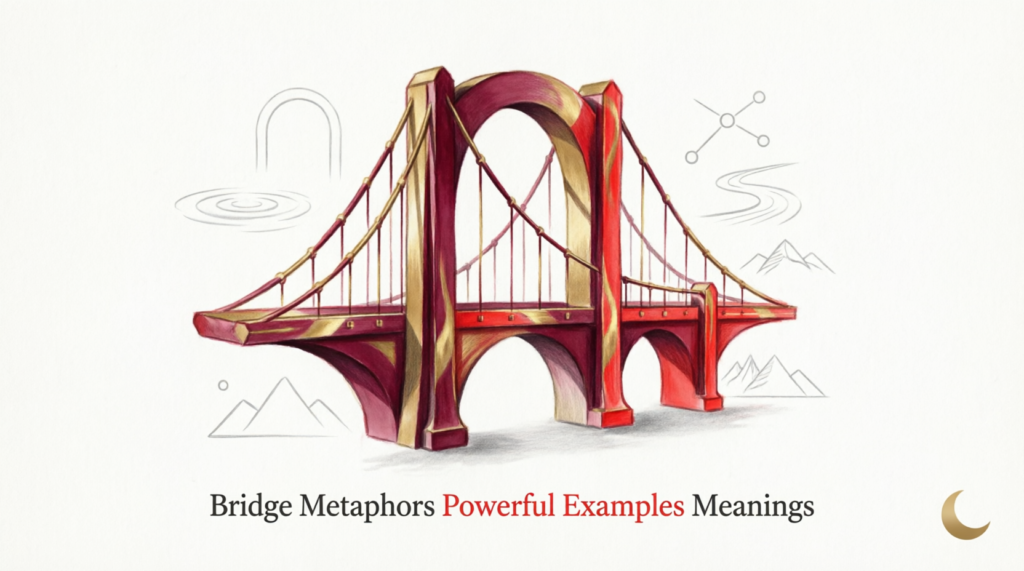
A bridge metaphor compares a bridge with an idea, person, feeling, relationship, or action. The bridge usually represents a connection between two different places, people, ideas, or stages of life. Bridge metaphors can describe friendship, communication, healing, learning, change, hope, and understanding.
The word bridge works so well as a metaphor because a real bridge connects two sides that would otherwise remain apart. In the same way, a person can “bridge” a disagreement, education can bridge a knowledge gap, or kindness can bridge differences between people.
You may see bridge metaphors in books, poems, speeches, songs, school assignments, social media posts, business writing, and everyday conversations.
For example:
“Trust is a bridge between two hearts.”
This does not mean trust is a physical bridge. It means trust helps two people connect and feel close.
Bridge Metaphor at a Glance
| Part | Simple meaning |
|---|---|
| Bridge | Connection |
| Two sides | Two different people, ideas, places, or situations |
| Crossing | Moving from one stage to another |
| Broken bridge | Lost connection or damaged relationship |
| Strong bridge | Healthy and lasting connection |
| Narrow bridge | Difficult connection or limited opportunity |
| Building a bridge | Creating understanding or connection |
| Crossing a bridge | Facing change or taking action |
| Bridge to the future | A path toward what comes next |
| Bridge over troubled water | Support during a hard time |
A bridge metaphor can be literal-looking but symbolic in meaning.
For example, saying “Education is a bridge to opportunity” means education can help a person move from limited choices toward greater opportunities.
What Does a Bridge Symbolize?
A bridge commonly symbolizes:
- Connection
- Communication
- Understanding
- Friendship
- Trust
- Peace
- Progress
- Change
- Hope
- Opportunity
- Reconciliation
- Growth
- Transition
- Cooperation
- Support
The exact meaning depends on the context.
A strong bridge may suggest a stable relationship, while a broken bridge may suggest separation. A bridge under construction can represent a relationship or plan that is still developing.
Why We Use Bridge Metaphors
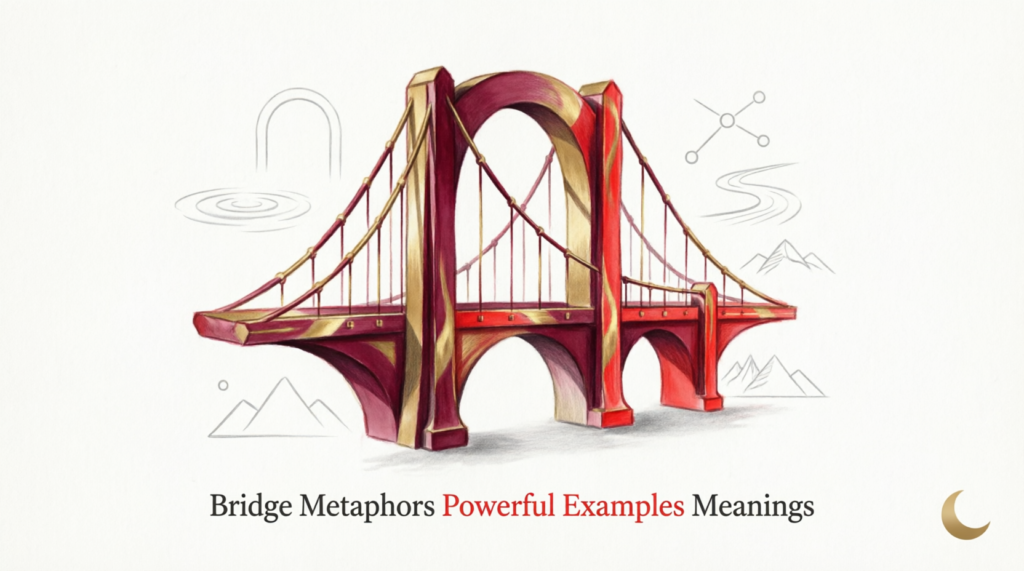
Bridge metaphors make abstract ideas easier to understand because they turn invisible connections into a familiar picture. People can easily imagine two sides separated by a river and a bridge joining them. That simple image can explain trust, communication, learning, peace, relationships, and personal growth.
Practical Purpose
People use bridge metaphors when they want to explain how something connects two things.
For example:
“Good communication is a bridge between people.”
The sentence gives communication a clear job: it connects people who might otherwise misunderstand each other.
Everyday Usage
You might hear someone say:
- “She built a bridge between the two groups.”
- “We need to cross this bridge together.”
- “His kindness was a bridge during a difficult time.”
- “Education can bridge the gap between poverty and opportunity.”
- “Time became a bridge between our past and present.”
Writing
Bridge metaphors are especially useful in descriptive writing.
Instead of saying:
“The experience helped me change.”
A writer might say:
“That experience became a bridge between who I was and who I wanted to become.”
The second sentence creates a stronger mental picture.
Speaking
Speakers often use bridge metaphors to make difficult ideas easier to remember.
A teacher might say:
“Practice is the bridge between knowing something and being able to do it.”
That gives students a simple picture of how practice works.
School
Students can use bridge metaphors in:
- Essays
- Personal narratives
- Poetry
- Book reports
- Speeches
- Creative writing
- Reflection papers
For example:
“Friendship became the bridge that helped me adjust to a new school.”
Social Media
Bridge metaphors also work well in short posts and captions.
Examples:
“Kindness builds bridges.”
“Some people are bridges to better days.”
“Never burn a bridge you may need to cross again.”
Professional Communication
Businesses and leaders use bridge language when discussing:
- Teamwork
- Partnerships
- Negotiation
- Customer relationships
- Communication
- Diversity
- Cooperation
- Leadership
For example:
“Our partnership can build a bridge between local businesses and new customers.”
1. A Bridge Between Two Hearts
Meaning: A connection that brings two people emotionally closer.
Real explanation:
The “two hearts” represent two people. The bridge represents love, trust, friendship, or emotional understanding that connects them.
Sample sentence:
“Trust became a bridge between two hearts.”
When to use it: Romantic writing, poetry, heartfelt messages, or personal reflections.
When NOT to use it: Formal business writing where emotional language may seem out of place.
Alternatives:
- A bond between two people
- An emotional connection
- A link between hearts
Difficulty level: Easy
Tone: Romantic, emotional
2. Education Is a Bridge to Opportunity
Meaning: Education can help people reach better opportunities.
Real explanation:
Education is compared to a bridge because it can help someone move from limited knowledge or choices toward new possibilities.
Sample sentence:
“Education is a bridge to opportunity.”
When to use it: Essays, speeches, school writing, motivational content, and professional discussions.
When NOT to use it: Avoid using it as if education guarantees success.
Alternatives:
- Education opens doors
- Learning creates opportunities
- Knowledge leads to new possibilities
Difficulty level: Easy
Tone: Neutral, motivational
3. Communication Is a Bridge
Meaning: Communication connects people and helps them understand each other.
Real explanation:
Good communication can cross differences in opinions, experiences, and emotions.
Sample sentence:
“Honest communication is a bridge between people.”
When to use it: Relationships, teamwork, education, leadership, and conflict discussions.
When NOT to use it: When communication itself is not the main connection being discussed.
Alternatives:
- Communication creates understanding
- Words connect people
- Conversation closes gaps
Difficulty level: Easy
Tone: Neutral
4. Friendship Is a Bridge
Meaning: Friendship connects people who might otherwise feel distant.
Real explanation:
A friendship can cross differences in age, culture, personality, location, or background.
Sample sentence:
“Our friendship became a bridge between two very different worlds.”
When to use it: Personal writing, social posts, stories, and speeches.
When NOT to use it: Highly technical writing.
Alternatives:
- Friendship is a bond
- Friendship connects us
- Friendship closes distances
Difficulty level: Easy
Tone: Warm, informal
5. Love Is a Bridge
Meaning: Love can connect people across differences or difficult circumstances.
Real explanation:
The metaphor suggests that love helps people overcome emotional distance.
Sample sentence:
“Love was the bridge that carried them through difficult years.”
When to use it: Poetry, romance, cards, stories, and personal writing.
When NOT to use it: Scientific or highly formal writing.
Alternatives:
- Love connects us
- Love creates a bond
- Love crosses boundaries
Difficulty level: Easy
Tone: Romantic
6. Trust Is a Bridge
Meaning: Trust creates a connection between people.
Real explanation:
A relationship may have distance or uncertainty until trust gives people something strong to stand on.
Sample sentence:
“Trust is the bridge that keeps a friendship strong.”
When to use it: Relationship advice, speeches, essays, and workplace communication.
When NOT to use it: When discussing a relationship where trust is not relevant.
Alternatives:
- Trust builds connection
- Trust creates a bond
- Trust holds people together
Difficulty level: Easy
Tone: Neutral
7. Kindness Builds Bridges
Meaning: Kind actions help people connect.
Real explanation:
Kindness can reduce tension and make people feel accepted and understood.
Sample sentence:
“A simple act of kindness can build a bridge between strangers.”
When to use it: Inspirational writing, school essays, speeches, and social media.
When NOT to use it: Avoid using it to suggest kindness alone solves every conflict.
Alternatives:
- Kindness brings people together
- Compassion creates connections
- Goodness opens hearts
Difficulty level: Easy
Tone: Warm, positive
8. Understanding Is a Bridge
Meaning: Understanding helps people overcome differences.
Real explanation:
When we understand another person’s feelings or viewpoint, emotional distance can become smaller.
Sample sentence:
“Understanding became a bridge between the two friends.”
When to use it: Conflict resolution, relationships, essays, and counseling-style writing.
When NOT to use it: In situations where agreement, rather than understanding, is the real goal.
Alternatives:
- Understanding connects us
- Empathy closes the gap
- Understanding creates common ground
Difficulty level: Easy
Tone: Neutral, thoughtful
9. Empathy Is a Bridge
Meaning: Empathy helps people connect with another person’s feelings.
Real explanation:
The bridge represents the emotional path between one person’s experience and another person’s understanding.
Sample sentence:
“Empathy is a bridge between pain and understanding.”
When to use it: Essays, speeches, social issues, education, and personal writing.
When NOT to use it: When the context has nothing to do with emotions or human understanding.
Alternatives:
- Empathy connects hearts
- Compassion creates understanding
- Empathy closes emotional distance
Difficulty level: Intermediate
Tone: Thoughtful
10. A Bridge to the Future
Meaning: Something that helps a person move toward future goals.
Real explanation:
The future is imagined as a place on the other side, while a bridge represents the steps needed to reach it.
Sample sentence:
“Every skill I learn is a bridge to the future I want.”
When to use it: Career writing, motivational speeches, education, personal goals, and essays.
When NOT to use it: Avoid it when discussing a purely immediate action.
Alternatives:
- A path to the future
- A step toward tomorrow
- A road to new possibilities
Difficulty level: Easy
Tone: Motivational
11. A Bridge to the Past
Meaning: Something that helps people remember or reconnect with earlier experiences.
Real explanation:
The bridge connects the present with memories, history, traditions, or earlier stages of life.
Sample sentence:
“Old photographs became a bridge to the past.”
When to use it: History, family stories, memoirs, museums, and cultural writing.
When NOT to use it: When the subject has no connection to memory or history.
Alternatives:
- A link to the past
- A connection to history
- A window into earlier times
Difficulty level: Easy
Tone: Reflective
12. A Bridge Between Generations
Meaning: Something that connects people from different age groups.
Real explanation:
Generations may have different experiences, values, or habits. Shared activities and communication can connect them.
Sample sentence:
“Music became a bridge between generations.”
When to use it: Family writing, culture, education, technology, and social topics.
When NOT to use it: When the groups are not actually separated by generation.
Alternatives:
- A generational connection
- A link between ages
- Common ground across generations
Difficulty level: Easy
Tone: Neutral
13. A Bridge Between Cultures
Meaning: Something that helps different cultures understand one another.
Real explanation:
Food, art, language, music, travel, and friendship can connect people from different cultural backgrounds.
Sample sentence:
“Food can be a bridge between cultures.”
When to use it: Cultural writing, travel, education, social media, and speeches.
When NOT to use it: Avoid making broad claims about entire cultures.
Alternatives:
- Cultural connection
- A link between cultures
- Common ground between communities
Difficulty level: Easy
Tone: Neutral, respectful
14. Language Is a Bridge
Meaning: Language helps people communicate across differences.
Real explanation:
Words allow people to share thoughts, needs, stories, and feelings.
Sample sentence:
“Language is a bridge between people who have never met.”
When to use it: Language learning, education, speeches, and cultural writing.
When NOT to use it: When discussing communication that does not involve language.
Alternatives:
- Language connects people
- Words create understanding
- Communication links us
Difficulty level: Easy
Tone: Neutral
15. Books Are Bridges
Meaning: Books connect readers with people, places, ideas, and experiences.
Real explanation:
Reading can let someone enter a world or understand a person they have never encountered directly.
Sample sentence:
“Books are bridges to worlds we may never visit.”
When to use it: School writing, library campaigns, book reviews, speeches, and literary essays.
When NOT to use it: Rarely inappropriate, but it may sound too poetic for technical documents.
Alternatives:
- Books open windows
- Reading connects worlds
- Stories link us to others
Difficulty level: Easy
Tone: Literary
16. Stories Are Bridges
Meaning: Stories connect people through shared experiences and emotions.
Real explanation:
A story can help one person understand another person’s life, even when their experiences are very different.
Sample sentence:
“Stories are bridges between lives.”
When to use it: Literature, speeches, education, storytelling, and social posts.
When NOT to use it: Formal reports that need direct language.
Alternatives:
- Stories connect people
- Narratives create understanding
- Stories bring worlds together
Difficulty level: Easy
Tone: Literary
17. Art Is a Bridge
Meaning: Art can connect people across language, culture, and experience.
Real explanation:
Paintings, music, dance, photography, and other forms of art can communicate ideas without relying only on spoken words.
Sample sentence:
“Art became a bridge between two communities.”
When to use it: Art essays, cultural writing, speeches, and museum descriptions.
When NOT to use it: Avoid presenting it as a universal fact in every situation.
Alternatives:
- Art connects worlds
- Art creates common ground
- Creativity brings people together
Difficulty level: Easy
Tone: Neutral, artistic
18. Music Is a Bridge
Meaning: Music can connect people emotionally or culturally.
Real explanation:
People may enjoy the same music even when they speak different languages or come from different backgrounds.
Sample sentence:
“Music became a bridge between strangers.”
When to use it: Music writing, cultural essays, social media, and speeches.
When NOT to use it: Technical music analysis where literal language is clearer.
Alternatives:
- Music connects hearts
- Music crosses boundaries
- Songs bring people together
Difficulty level: Easy
Tone: Emotional
19. A Bridge Over Troubled Waters
Meaning: A source of support during a difficult time.
Real explanation:
The troubled water represents problems, pain, fear, or uncertainty. The bridge represents something that helps a person get through those difficulties.
Sample sentence:
“My sister was a bridge over troubled waters during my hardest year.”
When to use it: Emotional writing, speeches, encouragement, and personal stories.
When NOT to use it: Avoid it if the dramatic image feels too strong for a small problem.
Alternatives:
- A source of support
- A helping hand
- A safe path through trouble
Difficulty level: Intermediate
Tone: Emotional
20. A Bridge Through the Storm
Meaning: Something that helps a person survive a difficult period.
Real explanation:
The storm represents hardship. The bridge represents support or a path through that hardship.
Sample sentence:
“Her friendship was a bridge through the storm.”
When to use it: Personal writing, encouragement, poetry, and speeches.
When NOT to use it: Casual situations where the problem is minor.
Alternatives:
- A path through hardship
- Support during difficult times
- A way through the storm
Difficulty level: Easy
Tone: Emotional
21. A Bridge to Healing
Meaning: Something that helps someone move toward emotional or personal recovery.
Real explanation:
Healing is treated as a destination, while support, time, honesty, or forgiveness becomes the bridge.
Sample sentence:
“Forgiveness became a bridge to healing.”
When to use it: Personal reflection, wellness writing, relationships, and poetry.
When NOT to use it: Avoid suggesting that one action guarantees healing.
Alternatives:
- A path toward healing
- A step toward recovery
- A road to peace
Difficulty level: Easy
Tone: Reflective
22. Forgiveness Is a Bridge
Meaning: Forgiveness can reconnect people after conflict.
Real explanation:
The metaphor suggests that forgiveness can help people move from hurt toward a repaired relationship.
Sample sentence:
“Forgiveness can become a bridge after a painful argument.”
When to use it: Personal writing, relationship advice, and speeches.
When NOT to use it: Do not imply that forgiveness requires forgetting harm or restoring every relationship.
Alternatives:
- Forgiveness opens a path forward
- Forgiveness can restore connection
- Forgiveness closes emotional distance
Difficulty level: Intermediate
Tone: Thoughtful
23. Apology Is a Bridge
Meaning: A sincere apology can help repair a damaged relationship.
Real explanation:
An apology does not erase what happened, but it can create a path toward honest communication and repair.
Sample sentence:
“Her apology became the first bridge back to friendship.”
When to use it: Relationship writing and conflict discussions.
When NOT to use it: When an apology is being used to excuse repeated harmful behavior.
Alternatives:
- An apology opens the door
- An apology repairs a connection
- Saying sorry can rebuild trust
Difficulty level: Easy
Tone: Neutral
24. Patience Is a Bridge
Meaning: Patience helps people move through difficult periods.
Real explanation:
Instead of demanding an immediate solution, patience gives time for understanding, growth, or change.
Sample sentence:
“Patience was the bridge between frustration and progress.”
When to use it: Personal growth, education, relationships, and motivational writing.
When NOT to use it: When immediate action is genuinely necessary.
Alternatives:
- Patience creates room for growth
- Time helps us move forward
- Patience connects effort to results
Difficulty level: Intermediate
Tone: Thoughtful
25. Hope Is a Bridge
Meaning: Hope helps people move from present difficulty toward a better possibility.
Real explanation:
The bridge connects a difficult present with an imagined better future.
Sample sentence:
“Hope was the bridge that kept him moving forward.”
When to use it: Inspirational writing, poetry, speeches, and personal stories.
When NOT to use it: Avoid using hope as a substitute for practical action.
Alternatives:
- Hope lights the way
- Hope creates a path forward
- Hope connects today with tomorrow
Difficulty level: Easy
Tone: Inspirational
26. Courage Is a Bridge
Meaning: Courage helps people move from fear toward action.
Real explanation:
Fear represents one side, and action represents the other. Courage connects them.
Sample sentence:
“Courage was the bridge between fear and action.”
When to use it: Motivational speeches, essays, personal development, and stories.
When NOT to use it: When the person did not actually face fear or uncertainty.
Alternatives:
- Courage helps us act
- Bravery crosses fear
- Courage moves us forward
Difficulty level: Easy
Tone: Motivational
27. Knowledge Is a Bridge
Meaning: Knowledge connects people with better understanding or new possibilities.
Real explanation:
Learning can move a person from confusion toward understanding.
Sample sentence:
“Knowledge is a bridge from confusion to clarity.”
When to use it: Education, essays, speeches, and professional writing.
When NOT to use it: When knowledge alone cannot address the problem.
Alternatives:
- Knowledge opens doors
- Learning creates understanding
- Information connects ideas
Difficulty level: Easy
Tone: Educational
28. Practice Is a Bridge
Meaning: Practice connects knowing something with being able to do it well.
Real explanation:
A learner may understand a skill in theory but need practice before performing it confidently.
Sample sentence:
“Practice is the bridge between knowledge and skill.”
When to use it: Teaching, coaching, school, sports, music, and career advice.
When NOT to use it: Avoid implying practice is the only factor in success.
Alternatives:
- Practice turns knowledge into skill
- Repetition builds ability
- Practice connects learning with performance
Difficulty level: Easy
Tone: Educational
29. Experience Is a Bridge
Meaning: Experience helps people move from learning to practical understanding.
Real explanation:
Experience gives people opportunities to apply ideas in real situations.
Sample sentence:
“Experience became a bridge between classroom lessons and real work.”
When to use it: Career writing, education, interviews, and personal essays.
When NOT to use it: When discussing knowledge that does not require practical experience.
Alternatives:
- Experience puts learning into practice
- Experience connects theory and action
- Real-world experience builds skill
Difficulty level: Easy
Tone: Professional
30. Mentorship Is a Bridge
Meaning: A mentor can help someone move from inexperience toward greater knowledge or confidence.
Real explanation:
The mentor provides guidance that connects where someone is now with where they hope to be.
Sample sentence:
“Her mentor was a bridge between her first job and her career goals.”
When to use it: Professional writing, education, career discussions, and speeches.
When NOT to use it: When there is no meaningful guidance relationship.
Alternatives:
- A mentor provides a path forward
- Guidance connects experience to growth
- Mentorship opens opportunities
Difficulty level: Intermediate
Tone: Professional
31. A Teacher Is a Bridge
Meaning: A teacher connects students with knowledge and understanding.
Real explanation:
Teachers help learners cross the gap between what they know and what they are trying to learn.
Sample sentence:
“My teacher was a bridge between difficult ideas and clear understanding.”
When to use it: School essays, appreciation posts, speeches, and education writing.
When NOT to use it: In technical writing where a direct explanation is better.
Alternatives:
- A teacher connects students with knowledge
- Teachers open doors to learning
- A teacher guides learners forward
Difficulty level: Easy
Tone: Warm
32. A Mentor Is a Bridge to Success
Meaning: Mentorship can help someone move toward a goal.
Real explanation:
The metaphor focuses on guidance, experience, and support.
Sample sentence:
“A good mentor can be a bridge to new opportunities.”
When to use it: Career content, speeches, school assignments, and professional posts.
When NOT to use it: Avoid promising that mentorship guarantees success.
Alternatives:
- A mentor guides you forward
- Mentorship creates opportunities
- Guidance helps people grow
Difficulty level: Easy
Tone: Professional
33. Teamwork Is a Bridge
Meaning: Teamwork connects people so they can reach a shared goal.
Real explanation:
Different people bring different skills. Working together creates a connection between individual efforts and group results.
Sample sentence:
“Teamwork is the bridge between individual talent and shared success.”
When to use it: Office writing, sports, school projects, and leadership speeches.
When NOT to use it: When the task genuinely requires independent work.
Alternatives:
- Teamwork brings strengths together
- Collaboration connects people
- Cooperation creates shared results
Difficulty level: Easy
Tone: Professional
34. Cooperation Is a Bridge
Meaning: Cooperation helps people with different interests work together.
Real explanation:
The metaphor focuses on creating common ground instead of remaining separated.
Sample sentence:
“Cooperation built a bridge between the two teams.”
When to use it: Business, community projects, school, and diplomacy-related writing.
When NOT to use it: When cooperation is not actually happening.
Alternatives:
- Cooperation creates common ground
- Working together closes gaps
- Collaboration builds connections
Difficulty level: Easy
Tone: Professional
35. Compromise Is a Bridge
Meaning: Compromise helps people with different positions reach a shared solution.
Real explanation:
Two sides may not get everything they want, but compromise can create a workable path between them.
Sample sentence:
“Compromise became a bridge between their two plans.”
When to use it: Relationships, teamwork, negotiations, and conflict resolution.
When NOT to use it: When one side must protect a basic right or safety.
Alternatives:
- Compromise creates common ground
- Meeting halfway
- Finding a middle ground
Difficulty level: Intermediate
Tone: Neutral
36. Diplomacy Is a Bridge
Meaning: Diplomacy helps people or groups manage differences peacefully.
Real explanation:
Diplomatic communication can create a connection between groups with competing interests.
Sample sentence:
“Diplomacy served as a bridge between the two sides.”
When to use it: Politics, international relations, business, and formal writing.
When NOT to use it: Casual conversations where simpler wording works better.
Alternatives:
- Diplomacy creates dialogue
- Negotiation builds understanding
- Peaceful discussion connects sides
Difficulty level: Intermediate
Tone: Formal
37. Conversation Is a Bridge
Meaning: Conversation helps people connect and understand one another.
Real explanation:
Talking openly can reduce distance between people.
Sample sentence:
“One honest conversation became a bridge between them.”
When to use it: Relationships, stories, essays, and social posts.
When NOT to use it: When no actual communication occurs.
Alternatives:
- Conversation opens communication
- Talking brings people closer
- Dialogue creates connection
Difficulty level: Easy
Tone: Natural
38. Listening Is a Bridge
Meaning: Listening helps people understand one another.
Real explanation:
People often feel closer when they believe someone truly hears them.
Sample sentence:
“Listening is a bridge between speaking and understanding.”
When to use it: Leadership, relationships, education, and communication advice.
When NOT to use it: When the issue requires action rather than listening alone.
Alternatives:
- Listening builds understanding
- Careful listening closes gaps
- Hearing others creates connection
Difficulty level: Easy
Tone: Thoughtful
39. A Smile Is a Bridge
Meaning: A smile can create a small connection between people.
Real explanation:
A smile may communicate friendliness even when strangers do not share words.
Sample sentence:
“Her smile became a bridge between two strangers.”
When to use it: Stories, poetry, social posts, and warm descriptions.
When NOT to use it: Serious situations where smiling could seem inappropriate.
Alternatives:
- A smile creates warmth
- A friendly gesture opens the door
- Kindness connects strangers
Difficulty level: Easy
Tone: Warm
40. A Handshake Is a Bridge
Meaning: A handshake can symbolize agreement, respect, or connection.
Real explanation:
The physical act represents a social connection between two people.
Sample sentence:
“The handshake became a bridge between two new business partners.”
When to use it: Business writing, stories, speeches, and symbolic descriptions.
When NOT to use it: When discussing settings where handshakes are not appropriate or customary.
Alternatives:
- A gesture of agreement
- A sign of partnership
- A symbol of trust
Difficulty level: Easy
Tone: Professional
41. Technology Is a Bridge
Meaning: Technology can connect people across distance.
Real explanation:
Phones, video calls, messaging services, and other tools can help people communicate when they are far apart.
Sample sentence:
“Video calls became a bridge between our families.”
When to use it: Technology essays, workplace writing, education, and social posts.
When NOT to use it: When technology actually creates the separation being discussed.
Alternatives:
- Technology connects distant people
- Digital tools close distance
- Technology links communities
Difficulty level: Easy
Tone: Neutral
42. The Internet Is a Bridge
Meaning: The internet connects people, information, and communities.
Real explanation:
The metaphor focuses on the way online networks connect people who may be physically far apart.
Sample sentence:
“The internet became a bridge between learners around the world.”
When to use it: Digital communication, education, technology writing, and social media.
When NOT to use it: When a more specific description of technology is needed.
Alternatives:
- The internet connects communities
- Digital networks link people
- Online spaces create connections
Difficulty level: Easy
Tone: Neutral
43. Social Media Is a Bridge
Meaning: Social media can connect people who live far apart or have shared interests.
Real explanation:
Online platforms can create relationships and communities across physical distance.
Sample sentence:
“Social media became a bridge between fans from different countries.”
When to use it: Digital marketing, personal posts, communication writing, and essays.
When NOT to use it: When discussing a platform mainly as a source of conflict or isolation.
Alternatives:
- Social media connects communities
- Online platforms bring people together
- Digital communities cross borders
Difficulty level: Easy
Tone: Neutral
44. Travel Is a Bridge
Meaning: Travel can connect people with new places and cultures.
Real explanation:
Travel gives people direct experiences that may reduce unfamiliarity with other communities.
Sample sentence:
“Travel became a bridge between my hometown and the wider world.”
When to use it: Travel writing, personal essays, blogs, and social posts.
When NOT to use it: Avoid implying that every traveler gains deep cultural understanding.
Alternatives:
- Travel opens cultural doors
- Travel connects worlds
- Travel creates new perspectives
Difficulty level: Easy
Tone: Reflective
45. Food Is a Bridge
Meaning: Food can connect people and cultures.
Real explanation:
Sharing a meal or learning about another culture’s food can create opportunities for conversation and connection.
Sample sentence:
“Food became a bridge between our two families.”
When to use it: Cultural writing, family stories, travel content, and social media.
When NOT to use it: Avoid making food the only measure of a culture.
Alternatives:
- Food brings people together
- Meals create connection
- Shared meals build relationships
Difficulty level: Easy
Tone: Warm
46. Laughter Is a Bridge
Meaning: Shared laughter can make people feel closer.
Real explanation:
Laughing together can reduce tension and create a sense of connection.
Sample sentence:
“Laughter became a bridge between the nervous students and their new teacher.”
When to use it: Stories, personal essays, social posts, and speeches.
When NOT to use it: Serious situations where humor would be disrespectful.
Alternatives:
- Laughter brings people closer
- Humor creates connection
- A shared laugh breaks the ice
Difficulty level: Easy
Tone: Friendly
47. Shared Memories Are Bridges
Meaning: Memories can connect people across time.
Real explanation:
People who remember the same experiences often feel connected even after many years.
Sample sentence:
“Our shared memories were bridges back to childhood.”
When to use it: Family writing, friendship posts, memoirs, and poetry.
When NOT to use it: When the people do not share the memory.
Alternatives:
- Memories connect us
- Shared experiences create bonds
- The past links us together
Difficulty level: Easy
Tone: Nostalgic
48. Memories Are Bridges Between Yesterday and Today
Meaning: Memories connect the past with the present.
Real explanation:
The metaphor treats memory as a path between earlier experiences and current life.
Sample sentence:
“Family traditions are bridges between yesterday and today.”
When to use it: Personal writing, history, family stories, and poetry.
When NOT to use it: In short practical messages where the metaphor adds little.
Alternatives:
- Memories link past and present
- The past lives in memory
- Memories connect generations
Difficulty level: Intermediate
Tone: Reflective
49. Change Is a Bridge
Meaning: Change can move a person from one stage of life to another.
Real explanation:
A bridge represents transition. The old situation is on one side, and the new situation is on the other.
Sample sentence:
“Change became a bridge to a new chapter.”
When to use it: Personal growth, career writing, stories, and motivational content.
When NOT to use it: When change is not actually a transition between stages.
Alternatives:
- Change opens a new path
- Change leads to a new chapter
- Change moves us forward
Difficulty level: Easy
Tone: Motivational
50. Growing Up Is a Bridge
Meaning: Growing up connects childhood with adulthood.
Real explanation:
The metaphor focuses on the transition from one stage of life to another.
Sample sentence:
“Growing up is a bridge between childhood dreams and adult choices.”
When to use it: Coming-of-age stories, school essays, poetry, and personal writing.
When NOT to use it: When discussing a person without focusing on development.
Alternatives:
- Growing up is a transition
- Maturity connects childhood and adulthood
- Adulthood grows from childhood
Difficulty level: Intermediate
Tone: Reflective
51. Time Is a Bridge
Meaning: Time connects different moments or stages of life.
Real explanation:
Time allows people to move from the past into the present and future.
Sample sentence:
“Time became a bridge between old pain and new hope.”
When to use it: Poetry, personal essays, stories, and reflective writing.
When NOT to use it: Technical or scientific writing where precision matters more than imagery.
Alternatives:
- Time connects moments
- Time carries us forward
- Time links past and future
Difficulty level: Easy
Tone: Poetic
52. Memory Is a Bridge
Meaning: Memory connects the present person with past experiences.
Real explanation:
A memory can bring an earlier person, place, or event into the present.
Sample sentence:
“Her voice was a bridge to memories I had almost forgotten.”
When to use it: Poetry, memoirs, stories, and emotional writing.
When NOT to use it: Formal factual reports.
Alternatives:
- Memory links us to the past
- Memories bring the past back
- Memory keeps old moments alive
Difficulty level: Easy
Tone: Poetic
53. Home Is a Bridge
Meaning: Home can connect people with their identity, family, or past.
Real explanation:
Home may represent a connection between where someone came from and who they are now.
Sample sentence:
“Home was the bridge between my childhood and my adult life.”
When to use it: Personal essays, poetry, family writing, and stories.
When NOT to use it: When “home” has no symbolic role.
Alternatives:
- Home connects us to our roots
- Home is a link to belonging
- Home ties us to our past
Difficulty level: Easy
Tone: Emotional
54. Culture Is a Bridge to Identity
Meaning: Culture can connect people with their history, values, and sense of belonging.
Real explanation:
Traditions, language, food, music, and shared customs can help people understand where they come from.
Sample sentence:
“Culture can be a bridge to identity.”
When to use it: Cultural essays, personal writing, education, and community discussions.
When NOT to use it: Avoid treating culture as a single fixed experience for everyone.
Alternatives:
- Culture connects us to our roots
- Traditions shape identity
- Culture links people to heritage
Difficulty level: Intermediate
Tone: Thoughtful
55. Peace Is a Bridge
Meaning: Peace can connect people after conflict.
Real explanation:
The bridge represents a path away from hostility and toward cooperation.
Sample sentence:
“Peace became a bridge between two communities.”
When to use it: Speeches, essays, community writing, and poetry.
When NOT to use it: When peace has not actually been established.
Alternatives:
- Peace creates common ground
- Dialogue opens a path to peace
- Peace brings divided sides together
Difficulty level: Easy
Tone: Formal, hopeful
56. Respect Is a Bridge
Meaning: Respect helps people with differences maintain a healthy relationship.
Real explanation:
People do not need identical opinions to treat each other with dignity.
Sample sentence:
“Respect was the bridge that allowed them to disagree without becoming enemies.”
When to use it: Leadership, education, relationships, workplaces, and essays.
When NOT to use it: When one side is being seriously mistreated and the metaphor hides that problem.
Alternatives:
- Respect creates common ground
- Respect keeps relationships strong
- Mutual respect connects people
Difficulty level: Easy
Tone: Neutral
57. Diversity Is a Bridge
Meaning: Diversity can create opportunities for people with different experiences to connect and learn.
Real explanation:
The metaphor focuses on different people sharing ideas and experiences rather than remaining isolated.
Sample sentence:
“Diversity can be a bridge to new ideas.”
When to use it: Education, workplaces, community writing, and professional communication.
When NOT to use it: When discussing diversity without a meaningful connection to collaboration or learning.
Alternatives:
- Diversity expands perspectives
- Different experiences create new ideas
- Variety connects viewpoints
Difficulty level: Intermediate
Tone: Professional
58. Common Ground Is a Bridge
Meaning: Shared beliefs or interests can connect people who disagree.
Real explanation:
Common ground gives two sides something they can stand on together.
Sample sentence:
“Their shared love of music became a bridge between them.”
When to use it: Conflict resolution, friendships, teamwork, and negotiations.
When NOT to use it: When the sides truly have no shared point.
Alternatives:
- Find common ground
- Shared interests connect us
- Agreement creates a link
Difficulty level: Easy
Tone: Neutral
59. A Shared Goal Is a Bridge
Meaning: A common goal can unite people who are otherwise different.
Real explanation:
People may disagree about many things but still work together when they want the same result.
Sample sentence:
“Our shared goal became a bridge between two departments.”
When to use it: Business, sports, school projects, teamwork, and leadership.
When NOT to use it: When the people do not actually share a goal.
Alternatives:
- A common goal unites us
- Shared goals bring teams together
- Working toward one goal creates unity
Difficulty level: Easy
Tone: Professional
60. A Bridge to Understanding
Meaning: Something that helps people move from confusion toward understanding.
Real explanation:
The bridge represents an explanation, conversation, experience, or lesson that makes something clearer.
Sample sentence:
“The teacher’s example was a bridge to understanding.”
When to use it: Education, essays, communication, and professional writing.
When NOT to use it: When the connection is already obvious and the metaphor adds unnecessary decoration.
Alternatives:
- A path to understanding
- A key to clarity
- Something that makes the idea clearer
Difficulty level: Easy
Tone: Neutral
61. A Bridge Across Differences
Meaning: Something that connects people despite their differences.
Real explanation:
The differences may involve opinions, age, culture, background, or experience.
Sample sentence:
“Shared respect became a bridge across their differences.”
When to use it: Social writing, essays, speeches, and relationship discussions.
When NOT to use it: Avoid suggesting differences must disappear for people to connect.
Alternatives:
- A connection despite differences
- Common ground across differences
- A link between different viewpoints
Difficulty level: Easy
Tone: Thoughtful
62. A Broken Bridge
Meaning: A broken relationship, lost connection, or failed opportunity.
Real explanation:
A bridge that cannot be crossed represents a connection that has been damaged or removed.
Sample sentence:
“Years of silence left a broken bridge between the brothers.”
When to use it: Stories, poetry, relationship writing, and emotional reflection.
When NOT to use it: Avoid using it if the relationship can still be easily repaired and the image sounds overly final.
Alternatives:
- A damaged relationship
- A lost connection
- A broken bond
Difficulty level: Easy
Tone: Sad, emotional
63. Burning a Bridge
Meaning: Destroying a relationship or opportunity so that returning becomes difficult.
Real explanation:
The phrase comes from the image of destroying a bridge after crossing it. It suggests making it hard or impossible to go back.
Sample sentence:
“Quitting in anger may mean burning a bridge with your former employer.”
When to use it: Everyday conversation, career advice, and relationship discussions.
When NOT to use it: Do not use it when someone simply makes a small mistake.
Alternatives:
- Damage a relationship
- Close a door
- Cut off an opportunity
Difficulty level: Easy
Tone: Informal
64. Building Bridges
Meaning: Creating relationships, understanding, or cooperation.
Real explanation:
Building a bridge suggests deliberately creating a connection where one did not exist before.
Sample sentence:
“The new program is building bridges between students and local businesses.”
When to use it: Business, education, politics, community work, and everyday speech.
When NOT to use it: When describing something unrelated to connection.
Alternatives:
- Create connections
- Build relationships
- Find common ground
Difficulty level: Easy
Tone: Neutral
65. Crossing the Bridge
Meaning: Moving through an important change or taking a difficult step.
Real explanation:
The bridge represents a transition. Crossing it means choosing to move forward.
Sample sentence:
“I was afraid to leave my old job, but I knew it was time to cross the bridge.”
When to use it: Personal growth, stories, speeches, and motivational writing.
When NOT to use it: When there is no meaningful transition.
Alternatives:
- Move forward
- Take the next step
- Enter a new stage
Difficulty level: Easy
Tone: Reflective
66. Standing at the Bridge
Meaning: Being at a point where an important decision or transition is approaching.
Real explanation:
The person is imagined as standing between the old situation and the next stage.
Sample sentence:
“After graduation, I felt like I was standing at the bridge between school and adult life.”
When to use it: Personal essays, stories, poetry, and reflective writing.
When NOT to use it: Simple everyday situations that do not involve a major choice.
Alternatives:
- At a turning point
- Facing a major decision
- Between two stages
Difficulty level: Intermediate
Tone: Reflective
67. A Bridge Under Construction
Meaning: A relationship, plan, or connection that is still developing.
Real explanation:
A physical bridge under construction cannot yet provide a complete crossing. In the same way, a new relationship or partnership may need time to become strong.
Sample sentence:
“Our partnership is still a bridge under construction.”
When to use it: Business, relationships, teamwork, and personal growth.
When NOT to use it: When the connection is already complete and stable.
Alternatives:
- A relationship still growing
- A connection in progress
- A partnership taking shape
Difficulty level: Intermediate
Tone: Neutral
68. A Strong Bridge
Meaning: A dependable connection that can withstand difficulty.
Real explanation:
A strong physical bridge can carry weight and survive pressure. Symbolically, a strong relationship or connection can survive challenges.
Sample sentence:
“Years of honesty built a strong bridge between them.”
When to use it: Relationships, teamwork, family writing, and professional communication.
When NOT to use it: When the relationship is fragile.
Alternatives:
- A lasting bond
- A solid connection
- A dependable relationship
Difficulty level: Easy
Tone: Positive
69. A Narrow Bridge
Meaning: A difficult or limited path between two situations.
Real explanation:
A narrow bridge can be harder to cross safely. Symbolically, it can represent a fragile opportunity or difficult transition.
Sample sentence:
“Finding peace between the two groups was a narrow bridge to cross.”
When to use it: Poetry, stories, and serious reflective writing.
When NOT to use it: When the situation is simple or easy.
Alternatives:
- A difficult path
- A fragile connection
- A challenging transition
Difficulty level: Intermediate
Tone: Serious
70. A Bridge of Hope
Meaning: Something that connects a difficult present with the possibility of a better future.
Real explanation:
Hope is represented as a bridge because it gives people a reason to continue moving forward.
Sample sentence:
“The community center became a bridge of hope for local families.”
When to use it: Speeches, charity writing, stories, poetry, and inspirational content.
When NOT to use it: Avoid using overly emotional language in settings that require strict factual reporting.
Alternatives:
- A sign of hope
- A path toward a better future
- A source of encouragement
Difficulty level: Easy
Tone: Inspirational
Quick Reference Table
| # | Bridge metaphor | Meaning | Best use | Tone |
|---|---|---|---|---|
| 1 | Bridge between two hearts | Emotional connection | Romance | Romantic |
| 2 | Education is a bridge to opportunity | Learning creates possibilities | School | Motivational |
| 3 | Communication is a bridge | Communication connects people | Relationships | Neutral |
| 4 | Friendship is a bridge | Friendship creates connection | Personal writing | Warm |
| 5 | Love is a bridge | Love crosses emotional distance | Poetry | Romantic |
| 6 | Trust is a bridge | Trust creates stability | Relationships | Neutral |
| 7 | Kindness builds bridges | Kindness creates connection | Social writing | Warm |
| 8 | Understanding is a bridge | Understanding closes gaps | Communication | Thoughtful |
| 9 | Empathy is a bridge | Empathy connects feelings | Essays | Thoughtful |
| 10 | Bridge to the future | Progress toward future goals | Motivation | Motivational |
| 11 | Bridge to the past | Connection with history | Memoir | Reflective |
| 12 | Bridge between generations | Connects age groups | Family/culture | Neutral |
| 13 | Bridge between cultures | Connects cultures | Cultural writing | Respectful |
| 14 | Language is a bridge | Language connects people | Education | Neutral |
| 15 | Books are bridges | Reading connects worlds | Literature | Literary |
| 16 | Stories are bridges | Stories connect lives | Writing | Literary |
| 17 | Art is a bridge | Art creates connection | Culture | Artistic |
| 18 | Music is a bridge | Music connects people | Music writing | Emotional |
| 19 | Bridge over troubled waters | Support during hardship | Personal writing | Emotional |
| 20 | Bridge through the storm | Help during hardship | Encouragement | Emotional |
| 21 | Bridge to healing | Path toward recovery | Reflection | Thoughtful |
| 22 | Forgiveness is a bridge | Forgiveness can repair connection | Relationships | Thoughtful |
| 23 | Apology is a bridge | Apology can begin repair | Relationships | Neutral |
| 24 | Patience is a bridge | Patience supports progress | Advice | Thoughtful |
| 25 | Hope is a bridge | Hope connects today and tomorrow | Motivation | Inspirational |
| 26 | Courage is a bridge | Courage connects fear and action | Motivation | Motivational |
| 27 | Knowledge is a bridge | Knowledge creates understanding | Education | Educational |
| 28 | Practice is a bridge | Practice builds skill | Learning | Educational |
| 29 | Experience is a bridge | Experience links theory and action | Career | Professional |
| 30 | Mentorship is a bridge | Guidance supports growth | Career | Professional |
| 31 | Teacher is a bridge | Teacher connects students to knowledge | School | Warm |
| 32 | Mentor is a bridge to success | Mentorship supports goals | Career | Professional |
| 33 | Teamwork is a bridge | Teamwork connects efforts | Workplace | Professional |
| 34 | Cooperation is a bridge | Cooperation connects groups | Business | Professional |
| 35 | Compromise is a bridge | Compromise creates common ground | Conflict | Neutral |
| 36 | Diplomacy is a bridge | Diplomacy connects opposing sides | Formal writing | Formal |
| 37 | Conversation is a bridge | Conversation creates connection | Relationships | Natural |
| 38 | Listening is a bridge | Listening creates understanding | Communication | Thoughtful |
| 39 | Smile is a bridge | A smile creates warmth | Stories | Warm |
| 40 | Handshake is a bridge | Gesture symbolizes partnership | Business | Professional |
| 41 | Technology is a bridge | Technology connects distant people | Technology | Neutral |
| 42 | Internet is a bridge | Online networks connect people | Digital writing | Neutral |
| 43 | Social media is a bridge | Platforms connect communities | Social media | Neutral |
| 44 | Travel is a bridge | Travel connects people and cultures | Travel writing | Reflective |
| 45 | Food is a bridge | Food creates social connection | Culture | Warm |
| 46 | Laughter is a bridge | Shared humor creates connection | Stories | Friendly |
| 47 | Shared memories are bridges | Memories connect people | Family | Nostalgic |
| 48 | Memories bridge yesterday and today | Memory connects past and present | Reflection | Reflective |
| 49 | Change is a bridge | Change creates transition | Personal growth | Motivational |
| 50 | Growing up is a bridge | Childhood connects to adulthood | School | Reflective |
| 51 | Time is a bridge | Time connects stages | Poetry | Poetic |
| 52 | Memory is a bridge | Memory links present and past | Poetry | Poetic |
| 53 | Home is a bridge | Home connects identity and roots | Personal writing | Emotional |
| 54 | Culture is a bridge to identity | Culture connects people with heritage | Essays | Thoughtful |
| 55 | Peace is a bridge | Peace connects divided groups | Speeches | Hopeful |
| 56 | Respect is a bridge | Respect helps differences coexist | Leadership | Neutral |
| 57 | Diversity is a bridge | Different experiences create connection | Workplace | Professional |
| 58 | Common ground is a bridge | Shared ideas connect people | Conflict resolution | Neutral |
| 59 | Shared goal is a bridge | Goals unite people | Teamwork | Professional |
| 60 | Bridge to understanding | Something creates clarity | Education | Neutral |
| 61 | Bridge across differences | Connection despite differences | Social writing | Thoughtful |
| 62 | Broken bridge | Lost or damaged connection | Poetry | Emotional |
| 63 | Burning a bridge | Destroying a relationship or opportunity | Conversation | Informal |
| 64 | Building bridges | Creating relationships | Business | Neutral |
| 65 | Crossing the bridge | Moving through change | Personal growth | Reflective |
| 66 | Standing at the bridge | Facing a transition | Personal writing | Reflective |
| 67 | Bridge under construction | Connection still developing | Relationships | Neutral |
| 68 | Strong bridge | Dependable connection | Relationships | Positive |
| 69 | Narrow bridge | Difficult or fragile path | Poetry | Serious |
| 70 | Bridge of hope | Path toward better possibilities | Speeches | Inspirational |
Real-Life Conversations
These examples show how bridge metaphors can sound natural when people actually speak. The goal is not to force a metaphor into every sentence. A good metaphor should fit the moment.
Conversation 1: Friends
Maya: “You two used to argue all the time. What changed?”
Jordan: “We finally started talking instead of guessing what the other person meant.”
Maya: “So communication fixed everything?”
Jordan: “Not everything. But it became a bridge. We finally had a way to meet in the middle.”
Maya: “That makes sense.”
Jordan: “Sometimes you don’t need a perfect answer. You just need a way to reach the other person.”
Conversation 2: Student and Teacher
Student: “I understand the formula, but I can’t solve the problems.”
Teacher: “That’s normal. Knowing the formula is only one step.”
Student: “So what am I missing?”
Teacher: “Practice. Think of practice as a bridge between knowing and doing.”
Student: “So I need to cross that bridge.”
Teacher: “Exactly. Start with one problem, then another.”
Conversation 3: Family
Daughter: “Grandpa doesn’t understand why I spend so much time online.”
Mother: “Have you asked him what he thinks?”
Daughter: “Not really.”
Mother: “Maybe show him what you do. Let him see it instead of assuming he won’t understand.”
Daughter: “You think that could help?”
Mother: “Sure. Sometimes sharing an experience becomes a bridge between generations.”
Conversation 4: Office
Manager: “The design team and sales team keep disagreeing.”
Alex: “They both want the project to succeed. They just focus on different problems.”
Manager: “What should we do?”
Alex: “Start with that shared goal. It could be the bridge between them.”
Manager: “Good point. Instead of asking who is right, we’ll ask what both teams need.”
Conversation 5: Dating
Emma: “I thought you were ignoring me yesterday.”
Ryan: “I wasn’t. I had a terrible day and didn’t know how to explain it.”
Emma: “You could have told me.”
Ryan: “You’re right. I should have.”
Emma: “I don’t need you to have everything figured out. I just need you to talk to me.”
Ryan: “Then let’s start there.”
Emma: “Good. Maybe that conversation can be our bridge back.”
Everyday Usage
Bridge metaphors work best when the image matches the idea of connection, transition, support, or movement. They can appear in casual speech, formal writing, literature, poetry, business communication, and social media.
In Conversation
People often use bridge expressions without thinking about them as literary devices.
Examples:
“We need to build a bridge between the two groups.”
“Don’t burn that bridge.”
“That conversation helped us cross a difficult bridge.”
“Her friendship was a bridge during a hard time.”
These expressions make abstract situations easier to picture.
In Writing
Writers use bridge metaphors to give ideas a clear image.
Instead of:
“My college experience helped me prepare for work.”
You could write:
“College became a bridge between my student life and my professional life.”
The metaphor adds movement and makes the transition easier to imagine.
In Books
Authors often use bridges to represent:
- Change
- Separation
- Reconnection
- Choice
- Memory
- Hope
- Fear
- Escape
- Personal growth
A character crossing a bridge may literally travel from one place to another while symbolically entering a new part of life.
For example:
“When she crossed the old bridge, she knew she was leaving her childhood behind.”
The bridge is physical, but its deeper meaning is emotional.
In Movies
Visual storytelling makes bridge metaphors especially powerful.
A character might:
- Stand alone on a bridge after an argument.
- Cross a bridge before starting a new life.
- Meet someone on a bridge after years apart.
- Look across a bridge while making an important decision.
- Repair a bridge as a symbol of repairing a relationship.
The physical setting can quietly represent the character’s emotional state.
In Poetry
Poetry often uses bridge imagery because it creates a strong picture with very few words.
Examples:
“Hope was my bridge through the night.”
“Your words became a bridge across my silence.”
“We met halfway on a bridge of trust.”
Poetry allows the metaphor to become more emotional and imaginative.
In Emails
Bridge metaphors can work in professional emails, but they should be used carefully.
A natural example:
“I believe this partnership can build a bridge between our two teams.”
This sounds professional because the metaphor relates directly to cooperation.
Avoid packing an email with several metaphors:
“Let’s build bridges, cross rivers, open doors, climb mountains, and light the road together.”
That can sound forced.
One clear metaphor is usually stronger.
In Text Messages
Short bridge metaphors can work well in personal messages.
Examples:
“I don’t want to burn this bridge.”
“Thanks for being my bridge through a rough week.”
“Maybe talking is the bridge we need.”
“Our friendship crossed a lot of distance.”
On Instagram
Bridge metaphors can make short captions memorable.
Examples:
“Build bridges, not walls.”
“Some people become bridges to better days.”
“Cross the fear. Find the future.”
“Kindness is a bridge.”
“Between who I was and who I’m becoming, there is a bridge.”
On Facebook
Facebook posts often allow slightly longer reflective metaphors.
Example:
“Life has a strange way of building bridges. Sometimes a difficult experience connects us to a person, place, or opportunity we would never have found otherwise.”
On X
Shorter expressions work best:
“Trust builds bridges. Ego burns them.”
“Sometimes progress begins when you decide to cross the bridge.”
“A good conversation can be a bridge.”
On LinkedIn
Professional bridge metaphors can describe teamwork, partnerships, leadership, and career development.
Example:
“Strong teams are built when communication becomes a bridge between different skills, perspectives, and goals.”
Another example:
“Mentorship can serve as a bridge between potential and practical experience.”
In School Assignments
Students can use bridge metaphors to explain abstract ideas.
For example:
Topic: Education
“Education is a bridge because it can connect students with knowledge, skills, and future opportunities.”
Topic: Friendship
“Friendship is like a bridge because it connects people even when their personalities and backgrounds are different.”
Topic: Growing up
“Growing up is a bridge between childhood and adulthood. Each experience helps us move closer to the person we will become.”
How to Make a Bridge Metaphor Stronger
A good bridge metaphor usually has three parts:
1. The bridge
What creates the connection?
2. The two sides
What is being connected?
3. The reason for crossing
Why does the connection matter?
For example:
“Practice is a bridge between knowing a skill and using it with confidence.”
Here:
- Bridge: Practice
- First side: Knowing the skill
- Second side: Using the skill
- Purpose: Building confidence
This structure makes the metaphor easy to understand.
Bridge Metaphors vs. Similes
A metaphor says one thing is another thing for comparison.
“Trust is a bridge.”
A simile uses words such as like or as.
“Trust is like a bridge.”
Both express a similar idea, but the metaphor is usually more direct.
Bridge Metaphors vs. Idioms
Some bridge expressions are common idioms.
For example:
“Burning bridges”
is an established expression meaning to damage a relationship or opportunity so badly that returning becomes difficult.
Other expressions are fresh metaphors:
“Her kindness was a bridge between two lonely people.”
The second example creates a new comparison rather than relying on a fixed idiom.
Common Mistakes to Avoid
Using too many bridge metaphors
One strong metaphor is often better than five weak ones.
Mixing metaphors
Avoid sentences such as:
“We need to build a bridge, open the door, climb the ladder, and sail toward success.”
The images compete with each other.
Using the metaphor when a direct sentence is clearer
Instead of forcing:
“The bridge of administrative efficiency carried the project across the ocean of paperwork.”
Simply say:
“Better organization helped the team finish the paperwork.”
Making the meaning unclear
A reader should be able to understand what the bridge represents.
Final Tip
The strongest bridge metaphors usually connect ideas that naturally belong together: trust and relationships, education and opportunity, communication and understanding, courage and action, or change and growth.
A bridge is powerful because it does not erase the distance between two sides. It gives people a way to cross it.
That is why bridge metaphors remain useful in everyday speech, creative writing, school assignments, professional communication, poetry, and personal reflection.
descover more post
29+ River Metaphors and What They Really Mean 2026
60+What Are Visual Metaphors Meaning Examples and …
60+ Clock Metaphors Meaning Examples and How to Use …

Anderson is the founder and lead content writer at MetaphorVault.com, where he specializes in creating engaging, easy-to-understand content about metaphors, idioms, figurative language, and modern English expressions. With over 8 years of experience in content writing and language education, he is passionate about making complex language concepts simple and practical for readers of all levels. His work focuses on delivering accurate, well-researched, and reader-friendly articles that help students, writers, educators, and English learners improve their communication skills. Through MetaphorVault.com, Anderson is committed to publishing high-quality, informative content that is both engaging and trustworthy.