Learning can be hard to explain with plain words. We may say that someone is gaining knowledge, building skills, or improving through practice, but these phrases do not always show what learning feels like. That is where learning metaphors help.
A learning metaphor compares learning to something familiar, such as climbing a mountain, planting a seed, building a house, or opening a door. The comparison gives an abstract idea a clear picture that readers and listeners can understand.
People search for learning metaphors for many reasons. Students may need them for essays or presentations. Teachers use them to explain growth and motivation. Writers use them to make ideas more vivid. Speakers, coaches, parents, and social-media creators can also use them to describe the ups and downs of gaining knowledge.
You may see learning metaphors in classrooms, books, speeches, poems, motivational posts, conversations, and professional writing. Some describe learning as a journey, while others focus on patience, practice, mistakes, curiosity, or personal growth.
This guide, for 2026, explains what learning metaphors mean and gives you more than 60 practical examples. Each example includes its meaning, a natural sentence, the best situation for using it, when to avoid it, alternative expressions, difficulty, and tone.
Definition & Meaning
A learning metaphor is a figurative expression that compares the process of learning to another familiar experience. Instead of describing knowledge in literal terms, it creates an image that makes learning easier to picture, feel, or remember.
Simple Definition
A learning metaphor compares learning to something else to explain how knowledge, skills, understanding, or personal growth develops.
For example:
“Learning is a journey.”
Learning is not literally a journey on a road. The metaphor suggests that learning happens over time, includes different stages, and may involve wrong turns and discoveries.
Quick Explanation
Learning metaphors can describe different parts of the learning experience:
- Progress: “Learning is climbing a mountain.”
- Growth: “Knowledge is a seed.”
- Practice: “Practice sharpens the mind.”
- Discovery: “Learning is opening a door.”
- Difficulty: “Learning is crossing a bridge.”
- Knowledge: “The mind is a garden.”
- Curiosity: “Questions are keys.”
- Mistakes: “Failure is a stepping stone.”
- Education: “A teacher is a guide.”
- Memory: “Knowledge is a toolbox.”
Quick Summary Table
| Learning metaphor | Main idea | Best use |
|---|---|---|
| Learning is a journey | Progress takes time | General writing |
| Learning is a mountain | Learning can be challenging | Motivation |
| Knowledge is a seed | Knowledge grows | Education |
| Mind is a garden | Ideas need care | Teaching |
| Learning is building | Skills develop step by step | School/work |
| Questions are keys | Questions unlock knowledge | Classroom |
| Mistakes are stepping stones | Errors help growth | Motivation |
| Teacher is a guide | Teachers provide direction | Education |
| Knowledge is a toolbox | Knowledge gives useful skills | Practical learning |
| Learning is a puzzle | Understanding comes together | Problem-solving |
Why We Use Learning Metaphors
We use learning metaphors because learning is an abstract process that can be difficult to describe directly. A metaphor turns that process into a familiar picture. It can make an idea easier to understand, remember, discuss, and feel.
Learning metaphors are useful in everyday conversation, teaching, school assignments, speeches, books, social media, and professional communication.
1. They Make Abstract Ideas Clear
“Learning takes time” is true, but “learning is a journey” gives the reader a picture of movement and progress.
2. They Make Writing More Vivid
A metaphor can turn an ordinary sentence into an image:
“Her knowledge grew like a tree.”
The reader can imagine roots, branches, and steady growth.
3. They Help Teachers Explain Difficult Ideas
Teachers often need simple ways to explain complex learning processes. A metaphor gives students something familiar to connect with.
4. They Help Students Write Better
A strong learning metaphor can make an essay, reflection, speech, or presentation more memorable.
5. They Express Emotion
Learning can bring excitement, frustration, fear, confidence, and pride. Metaphors can express these feelings without explaining every emotion directly.
6. They Work Well in Motivational Writing
Expressions such as “mistakes are stepping stones” encourage people to see setbacks as part of improvement.
7. They Make Ideas Memorable
People often remember pictures better than abstract explanations. A simple metaphor can stay in the mind long after the lesson ends.
1. Learning Is a Journey
Meaning: Learning happens gradually, with different stages, challenges, discoveries, and destinations.
Real explanation: You do not learn everything at once. You move from not knowing something to understanding it through experience and practice.
Sample sentence: “Learning a new language is a journey, not a race.”
When to use it: Essays, speeches, teaching, and motivational writing.
When NOT to use it: Avoid it when you need a precise technical description.
Alternatives:
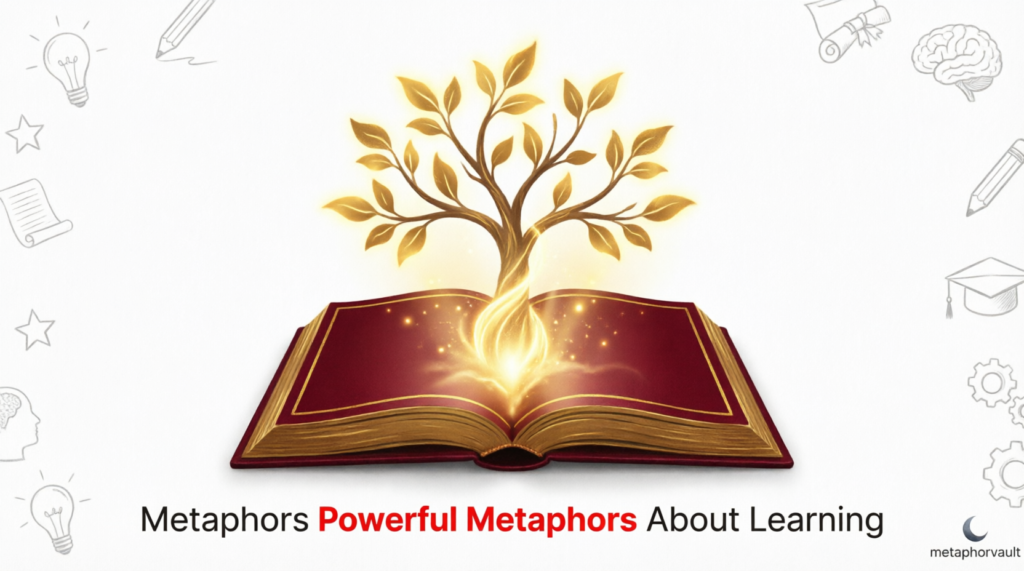
- Learning is a path.
- Education is a lifelong journey.
- Knowledge grows over time.
Difficulty: Easy
Tone: Neutral
2. Learning Is Climbing a Mountain
Meaning: Learning can be difficult, but steady effort helps you reach higher levels.
Real explanation: A mountain represents challenges, effort, progress, and achievement.
Sample sentence: “Learning calculus felt like climbing a mountain, but every problem brought me closer to the top.”
When to use it: Motivation and student reflections.
When NOT to use it: Avoid it if the subject is extremely simple and the comparison feels exaggerated.
Alternatives:
- Learning is a climb.
- Knowledge is a summit.
- Education is a challenging path.
Difficulty: Easy
Tone: Neutral
3. Knowledge Is a Seed
Meaning: Knowledge starts small and grows when it receives attention and practice.
Real explanation: A seed represents potential. What begins as one small idea can develop into deep understanding.
Sample sentence: “Every lesson is a seed of knowledge.”
When to use it: School writing, teaching, and inspirational messages.
When NOT to use it: Avoid repeating plant metaphors throughout the same paragraph.
Alternatives:
- Ideas are seeds.
- Learning plants the seeds of wisdom.
- Knowledge begins small.
Difficulty: Easy
Tone: Neutral
4. The Mind Is a Garden
Meaning: The mind needs care, useful ideas, and regular attention to grow well.
Real explanation: A garden needs water, sunlight, and care. In the same way, the mind benefits from reading, practice, curiosity, and reflection.
Sample sentence: “Your mind is a garden, so choose carefully what you plant in it.”
When to use it: Education, personal development, and motivational writing.
When NOT to use it: Avoid it in highly technical documents.
Alternatives:
- The mind is fertile ground.
- Ideas grow in the mind.
- Knowledge cultivates the mind.
Difficulty: Easy
Tone: Neutral
5. Learning Is Building a House
Meaning: Knowledge develops layer by layer, with basic skills supporting more advanced ones.
Real explanation: You cannot build a strong house without a foundation. Similarly, advanced learning often depends on basic knowledge.
Sample sentence: “Learning grammar is like building a house; the basics form the foundation.”
When to use it: Teaching and explaining skill development.
When NOT to use it: Do not imply that every subject follows a perfectly fixed sequence.
Alternatives:
- Learning builds a foundation.
- Knowledge is built step by step.
- Skills are building blocks.
Difficulty: Easy
Tone: Neutral
6. Knowledge Is a Toolbox
Meaning: Knowledge gives you tools that you can use to solve problems.
Real explanation: Different facts and skills become useful when you apply them to real situations.
Sample sentence: “A good education gives you a toolbox for solving life’s problems.”
When to use it: Practical education and career writing.
When NOT to use it: Avoid it when discussing learning mainly as emotional or artistic growth.
Alternatives:
- Skills are tools.
- Education equips you.
- Knowledge gives you resources.
Difficulty: Easy
Tone: Neutral
7. Questions Are Keys
Meaning: Questions can unlock new knowledge and understanding.
Real explanation: Asking a thoughtful question often leads to information that was previously hidden or unclear.
Sample sentence: “Good questions are keys that open doors to deeper learning.”
When to use it: Teaching, speeches, and classroom writing.
When NOT to use it: Avoid suggesting that every question has an easy answer.
Alternatives:
- Questions unlock knowledge.
- Curiosity opens doors.
- Questions reveal new ideas.
Difficulty: Easy
Tone: Neutral
8. Learning Is Opening a Door
Meaning: Learning gives you access to new ideas, opportunities, or ways of thinking.
Sample sentence: “Learning another language opened a door to a new culture.”
When to use it: Education, languages, careers, and personal growth.
When NOT to use it: Avoid using it repeatedly with other “door” metaphors nearby.
Alternatives:
- Education opens opportunities.
- Knowledge creates possibilities.
- Learning gives you access to new worlds.
Difficulty: Easy
Tone: Neutral
9. Mistakes Are Stepping Stones
Meaning: Mistakes can help you move toward greater understanding.
Real explanation: An error can show you what needs to change and give you information for your next attempt.
Sample sentence: “Her mistakes became stepping stones toward mastery.”
When to use it: Motivation, teaching, and student reflections.
When NOT to use it: Avoid minimizing serious consequences of mistakes.
Alternatives:
- Mistakes are lessons.
- Errors help us grow.
- Failure can teach us.
Difficulty: Easy
Tone: Neutral
10. Learning Is a Puzzle
Meaning: Understanding develops as separate pieces of information come together.
Sample sentence: “At first the theory seemed confusing, but each lesson added another piece to the puzzle.”
When to use it: Problem-solving and academic writing.
When NOT to use it: Avoid suggesting that every complex issue has one neat solution.
Alternatives:
- Knowledge comes together piece by piece.
- Understanding is a puzzle.
- Ideas fit together.
Difficulty: Easy
Tone: Neutral
11. A Teacher Is a Guide
Meaning: A teacher helps learners find direction without doing all the learning for them.
Sample sentence: “A good teacher is a guide who helps students find their own path.”
When to use it: Education and teaching discussions.
When NOT to use it: Avoid using this metaphor to suggest teachers have no instructional role.
Alternatives:
- A teacher is a mentor.
- Teachers provide direction.
- A teacher helps students navigate learning.
Difficulty: Easy
Tone: Neutral
12. Knowledge Is Light
Meaning: Knowledge can remove confusion and help people see things more clearly.
Sample sentence: “Education brought light to a subject I once found confusing.”
When to use it: Essays, speeches, and inspirational writing.
When NOT to use it: Avoid treating people without education as simply “in the dark.”
Alternatives:
- Knowledge illuminates ideas.
- Education brings clarity.
- Understanding sheds light on problems.
Difficulty: Easy
Tone: Neutral
13. Ignorance Is a Fog
Meaning: Not understanding something can make a situation feel unclear.
Sample sentence: “The first lesson lifted the fog surrounding the difficult topic.”
When to use it: Reflective and educational writing.
When NOT to use it: Avoid insulting someone by calling them ignorant.
Alternatives:
- Confusion is a fog.
- Understanding clears the way.
- Knowledge brings clarity.
Difficulty: Easy
Tone: Neutral
14. Learning Is Planting Roots
Meaning: Early learning creates a strong base for future growth.
Sample sentence: “Reading widely helped me plant roots for lifelong learning.”
When to use it: Long-term education and personal growth.
When NOT to use it: Avoid it when discussing rapid, short-term learning.
Alternatives:
- Learning builds roots.
- Education creates a foundation.
- Knowledge takes root.
Difficulty: Easy
Tone: Neutral
15. Skills Are Building Blocks
Meaning: Individual skills combine to create more advanced abilities.
Sample sentence: “Vocabulary and grammar are building blocks for effective communication.”
When to use it: Language learning, education, and professional development.
When NOT to use it: Avoid implying that skills always develop in a strict order.
Alternatives:
- Skills form a foundation.
- Abilities build on one another.
- Each skill adds another layer.
Difficulty: Easy
Tone: Neutral
16. Learning Is a Road
Meaning: Learning involves movement from one level of understanding to another.
Sample sentence: “Every new book took her farther down the road of learning.”
When to use it: General educational writing.
When NOT to use it: Avoid mixing it heavily with mountain, ocean, and building imagery in the same sentence.
Alternatives:
- Learning is a path.
- Knowledge is a route.
- Education is a road forward.
Difficulty: Easy
Tone: Neutral
17. Curiosity Is a Compass
Meaning: Curiosity helps learners decide what to explore next.
Sample sentence: “His curiosity became a compass that guided him toward new subjects.”
When to use it: Creative essays and motivational writing.
When NOT to use it: Avoid it when you need to emphasize a structured curriculum instead.
Alternatives:
- Curiosity guides learning.
- Questions point the way.
- Interest leads discovery.
Difficulty: Medium
Tone: Neutral
18. Practice Is Sharpening a Blade
Meaning: Repeated practice improves a skill and makes performance stronger.
Sample sentence: “Daily writing is like sharpening a blade; each session makes the skill more precise.”
When to use it: Skills, sports, music, writing, and language learning.
When NOT to use it: Avoid it for subjects where practice alone is not enough.
Alternatives:
- Practice strengthens skills.
- Repetition builds ability.
- Practice makes skills sharper.
Difficulty: Medium
Tone: Neutral
19. Learning Is Training a Muscle
Meaning: Regular mental practice can strengthen abilities.
Sample sentence: “Solving puzzles trains your problem-solving muscles.”
When to use it: Study advice and skill development.
When NOT to use it: Do not present the metaphor as a literal scientific claim about every kind of learning.
Alternatives:
- Practice strengthens the mind.
- Learning builds mental strength.
- Skills improve with exercise.
Difficulty: Easy
Tone: Informal
20. The Brain Is a Sponge
Meaning: Someone can absorb information quickly.
Sample sentence: “Young children can sometimes seem like sponges, absorbing new words wherever they go.”
When to use it: Informal conversation and teaching.
When NOT to use it: Avoid suggesting that learners simply absorb information without active thinking.
Alternatives:
- Absorb knowledge.
- Take in information.
- Soak up new ideas.
Difficulty: Easy
Tone: Informal
21. Knowledge Is a Treasure
Meaning: Knowledge is valuable and worth seeking.
Sample sentence: “The library was a treasure chest of knowledge.”
When to use it: Creative writing, speeches, and school assignments.
When NOT to use it: Avoid overusing treasure imagery.
Alternatives:
- Knowledge is valuable.
- Learning is an investment.
- Education is a valuable resource.
Difficulty: Easy
Tone: Neutral
22. Books Are Windows
Meaning: Books allow readers to see different experiences, cultures, ideas, and perspectives.
Sample sentence: “Books are windows into lives we may never experience ourselves.”
When to use it: Reading and literature essays.
When NOT to use it: Avoid suggesting books are the only way to understand other experiences.
Alternatives:
- Books open new worlds.
- Reading expands perspective.
- Stories offer new viewpoints.
Difficulty: Easy
Tone: Neutral
23. Books Are Bridges
Meaning: Reading can connect people to unfamiliar ideas, cultures, or experiences.
Sample sentence: “Books can build bridges between people from different cultures.”
When to use it: Literature, cultural studies, and education.
When NOT to use it: Avoid mixing the window and bridge metaphors too closely.
Alternatives:
- Reading connects worlds.
- Stories create connections.
- Literature links experiences.
Difficulty: Easy
Tone: Neutral
24. Learning Is Lighting a Fire
Meaning: A powerful lesson can create enthusiasm and lasting curiosity.
Sample sentence: “That science experiment lit a fire in her; she wanted to learn everything about space.”
When to use it: Inspirational writing and teaching.
When NOT to use it: Avoid suggesting that excitement alone guarantees learning.
Alternatives:
- Spark curiosity.
- Ignite interest.
- Awaken a passion for learning.
Difficulty: Easy
Tone: Neutral
25. A Lesson Is a Spark
Meaning: A lesson can begin a much larger process of thinking and discovery.
Sample sentence: “The lecture was only a spark, but it inspired years of research.”
When to use it: Education and reflective writing.
When NOT to use it: Avoid implying that every lesson has a dramatic effect.
Alternatives:
- A lesson sparks curiosity.
- An idea starts a fire.
- Teaching can inspire discovery.
Difficulty: Easy
Tone: Neutral
26. Learning Is Crossing a Bridge
Meaning: Learning can help someone move from confusion to understanding or from one ability level to another.
Sample sentence: “Practice helped him cross the bridge from beginner to confident speaker.”
When to use it: Skill development.
When NOT to use it: Avoid if there is no clear “before and after” in your context.
Alternatives:
- Learning connects two stages.
- Education creates a path forward.
- Practice takes you to the next level.
Difficulty: Easy
Tone: Neutral
27. Understanding Is a Light Switch
Meaning: Sometimes one idea suddenly makes a confusing subject clear.
Sample sentence: “The teacher’s example flipped the light switch in my mind.”
When to use it: Informal explanations and student reflections.
When NOT to use it: Not all learning happens suddenly.
Alternatives:
- It suddenly clicked.
- The idea became clear.
- I finally understood.
Difficulty: Easy
Tone: Informal
28. Learning Is a Treasure Hunt
Meaning: Learning involves searching, discovering, and finding valuable information.
Sample sentence: “Research turned the history project into a treasure hunt.”
When to use it: Research and classroom activities.
When NOT to use it: Avoid implying that research always produces exciting discoveries.
Alternatives:
- Learning is exploration.
- Research is discovery.
- Knowledge can be found through exploration.
Difficulty: Easy
Tone: Neutral
29. Curiosity Is a Doorway
Meaning: Curiosity leads people toward new ideas and experiences.
Sample sentence: “One question became a doorway to an entirely new field of study.”
When to use it: Creative educational writing.
When NOT to use it: Avoid repeating “door” imagery nearby.
Alternatives:
- Curiosity opens possibilities.
- Questions lead to discovery.
- Interest creates new paths.
Difficulty: Medium
Tone: Neutral
30. Learning Is Exploring an Ocean
Meaning: Knowledge is vast, and there is always more to discover.
Sample sentence: “The internet is an ocean of information, but learning requires knowing where to look.”
When to use it: Broad subjects and lifelong learning.
When NOT to use it: Avoid using the metaphor to suggest that all online information is reliable.
Alternatives:
- Knowledge is vast.
- Learning is exploration.
- There is always more to discover.
Difficulty: Easy
Tone: Neutral
31. Knowledge Is an Ocean
Meaning: There is an enormous amount of information and understanding available.
Sample sentence: “One textbook gave me a glimpse of the vast ocean of knowledge.”
When to use it: Essays and speeches.
When NOT to use it: Avoid if you need to emphasize a small, focused topic.
Alternatives:
- Knowledge is vast.
- Information is deep.
- Learning has no end.
Difficulty: Easy
Tone: Neutral
32. A Beginner Is at the Starting Line
Meaning: Being new to a subject means beginning a process rather than failing.
Sample sentence: “Being at the starting line is nothing to be ashamed of.”
When to use it: Motivation and beginner education.
When NOT to use it: Avoid making learning sound like a competition.
Alternatives:
- Start from the beginning.
- Begin your learning path.
- Take the first step.
Difficulty: Easy
Tone: Neutral
33. Progress Is a Staircase
Meaning: Improvement often happens through a series of small steps.
Sample sentence: “Each new skill was another step on the staircase of learning.”
When to use it: Study motivation.
When NOT to use it: Avoid implying that progress is always steady.
Alternatives:
- Progress comes step by step.
- Each skill raises your level.
- Learning has stages.
Difficulty: Easy
Tone: Neutral
34. Learning Is Climbing a Ladder
Meaning: Learners can gradually move toward greater knowledge or skill.
Sample sentence: “Each new course helped her climb another rung on the ladder of knowledge.”
When to use it: Education and career development.
When NOT to use it: Avoid if the learning process is not hierarchical.
Alternatives:
- Move to the next level.
- Build expertise.
- Develop your skills.
Difficulty: Easy
Tone: Neutral
35. Experience Is a Teacher
Meaning: Real experiences can teach lessons that cannot always be learned from books.
Sample sentence: “Experience was his greatest teacher.”
When to use it: Personal essays and reflective writing.
When NOT to use it: Avoid suggesting experience replaces formal education.
Alternatives:
- Experience teaches us.
- Life provides lessons.
- We learn by doing.
Difficulty: Easy
Tone: Neutral
36. Failure Is a Teacher
Meaning: Failure can reveal weaknesses and show what needs to change.
Sample sentence: “The failed experiment became a teacher rather than a defeat.”
When to use it: Motivation and personal development.
When NOT to use it: Do not romanticize harmful or serious failures.
Alternatives:
- Failure teaches lessons.
- Setbacks reveal weaknesses.
- Errors provide feedback.
Difficulty: Easy
Tone: Neutral
37. Feedback Is a Mirror
Meaning: Feedback shows us things about our performance that we may not notice ourselves.
Sample sentence: “Honest feedback is a mirror that helps a writer see weak parts of a draft.”
When to use it: School, work, writing, and coaching.
When NOT to use it: Avoid treating every opinion as accurate feedback.
Alternatives:
- Feedback reveals weaknesses.
- Criticism can show blind spots.
- Feedback gives perspective.
Difficulty: Medium
Tone: Neutral
38. Memory Is a Library
Meaning: The mind can store information that can later be retrieved.
Sample sentence: “His memory was a library filled with stories and facts.”
When to use it: Creative writing.
When NOT to use it: Avoid presenting memory as perfectly organized.
Alternatives:
- Memory stores experiences.
- The mind holds knowledge.
- Memories fill the mind.
Difficulty: Easy
Tone: Neutral
39. The Mind Is a Library
Meaning: The mind contains many ideas, experiences, and pieces of knowledge.
Sample sentence: “Every book added another volume to her mental library.”
When to use it: Reading and education.
When NOT to use it: Avoid suggesting that knowledge is simply stored without interpretation.
Alternatives:
- The mind stores ideas.
- Knowledge fills the mind.
- Reading expands the mental library.
Difficulty: Easy
Tone: Neutral
40. Knowledge Is a Map
Meaning: Knowledge helps people understand where they are and decide what to do next.
Sample sentence: “Basic financial knowledge gives young adults a map for making better decisions.”
When to use it: Practical education and professional writing.
When NOT to use it: Avoid suggesting knowledge always gives one correct route.
Alternatives:
- Knowledge provides direction.
- Education guides decisions.
- Understanding helps us navigate.
Difficulty: Easy
Tone: Neutral
41. A Mentor Is a Lighthouse
Meaning: A mentor can provide guidance when someone feels uncertain.
Sample sentence: “Her mentor was a lighthouse during the confusing first year of her career.”
When to use it: Mentoring and professional development.
When NOT to use it: Avoid suggesting mentors make decisions for others.
Alternatives:
- A mentor provides direction.
- A mentor guides learners.
- Good mentors offer clarity.
Difficulty: Medium
Tone: Neutral
42. Learning Is Sailing
Meaning: Learning requires direction while also responding to changing conditions.
Sample sentence: “Learning to lead a team is like sailing; you need a destination, but you must also respond to changing conditions.”
When to use it: Leadership and personal development.
When NOT to use it: Avoid if the audience may find the nautical imagery confusing.
Alternatives:
- Learning requires navigation.
- Education is a voyage.
- Growth requires direction.
Difficulty: Medium
Tone: Neutral
43. Questions Are Seeds
Meaning: A question can grow into deeper thinking and new knowledge.
Sample sentence: “Every good question is a seed that can grow into a new idea.”
When to use it: Teaching and creative writing.
When NOT to use it: Avoid if the questions are purely factual and require immediate answers.
Alternatives:
- Questions inspire ideas.
- Curiosity starts growth.
- Questions lead to discovery.
Difficulty: Easy
Tone: Neutral
44. Ideas Are Sparks
Meaning: Ideas can start a larger process of thinking.
Sample sentence: “One small idea sparked a year of research.”
When to use it: Creativity and academic work.
When NOT to use it: Avoid if the idea developed slowly and the “spark” image feels unnatural.
Alternatives:
- Ideas inspire thought.
- Ideas trigger discovery.
- One thought can start a process.
Difficulty: Easy
Tone: Neutral
45. Learning Is a Conversation
Meaning: Learning grows through questions, answers, discussion, listening, and exchange.
Sample sentence: “The best classroom felt less like a lecture and more like a conversation.”
When to use it: Teaching and collaborative learning.
When NOT to use it: Avoid implying that individual study has no value.
Alternatives:
- Learning is dialogue.
- Education grows through discussion.
- We learn through exchange.
Difficulty: Medium
Tone: Neutral
46. A Classroom Is a Laboratory
Meaning: A classroom can be a place where learners test ideas, make mistakes, and discover what works.
Sample sentence: “The writing class became a laboratory for testing different storytelling techniques.”
When to use it: Creative and practical education.
When NOT to use it: Avoid suggesting every classroom activity is an experiment.
Alternatives:
- The classroom is a place for discovery.
- Students test ideas.
- Learning happens through practice.
Difficulty: Medium
Tone: Neutral
47. Learning Is a Workout
Meaning: Mental skills improve through regular effort and practice.
Sample sentence: “Reading difficult books can feel like a workout for the mind.”
When to use it: Study habits and motivation.
When NOT to use it: Avoid implying that struggling is always necessary for learning.
Alternatives:
- Learning exercises the mind.
- Practice strengthens skills.
- Study builds mental ability.
Difficulty: Easy
Tone: Informal
48. Knowledge Is a Bridge to Opportunity
Meaning: Education and skills can help people reach new possibilities.
Sample sentence: “Digital skills can become a bridge to new career opportunities.”
When to use it: Career, education, and motivational writing.
When NOT to use it: Avoid implying education guarantees success.
Alternatives:
- Education creates opportunities.
- Skills open doors.
- Knowledge supports career growth.
Difficulty: Easy
Tone: Neutral
49. Learning Is a Key
Meaning: Learning can provide access to new opportunities, skills, or understanding.
Sample sentence: “Learning to communicate clearly was the key to her professional growth.”
When to use it: Career and personal development.
When NOT to use it: Avoid suggesting one skill is the answer to every problem.
Alternatives:
- Education unlocks opportunities.
- Skills create access.
- Knowledge opens doors.
Difficulty: Easy
Tone: Neutral
50. Education Is an Investment
Meaning: Time and effort spent learning can create value later.
Sample sentence: “She viewed education as an investment in her future.”
When to use it: Career, school, and financial discussions.
When NOT to use it: Avoid reducing education only to financial returns.
Alternatives:
- Learning pays off.
- Knowledge has long-term value.
- Education builds future possibilities.
Difficulty: Easy
Tone: Neutral
51. Learning Is a Workout for Curiosity
Meaning: Exploring ideas regularly can keep curiosity active and strong.
Sample sentence: “Reading outside your field is a workout for curiosity.”
When to use it: Informal educational writing.
When NOT to use it: Avoid if you need a more formal metaphor.
Alternatives:
- Reading feeds curiosity.
- Exploration strengthens curiosity.
- Learning keeps curiosity alive.
Difficulty: Medium
Tone: Informal
52. Knowledge Is a Compass
Meaning: Understanding helps people make informed choices.
Sample sentence: “Knowledge became her compass when she had to choose a career.”
When to use it: Advice, education, and personal development.
When NOT to use it: Avoid implying that knowledge removes uncertainty completely.
Alternatives:
- Knowledge guides decisions.
- Education provides direction.
- Understanding helps us choose.
Difficulty: Easy
Tone: Neutral
53. Learning Is a Garden That Never Stops Growing
Meaning: Lifelong learning continues throughout life.
Sample sentence: “The mind is a garden that never stops growing when we continue to learn.”
When to use it: Lifelong learning and inspirational writing.
When NOT to use it: Avoid if your subject concerns a short training course.
Alternatives:
- Learning is lifelong growth.
- Knowledge keeps expanding.
- There is always more to learn.
Difficulty: Easy
Tone: Neutral
54. Practice Is the Road to Mastery
Meaning: Regular practice helps turn knowledge into reliable skill.
Sample sentence: “Practice is the road to mastery for musicians, athletes, and writers alike.”
When to use it: Skill development.
When NOT to use it: Avoid suggesting practice is the only factor involved in mastery.
Alternatives:
- Practice builds mastery.
- Repetition develops skill.
- Improvement comes through practice.
Difficulty: Easy
Tone: Neutral
55. A Difficult Problem Is a Locked Door
Meaning: A challenging problem requires a solution before progress can continue.
Sample sentence: “The final equation felt like a locked door until she understood the underlying rule.”
When to use it: Mathematics, puzzles, and problem-solving.
When NOT to use it: Avoid if the problem has several possible solutions.
Alternatives:
- The problem is a barrier.
- The solution unlocks understanding.
- A challenge blocks progress.
Difficulty: Easy
Tone: Neutral
56. Understanding Is Putting Pieces Together
Meaning: Learning often involves connecting separate facts and ideas.
Sample sentence: “Once I understood how the events were connected, the history lesson finally came together.”
When to use it: Academic writing and explanations.
When NOT to use it: Avoid treating every form of understanding as a simple puzzle.
Alternatives:
- Ideas connect.
- The bigger picture emerges.
- The concepts come together.
Difficulty: Easy
Tone: Neutral
57. Learning Is Leaving a Comfort Zone
Meaning: Growth often requires trying unfamiliar things and facing uncertainty.
Sample sentence: “Speaking English in public meant leaving my comfort zone.”
When to use it: Language learning, confidence, and personal growth.
When NOT to use it: Avoid implying that people must always feel uncomfortable to learn.
Alternatives:
- Try something unfamiliar.
- Push beyond familiar limits.
- Take on a new challenge.
Difficulty: Easy
Tone: Neutral
58. Knowledge Is a Backpack
Meaning: People collect useful knowledge and skills that they can carry into new situations.
Sample sentence: “Every course added another useful tool to his mental backpack.”
When to use it: Creative educational writing.
When NOT to use it: Avoid implying that knowledge is always useful in every situation.
Alternatives:
- Carry useful skills with you.
- Build a collection of knowledge.
- Add to your experience.
Difficulty: Easy
Tone: Informal
59. Learning Is a River
Meaning: Learning can keep moving and changing rather than following a perfectly straight path.
Sample sentence: “Her education was a river that changed direction as her interests developed.”
When to use it: Personal essays and creative writing.
When NOT to use it: Avoid it when you need to describe a fixed curriculum.
Alternatives:
- Learning keeps flowing.
- Education evolves.
- Knowledge is always moving.
Difficulty: Medium
Tone: Neutral
60. Curiosity Is Fuel
Meaning: Curiosity provides the motivation to keep learning.
Sample sentence: “Curiosity was the fuel that kept him studying long after class ended.”
When to use it: Motivation and education.
When NOT to use it: Avoid suggesting curiosity is the only source of motivation.
Alternatives:
- Curiosity drives learning.
- Interest motivates discovery.
- Questions keep us moving.
Difficulty: Easy
Tone: Neutral
61. Learning Is a Treasure Map
Meaning: Education can provide clues and directions for finding valuable knowledge or opportunities.
Sample sentence: “Each new skill was another mark on her treasure map toward a career she loved.”
When to use it: Creative writing and motivational posts.
When NOT to use it: Avoid in formal academic analysis unless the metaphor serves a clear purpose.
Alternatives:
- Education provides direction.
- Skills guide your progress.
- Knowledge points toward opportunity.
Difficulty: Easy
Tone: Neutral
62. A Good Question Is a Doorway to Discovery
Meaning: Thoughtful questions can lead learners to information and ideas they had not considered.
Sample sentence: “The student’s simple question became a doorway to a much deeper discussion.”
When to use it: Teaching and classroom writing.
When NOT to use it: Avoid if the question has already been fully answered and produced no further exploration.
Alternatives:
- Questions lead to discovery.
- Curiosity opens new paths.
- Inquiry creates understanding.
Difficulty: Medium
Tone: Neutral
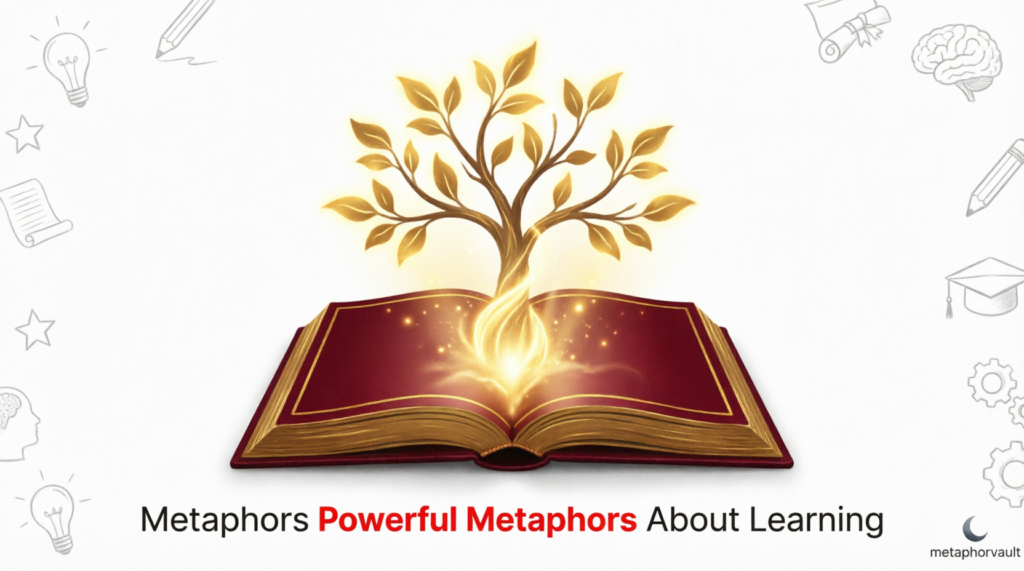
63. Learning Is a Seed Becoming a Tree
Meaning: Small pieces of knowledge can develop into deep understanding over time.
Sample sentence: “That first history lesson was a seed that eventually grew into a love of archaeology.”
When to use it: Personal stories and inspirational writing.
When NOT to use it: Avoid when describing learning that happens immediately.
Alternatives:
- Knowledge grows over time.
- Small ideas become deep understanding.
- Learning develops gradually.
Difficulty: Easy
Tone: Neutral
64. Wisdom Is the Fruit of Learning
Meaning: Knowledge and experience can eventually produce better judgment.
Sample sentence: “Wisdom is often the fruit that grows from years of learning and experience.”
When to use it: Reflective essays and speeches.
When NOT to use it: Avoid assuming that age or education automatically produces wisdom.
Alternatives:
- Wisdom grows from experience.
- Learning develops judgment.
- Experience deepens understanding.
Difficulty: Medium
Tone: Neutral
Quick Reference Table
| # | Metaphor | Main meaning | Difficulty | Tone |
|---|---|---|---|---|
| 1 | Learning is a journey | Progress takes time | Easy | Neutral |
| 2 | Learning is climbing a mountain | Learning requires effort | Easy | Neutral |
| 3 | Knowledge is a seed | Knowledge grows | Easy | Neutral |
| 4 | Mind is a garden | Ideas need care | Easy | Neutral |
| 5 | Learning is building a house | Skills build on foundations | Easy | Neutral |
| 6 | Knowledge is a toolbox | Knowledge provides useful skills | Easy | Neutral |
| 7 | Questions are keys | Questions unlock knowledge | Easy | Neutral |
| 8 | Learning is opening a door | Learning creates access | Easy | Neutral |
| 9 | Mistakes are stepping stones | Errors can support growth | Easy | Neutral |
| 10 | Learning is a puzzle | Ideas come together | Easy | Neutral |
| 11 | Teacher is a guide | Teachers provide direction | Easy | Neutral |
| 12 | Knowledge is light | Knowledge creates clarity | Easy | Neutral |
| 13 | Ignorance is fog | Lack of understanding creates confusion | Easy | Neutral |
| 14 | Learning is planting roots | Early learning creates a base | Easy | Neutral |
| 15 | Skills are building blocks | Skills combine | Easy | Neutral |
| 16 | Learning is a road | Learning involves progress | Easy | Neutral |
| 17 | Curiosity is a compass | Curiosity guides exploration | Medium | Neutral |
| 18 | Practice sharpens a blade | Practice improves ability | Medium | Neutral |
| 19 | Learning trains a muscle | Practice strengthens skills | Easy | Informal |
| 20 | Brain is a sponge | Absorbing information | Easy | Informal |
| 21 | Knowledge is treasure | Knowledge has value | Easy | Neutral |
| 22 | Books are windows | Books offer perspectives | Easy | Neutral |
| 23 | Books are bridges | Reading connects people and ideas | Easy | Neutral |
| 24 | Learning lights a fire | Learning creates passion | Easy | Neutral |
| 25 | Lesson is a spark | Lessons inspire thought | Easy | Neutral |
| 26 | Learning crosses a bridge | Learning connects stages | Easy | Neutral |
| 27 | Understanding is a light switch | Something suddenly becomes clear | Easy | Informal |
| 28 | Learning is a treasure hunt | Learning involves discovery | Easy | Neutral |
| 29 | Curiosity is a doorway | Curiosity leads to ideas | Medium | Neutral |
| 30 | Learning is exploring an ocean | Knowledge is vast | Easy | Neutral |
| 31 | Knowledge is an ocean | Information is enormous | Easy | Neutral |
| 32 | Beginner is at the starting line | Beginning is normal | Easy | Neutral |
| 33 | Progress is a staircase | Improvement happens in steps | Easy | Neutral |
| 34 | Learning is climbing a ladder | Learners reach higher levels | Easy | Neutral |
| 35 | Experience is a teacher | Experience teaches lessons | Easy | Neutral |
| 36 | Failure is a teacher | Failure provides lessons | Easy | Neutral |
| 37 | Feedback is a mirror | Feedback reveals weaknesses | Medium | Neutral |
| 38 | Memory is a library | Memory stores information | Easy | Neutral |
| 39 | Mind is a library | Mind contains ideas | Easy | Neutral |
| 40 | Knowledge is a map | Knowledge provides direction | Easy | Neutral |
| 41 | Mentor is a lighthouse | Mentors provide guidance | Medium | Neutral |
| 42 | Learning is sailing | Learning requires navigation | Medium | Neutral |
| 43 | Questions are seeds | Questions grow into ideas | Easy | Neutral |
| 44 | Ideas are sparks | Ideas start thinking | Easy | Neutral |
| 45 | Learning is a conversation | Discussion supports learning | Medium | Neutral |
| 46 | Classroom is a laboratory | Learning involves testing ideas | Medium | Neutral |
| 47 | Learning is a workout | Practice develops skills | Easy | Informal |
| 48 | Knowledge is a bridge to opportunity | Skills create possibilities | Easy | Neutral |
| 49 | Learning is a key | Learning unlocks opportunities | Easy | Neutral |
| 50 | Education is an investment | Learning has future value | Easy | Neutral |
| 51 | Learning is a workout for curiosity | Exploration keeps curiosity active | Medium | Informal |
| 52 | Knowledge is a compass | Knowledge guides choices | Easy | Neutral |
| 53 | Learning is a growing garden | Learning is lifelong | Easy | Neutral |
| 54 | Practice is the road to mastery | Practice builds expertise | Easy | Neutral |
| 55 | Difficult problem is a locked door | Problems require solutions | Easy | Neutral |
| 56 | Understanding is putting pieces together | Ideas connect | Easy | Neutral |
| 57 | Learning is leaving a comfort zone | Growth involves new experiences | Easy | Neutral |
| 58 | Knowledge is a backpack | People carry useful skills | Easy | Informal |
| 59 | Learning is a river | Learning changes and flows | Medium | Neutral |
| 60 | Curiosity is fuel | Curiosity drives learning | Easy | Neutral |
| 61 | Learning is a treasure map | Learning gives direction | Easy | Neutral |
| 62 | Question is a doorway | Questions lead to discovery | Medium | Neutral |
| 63 | Seed becomes a tree | Understanding develops | Easy | Neutral |
| 64 | Wisdom is the fruit of learning | Learning can develop judgment | Medium | Neutral |
Real-Life Conversations
Learning metaphors sound most natural when they fit the situation. Here are several examples showing how people might actually use them.
Conversation 1: Two Friends
Sam: I thought learning Spanish would be easy.
Maya: Same. Then I realized how much there was to learn.
Sam: Exactly. It feels like climbing a mountain.
Maya: But you’re already much better than you were three months ago.
Sam: True. I guess every mistake is a stepping stone.
Maya: That’s the right way to see it. Keep practicing.
Conversation 2: Student and Teacher
Student: I don’t understand how this formula works.
Teacher: That’s okay. Think of the problem like a puzzle.
Student: So I should look for the pieces first?
Teacher: Exactly. Find what you know, then see how the pieces connect.
Student: Oh, that makes more sense.
Teacher: Good questions are often the keys that unlock difficult ideas.
Conversation 3: Parent and Child
Child: I got three questions wrong on my test.
Parent: How do you feel about it?
Child: Bad. I thought I knew everything.
Parent: Mistakes can be stepping stones. What did those three questions teach you?
Child: That I need to practice fractions more.
Parent: Then you already learned something valuable from the test.
Conversation 4: Student and Classmate
Alex: Why do you read books that aren’t on the syllabus?
Jordan: Because books are like windows. They let me see ideas I wouldn’t meet otherwise.
Alex: Doesn’t it take too much time?
Jordan: Sometimes. But I learn things that help me in other classes too.
Alex: Maybe I’ll try one this weekend.
Conversation 5: Office Conversation
Manager: How are you finding the new software?
Employee: Honestly, it’s confusing.
Manager: That’s normal at first.
Employee: I feel like I’m starting from zero.
Manager: Everyone starts at the starting line. Give yourself time.
Employee: I suppose each mistake is another stepping stone.
Manager: Exactly. Keep asking questions.
Everyday Usage
Learning metaphors appear in many forms of communication because they can explain an invisible process in a way people immediately understand.
Learning Metaphors in Conversation
In everyday speech, people usually choose short and familiar metaphors.
For example:
“I’m still finding my feet.”
“It finally clicked.”
“I’m getting the hang of it.”
“I have a lot to learn.”
“Practice is paying off.”
These expressions sound natural because people do not stop to analyze the metaphor. They understand the meaning from context.
Learning Metaphors in Writing
Metaphors can make essays and personal reflections more vivid.
Instead of:
“I learned slowly and made many mistakes.”
You could write:
“My learning was a winding road, filled with wrong turns and small discoveries.”
The second sentence gives the reader a stronger picture.
Learning Metaphors in Books
Authors often use metaphors to describe intellectual and emotional growth.
A character may discover that:
- knowledge is a key,
- education is a journey,
- memory is a room,
- curiosity is a flame,
- or experience is a teacher.
These images help readers understand a character’s inner development.
Learning Metaphors in Movies
Movies often show learning visually. A character may begin at the bottom of a mountain, enter a new world, train repeatedly, fail, and eventually succeed.
Even when the dialogue does not explicitly say “learning is a journey,” the story may communicate exactly that metaphor.
Learning Metaphors in Poetry
Poetry gives metaphors even more freedom.
A poet might describe knowledge as:
“a small flame in a dark room”
or learning as:
“a river carrying questions toward the sea.”
Poetry does not need the metaphor to be literal or practical. Emotional impact matters more.
Learning Metaphors in Emails
Professional emails should usually use simple metaphors.
For example:
“This training will give the team a strong foundation for the next stage of the project.”
That sounds natural and professional.
Avoid highly dramatic expressions such as “This course will ignite a blazing fire of knowledge” in a normal workplace email.
Learning Metaphors in Text Messages
Text messages allow more casual language:
“Math finally clicked 😂”
“I’m slowly getting the hang of coding.”
“That class opened my eyes.”
These expressions feel natural because they are short and conversational.
Learning Metaphors on Instagram
Social-media captions often use motivational learning metaphors:
“Every mistake is another stepping stone.”
“Keep planting seeds. Growth takes time.”
“Learning is a journey, not a race.”
Short metaphors work particularly well because users can understand them quickly.
Learning Metaphors on Facebook
Facebook posts can use slightly longer reflections:
“Looking back, I realize that every difficult lesson was another piece of the puzzle. I didn’t understand the picture at the time, but the pieces slowly came together.”
Learning Metaphors on X
Short metaphors are usually strongest:
“Curiosity is fuel. Keep asking questions.”
Or:
“Don’t fear the steep part of the climb. That’s where growth happens.”
Learning Metaphors on LinkedIn
Professional platforms usually favor practical metaphors:
“Every new skill becomes another tool in your professional toolbox.”
Or:
“Good feedback acts like a mirror. It shows you what you cannot always see yourself.”
These expressions connect learning with workplace growth without sounding overly dramatic.
Learning Metaphors in School Assignments
Students can use metaphors to make personal reflections more interesting.
For example:
“My first attempt at public speaking felt like standing at the bottom of a mountain. Every presentation became another step upward.”
This works because the metaphor connects directly to the student’s experience.
How to Choose the Right Learning Metaphor
The best metaphor depends on the message you want to communicate.
Use a journey metaphor when you want to emphasize time and progress.
“Learning is a journey.”
Use a mountain metaphor when you want to emphasize difficulty and achievement.
“Learning is climbing a mountain.”
Use a garden metaphor when you want to emphasize growth and care.
“The mind is a garden.”
Use a building metaphor when you want to emphasize foundations and skills.
“Skills are building blocks.”
Use a key or door metaphor when you want to emphasize new opportunities.
“Knowledge is a key.”
Use a puzzle metaphor when you want to emphasize connecting ideas.
“Understanding is putting the pieces together.”
Use a toolbox metaphor when you want to emphasize practical skills.
“Knowledge is a toolbox.”
Use a compass metaphor when you want to emphasize direction.
“Curiosity is a compass.”
Example Student Paragraph
Learning is like climbing a mountain. At first, the path may seem difficult, and every step may feel slow. But with practice, patience, and guidance, the climb becomes easier. Mistakes are not signs that we should stop. They are stepping stones that help us find a better path. When we finally reach a new level of understanding, we can look back and see how far we have come.
Learning Metaphors for Teachers
Teachers can use metaphors to explain growth without making lessons unnecessarily complicated.
Useful choices include:
- The teacher is a guide.
- The classroom is a laboratory.
- Questions are keys.
- Knowledge is a seed.
- The mind is a garden.
- Learning is a journey.
- Feedback is a mirror.
- Skills are building blocks.
For example:
“My job as a teacher is not to carry students up the mountain. It is to help them learn how to climb.”
This metaphor emphasizes guidance, independence, and student effort.
Learning Metaphors for Essays
For formal or semi-formal essays, choose metaphors that are clear rather than overly poetic.
Strong choices
- Learning is a journey.
- Education is a foundation.
- Knowledge is a key.
- Experience is a teacher.
- Skills are building blocks.
- Curiosity is a compass.
- Mistakes are stepping stones.
Example
“Education provides the foundation on which future skills can be built.”
This works particularly well because the metaphor is clear without distracting from the argument.
Learning Metaphors for Motivation
Motivational writing often focuses on persistence.
Some effective examples are:
“Every mistake is a stepping stone.”
“Learning is a climb, not a race.”
“Keep planting seeds; growth takes time.”
“Practice is the road to mastery.”
“Curiosity is fuel.”
“Every question opens another door.”
The strongest motivational metaphor is usually one that feels realistic. Learning does not always move upward. People forget things, struggle, change direction, and sometimes need to start again.
That is why a metaphor such as “learning is a journey” can be more useful than saying “learning is a straight staircase.”
Learning Metaphors About Growth
When your main idea is personal or intellectual growth, nature metaphors work especially well.
Examples
Knowledge is a seed.
Small ideas can grow into deep understanding.
The mind is a garden.
What we read, practice, and think about can shape our mental growth.
Wisdom is the fruit of learning.
Knowledge and experience can contribute to mature judgment.
Learning is planting roots.
Early knowledge can provide a strong base for future development.
Learning is a tree growing branches.
One subject can lead naturally to many related interests.
Example
“Her first science lesson was a tiny seed, but years of study allowed it to grow into a deep passion for research.”
Learning Metaphors About Mistakes
Mistakes are one of the most common parts of learning, so they deserve their own group of metaphors.
Useful expressions
- Mistakes are stepping stones.
- Failure is a teacher.
- Errors are signposts.
- Feedback is a mirror.
- Setbacks are detours.
- Difficulties are hurdles.
- Challenges are training grounds.
For example:
“The wrong answer was not the end of the lesson; it was a signpost showing me where my thinking needed to change.”
This approach is more useful than simply saying “failure is good.” Some failures are painful or costly. The useful point is that reflection can sometimes turn an unsuccessful attempt into information for the next attempt.
Learning Metaphors About Curiosity
Curiosity drives many forms of learning.
Good metaphors include:
- Curiosity is a compass.
- Curiosity is fuel.
- Questions are keys.
- Questions are seeds.
- Curiosity is a doorway.
- Ideas are sparks.
- Learning is a treasure hunt.
Example
“Curiosity was the compass that led her from one question to another until she discovered a subject she loved.”
This works especially well in personal statements, student essays, and educational speeches.
Learning Metaphors About Teachers
Teachers can be compared to people or objects that provide direction and support.
Common metaphors
Teacher as a guide: Provides direction.
Teacher as a lighthouse: Helps learners navigate uncertainty.
Teacher as a gardener: Creates conditions for growth.
Teacher as a coach: Gives practice, feedback, and encouragement.
Teacher as a bridge: Helps students move from one level of understanding to another.
Example
“A great teacher is less like a person carrying you to the finish line and more like a guide showing you how to find your own way.”
Learning Metaphors About Knowledge
Knowledge itself can take many metaphorical forms.
It can be:
- a key,
- a map,
- a compass,
- light,
- treasure,
- a toolbox,
- a bridge,
- a seed,
- a library,
- a foundation.
Each metaphor changes the emphasis.
Knowledge as a key emphasizes access.
Knowledge as a map emphasizes direction.
Knowledge as light emphasizes clarity.
Knowledge as a toolbox emphasizes practical use.
Knowledge as treasure emphasizes value.
Knowledge as a foundation emphasizes stability.
Common Mistakes When Using Learning Metaphors
1. Mixing Too Many Metaphors
Avoid sentences like:
“Learning is a mountain, a river, a garden, a spaceship, and a puzzle.”
Each metaphor may work separately, but together they create confusion.
Choose one central image.
2. Making the Metaphor Too Complicated
A metaphor should clarify the idea, not create another problem for the reader.
Simple is usually stronger.
3. Using a Metaphor That Does Not Fit
If you are discussing steady practice, “practice sharpens a blade” may work.
If you are discussing discovering new ideas, “curiosity is a compass” may be better.
4. Treating a Metaphor as a Literal Fact
A metaphor is a comparison. Saying “the brain is a sponge” does not mean the brain literally works like a household sponge.
5. Overusing Clichés
“Learning is a journey” is useful, but it is also familiar.
In creative writing, you can make it more personal:
“My learning journey was less like a straight road and more like a trail with unexpected turns.”
6. Forgetting the Audience
A metaphor suitable for an Instagram caption may not belong in a scientific report.
Match the language to the reader.
Learning Metaphors vs. Literal Language
Understanding the difference helps you use metaphors correctly.
| Literal expression | Metaphorical expression |
|---|---|
| Learning takes time. | Learning is a journey. |
| Knowledge helps us make decisions. | Knowledge is a compass. |
| Practice improves skills. | Practice sharpens a blade. |
| Mistakes can teach us. | Mistakes are stepping stones. |
| Books provide new perspectives. | Books are windows. |
| Questions lead to answers. | Questions are keys. |
| Skills support advanced learning. | Skills are building blocks. |
| Education creates opportunities. | Education opens doors. |
| Feedback reveals weaknesses. | Feedback is a mirror. |
| Understanding develops gradually. | Knowledge grows like a tree. |
Literal language gives information directly.
Metaphorical language gives information plus an image.
Are Learning Metaphors and Metaphors for Learning the Same?
They are closely related, but the wording can suggest slightly different things.
Learning metaphors usually means metaphors that describe or represent the process of learning.
Examples include:
“Learning is a journey.”
“The mind is a garden.”
“Mistakes are stepping stones.”
Metaphors for learning can also refer to the mental models people use to understand how learning works.
For example, someone may think of learning as building, where new knowledge rests on previous knowledge. Another person may think of learning as exploration, where questions lead to discovery.
So both phrases are often used for the same general topic, but “metaphors for learning” can include broader theories or ways of thinking about education.
Frequently Asked Questions About Learning Metaphors
What is a metaphor for learning?
A metaphor for learning is a comparison that describes the learning process through something familiar. Examples include “learning is a journey,” “learning is climbing a mountain,” and “the mind is a garden.” These comparisons make abstract ideas about knowledge, growth, practice, and understanding easier to picture.
What is the best metaphor for learning?
There is no single best metaphor for learning because different metaphors emphasize different parts of the experience. “Learning is a journey” is one of the most flexible because it can represent progress, challenges, mistakes, discoveries, and personal growth.
What is a good metaphor for education?
A strong metaphor for education is “education is a foundation.” It suggests that education provides basic knowledge and skills on which people can build future abilities, opportunities, and understanding.
What is a metaphor for gaining knowledge?
“Knowledge is a treasure” is a simple metaphor for gaining knowledge because it presents information and understanding as valuable things worth seeking. “Knowledge is a toolbox” works better when you want to emphasize using what you learn.
What is a metaphor for a teacher?
“A teacher is a guide” is one of the clearest metaphors for a teacher. It suggests that teachers provide direction, support, explanations, and encouragement while learners still do their own work.
What is a metaphor for a student?
A student can be described as an explorer, a gardener, a builder, or a traveler. Each metaphor emphasizes something different: exploration focuses on discovery, gardening on growth, building on skill development, and traveling on progress.
What is a metaphor for knowledge?
Knowledge can be described as a key, map, compass, light, treasure, toolbox, bridge, library, or foundation. The best choice depends on your intended meaning.
What is a metaphor for studying?
Studying can be described as training a muscle, sharpening a blade, climbing a mountain, or putting together a puzzle. These metaphors emphasize practice, improvement, difficulty, and connecting ideas.
What metaphor represents lifelong learning?
“Learning is a journey” is an excellent metaphor for lifelong learning because a journey does not have to end at graduation. People can continue gaining knowledge and skills throughout their lives.
What is a metaphor for learning from mistakes?
“Mistakes are stepping stones” is one of the clearest metaphors. It suggests that errors can become part of the path toward improvement when people reflect on them and use what they learned.
Final Takeaway
Learning is much more than collecting facts. It is a process of asking questions, making connections, practicing skills, making mistakes, gaining experience, and slowly developing a deeper understanding.
That is why learning metaphors are so useful. A journey shows progress. A mountain shows difficulty. A garden shows growth. A building shows foundations. A puzzle shows connection. A key shows opportunity. A compass shows direction.
The best metaphor is the one that matches the idea you want to communicate.
If you are writing for students, start with simple images such as “learning is a journey” or “skills are building blocks.” For creative writing, you can use richer comparisons such as “curiosity is a compass” or “knowledge is an ocean.” For professional communication, practical metaphors such as “knowledge is a toolbox” often sound more natural.
Above all, use metaphors to make learning clearer, more memorable, and more human—not simply more decorative.
descover more post
29+ River Metaphors and What They Really Mean 2026
60+ Marriage Metaphors Meaning Examples and How to …
60+ Clock Metaphors Meaning Examples and How to Use …

Kovien is an experienced English language researcher, editor, and digital content strategist at MetaphorVault.com. He earned a Bachelor’s degree in English Language and Literature and has spent more than 5 years creating educational resources that simplify figurative language, metaphors, idioms, and modern English usage. His expertise combines linguistic knowledge with practical SEO writing, allowing him to produce content that is both informative and engaging. Kovien enjoys transforming complex language concepts into clear, relatable explanations supported by real-world examples. His work is driven by a commitment to accuracy, originality, and continuous learning. Through MetaphorVault.com, he aims to help readers build stronger communication skills and gain greater confidence in understanding and using the English language.