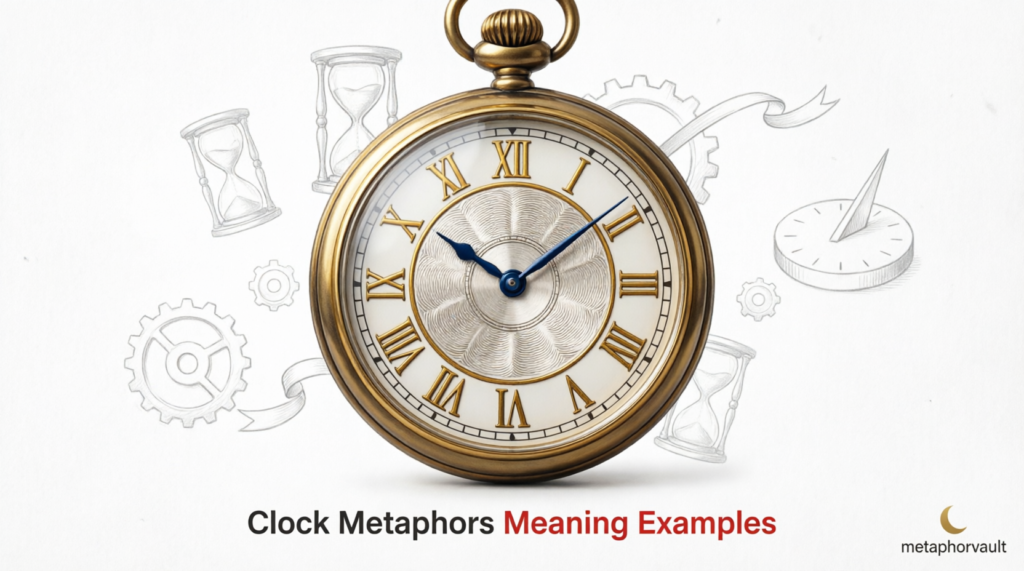
A clock does more than tell us what hour it is. In language, it can represent life, pressure, change, waiting, aging, deadlines, memories, and the feeling that time is moving too fast or too slowly. A clock metaphor describes time or life by comparing it with a clock, its hands, its movement, or the sounds it makes.
People search for these expressions because they want better ways to describe time in stories, poems, conversations, school assignments, speeches, captions, and everyday writing. Saying “time is passing” is clear, but saying “the clock is chasing me” creates a stronger picture.
You may see this kind of imagery in novels, movies, songs, social media posts, motivational quotes, and personal messages. It can make an ordinary thought feel more vivid and emotional.
This guide explains more than 60 useful examples, what each one means, how it sounds, and when to use it. You will also find real conversations and practical examples for school, work, social media, and creative writing.
The examples and usage guidance below are for 2026, with a focus on clear, natural English.
Definition & Meaning
A clock metaphor compares time, life, waiting, deadlines, or change to a clock or something connected with a clock. It does not mean the clock is literally performing the action described. Instead, the comparison creates an image that helps readers or listeners understand an idea more deeply.
For example, “The clock is racing toward midnight” does not mean the clock has legs and can run. It suggests that midnight is approaching quickly and that there may be pressure or excitement.
These expressions are especially useful when ordinary words do not fully capture how time feels.
Simple Definition
A clock metaphor is a figurative comparison that uses a clock, clock hands, ticking, time, or clock movement to express an idea about time or life.
Quick Explanation
Instead of simply saying:
“I do not have much time.”
You could say:
“The clock is closing in on me.”
The second sentence gives the reader a feeling of pressure.
Quick Summary Table
| Expression | Simple Meaning | Tone |
|---|---|---|
| Time is a thief | Time takes moments away | Emotional |
| The clock is racing | Time feels very fast | Informal/Neutral |
| The clock is ticking | Time is running out | Neutral |
| Life is a clock | Life has limited stages | Philosophical |
| The hands are marching | Time keeps moving forward | Literary |
| Time is frozen | Time seems not to move | Emotional |
| The clock is chasing me | I feel pressured by time | Informal |
| Midnight is the finish line | A deadline is approaching | Motivational |
| The clock is my enemy | Time creates stress | Informal |
| Every tick is a heartbeat | Each moment feels important | Poetic |
Why We Use Clock Metaphors
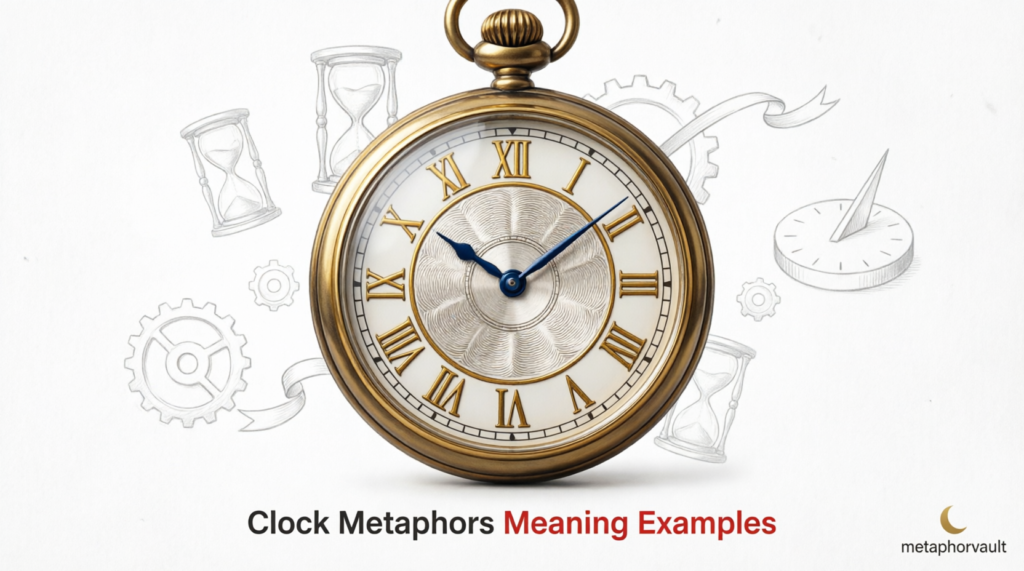
These expressions help people turn an abstract idea into something easy to picture. Time cannot be held or seen, but a clock gives it a visible shape through hands, numbers, movement, and sound. Writers and speakers use this imagery to make feelings about time clearer, stronger, and more memorable.
Practical Purpose
A time comparison can make a simple statement more expressive.
Instead of:
“I am running out of time.”
You might write:
“The clock is breathing down my neck.”
The second version creates pressure and urgency.
Everyday Usage
People naturally use clock-related language when talking about:
- Deadlines
- Waiting
- Aging
- Childhood
- Work
- Exams
- Relationships
- Sleep
- Important events
- Missed opportunities
- Future plans
In Writing
Authors use clocks to represent more than minutes and hours. A stopped clock may suggest a painful memory. A broken clock may represent confusion. A fast-moving clock may represent fear that life is passing too quickly.
In Speaking
People often use simple expressions such as:
“The clock is ticking.”
“Time is flying.”
“We are racing against the clock.”
These sound natural in everyday English.
In School
Students can use time imagery in:
- Essays
- Creative writing
- Poetry
- Speeches
- Personal narratives
- Literary analysis
A metaphor can make an assignment more vivid without using difficult vocabulary.
On Social Media
Short time-related metaphors work well in captions because they express an idea quickly.
For example:
“Some moments are worth stopping the clock for.”
In Professional Communication
Workplaces often use time comparisons around deadlines and schedules.
For example:
“We are racing against the clock to finish the project.”
This is clear and common.
1. Time Is a Thief
Meaning: Time quietly takes moments from our lives.
Real explanation: This comparison focuses on how quickly precious moments disappear. It is often used when talking about childhood, memories, or aging.
Sample sentence:
“Time is a thief, and I did not realize how quickly these years would pass.”
When to use it: Personal writing, poetry, reflective conversations.
When NOT to use it: Formal reports or technical documents.
Alternatives:
- Time slips away.
- Moments disappear.
- Life moves on.
Difficulty: Easy
Tone: Emotional
2. The Clock Is Ticking
Meaning: Time is passing, and there may not be much left.
Real explanation: This is one of the most common time expressions in English. It often creates a sense of urgency.
Sample sentence:
“The clock is ticking, so we need to make a decision.”
When to use it: Deadlines, decisions, everyday conversation.
When NOT to use it: When you want to suggest there is plenty of time.
Alternatives:
- Time is running out.
- We are short on time.
- The deadline is near.
Difficulty: Easy
Tone: Neutral
3. The Clock Is Racing
Meaning: Time seems to be moving extremely fast.
Real explanation: The clock is imagined as a racer moving quickly toward an ending.
Sample sentence:
“The clock was racing, and I still had three pages to write.”
When to use it: Exams, deadlines, busy days.
When NOT to use it: Formal scientific writing.
Alternatives:
- Time is flying.
- The minutes are disappearing.
- Time is speeding by.
Difficulty: Easy
Tone: Informal
4. Racing Against the Clock
Meaning: Trying to finish something before time runs out.
Real explanation: This phrase creates the image of a person competing with time.
Sample sentence:
“We were racing against the clock to finish the presentation.”
When to use it: Work, school, sports, travel, deadlines.
When NOT to use it: Calm situations with no deadline.
Alternatives:
- Working under pressure.
- Beating the deadline.
- Hurrying to finish.
Difficulty: Easy
Tone: Neutral
5. The Clock Is Chasing Me
Meaning: You feel pressured because time is moving too quickly.
Real explanation: The clock is imagined as something following you.
Sample sentence:
“I have three assignments due tomorrow. The clock is chasing me.”
When to use it: Casual conversation, social media, creative writing.
When NOT to use it: Highly formal business reports.
Alternatives:
- Time is catching up with me.
- I am running out of time.
- I am under a time crunch.
Difficulty: Easy
Tone: Informal
6. The Clock Is My Enemy
Meaning: Time is creating difficulty or pressure.
Real explanation: This comparison gives time the role of an opponent.
Sample sentence:
“During finals week, the clock feels like my enemy.”
When to use it: Personal writing, casual speech.
When NOT to use it: Neutral situations where time is not a problem.
Alternatives:
- Time is working against me.
- I am fighting the deadline.
- Time is against us.
Difficulty: Easy
Tone: Informal
7. Time Is a River
Meaning: Time keeps flowing forward and cannot easily be stopped.
Real explanation: A river gives a strong image of constant movement.
Sample sentence:
“Time is a river, carrying us from childhood into adulthood.”
When to use it: Essays, poetry, reflective writing.
When NOT to use it: Very direct workplace instructions.
Alternatives:
- Time keeps flowing.
- Life moves forward.
- The years flow by.
Difficulty: Easy
Tone: Literary
8. The Clock Is a Race Track
Meaning: Time feels like a competition in which events move quickly toward an endpoint.
Real explanation: The clock becomes a track, while tasks or people compete to reach the finish.
Sample sentence:
“Every workday feels like a race track against the clock.”
When to use it: Creative writing and motivational content.
When NOT to use it: Formal instructions.
Alternatives:
- Time is a race.
- The day is a competition.
- We are racing toward the deadline.
Difficulty: Medium
Tone: Creative
9. The Hands Are Marching
Meaning: Time keeps moving steadily forward.
Real explanation: Clock hands are compared with soldiers marching in formation.
Sample sentence:
“The hands were marching toward midnight.”
When to use it: Stories, poems, suspenseful scenes.
When NOT to use it: Casual business emails unless used intentionally.
Alternatives:
- The minutes move forward.
- Time marches on.
- The hours advance.
Difficulty: Medium
Tone: Literary
10. Time Is a Machine
Meaning: Time moves continuously and follows a fixed process.
Real explanation: A machine suggests regular movement that does not stop simply because someone wants it to.
Sample sentence:
“Time is a machine that keeps moving, even when we want it to pause.”
When to use it: Essays and philosophical writing.
When NOT to use it: Warm emotional messages.
Alternatives:
- Time keeps working.
- Time moves mechanically.
- The hours keep turning.
Difficulty: Medium
Tone: Neutral/Literary
11. Time Is a Train
Meaning: Time carries us forward and does not wait forever.
Sample sentence:
“Time is a train; once the moment leaves, you cannot board it again.”
When to use it: Motivational writing and poetry.
When NOT to use it: Literal discussions of schedules.
Alternatives:
- Time moves forward.
- The moment passes.
- Life keeps moving.
Difficulty: Easy
Tone: Literary
12. The Clock Is a Gatekeeper
Meaning: Time controls when something can happen.
Sample sentence:
“The clock became the gatekeeper of our final exam.”
When to use it: Creative writing and school essays.
When NOT to use it: Everyday casual speech.
Alternatives:
- Time sets the limit.
- The deadline controls us.
- The schedule decides.
Difficulty: Medium
Tone: Literary
13. Time Is a Candle
Meaning: Life or available time gradually burns away.
Sample sentence:
“Our time is a candle, glowing brightly but slowly disappearing.”
When to use it: Poetry, speeches, reflective essays.
When NOT to use it: Technical communication.
Alternatives:
- Life is burning away.
- Our days are fading.
- Time is slowly disappearing.
Difficulty: Medium
Tone: Poetic
14. The Clock Is a Prison
Meaning: A strict schedule makes someone feel trapped.
Sample sentence:
“After weeks of deadlines, the office clock felt like a prison.”
When to use it: Personal writing or emotional storytelling.
When NOT to use it: Positive descriptions of schedules.
Alternatives:
- I feel trapped by time.
- The schedule confines me.
- Time feels restrictive.
Difficulty: Medium
Tone: Negative/Literary
15. Time Is a Teacher
Meaning: Life experience teaches lessons as years pass.
Sample sentence:
“Time is a patient teacher that reveals what matters.”
When to use it: Speeches, essays, inspirational writing.
When NOT to use it: When discussing an immediate deadline.
Alternatives:
- Experience teaches us.
- Life teaches lessons.
- The years teach wisdom.
Difficulty: Easy
Tone: Inspirational
16. The Clock Is a Mirror
Meaning: Time shows us how much our lives have changed.
Sample sentence:
“Every birthday makes the clock feel like a mirror.”
When to use it: Personal essays, poetry, reflective posts.
When NOT to use it: Formal scheduling discussions.
Alternatives:
- Time reflects our lives.
- The years show our growth.
- Age reveals change.
Difficulty: Medium
Tone: Reflective
17. The Clock Is a Judge
Meaning: Time seems to measure or evaluate our choices.
Sample sentence:
“The clock stood like a judge as I decided what to do next.”
When to use it: Dramatic stories and essays.
When NOT to use it: Light everyday conversation.
Alternatives:
- Time judges our choices.
- The deadline tests us.
- Time measures our progress.
Difficulty: Medium
Tone: Dramatic
18. Time Is a Storm
Meaning: Time or change can feel powerful and difficult to control.
Sample sentence:
“Time was a storm, sweeping away everything I thought would last.”
When to use it: Emotional writing.
When NOT to use it: Simple practical instructions.
Alternatives:
- Change is a storm.
- Life moves like a storm.
- The years sweep things away.
Difficulty: Medium
Tone: Dramatic
19. The Clock Is a Drum
Meaning: Repeated ticking creates a strong rhythm.
Sample sentence:
“The clock was a drum beating through the silent room.”
When to use it: Poetry, stories, descriptive writing.
When NOT to use it: Formal communication.
Alternatives:
- The clock beats.
- The ticking fills the room.
- Time keeps a rhythm.
Difficulty: Medium
Tone: Poetic
20. Every Tick Is a Footstep
Meaning: Each second represents another step forward in life.
Sample sentence:
“Every tick was a footstep leading him closer to the future.”
When to use it: Fiction and poetry.
When NOT to use it: Business writing.
Alternatives:
- Each second moves us forward.
- Every moment is a step.
- Time takes another step.
Difficulty: Medium
Tone: Literary
21. Every Tick Is a Heartbeat
Meaning: Each moment feels precious and connected to life.
Sample sentence:
“Every tick was a heartbeat reminding her to value the moment.”
When to use it: Emotional writing and speeches.
When NOT to use it: Technical writing.
Alternatives:
- Every second matters.
- Each moment is precious.
- Time is life in motion.
Difficulty: Easy
Tone: Emotional
22. The Clock Is Breathing Down My Neck
Meaning: A deadline is creating strong pressure.
Sample sentence:
“The clock is breathing down my neck, and the report is still unfinished.”
When to use it: Casual speech and humorous writing.
When NOT to use it: Formal reports.
Alternatives:
- I am under pressure.
- The deadline is close.
- Time is pressing me.
Difficulty: Easy
Tone: Informal
23. Time Has Wings
Meaning: Time seems to move very quickly.
Sample sentence:
“Time has wings when you are with people you love.”
When to use it: Captions, conversations, poems.
When NOT to use it: Situations where time feels slow.
Alternatives:
- Time flies.
- The hours disappear.
- The day passes quickly.
Difficulty: Easy
Tone: Poetic
24. Time Is Flying
Meaning: Time is passing quickly.
Sample sentence:
“Time is flying—we have already been here for three hours.”
When to use it: Everyday conversation.
When NOT to use it: Formal academic writing unless the style allows figurative language.
Alternatives:
- Time is moving fast.
- The hours are passing quickly.
- The day is disappearing.
Difficulty: Easy
Tone: Informal
25. Time Stands Still
Meaning: Time seems not to move.
Sample sentence:
“When I heard the news, time seemed to stand still.”
When to use it: Emotional moments and storytelling.
When NOT to use it: Literal scientific descriptions.
Alternatives:
- Everything felt frozen.
- The moment seemed endless.
- The world seemed to pause.
Difficulty: Easy
Tone: Emotional
26. The Clock Has Frozen
Meaning: A moment feels completely still or unforgettable.
Sample sentence:
“For one beautiful moment, the clock had frozen.”
When to use it: Poetry and creative writing.
When NOT to use it: Literal technical discussions.
Alternatives:
- Time stopped.
- The moment froze.
- Everything paused.
Difficulty: Easy
Tone: Poetic
27. The Clock Is Melting Away
Meaning: Available time is disappearing quickly.
Sample sentence:
“The clock was melting away while we searched for the missing file.”
When to use it: Creative descriptions of pressure.
When NOT to use it: Formal communication.
Alternatives:
- Time is slipping away.
- Minutes are disappearing.
- The deadline is getting closer.
Difficulty: Medium
Tone: Creative
28. Time Is Slipping Through My Fingers
Meaning: Time cannot be held or controlled.
Sample sentence:
“Summer is slipping through my fingers.”
When to use it: Personal writing, captions, poetry.
When NOT to use it: Technical writing.
Alternatives:
- Time is slipping away.
- The moment is fading.
- The days are disappearing.
Difficulty: Easy
Tone: Emotional
29. The Clock Is a Door
Meaning: A certain time can open a new stage or opportunity.
Sample sentence:
“Midnight was a door into a completely different life.”
When to use it: Stories and symbolic writing.
When NOT to use it: Literal schedules.
Alternatives:
- Time opens a new chapter.
- A new hour begins.
- The moment opens a path.
Difficulty: Medium
Tone: Literary
30. Time Is a Bridge
Meaning: Time connects different stages of life.
Sample sentence:
“Those ten years became a bridge between who I was and who I became.”
When to use it: Essays and personal stories.
When NOT to use it: Urgent workplace situations.
Alternatives:
- Time connects our past and future.
- The years link two lives.
- Time carries us forward.
Difficulty: Easy
Tone: Reflective
31. The Clock Is a Countdown
Meaning: Time is moving toward a known ending.
Sample sentence:
“The clock became a countdown to graduation.”
When to use it: Events, exams, launches, deadlines.
When NOT to use it: Situations with no fixed endpoint.
Alternatives:
- Time is counting down.
- The deadline approaches.
- The final moment is near.
Difficulty: Easy
Tone: Neutral
32. Time Is a Thief in the Night
Meaning: Time can take important moments without warning.
Sample sentence:
“Time is a thief in the night, quietly stealing our younger years.”
When to use it: Poetry and emotional writing.
When NOT to use it: Everyday professional speech.
Alternatives:
- Time steals our moments.
- The years disappear quietly.
- Life changes before we notice.
Difficulty: Medium
Tone: Poetic
33. The Clock Is a Compass
Meaning: Time helps guide decisions and actions.
Sample sentence:
“For the travelers, the clock was a compass that shaped their day.”
When to use it: Essays and creative writing.
When NOT to use it: When discussing an exact navigation device.
Alternatives:
- Time guides us.
- The schedule gives direction.
- The hour sets our course.
Difficulty: Medium
Tone: Literary
34. Time Is a Wheel
Meaning: Life moves through repeating stages or cycles.
Sample sentence:
“Time is a wheel, turning one season into another.”
When to use it: Poetry and philosophical writing.
When NOT to use it: Direct everyday instructions.
Alternatives:
- Life moves in cycles.
- The seasons turn.
- History repeats itself.
Difficulty: Easy
Tone: Philosophical
35. The Clock Turns Its Pages
Meaning: Time moves us from one chapter of life to another.
Sample sentence:
“Each birthday felt as if the clock were turning another page.”
When to use it: Personal essays and stories.
When NOT to use it: Formal reports.
Alternatives:
- Time opens a new chapter.
- The years turn a page.
- Life moves to another chapter.
Difficulty: Medium
Tone: Literary
36. Time Is a Book
Meaning: Life is made of chapters and experiences.
Sample sentence:
“Time is a book, and every year adds another page.”
When to use it: Essays, speeches, captions.
When NOT to use it: Urgent conversations.
Alternatives:
- Life has chapters.
- Each year is a page.
- Our memories form a story.
Difficulty: Easy
Tone: Neutral/Literary
37. The Clock Is a Storyteller
Meaning: The passage of time reveals what happened in life.
Sample sentence:
“The old clock was a storyteller, carrying decades of memories.”
When to use it: Fiction and descriptive writing.
When NOT to use it: Formal workplace messages.
Alternatives:
- Time tells our story.
- The years reveal the past.
- The clock holds memories.
Difficulty: Medium
Tone: Poetic
38. The Clock Holds Memories
Meaning: A clock can remind someone of past events.
Sample sentence:
“That old clock holds memories of my grandparents’ house.”
When to use it: Personal writing and conversations.
When NOT to use it: Literal technical descriptions.
Alternatives:
- The clock carries memories.
- The past lives in that clock.
- It reminds me of another time.
Difficulty: Easy
Tone: Emotional
39. Time Is a Shadow
Meaning: Time follows us and remains connected to our lives.
Sample sentence:
“Time is a shadow that follows us wherever we go.”
When to use it: Poetry and reflective essays.
When NOT to use it: Simple practical writing.
Alternatives:
- Time follows us.
- The past stays with us.
- Years remain behind us.
Difficulty: Easy
Tone: Poetic
40. The Past Is a Locked Clock
Meaning: The past cannot be changed or reopened.
Sample sentence:
“The past is a locked clock; we can remember it, but we cannot reset it.”
When to use it: Reflective writing.
When NOT to use it: Everyday conversation unless intentionally poetic.
Alternatives:
- The past cannot be changed.
- Yesterday is closed.
- We cannot turn back time.
Difficulty: Medium
Tone: Reflective
41. Tomorrow Is a Blank Clock
Meaning: The future is unknown and has not yet been shaped.
Sample sentence:
“Tomorrow is a blank clock waiting for us to fill its hours.”
When to use it: Inspirational writing.
When NOT to use it: Formal planning documents.
Alternatives:
- The future is unwritten.
- Tomorrow is an empty page.
- The next chapter is unknown.
Difficulty: Medium
Tone: Inspirational
42. The Clock Is a Lighthouse
Meaning: Time gives guidance during uncertain periods.
Sample sentence:
“Her morning routine became a lighthouse in the chaos of each day.”
When to use it: Creative writing.
When NOT to use it: Literal discussions about clocks.
Alternatives:
- Time gives direction.
- Routine provides guidance.
- The schedule keeps us steady.
Difficulty: Hard
Tone: Literary
43. Time Is a Garden
Meaning: Time allows things to grow gradually.
Sample sentence:
“Time is a garden where patience allows good things to grow.”
When to use it: Motivational writing and speeches.
When NOT to use it: When immediate action is needed.
Alternatives:
- Growth takes time.
- Patience helps us grow.
- The years nurture change.
Difficulty: Medium
Tone: Inspirational
44. The Hours Are Seeds
Meaning: Small amounts of time can grow into meaningful results.
Sample sentence:
“Every hour is a seed, so plant your time wisely.”
When to use it: Motivational posts and speeches.
When NOT to use it: Technical communication.
Alternatives:
- Small efforts grow.
- Every hour matters.
- Time creates results.
Difficulty: Medium
Tone: Inspirational
45. The Clock Is a Drumbeat
Meaning: The repeated movement of time creates a steady rhythm in life.
Sample sentence:
“The clock was a drumbeat beneath the quiet afternoon.”
When to use it: Poetry and descriptive writing.
When NOT to use it: Business communication.
Alternatives:
- Time keeps a rhythm.
- The seconds beat steadily.
- The ticking fills the silence.
Difficulty: Medium
Tone: Poetic
46. Time Is a Fire
Meaning: Time consumes moments and eventually changes everything.
Sample sentence:
“Time is a fire that slowly burns through every season of life.”
When to use it: Dramatic or philosophical writing.
When NOT to use it: Casual workplace communication.
Alternatives:
- Time consumes moments.
- The years burn away.
- Life slowly changes.
Difficulty: Medium
Tone: Dramatic
47. The Clock Is a Wave
Meaning: Time comes and goes in a continuous movement.
Sample sentence:
“The clock moved like a wave, carrying one hour into the next.”
When to use it: Poetry and creative descriptions.
When NOT to use it: Practical instructions.
Alternatives:
- Time flows.
- The hours roll forward.
- One moment follows another.
Difficulty: Medium
Tone: Literary
48. Time Is a Wind
Meaning: Time moves quickly and cannot be held.
Sample sentence:
“Time is a wind that touches us and then disappears.”
When to use it: Poetry and emotional writing.
When NOT to use it: Professional communication.
Alternatives:
- Time blows past us.
- The years pass quickly.
- Moments drift away.
Difficulty: Easy
Tone: Poetic
49. The Minutes Are Slipping Away
Meaning: Available time is decreasing.
Sample sentence:
“The minutes are slipping away, so let’s start.”
When to use it: Everyday conversation and meetings.
When NOT to use it: When there is no urgency.
Alternatives:
- Time is running out.
- We are losing time.
- The deadline is close.
Difficulty: Easy
Tone: Neutral
50. The Hour Is Closing In
Meaning: A specific deadline or important moment is approaching.
Sample sentence:
“The hour was closing in, and nobody had made a decision.”
When to use it: Stories, speeches, dramatic situations.
When NOT to use it: Relaxed conversation.
Alternatives:
- The moment is approaching.
- The deadline is near.
- Time is getting short.
Difficulty: Medium
Tone: Dramatic
51. Midnight Is the Finish Line
Meaning: Midnight represents the final point of a task or period.
Sample sentence:
“Midnight was the finish line, and we had one more chapter to write.”
When to use it: Creative writing and deadline-related posts.
When NOT to use it: When midnight has no significance.
Alternatives:
- Midnight is the deadline.
- The day ends at midnight.
- The final hour is here.
Difficulty: Easy
Tone: Creative
52. The Clock Is a Cage
Meaning: A strict schedule can make someone feel trapped.
Sample sentence:
“His routine became a cage ruled by the clock.”
When to use it: Emotional writing.
When NOT to use it: Positive descriptions of daily routines.
Alternatives:
- The schedule feels restrictive.
- Time traps me.
- I feel controlled by the clock.
Difficulty: Medium
Tone: Negative
53. The Clock Is a Master
Meaning: A person feels controlled by schedules or deadlines.
Sample sentence:
“When every minute is planned, the clock becomes your master.”
When to use it: Essays and social commentary.
When NOT to use it: Simple schedule discussions.
Alternatives:
- Time controls us.
- The schedule rules our day.
- Deadlines control the work.
Difficulty: Medium
Tone: Critical
54. Time Is a Road
Meaning: Life moves along a path from one point to another.
Sample sentence:
“Time is a road, and every year takes us farther from where we began.”
When to use it: Personal essays and poetry.
When NOT to use it: Formal instructions.
Alternatives:
- Life is a journey.
- The years form a path.
- Time carries us forward.
Difficulty: Easy
Tone: Reflective
55. The Clock Marks Our Journey
Meaning: Clock time can represent different stages of life.
Sample sentence:
“Each birthday marked another mile on her journey.”
When to use it: Speeches and personal writing.
When NOT to use it: Strictly factual documents.
Alternatives:
- The years mark our growth.
- Time records our journey.
- Each year is a milestone.
Difficulty: Easy
Tone: Reflective
56. Time Is a Currency
Meaning: Time is valuable and should be spent carefully.
Sample sentence:
“Time is a currency, so spend it on things that truly matter.”
When to use it: Business, motivation, productivity writing.
When NOT to use it: When discussing literal money.
Alternatives:
- Time is valuable.
- Spend your hours wisely.
- Do not waste your time.
Difficulty: Easy
Tone: Neutral/Professional
57. Minutes Are Coins
Meaning: Every small unit of time has value.
Sample sentence:
“Treat your minutes like coins because they cannot be recovered once spent.”
When to use it: Productivity posts and speeches.
When NOT to use it: Emotional conversations where the comparison may feel too practical.
Alternatives:
- Every minute has value.
- Time is precious.
- Use your hours wisely.
Difficulty: Easy
Tone: Motivational
58. The Clock Is a Thief
Meaning: Time takes opportunities or moments away.
Sample sentence:
“The clock is a thief when we spend our days waiting for the perfect moment.”
When to use it: Motivational writing.
When NOT to use it: Literal clock discussions.
Alternatives:
- Time steals opportunities.
- Moments disappear.
- We lose time.
Difficulty: Easy
Tone: Emotional
59. The Clock Is a Messenger
Meaning: The clock signals that something is about to happen.
Sample sentence:
“The ringing clock was a messenger announcing the start of class.”
When to use it: Stories and descriptive writing.
When NOT to use it: When the clock is simply showing the time.
Alternatives:
- The clock signals change.
- The bell announces the moment.
- Time gives us a signal.
Difficulty: Medium
Tone: Literary
60. Time Is a Sculptor
Meaning: Time slowly changes people, places, and situations.
Sample sentence:
“Time is a sculptor, shaping us through every experience.”
When to use it: Essays, speeches, inspirational writing.
When NOT to use it: Urgent conversations.
Alternatives:
- Time shapes us.
- Experience changes us.
- The years form our character.
Difficulty: Medium
Tone: Inspirational
61. Time Polishes Us
Meaning: Experience can make people wiser and stronger.
Sample sentence:
“Time polishes us through mistakes, patience, and experience.”
When to use it: Personal writing and motivational content.
When NOT to use it: When discussing an immediate problem.
Alternatives:
- Experience makes us wiser.
- Life teaches us.
- The years refine us.
Difficulty: Easy
Tone: Positive
62. The Clock Is a Reminder
Meaning: A clock reminds us that time is passing.
Sample sentence:
“The clock on my desk is a reminder to use the day well.”
When to use it: Everyday speech, writing, social media.
When NOT to use it: When no symbolic meaning is intended.
Alternatives:
- Time reminds us.
- The passing hours matter.
- The clock keeps me aware.
Difficulty: Easy
Tone: Neutral
63. The Clock Guards the Moment
Meaning: Time seems to protect or preserve an important moment.
Sample sentence:
“The old clock seemed to guard the moment when the family gathered together.”
When to use it: Fiction, poetry, sentimental writing.
When NOT to use it: Formal business communication.
Alternatives:
- The moment remains preserved.
- The clock holds the memory.
- Time protects the memory.
Difficulty: Medium
Tone: Emotional
64. Time Is a Mountain
Meaning: A long period can feel like a difficult distance to cross.
Sample sentence:
“Ten years felt like a mountain between us.”
When to use it: Emotional stories and personal essays.
When NOT to use it: Routine conversations.
Alternatives:
- Years separate us.
- Time created distance.
- The past feels far away.
Difficulty: Easy
Tone: Emotional
65. The Future Is Around the Corner
Meaning: The future is close and approaching.
Sample sentence:
“Graduation is around the corner.”
When to use it: Everyday conversation.
When NOT to use it: When discussing a distant future.
Alternatives:
- The future is near.
- A new stage is coming.
- The next chapter is close.
Difficulty: Easy
Tone: Informal
66. We Are Borrowing Time
Meaning: We have a limited amount of extra time before something ends.
Sample sentence:
“We are borrowing time, so we need a better plan.”
When to use it: Conversations about deadlines, risk, or temporary situations.
When NOT to use it: When there is no time limit.
Alternatives:
- We have extra time for now.
- Our time is limited.
- We are delaying the inevitable.
Difficulty: Easy
Tone: Neutral
67. Time Is on Our Side
Meaning: There is enough time to succeed or make a decision.
Sample sentence:
“Do not panic; time is on our side.”
When to use it: Reassurance, teamwork, planning.
When NOT to use it: When a deadline is extremely close.
Alternatives:
- We have plenty of time.
- There is no need to rush.
- We have time to prepare.
Difficulty: Easy
Tone: Positive
68. Time Is Working Against Us
Meaning: The passing hours make success more difficult.
Sample sentence:
“Time is working against us, so we need to act now.”
When to use it: Deadlines, emergencies, projects.
When NOT to use it: Relaxed situations.
Alternatives:
- We are losing time.
- The deadline is approaching.
- We need to hurry.
Difficulty: Easy
Tone: Neutral
69. We Turn Back the Clock
Meaning: We try to return to an earlier time or restore something from the past.
Sample sentence:
“You cannot turn back the clock, but you can change what happens next.”
When to use it: Advice, speeches, personal writing.
When NOT to use it: Literal clock repair.
Alternatives:
- Return to the past.
- Undo the past.
- Change what already happened.
Difficulty: Easy
Tone: Neutral
70. We Set the Clock for a New Beginning
Meaning: We choose a new starting point.
Sample sentence:
“After the mistake, she decided to set the clock for a new beginning.”
When to use it: Motivational writing and personal stories.
When NOT to use it: Literal alarm-clock instructions.
Alternatives:
- Start again.
- Begin a new chapter.
- Make a fresh start.
Difficulty: Medium
Tone: Inspirational
Quick Reference Table
| # | Expression | Main Idea | Tone |
|---|---|---|---|
| 1 | Time is a thief | Moments disappear | Emotional |
| 2 | The clock is ticking | Time is running out | Neutral |
| 3 | The clock is racing | Time feels fast | Informal |
| 4 | Racing against the clock | Fighting a deadline | Neutral |
| 5 | The clock is chasing me | Feeling time pressure | Informal |
| 6 | The clock is my enemy | Time creates stress | Informal |
| 7 | Time is a river | Time flows forward | Literary |
| 8 | The clock is a race track | Time feels competitive | Creative |
| 9 | The hands are marching | Time moves steadily | Literary |
| 10 | Time is a machine | Time never stops | Philosophical |
| 11 | Time is a train | Time carries us forward | Literary |
| 12 | The clock is a gatekeeper | Time controls access | Literary |
| 13 | Time is a candle | Time burns away | Poetic |
| 14 | The clock is a prison | Schedule feels restrictive | Negative |
| 15 | Time is a teacher | Experience brings wisdom | Inspirational |
| 16 | The clock is a mirror | Time shows change | Reflective |
| 17 | The clock is a judge | Time measures choices | Dramatic |
| 18 | Time is a storm | Change feels powerful | Dramatic |
| 19 | The clock is a drum | Ticking creates rhythm | Poetic |
| 20 | Every tick is a footstep | Each moment moves us forward | Literary |
| 21 | Every tick is a heartbeat | Each moment is precious | Emotional |
| 22 | Clock is breathing down my neck | Strong deadline pressure | Informal |
| 23 | Time has wings | Time moves fast | Poetic |
| 24 | Time is flying | Time passes quickly | Informal |
| 25 | Time stands still | Time seems frozen | Emotional |
| 26 | The clock has frozen | A moment feels still | Poetic |
| 27 | Clock is melting away | Time disappears | Creative |
| 28 | Time slips through my fingers | Time cannot be held | Emotional |
| 29 | The clock is a door | Time opens change | Literary |
| 30 | Time is a bridge | Time connects stages | Reflective |
| 31 | Clock is a countdown | An ending approaches | Neutral |
| 32 | Time is a thief in the night | Time takes moments quietly | Poetic |
| 33 | Clock is a compass | Time guides us | Literary |
| 34 | Time is a wheel | Time moves in cycles | Philosophical |
| 35 | Clock turns its pages | Life enters new chapters | Literary |
| 36 | Time is a book | Life has chapters | Reflective |
| 37 | Clock is a storyteller | Time reveals history | Poetic |
| 38 | Clock holds memories | Time connects to memories | Emotional |
| 39 | Time is a shadow | Time follows us | Poetic |
| 40 | Past is a locked clock | Past cannot change | Reflective |
| 41 | Tomorrow is a blank clock | Future is unknown | Inspirational |
| 42 | Clock is a lighthouse | Time guides us | Literary |
| 43 | Time is a garden | Time allows growth | Inspirational |
| 44 | Hours are seeds | Small moments create results | Motivational |
| 45 | Clock is a drumbeat | Time has rhythm | Poetic |
| 46 | Time is a fire | Time consumes moments | Dramatic |
| 47 | Clock is a wave | Time moves continuously | Literary |
| 48 | Time is a wind | Time cannot be held | Poetic |
| 49 | Minutes are slipping away | Time is decreasing | Neutral |
| 50 | Hour is closing in | A moment approaches | Dramatic |
| 51 | Midnight is the finish line | Deadline/end point | Creative |
| 52 | Clock is a cage | Schedule feels trapping | Negative |
| 53 | Clock is a master | Time controls us | Critical |
| 54 | Time is a road | Life moves forward | Reflective |
| 55 | Clock marks our journey | Time tracks life stages | Reflective |
| 56 | Time is a currency | Time has value | Professional |
| 57 | Minutes are coins | Small moments matter | Motivational |
| 58 | Clock is a thief | Time takes opportunities | Emotional |
| 59 | Clock is a messenger | Time signals change | Literary |
| 60 | Time is a sculptor | Time shapes people | Inspirational |
| 61 | Time polishes us | Experience improves us | Positive |
| 62 | Clock is a reminder | Time reminds us to act | Neutral |
| 63 | Clock guards the moment | Time preserves memories | Emotional |
| 64 | Time is a mountain | Time creates distance | Emotional |
| 65 | Future is around the corner | Future is close | Informal |
| 66 | Borrowing time | Extra time is temporary | Neutral |
| 67 | Time is on our side | Enough time remains | Positive |
| 68 | Time works against us | Time creates pressure | Neutral |
| 69 | Turn back the clock | Return to the past | Neutral |
| 70 | Set the clock for a new beginning | Start again | Inspirational |
Real-Life Conversations
These examples show how natural time imagery can sound in everyday speech. The best expressions usually fit the situation rather than appearing simply because they sound clever.
Conversation 1: Friends
Maya: Are you ready for the trip?
Lena: Almost. I still need to pack.
Maya: We leave in forty minutes.
Lena: I know! The clock is chasing me today.
Maya: Stop worrying. Time is on our side.
Lena: You say that now. Wait until you see my suitcase.
Maya: Fair point. Let’s get moving.
This conversation uses simple expressions that sound natural in casual speech.
Conversation 2: Student and Teacher
Student: Professor, can I have another five minutes?
Teacher: You have already had the full exam period.
Student: I know. I just need to finish one answer.
Teacher: The clock is ticking, so use the time you have left.
Student: Understood.
The expression adds urgency without making the teacher sound unnatural.
Conversation 3: Office
Manager: How is the presentation going?
Sam: The slides are almost done, but the numbers still need checking.
Manager: The client meeting starts at two.
Sam: Then we’re racing against the clock.
Manager: Exactly. Check the numbers first. We can polish the design later.
This is a good example of professional use because the phrase is common and easy to understand.
Conversation 4: Family
Mother: Your little brother starts school next week.
Father: Already?
Mother: Yes. Time flies.
Father: It feels like he was learning to walk yesterday.
Mother: That’s how quickly the years disappear.
This conversation shows how time language can express nostalgia.
Conversation 5: Dating
Alex: I can’t believe we’ve been talking for four hours.
Jordan: Neither can I.
Alex: Time flies when you’re having a good conversation.
Jordan: Maybe that’s a good sign.
Alex: I was thinking the same thing.
Here, the comparison feels warm rather than dramatic.
Everyday Usage
The strongest expressions about time are not limited to poetry. They appear in normal conversation, fiction, schoolwork, professional communication, and online posts.
Conversation
Common expressions include:
- “Time flies.”
- “The clock is ticking.”
- “We are running out of time.”
- “Time is on our side.”
- “I can’t turn back the clock.”
These are easy for most English speakers to understand.
Writing
In essays and personal writing, stronger imagery can create emotion.
Plain:
“My childhood ended quickly.”
More vivid:
“My childhood slipped through my fingers before I knew it.”
The second sentence gives the reader something to imagine.
Books
Fiction writers often use clocks as symbols.
An old clock may suggest:
- Family history
- Memory
- Aging
- Tradition
- The passage of years
A broken clock may suggest:
- A lost moment
- Emotional pain
- A disrupted life
- The inability to move forward
A clock that keeps ticking during a quiet scene can create tension.
Movies
Visual storytelling makes clocks especially powerful.
A countdown can create suspense. A clock striking midnight can signal a major change. A stopped clock can suggest that a character is trapped in a memory.
The image works because viewers already understand what clocks normally do.
Poetry
Poetry often gives time human qualities.
For example:
“The tired clock carried the night on its shoulders.”
The clock is not literally carrying anything. The image makes the passing hours feel heavy and slow.
Emails
Use simple expressions in professional emails.
For example:
“We are working against a tight deadline.”
This is usually better than using a highly poetic comparison.
For a friendly internal message, you might write:
“The clock is ticking, so let’s finalize the document this afternoon.”
Text Messages
Short expressions work best:
“Time flies 😂”
“We’re racing the clock!”
“The deadline is coming fast.”
“Can’t believe it’s already midnight.”
Emotional or poetic comparisons often work well in captions.
Examples:
“Some moments make you wish you could stop the clock.”
“Time flies, but memories stay.”
“Another year, another page.”
Facebook posts often use nostalgic time imagery.
Example:
“Looking at these old photos reminds me how quickly the clock moves.”
X
Short, sharp language is usually more effective.
Example:
“The clock doesn’t wait. Neither should your best ideas.”
Professional time comparisons should be clear rather than overly poetic.
Example:
“Time is one resource no team can recover once it is spent.”
Or:
“A deadline is not just a date; it is a signal to prioritize.”
School Assignments
Students can use these expressions in creative writing, but the metaphor should support the main idea.
For example:
“The clock seemed to chase me as I ran toward the examination hall.”
This works because the clock represents the pressure of arriving before the exam begins.
In a literary analysis, you can explain the symbolism:
“The ticking clock represents the character’s growing fear that an important opportunity is disappearing.”
That is stronger than simply saying, “The clock is important.”
A Simple Rule for Choosing the Right Expression
Choose the image based on the feeling you want to create.
For speed:
Use “time is flying” or “the clock is racing.”
For pressure:
Use “the clock is ticking” or “racing against the clock.”
For sadness:
Use “time is a thief” or “time slips through my fingers.”
For growth:
Use “time is a teacher” or “time is a sculptor.”
For memories:
Use “the clock holds memories.”
For hope:
Use “tomorrow is a blank page” or “time is on our side.”
For a new beginning:
Use “turning the page” or “setting the clock for a new beginning.”
For professional writing:
Prefer clear expressions such as “we are working against a tight deadline.”
How to Create Your Own Time Metaphors
You do not need to memorize dozens of expressions. You can build your own by deciding what time feels like in a particular situation.
Start with the feeling.
Is time:
- Fast?
- Slow?
- Valuable?
- Scary?
- Helpful?
- Painful?
- Hopeful?
- Uncontrollable?
Then choose an object that creates the same feeling.
For example, if time feels fast, you might compare it to:
- A runner
- A train
- Wind
- A river
- A bird
If time feels restrictive, you might compare it to:
- A cage
- A prison
- A wall
- A locked door
If time feels valuable, you might compare it to:
- Money
- Gold
- Seeds
- Water
Then connect the two ideas.
For example:
Feeling: Time is valuable.
Object: Currency.
Metaphor: “Time is a currency.”
That simple process can help students create original language instead of copying familiar phrases.
Common Mistakes to Avoid
Mixing Too Many Metaphors
Avoid changing images every few words.
Weak:
“Time is a river racing down a road while its wings fly toward a mountain.”
The reader has too many images to process.
Better:
“Time is a river, always moving forward.”
Using a Metaphor in the Wrong Setting
A poetic expression may sound strange in a formal email.
Instead of:
“The clock is hunting us through the dark forest of deadlines.”
Write:
“We are working against a tight deadline.”
Clear communication matters more than decorative language.
Explaining the Metaphor Too Much
A good metaphor usually speaks for itself.
Instead of writing:
“Time is a thief because, like a thief, it takes things away from us and we cannot stop it.”
Simply write:
“Time is a thief, quietly taking our moments away.”
Using Clichés Without Purpose
Common expressions are useful, but they can lose impact when repeated too often.
If a creative piece needs something fresh, create a new comparison that fits the scene.
Forgetting Context
“The clock is my enemy” suggests stress.
“The clock is my friend” suggests support or structure.
The same object can create very different meanings depending on the surrounding words.
Clock Symbolism: What Different Clock Images Can Represent
A clock does not have one fixed symbolic meaning. Its meaning changes according to the situation.
| Clock Image | Possible Symbolism |
|---|---|
| Working clock | Normal passage of time |
| Fast clock | Pressure or urgency |
| Slow clock | Boredom or waiting |
| Stopped clock | Memory or frozen emotion |
| Broken clock | Confusion or lost time |
| Old clock | History or aging |
| New clock | Fresh beginnings |
| Countdown clock | Suspense or deadline |
| Midnight | Ending or transformation |
| Alarm clock | Responsibility or awakening |
| Clock tower | Community or tradition |
| Watch | Personal time and responsibility |
| Silent clock | Absence or loss |
| Loud ticking | Anxiety or suspense |
Final Takeaway
The most effective time imagery does not simply make writing sound fancy. It helps the reader feel what time means in a particular moment.
A ticking clock can create pressure. A stopped clock can suggest loss. A racing clock can show urgency. A clock that holds memories can turn an ordinary object into a symbol of the past.
For everyday English, simple expressions such as “time flies,” “the clock is ticking,” and “we are racing against the clock” are usually the best choices.
For poetry, stories, and reflective writing, you can be more creative. Compare time with a river, road, candle, sculptor, shadow, train, or another image that matches your message.
The key is not to use the most complicated metaphor. Use the comparison that makes your meaning easiest to see and feel.
In 2026, strong writing is still less about using impressive words and more about choosing the right words for the reader, purpose, and situation.
descover more post
60+Freedom Metaphors Powerful Examples Meanings and Real …
30+Quiet Metaphors Powerful Examples and How to Use …
60+Negative Metaphors Examples Meanings and …

Kovien is an experienced English language researcher, editor, and digital content strategist at MetaphorVault.com. He earned a Bachelor’s degree in English Language and Literature and has spent more than 5 years creating educational resources that simplify figurative language, metaphors, idioms, and modern English usage. His expertise combines linguistic knowledge with practical SEO writing, allowing him to produce content that is both informative and engaging. Kovien enjoys transforming complex language concepts into clear, relatable explanations supported by real-world examples. His work is driven by a commitment to accuracy, originality, and continuous learning. Through MetaphorVault.com, he aims to help readers build stronger communication skills and gain greater confidence in understanding and using the English language.