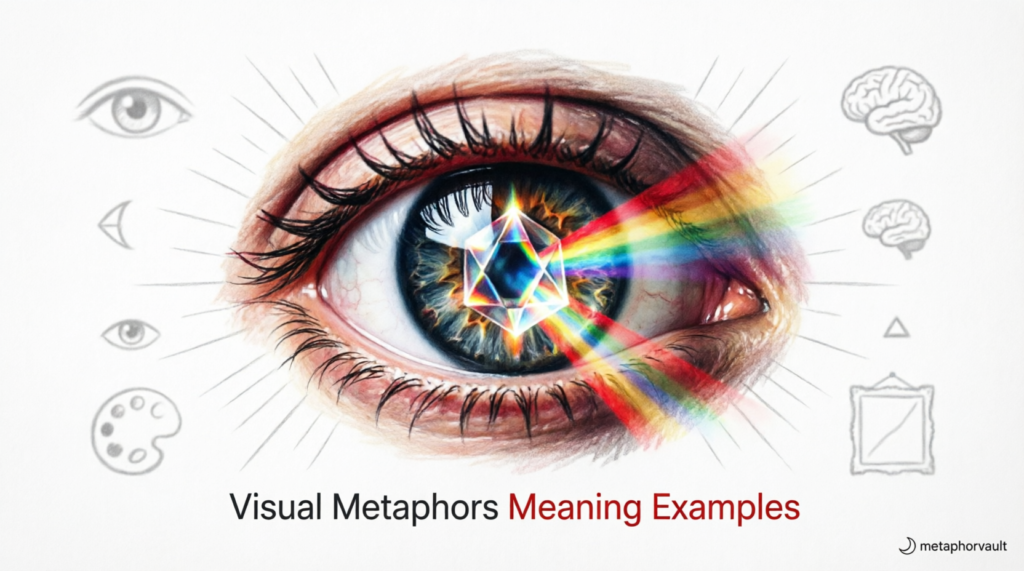
A visual metaphor is an image, object, scene, or design that represents an idea beyond its literal meaning. Instead of simply telling you what something means, it lets you see the idea. For example, a picture of a melting ice cube can represent climate change, while a broken chain can represent freedom. People search for “what are visual metaphors” because the term can sound complicated, especially when it is confused with symbols, icons, or ordinary pictures. Visual metaphors appear all around us—in advertisements, movies, posters, books, presentations, websites, social media posts, and even classroom lessons.
They help people understand abstract ideas such as love, fear, success, loneliness, freedom, danger, and time through familiar visual experiences. In this guide, for 2026, you will learn what visual metaphors mean, why people use them, how they work, how they differ from symbols and visual similes, and how to recognize them. You will also find more than 60 practical examples, real-life conversations, and simple tips for using visual metaphors in writing, speaking, schoolwork, design, and professional communication.
Definition & Meaning
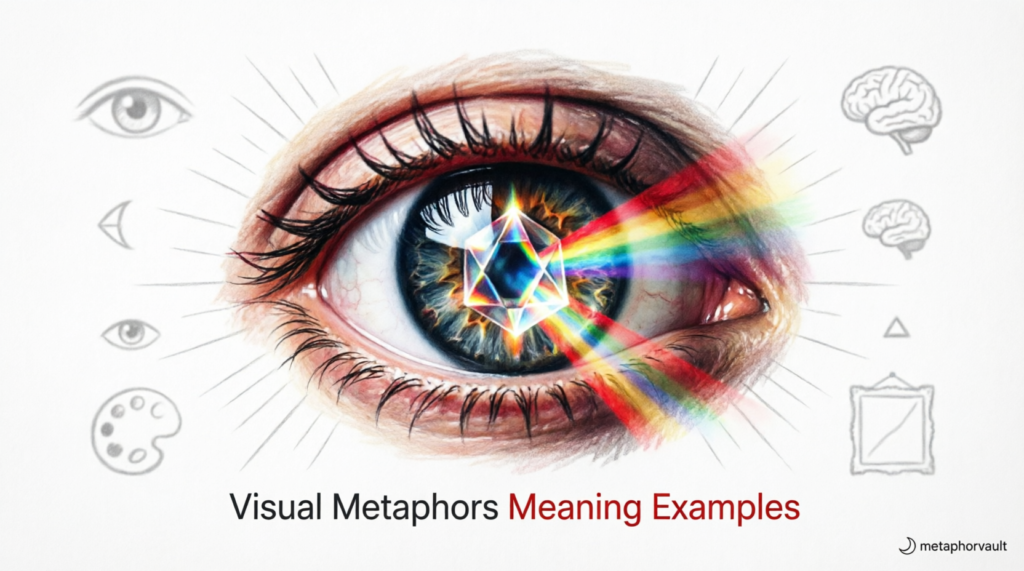
A visual metaphor uses a visible image to represent another idea, feeling, quality, or situation. The image is usually not meant literally. Instead, the viewer connects the image with a deeper meaning. For example, a light bulb can visually represent an idea, while a bridge can represent connection or progress. The meaning comes from the relationship between the picture and the idea.
Simple Definition
A visual metaphor is a picture or visual element that represents an idea by showing something related to it.
The image does not simply show the subject. It asks your mind to make a connection.
For example:
- A locked door can represent a missed opportunity.
- A storm can represent emotional trouble.
- A mountain can represent a difficult goal.
- A caged bird can represent a lack of freedom.
- A road can represent life’s journey.
The picture works because viewers already understand what these objects normally mean or feel like.
How Visual Metaphors Work
A visual metaphor usually has two parts:
The visual object: what you can see.
The underlying idea: what the object represents.
For example:
A mountain → a difficult challenge
The mountain is real, but the intended meaning may be much bigger than climbing.
A designer might show a person standing at the bottom of a huge mountain to communicate that a goal feels difficult. The viewer understands the message without needing a paragraph explaining it.
Quick Summary Table
| Visual metaphor | Possible meaning | Common use |
|---|---|---|
| Broken chain | Freedom | Posters, campaigns |
| Mountain | Challenge | Motivation |
| Light bulb | Idea | Education, business |
| Storm | Emotional struggle | Movies, art |
| Bridge | Connection | Business, relationships |
| Maze | Confusion | Education, psychology |
| Open door | Opportunity | Advertising |
| Empty chair | Loss or absence | Films, photography |
| Seedling | Growth | Education, business |
| Clock | Time | Advertising, presentations |
| Cage | Restriction | Social campaigns |
| Road | Life journey | Books, films |
| Iceberg | Hidden complexity | Business, education |
| Burning candle | Hope or life | Art, storytelling |
| Broken mirror | Identity or self-image | Films, art |
Why We Use Visual Metaphors
Visual metaphors help people understand complicated or abstract ideas quickly by connecting them to something familiar. They are useful when a direct explanation feels dull, difficult, or too long. Writers, teachers, designers, advertisers, filmmakers, and speakers use them to make messages clearer, stronger, and easier to remember.
Practical Purpose
Many ideas cannot be photographed directly.
You cannot take a picture of:
- freedom
- trust
- anxiety
- ambition
- confusion
- time
- loneliness
- success
But you can show an object that suggests those ideas.
A broken chain can suggest freedom. A maze can suggest confusion. A rising staircase can suggest progress.
That is the power of visual metaphor.
Everyday Usage
You may see visual metaphors in:
- advertisements
- posters
- websites
- presentations
- social media graphics
- product packaging
- public campaigns
- photography
- movies
- music videos
- cartoons
- book covers
They often communicate a message before you consciously read any words.
Writing
Visual metaphors can also support written descriptions.
For example:
“Her thoughts were a tangled maze.”
The sentence creates a mental picture. A visual artist could turn that same idea into an actual image of a person surrounded by maze walls.
Speaking
A speaker may use a visual metaphor in a presentation by showing a mountain when discussing a difficult business goal.
Instead of explaining every detail visually, the mountain immediately gives the audience a shared mental model: the goal is difficult, but it can be climbed.
School
Teachers use visual metaphors to make difficult subjects easier.
For example:
- A tree can represent a family tree.
- A road can represent historical progress.
- A pyramid can represent levels of importance.
- A bridge can represent a connection between two ideas.
Students can also use visual metaphors in essays, presentations, posters, and creative projects.
Social Media
Social media relies heavily on quick visual communication.
A post about burnout might show a phone with an empty battery. The battery is not literally the person’s energy level. It is a visual comparison that makes the feeling easy to understand.
Professional Communication
Businesses use visual metaphors in:
- presentations
- marketing campaigns
- websites
- reports
- training materials
- advertisements
- brand identity
A company discussing growth might show a small plant becoming a large tree.
The plant suggests that growth takes time and requires care.
Main Section
Visual metaphors work by making one thing stand for another idea through a visual connection. A strong example is immediately understandable but still leaves room for interpretation. The examples below cover common visual metaphors used in advertising, education, storytelling, design, social media, presentations, and everyday communication.
1. Broken Chain
Meaning: Freedom or release.
Real explanation: A broken chain suggests that something once restricting a person has been removed.
Sample sentence: “The broken chain represents freedom from unfair control.”
When to use it: Freedom, independence, liberation, social change.
When NOT to use it: When the subject has nothing to do with restriction or freedom.
Alternatives: Open gate; unlocked door; bird leaving a cage.
Difficulty: Easy
Tone: Neutral
2. Mountain
Meaning: A difficult challenge or major goal.
Real explanation: Mountains require effort to climb, so they naturally suggest obstacles and achievement.
Sample sentence: “The mountain represents the challenges the team must overcome.”
When to use it: Goals, personal growth, business challenges.
When NOT to use it: For a simple task with no meaningful obstacle.
Alternatives: Steep staircase; wall; uphill road.
Difficulty: Easy
Tone: Neutral
3. Light Bulb
Meaning: An idea or moment of understanding.
Real explanation: A light turning on is commonly associated with suddenly understanding something.
Sample sentence: “The light bulb represents a new solution.”
When to use it: Education, brainstorming, creativity.
When NOT to use it: When the message is unrelated to ideas.
Alternatives: Spark; sunrise; open book.
Difficulty: Easy
Tone: Neutral
4. Open Door
Meaning: Opportunity.
Real explanation: An open door suggests that access is available and someone can move forward.
Sample sentence: “The open door represents a new career opportunity.”
When to use it: Jobs, education, new beginnings.
When NOT to use it: When you need to communicate danger or rejection.
Alternatives: Open gate; pathway; key.
Difficulty: Easy
Tone: Neutral
5. Locked Door
Meaning: A barrier, rejection, or unavailable opportunity.
Real explanation: A locked door prevents entry, making it a useful image for something that cannot currently be reached.
Sample sentence: “The locked door represents a goal that remains out of reach.”
When to use it: Obstacles, rejection, restrictions.
When NOT to use it: To suggest an easy opportunity.
Alternatives: Wall; closed gate; blocked road.
Difficulty: Easy
Tone: Neutral
6. Bridge
Meaning: Connection or cooperation.
Real explanation: A bridge connects two places that would otherwise be separated.
Sample sentence: “The bridge represents communication between two communities.”
When to use it: Relationships, diplomacy, teamwork, communication.
When NOT to use it: When separation rather than connection is the central idea.
Alternatives: Handshake; link; joined paths.
Difficulty: Easy
Tone: Neutral
7. Maze
Meaning: Confusion or a complicated problem.
Real explanation: A maze has many paths and makes it difficult to find the exit.
Sample sentence: “The maze represents the student’s confusion about the problem.”
When to use it: Difficult decisions, confusion, complex systems.
When NOT to use it: For something simple and straightforward.
Alternatives: Tangled thread; puzzle; winding path.
Difficulty: Easy
Tone: Neutral
8. Caged Bird
Meaning: Lack of freedom.
Real explanation: A bird normally flies freely, so seeing one trapped in a cage creates a strong contrast.
Sample sentence: “The caged bird represents a person who feels trapped.”
When to use it: Freedom, oppression, emotional restriction.
When NOT to use it: When the subject has no connection to freedom.
Alternatives: Locked window; broken chain; closed gate.
Difficulty: Easy
Tone: Emotional
9. Storm
Meaning: Emotional or personal turmoil.
Real explanation: A storm is violent and unpredictable, making it useful for representing difficult emotional experiences.
Sample sentence: “The storm represents the character’s inner struggle.”
When to use it: Conflict, grief, anger, anxiety, hardship.
When NOT to use it: For calm or peaceful subjects.
Alternatives: Dark clouds; crashing waves; thunder.
Difficulty: Easy
Tone: Emotional
10. Calm Sea
Meaning: Peace or emotional stability.
Real explanation: Still water often creates a feeling of calm and control.
Sample sentence: “The calm sea represents her peaceful state of mind.”
When to use it: Peace, recovery, relaxation.
When NOT to use it: When the subject is chaotic.
Alternatives: Still lake; quiet garden; clear sky.
Difficulty: Easy
Tone: Neutral
11. Rising Staircase
Meaning: Progress or improvement.
Real explanation: Moving upward on stairs suggests advancement toward a higher level.
Sample sentence: “The staircase represents progress in her career.”
When to use it: Career growth, education, achievement.
When NOT to use it: To represent failure or decline.
Alternatives: Growing tree; rising arrow; hill.
Difficulty: Easy
Tone: Positive
12. Falling Staircase
Meaning: Decline or setback.
Real explanation: Moving downward can suggest losing progress or status.
Sample sentence: “The downward staircase represents the company’s decline.”
When to use it: Failure, loss, setbacks.
When NOT to use it: Positive achievement.
Alternatives: Falling arrow; collapsing tower; downward slope.
Difficulty: Easy
Tone: Serious
13. Seedling
Meaning: Growth and potential.
Real explanation: A small plant can grow into something much larger, making it a natural metaphor for development.
Sample sentence: “The seedling represents a student’s growing confidence.”
When to use it: Learning, startups, children, personal development.
When NOT to use it: When immediate results are the main message.
Alternatives: Seed; young tree; sunrise.
Difficulty: Easy
Tone: Positive
14. Large Tree
Meaning: Strength, maturity, or long-term growth.
Real explanation: A mature tree takes time to develop roots, branches, and strength.
Sample sentence: “The tree represents years of experience.”
When to use it: Experience, stability, family, history.
When NOT to use it: For very short-term growth.
Alternatives: Strong foundation; oak; tall building.
Difficulty: Easy
Tone: Positive
15. Roots
Meaning: Identity, family, history, or belonging.
Real explanation: Roots keep a tree connected to the ground, so they can represent the things that keep a person connected to a place or community.
Sample sentence: “The roots represent her connection to her family.”
When to use it: Heritage, identity, family.
When NOT to use it: For ideas about movement or freedom.
Alternatives: Anchor; foundation; home.
Difficulty: Easy
Tone: Emotional
16. Anchor
Meaning: Stability or security.
Real explanation: An anchor keeps a ship from drifting away.
Sample sentence: “His family is an anchor during difficult times.”
When to use it: Relationships, support, stability.
When NOT to use it: When you want to suggest speed or freedom.
Alternatives: Foundation; rock; support beam.
Difficulty: Easy
Tone: Warm
17. Empty Chair
Meaning: Absence or loss.
Real explanation: An empty chair where someone normally sits can make their absence feel visible.
Sample sentence: “The empty chair represents the person the family has lost.”
When to use it: Grief, absence, remembrance.
When NOT to use it: For ordinary furniture.
Alternatives: Empty room; missing photograph; vacant place.
Difficulty: Easy
Tone: Emotional
18. Burning Candle
Meaning: Hope, life, memory, or endurance.
Real explanation: A small flame continuing to burn can suggest hope surviving during darkness.
Sample sentence: “The candle represents hope during a difficult period.”
When to use it: Hope, remembrance, faith, endurance.
When NOT to use it: When the subject needs a modern or technical image.
Alternatives: Lantern; small flame; sunrise.
Difficulty: Easy
Tone: Emotional
19. Iceberg
Meaning: Hidden complexity.
Real explanation: Most of an iceberg exists beneath the water, making it useful for showing that the visible part of a problem may be small.
Sample sentence: “The chart shows that the complaint is only the tip of the iceberg.”
When to use it: Business, psychology, education, hidden problems.
When NOT to use it: For simple situations.
Alternatives: Hidden roots; underground structure; submerged rock.
Difficulty: Medium
Tone: Neutral
20. Mirror
Meaning: Self-reflection or identity.
Real explanation: A mirror shows a person’s reflection, so it can represent examining oneself.
Sample sentence: “The mirror represents the character’s struggle with her identity.”
When to use it: Identity, self-awareness, appearance.
When NOT to use it: For unrelated physical objects.
Alternatives: Reflection in water; portrait; shadow.
Difficulty: Easy
Tone: Neutral
21. Broken Mirror
Meaning: Damaged identity or fractured self-image.
Real explanation: A broken reflection suggests that a person’s sense of self has been disturbed.
Sample sentence: “The broken mirror represents his damaged self-image.”
When to use it: Identity conflict, trauma in fiction, emotional struggle.
When NOT to use it: For simple messages about beauty.
Alternatives: Cracked photograph; fragmented portrait; scattered pieces.
Difficulty: Medium
Tone: Emotional
22. Shadow
Meaning: Hidden fear, secret, memory, or darker side.
Real explanation: A shadow follows a person but remains visually separate, making it useful for unseen or unwanted parts of life.
Sample sentence: “The shadow represents the character’s past.”
When to use it: Mystery, fear, guilt, memory.
When NOT to use it: When complete clarity is the intended message.
Alternatives: Dark cloud; hidden figure; silhouette.
Difficulty: Medium
Tone: Serious
23. Sunrise
Meaning: New beginning or hope.
Real explanation: Sunrise marks the beginning of a new day.
Sample sentence: “The sunrise represents a fresh start.”
When to use it: Recovery, new beginnings, hope.
When NOT to use it: To communicate endings.
Alternatives: Dawn; opening flower; new page.
Difficulty: Easy
Tone: Positive
24. Sunset
Meaning: Ending, change, or reflection.
Real explanation: Sunset marks the close of a day.
Sample sentence: “The sunset represents the end of an important chapter.”
When to use it: Endings, aging, reflection.
When NOT to use it: For energetic new beginnings.
Alternatives: Closing book; fading light; final page.
Difficulty: Easy
Tone: Reflective
25. Clock
Meaning: Time, pressure, or limited opportunity.
Real explanation: A clock makes the passage of time visible.
Sample sentence: “The clock represents the pressure of a deadline.”
When to use it: Deadlines, aging, urgency, time management.
When NOT to use it: When time has no role in the message.
Alternatives: Hourglass; calendar; stopwatch.
Difficulty: Easy
Tone: Neutral
26. Hourglass
Meaning: Passing or limited time.
Real explanation: Sand gradually falling through an hourglass creates a clear visual sense of time running out.
Sample sentence: “The hourglass represents the limited time available.”
When to use it: Deadlines, aging, urgency.
When NOT to use it: For unlimited time.
Alternatives: Countdown clock; melting candle; calendar.
Difficulty: Easy
Tone: Serious
27. Road
Meaning: A journey or life path.
Real explanation: A road takes someone from one place to another, so it naturally represents progress through life.
Sample sentence: “The road represents her journey toward independence.”
When to use it: Careers, life stories, travel, personal growth.
When NOT to use it: When there is no idea of movement.
Alternatives: Path; trail; staircase.
Difficulty: Easy
Tone: Neutral
28. Fork in the Road
Meaning: A difficult choice.
Real explanation: Two roads create a visual choice between different directions.
Sample sentence: “The fork in the road represents an important decision.”
When to use it: Decisions, careers, relationships.
When NOT to use it: When there is only one clear option.
Alternatives: Two doors; crossroads; branching path.
Difficulty: Easy
Tone: Neutral
29. Crossroads
Meaning: A major decision or turning point.
Real explanation: A crossroads is a place where different paths meet.
Sample sentence: “The character is at a crossroads in her career.”
When to use it: Life decisions, business choices, change.
When NOT to use it: For routine decisions.
Alternatives: Forked road; two doors; turning point.
Difficulty: Easy
Tone: Neutral
30. Key
Meaning: A solution, access, or knowledge.
Real explanation: A key opens something that was previously inaccessible.
Sample sentence: “Education is shown as the key to opportunity.”
When to use it: Solutions, access, learning.
When NOT to use it: When the answer is not about access or discovery.
Alternatives: Password; map; doorway.
Difficulty: Easy
Tone: Neutral
31. Puzzle Piece
Meaning: A missing part of a larger problem.
Real explanation: One puzzle piece makes sense only as part of the complete picture.
Sample sentence: “The missing puzzle piece represents the information we still need.”
When to use it: Research, teamwork, problem-solving.
When NOT to use it: For completely independent ideas.
Alternatives: Missing link; clue; building block.
Difficulty: Easy
Tone: Neutral
32. Puzzle
Meaning: Complexity or a problem that requires thought.
Real explanation: A puzzle cannot be understood instantly and requires pieces to be connected.
Sample sentence: “The puzzle represents the mystery surrounding the case.”
When to use it: Problems, mysteries, learning.
When NOT to use it: For obvious information.
Alternatives: Maze; riddle; tangled thread.
Difficulty: Easy
Tone: Neutral
33. Tangled Threads
Meaning: Confusion or complicated relationships.
Real explanation: Tangled threads are difficult to separate, making them useful for complex situations.
Sample sentence: “The tangled threads represent the team’s communication problems.”
When to use it: Confusion, relationships, complex issues.
When NOT to use it: For simple situations.
Alternatives: Maze; knot; web.
Difficulty: Medium
Tone: Neutral
34. Knot
Meaning: A difficult problem or emotional tension.
Real explanation: A tight knot is difficult to undo.
Sample sentence: “The knot represents the conflict between the two friends.”
When to use it: Problems, conflict, complicated emotions.
When NOT to use it: For simple solutions.
Alternatives: Tangled rope; maze; locked box.
Difficulty: Easy
Tone: Neutral
35. Broken Bridge
Meaning: Damaged communication or separation.
Real explanation: A bridge normally connects two sides, so a broken bridge suggests that connection has failed.
Sample sentence: “The broken bridge represents the damaged relationship.”
When to use it: Conflict, broken relationships, communication problems.
When NOT to use it: To show cooperation.
Alternatives: Broken link; closed gate; divided road.
Difficulty: Medium
Tone: Serious
36. Wall
Meaning: A barrier.
Real explanation: A wall prevents movement from one side to another.
Sample sentence: “The wall represents the emotional barrier between them.”
When to use it: Emotional distance, obstacles, restrictions.
When NOT to use it: When connection is the central idea.
Alternatives: Locked door; fence; blocked road.
Difficulty: Easy
Tone: Neutral
37. Fence
Meaning: Separation or boundaries.
Real explanation: A fence divides one space from another.
Sample sentence: “The fence represents the social divide between the groups.”
When to use it: Boundaries, separation, social divisions.
When NOT to use it: To suggest openness.
Alternatives: Wall; border; closed gate.
Difficulty: Easy
Tone: Neutral
38. Cage
Meaning: Restriction or imprisonment.
Real explanation: A cage limits movement and freedom.
Sample sentence: “The cage represents the character’s feeling of being trapped.”
When to use it: Freedom, control, emotional restriction.
When NOT to use it: For positive independence.
Alternatives: Locked room; chain; prison wall.
Difficulty: Easy
Tone: Emotional
39. Wings
Meaning: Freedom, ambition, or possibility.
Real explanation: Wings allow birds to fly, so they often represent freedom or reaching beyond limits.
Sample sentence: “The wings represent her growing confidence.”
When to use it: Dreams, freedom, ambition.
When NOT to use it: For ideas about restriction.
Alternatives: Flying bird; open sky; soaring plane.
Difficulty: Easy
Tone: Positive
40. Bird Flying Away
Meaning: Freedom or leaving the past behind.
Real explanation: A bird moving into open space creates a strong image of release.
Sample sentence: “The flying bird represents his decision to start over.”
When to use it: Independence, change, new beginnings.
When NOT to use it: For staying or belonging.
Alternatives: Open door; broken chain; departing train.
Difficulty: Easy
Tone: Positive
41. Heavy Backpack
Meaning: Emotional or personal burden.
Real explanation: A heavy backpack makes movement harder, so it can represent problems a person carries.
Sample sentence: “The backpack represents the stress she carries every day.”
When to use it: Stress, responsibility, grief, pressure.
When NOT to use it: For lighthearted subjects.
Alternatives: Heavy suitcase; weight on shoulders; large burden.
Difficulty: Easy
Tone: Emotional
42. Empty Battery
Meaning: Exhaustion or lack of energy.
Real explanation: A battery with no charge cannot provide power, making it a simple metaphor for exhaustion.
Sample sentence: “The empty battery represents employee burnout.”
When to use it: Work, technology, social media, burnout.
When NOT to use it: For physical strength or abundance.
Alternatives: Dead phone; drained cup; dim light.
Difficulty: Easy
Tone: Modern
43. Charging Battery
Meaning: Recovery or renewed energy.
Real explanation: A battery being charged is gaining the energy needed to function again.
Sample sentence: “The charging phone represents her need to rest and recover.”
When to use it: Rest, recovery, self-care.
When NOT to use it: For permanent endings.
Alternatives: Refilling cup; resting person; growing plant.
Difficulty: Easy
Tone: Modern
44. Burning Fuse
Meaning: Rising tension or approaching danger.
Real explanation: A fuse burning toward an explosive point suggests that time is running out before something happens.
Sample sentence: “The burning fuse represents the team’s growing conflict.”
When to use it: Suspense, anger, danger, urgency.
When NOT to use it: Calm situations.
Alternatives: Countdown; ticking clock; warning light.
Difficulty: Medium
Tone: Dramatic
45. Red Warning Light
Meaning: Danger or urgent attention.
Real explanation: A warning light signals that something needs attention.
Sample sentence: “The red light represents a serious problem.”
When to use it: Safety, business risks, urgent problems.
When NOT to use it: When no warning is intended.
Alternatives: Alarm bell; warning sign; flashing signal.
Difficulty: Easy
Tone: Serious
46. Green Light
Meaning: Permission or approval.
Real explanation: A green traffic light tells drivers that they may move forward.
Sample sentence: “The green light represents approval for the project.”
When to use it: Business, permission, progress.
When NOT to use it: For rejection.
Alternatives: Open gate; thumbs-up; signed approval.
Difficulty: Easy
Tone: Neutral
47. Red Light
Meaning: Stop, rejection, or warning.
Real explanation: A red traffic signal tells people to stop.
Sample sentence: “The red light represents a decision to stop the project.”
When to use it: Restrictions, warnings, rejection.
When NOT to use it: To suggest approval.
Alternatives: Closed door; stop sign; barrier.
Difficulty: Easy
Tone: Serious
48. Golden Trophy
Meaning: Success or achievement.
Real explanation: A trophy is commonly awarded for accomplishment.
Sample sentence: “The trophy represents years of hard work.”
When to use it: Awards, achievement, competition.
When NOT to use it: For failure or uncertainty.
Alternatives: Medal; crown; finish line.
Difficulty: Easy
Tone: Positive
49. Finish Line
Meaning: Completion or achievement.
Real explanation: Reaching the finish line means completing a race.
Sample sentence: “The finish line represents the final stage of the project.”
When to use it: Goals, projects, education.
When NOT to use it: When the process is just beginning.
Alternatives: Graduation stage; completed checklist; destination.
Difficulty: Easy
Tone: Positive
50. Trophy on a Mountain
Meaning: Achievement after difficulty.
Real explanation: Combining the mountain with a trophy adds a second idea: success requires overcoming obstacles.
Sample sentence: “The trophy at the mountain’s peak represents success after hard work.”
When to use it: Motivation, business goals, personal achievement.
When NOT to use it: For effortless success.
Alternatives: Medal at the finish line; flag on a peak; crown at the top.
Difficulty: Medium
Tone: Motivational
51. Crown
Meaning: Leadership, power, or excellence.
Real explanation: Crowns have long been associated with rulers and high status.
Sample sentence: “The crown represents leadership in the industry.”
When to use it: Leadership, achievement, status.
When NOT to use it: For ordinary teamwork unless the context supports leadership.
Alternatives: Trophy; medal; throne.
Difficulty: Easy
Tone: Formal
52. Throne
Meaning: Authority or power.
Real explanation: A throne is associated with a person who holds significant authority.
Sample sentence: “The throne represents political power.”
When to use it: Leadership, authority, historical storytelling.
When NOT to use it: For casual situations.
Alternatives: Crown; executive chair; podium.
Difficulty: Easy
Tone: Formal
53. Puppet Strings
Meaning: Control or manipulation.
Real explanation: A puppet moves according to the person controlling its strings.
Sample sentence: “The strings represent the hidden influence controlling the character.”
When to use it: Manipulation, politics, relationships, power.
When NOT to use it: When people are acting independently.
Alternatives: Remote control; hand on a lever; invisible strings.
Difficulty: Medium
Tone: Serious
54. Remote Control
Meaning: Control from a distance.
Real explanation: A remote control allows someone to operate a device without directly touching it.
Sample sentence: “The remote represents how the manager controls every small decision.”
When to use it: Technology, authority, manipulation.
When NOT to use it: For independence.
Alternatives: Puppet strings; control panel; steering wheel.
Difficulty: Easy
Tone: Modern
55. Steering Wheel
Meaning: Direction or control.
Real explanation: The person holding a steering wheel controls where a vehicle goes.
Sample sentence: “The steering wheel represents control over one’s future.”
When to use it: Leadership, decision-making, direction.
When NOT to use it: When someone has no control.
Alternatives: Compass; map; driver’s seat.
Difficulty: Easy
Tone: Neutral
56. Compass
Meaning: Guidance or direction.
Real explanation: A compass helps travelers determine direction.
Sample sentence: “The compass represents the values that guide her decisions.”
When to use it: Ethics, careers, life choices, leadership.
When NOT to use it: When the person has no clear direction.
Alternatives: Map; lighthouse; North Star.
Difficulty: Easy
Tone: Positive
57. Lighthouse
Meaning: Guidance and safety.
Real explanation: A lighthouse helps ships navigate dangerous waters.
Sample sentence: “The lighthouse represents the teacher’s guidance.”
When to use it: Mentoring, leadership, education, hope.
When NOT to use it: For confusion without guidance.
Alternatives: Compass; lantern; guiding star.
Difficulty: Easy
Tone: Warm
58. North Star
Meaning: A clear goal or guiding principle.
Real explanation: The North Star has historically been used as a navigational reference point.
Sample sentence: “Customer trust became the company’s North Star.”
When to use it: Strategy, goals, values.
When NOT to use it: For short-term tasks.
Alternatives: Compass; guiding light; destination.
Difficulty: Medium
Tone: Professional
59. Open Book
Meaning: Honesty, transparency, or learning.
Real explanation: An open book reveals its contents instead of hiding them.
Sample sentence: “The open book represents the company’s transparent approach.”
When to use it: Education, honesty, openness.
When NOT to use it: When secrecy is intended.
Alternatives: Clear window; open door; uncovered page.
Difficulty: Easy
Tone: Neutral
60. Closed Book
Meaning: Secrecy, an ending, or unavailable information.
Real explanation: A closed book hides its contents and can suggest that something is finished or unknown.
Sample sentence: “The closed book represents a chapter of her life that has ended.”
When to use it: Endings, secrets, unavailable information.
When NOT to use it: When transparency is the message.
Alternatives: Locked box; closed door; sealed envelope.
Difficulty: Easy
Tone: Neutral
61. Sealed Envelope
Meaning: Hidden or unknown information.
Real explanation: A sealed envelope contains information that cannot yet be seen.
Sample sentence: “The envelope represents the secret she has not revealed.”
When to use it: Mystery, privacy, secrets.
When NOT to use it: When information is public.
Alternatives: Locked box; closed book; hidden message.
Difficulty: Easy
Tone: Neutral
62. Glass Wall
Meaning: An invisible barrier.
Real explanation: Glass allows people to see through it but still prevents physical movement.
Sample sentence: “The glass wall represents a barrier that is visible but difficult to overcome.”
When to use it: Social barriers, workplace issues, invisible restrictions.
When NOT to use it: When a physical wall is meant literally.
Alternatives: Invisible fence; transparent barrier; closed window.
Difficulty: Medium
Tone: Serious
63. Tightrope
Meaning: Risk or a difficult balance.
Real explanation: Walking on a tightrope requires careful balance, so it can represent a situation where one mistake could cause problems.
Sample sentence: “The tightrope represents the balance between profit and customer trust.”
When to use it: Risk, balance, difficult choices.
When NOT to use it: For safe and simple situations.
Alternatives: Balancing scale; narrow bridge; edge.
Difficulty: Medium
Tone: Serious
64. Balancing Scale
Meaning: Fairness, equality, or difficult choices.
Real explanation: A scale compares two sides and is strongly associated with balance and justice.
Sample sentence: “The scale represents the need to balance work and family.”
When to use it: Fairness, decisions, justice.
When NOT to use it: When only one side matters.
Alternatives: Balanced seesaw; equal weights; two-sided path.
Difficulty: Easy
Tone: Formal
65. Dominoes Falling
Meaning: One event causing another.
Real explanation: When one domino falls, it can knock down the next, creating a chain reaction.
Sample sentence: “The falling dominoes represent how one mistake caused several others.”
When to use it: Consequences, chain reactions, cause and effect.
When NOT to use it: When events are completely unrelated.
Alternatives: Ripple effect; falling blocks; chain reaction.
Difficulty: Easy
Tone: Neutral
66. Ripple in Water
Meaning: A small action creating wider effects.
Real explanation: One drop or movement in water creates waves that spread outward.
Sample sentence: “The ripple represents how one kind action affected the whole community.”
When to use it: Social impact, consequences, influence.
When NOT to use it: For isolated events.
Alternatives: Domino effect; expanding circle; spreading wave.
Difficulty: Easy
Tone: Positive
67. Butterfly Emerging
Meaning: Transformation.
Real explanation: A butterfly’s life cycle makes it a powerful visual representation of change and development.
Sample sentence: “The butterfly represents her transformation after years of struggle.”
When to use it: Personal change, recovery, growth.
When NOT to use it: For situations where nothing changes.
Alternatives: Opening flower; sunrise; growing tree.
Difficulty: Easy
Tone: Positive
68. Phoenix Rising
Meaning: Rebirth or recovery after destruction.
Real explanation: The phoenix is traditionally associated with rising again after being destroyed.
Sample sentence: “The phoenix represents the company’s recovery after failure.”
When to use it: Reinvention, recovery, resilience.
When NOT to use it: For ordinary improvement.
Alternatives: Sunrise; new tree; rising bird.
Difficulty: Medium
Tone: Dramatic
69. Wilting Flower
Meaning: Decline, sadness, or loss of vitality.
Real explanation: A wilting flower visibly loses its freshness and strength.
Sample sentence: “The wilting flower represents her fading hope.”
When to use it: Loss, aging, sadness, decline.
When NOT to use it: For growth or celebration.
Alternatives: Falling leaves; fading light; dying plant.
Difficulty: Easy
Tone: Emotional
70. Open Window
Meaning: Freedom, possibility, or a new perspective.
Real explanation: An open window allows light and fresh air to enter and provides access to the outside world.
Sample sentence: “The open window represents a new way of seeing the problem.”
When to use it: Opportunity, freedom, new ideas.
When NOT to use it: When the message is about restriction.
Alternatives: Open door; clear sky; wide horizon.
Difficulty: Easy
Tone: Positive
Quick Reference Table
| # | Visual metaphor | Main meaning | Common context |
|---|---|---|---|
| 1 | Broken chain | Freedom | Social issues |
| 2 | Mountain | Challenge | Goals |
| 3 | Light bulb | Idea | Education |
| 4 | Open door | Opportunity | Careers |
| 5 | Locked door | Barrier | Rejection |
| 6 | Bridge | Connection | Relationships |
| 7 | Maze | Confusion | Problems |
| 8 | Caged bird | Lack of freedom | Social issues |
| 9 | Storm | Emotional struggle | Stories |
| 10 | Calm sea | Peace | Art |
| 11 | Rising staircase | Progress | Careers |
| 12 | Falling staircase | Decline | Business |
| 13 | Seedling | Growth | Education |
| 14 | Large tree | Maturity | Life |
| 15 | Roots | Identity | Family |
| 16 | Anchor | Stability | Relationships |
| 17 | Empty chair | Absence | Grief |
| 18 | Burning candle | Hope | Remembrance |
| 19 | Iceberg | Hidden complexity | Business |
| 20 | Mirror | Self-reflection | Psychology |
| 21 | Broken mirror | Damaged identity | Stories |
| 22 | Shadow | Hidden side | Fiction |
| 23 | Sunrise | New beginning | Motivation |
| 24 | Sunset | Ending | Reflection |
| 25 | Clock | Time | Work |
| 26 | Hourglass | Limited time | Deadlines |
| 27 | Road | Journey | Life |
| 28 | Fork in road | Choice | Decisions |
| 29 | Crossroads | Turning point | Life |
| 30 | Key | Solution | Education |
| 31 | Puzzle piece | Missing information | Research |
| 32 | Puzzle | Complex problem | Education |
| 33 | Tangled threads | Confusion | Relationships |
| 34 | Knot | Difficult problem | Conflict |
| 35 | Broken bridge | Separation | Relationships |
| 36 | Wall | Barrier | Communication |
| 37 | Fence | Separation | Society |
| 38 | Cage | Restriction | Freedom |
| 39 | Wings | Freedom | Dreams |
| 40 | Flying bird | Independence | Change |
| 41 | Heavy backpack | Burden | Stress |
| 42 | Empty battery | Exhaustion | Work |
| 43 | Charging battery | Recovery | Wellness |
| 44 | Burning fuse | Rising tension | Conflict |
| 45 | Warning light | Danger | Safety |
| 46 | Green light | Approval | Business |
| 47 | Red light | Stop or rejection | Decisions |
| 48 | Trophy | Achievement | Awards |
| 49 | Finish line | Completion | Goals |
| 50 | Trophy on mountain | Hard-earned success | Motivation |
| 51 | Crown | Leadership | Business |
| 52 | Throne | Authority | History |
| 53 | Puppet strings | Manipulation | Relationships |
| 54 | Remote control | Control | Technology |
| 55 | Steering wheel | Direction | Leadership |
| 56 | Compass | Guidance | Life |
| 57 | Lighthouse | Support | Education |
| 58 | North Star | Guiding goal | Strategy |
| 59 | Open book | Transparency | Education |
| 60 | Closed book | Secrecy or ending | Stories |
| 61 | Sealed envelope | Hidden information | Mystery |
| 62 | Glass wall | Invisible barrier | Workplace |
| 63 | Tightrope | Risk and balance | Business |
| 64 | Balancing scale | Fairness | Justice |
| 65 | Falling dominoes | Chain reaction | Cause and effect |
| 66 | Ripple | Wider impact | Social change |
| 67 | Butterfly | Transformation | Personal growth |
| 68 | Phoenix | Rebirth | Recovery |
| 69 | Wilting flower | Decline | Loss |
| 70 | Open window | Possibility | New ideas |
Real-Life Conversations
Visual metaphors often become easier to understand when you hear people use them naturally. The following conversations show how the same idea can appear in everyday speech, school, work, relationships, and social media.
Conversation 1: Friends
Maya: How did your interview go?
Alex: Better than I expected. I think I finally found an open door.
Maya: An open door?
Alex: Yeah. It feels like a real opportunity instead of another dead end.
Maya: Then walk through it.
Alex: That’s the plan.
Here, “open door” is a visual metaphor for a new opportunity.
Conversation 2: Student and Teacher
Student: I still don’t understand how the parts connect.
Teacher: Think of the whole assignment as a puzzle.
Student: So each source is like a puzzle piece?
Teacher: Exactly. One piece does not show the whole picture, but several pieces together make the argument clearer.
The puzzle and puzzle pieces represent a complex idea and the information needed to understand it.
Conversation 3: Office
Manager: How is the new project going?
Sara: Honestly, it feels like climbing a mountain.
Manager: What’s the hardest part?
Sara: Getting all three departments to agree on the same plan.
Manager: Then let’s focus on one section at a time.
The mountain represents a difficult business challenge.
Conversation 4: Family
Dad: You seem tired.
Jordan: I am. Work has been a heavy backpack lately.
Dad: You don’t have to carry everything alone.
Jordan: I know. I just keep thinking I have to handle it myself.
Dad: Put some of that weight down.
The heavy backpack represents emotional and mental burdens.
Conversation 5: Social Media
Nina: I saw your post about taking a break from work.
Lena: I really needed it.
Nina: The empty battery picture was perfect.
Lena: That’s exactly how I felt—like I had nothing left.
Nina: Sometimes you have to recharge before you can keep going.
The empty battery represents exhaustion, while the charging battery represents recovery.
Everyday Usage
Visual metaphors appear in many forms of communication because people understand images quickly. A useful visual metaphor does not need to be complicated. In many cases, the strongest image is an ordinary object that everyone already understands.
Conversation
People use visual metaphors in everyday speech, even when no picture is present.
Examples include:
- “I’m at a crossroads.”
- “She is the anchor of the family.”
- “That job opened a door for him.”
- “I have a mountain of work.”
- “We need to build a bridge between the teams.”
- “He’s carrying a lot of baggage.”
These expressions began with physical images but are now commonly used to communicate abstract ideas.
Writing
Writers use visual metaphors to make abstract ideas easier to imagine.
Instead of writing:
“She felt confused about her future.”
A writer might say:
“She stood at a crossroads, unsure which road to take.”
The second version creates a mental picture.
Visual metaphors can make writing:
- more vivid
- more emotional
- easier to remember
- more precise
- more engaging
Books
Authors frequently use visual imagery to represent character development, conflict, relationships, and emotional states.
A dark room may suggest loneliness.
A long road may suggest a character’s journey.
A broken object may represent a damaged relationship.
The image gives readers something concrete to picture while they interpret the deeper meaning.
Movies
Film is especially powerful for visual metaphor because directors can communicate without dialogue.
A character standing alone in a huge empty room might suggest loneliness.
A character trapped behind glass might suggest emotional isolation.
A sunrise after a difficult scene might suggest hope.
The audience does not always need a character to explain the meaning.
Poetry
Poetry often combines words and visual imagery.
A poet may describe:
- a dying flower to suggest fading love
- a storm to suggest emotional pain
- a road to suggest life’s journey
- darkness to suggest fear
- light to suggest hope
The meaning can be direct, subtle, or open to interpretation.
Emails
Professional emails usually need clear language, but visual metaphors can sometimes make an idea easier to explain.
For example:
“We need to build a bridge between the sales and support teams.”
This does not mean employees should literally construct a bridge. It means the two teams need better communication.
Use metaphors carefully in formal emails. A simple metaphor can make a message friendly, but too many can make business writing unclear.
Text Messages
People often use short visual metaphors in casual messages.
Examples:
“My brain is an empty battery today.”
“I’m at a crossroads.”
“This deadline is a ticking clock.”
“That exam was a mountain.”
Because text messages are short, familiar metaphors can communicate a feeling quickly.
Instagram posts often rely on visual storytelling.
A photograph of a person standing at the top of a mountain may suggest:
- achievement
- freedom
- independence
- overcoming difficulty
A picture of an open door with sunlight coming through may suggest:
- opportunity
- hope
- change
- a fresh beginning
The caption can strengthen the metaphor without explaining every detail.
Facebook posts may use visual metaphors for personal stories, community campaigns, and social issues.
For example, a broken chain can accompany a post about freedom.
A growing tree can accompany a post about community development.
A bridge can represent people coming together.
X
Short-form social posts benefit from visual metaphors because readers often scan quickly.
A simple image can communicate an idea before the reader studies the text.
For example:
Image: A nearly empty battery.
Caption: “This is what burnout feels like.”
The visual supplies the emotional context immediately.
LinkedIn users frequently use visual metaphors to explain business ideas.
Examples include:
- Mountain: difficult business goal
- Compass: company direction
- Bridge: collaboration
- Seedling: startup growth
- Trophy: achievement
- Dominoes: business consequences
- North Star: strategic goal
A presentation showing a compass can communicate the idea of business direction much faster than a slide filled with text.
School Assignments
Students can use visual metaphors in:
- presentations
- posters
- essays
- book reports
- art projects
- creative writing
- history projects
- science explanations
For example, a student discussing climate change might use a melting ice cube as a visual metaphor for rising temperatures.
A student discussing freedom might use a broken chain.
A student discussing education might use an open book or a key.
The best visual metaphor should support the central idea rather than simply decorate the page.
How to Create Your Own Visual Metaphor
Start with the idea you want to communicate.
For example:
Abstract idea: Stress.
Now ask:
“What physical thing feels like stress?”
Possible answers include:
- heavy backpack
- tangled rope
- storm
- pressure cooker
- shrinking room
Choose the image that communicates your specific meaning best.
If you want to show too much responsibility, a heavy backpack may work.
If you want to show confusion, tangled rope may work better.
If you want to show emotional chaos, a storm may be stronger.
A Simple Formula
You can create a visual metaphor with this formula:
Abstract idea + familiar visual object = visual metaphor
Examples:
Hope + sunrise = visual metaphor for hope
Confusion + maze = visual metaphor for confusion
Freedom + broken chain = visual metaphor for freedom
Growth + seedling = visual metaphor for growth
Success + trophy = visual metaphor for achievement
The goal is not to find the fanciest picture. The goal is to find the picture that creates the clearest connection.
Final Takeaway
A visual metaphor is a visual comparison that uses an image to communicate an idea beyond its literal meaning. It can turn abstract concepts such as freedom, stress, growth, success, confusion, love, or loss into something people can immediately see and understand.
The best visual metaphors are familiar, relevant, and purposeful. A mountain can represent a challenge. A bridge can represent connection. A seedling can represent growth. An empty battery can represent exhaustion. A sunrise can represent a new beginning.
Once you learn to look for the relationship between the image and the idea behind it, visual metaphors become much easier to recognize—and much easier to create.
descover more post
25+Personal Metaphors Ways to Describe Yourself 2026
27+Metaphors Describing Yourself Creative Examples 2026
28+Metaphors in Art Examples That Reveal Hidden …

Anderson is the founder and lead content writer at MetaphorVault.com, where he specializes in creating engaging, easy-to-understand content about metaphors, idioms, figurative language, and modern English expressions. With over 8 years of experience in content writing and language education, he is passionate about making complex language concepts simple and practical for readers of all levels. His work focuses on delivering accurate, well-researched, and reader-friendly articles that help students, writers, educators, and English learners improve their communication skills. Through MetaphorVault.com, Anderson is committed to publishing high-quality, informative content that is both engaging and trustworthy.