
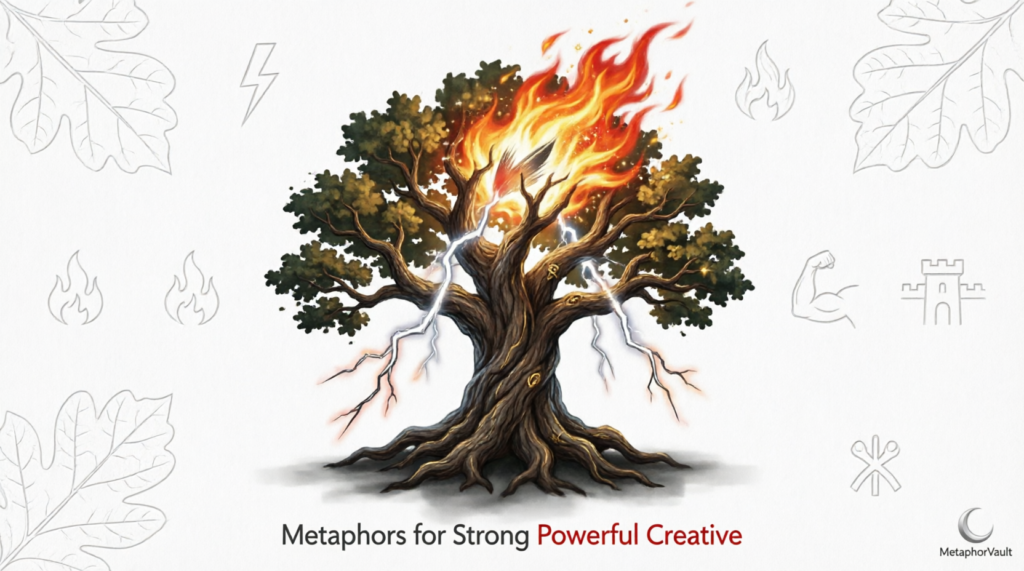
Metaphors for strong are creative comparisons that describe physical strength, mental toughness, emotional courage, strong relationships, powerful personalities, or even powerful ideas without saying simply that someone or something is “strong.” A metaphor compares one thing with another to create a clearer picture in the reader’s mind.
People search for metaphors for strong because the word strong can feel too plain. Saying “She is strong” tells us something, but “She is an oak tree in a storm” gives us an image of someone who stays firm when life becomes difficult.
You may see these expressions in everyday conversations, school assignments, novels, poems, speeches, social media captions, motivational writing, sports commentary, and professional communication. Some describe people, while others describe character, love, determination, arguments, communities, or physical power.
This guide explains 60+ metaphors for strong, including what each one means, when to use it, when to avoid it, sample sentences, tone, alternatives, and difficulty level. You will also learn how to choose the right metaphor for different situations.
This guide is for 2026 and focuses on natural expressions that sound meaningful rather than forced.
Definition & Meaning
Metaphors for strong are comparisons that show strength by connecting a person, object, feeling, or idea to something known for power, stability, endurance, or force. They help readers picture strength instead of simply hearing the word “strong.”
Simple Definition
A metaphor for strong describes strength indirectly.
Instead of:
“He is very strong.”
You might write:
“He is a mountain that refuses to move.”
The mountain represents stability, endurance, and power. The sentence does not literally say the person is a mountain.
Quick Summary Table
| Type of strength | Example metaphor | Main meaning |
|---|---|---|
| Physical | A wall of steel | Great physical power |
| Mental | An iron fortress | Strong mind |
| Emotional | An oak tree in a storm | Emotional stability |
| Courage | A lion | Bravery |
| Determination | A charging train | Relentless effort |
| Resilience | A phoenix | Ability to recover |
| Leadership | An anchor | Stability and guidance |
| Character | A rock | Dependability |
| Confidence | A mountain | Self-assurance |
| Willpower | Iron will | Strong determination |
Why We Use Metaphors for Strong
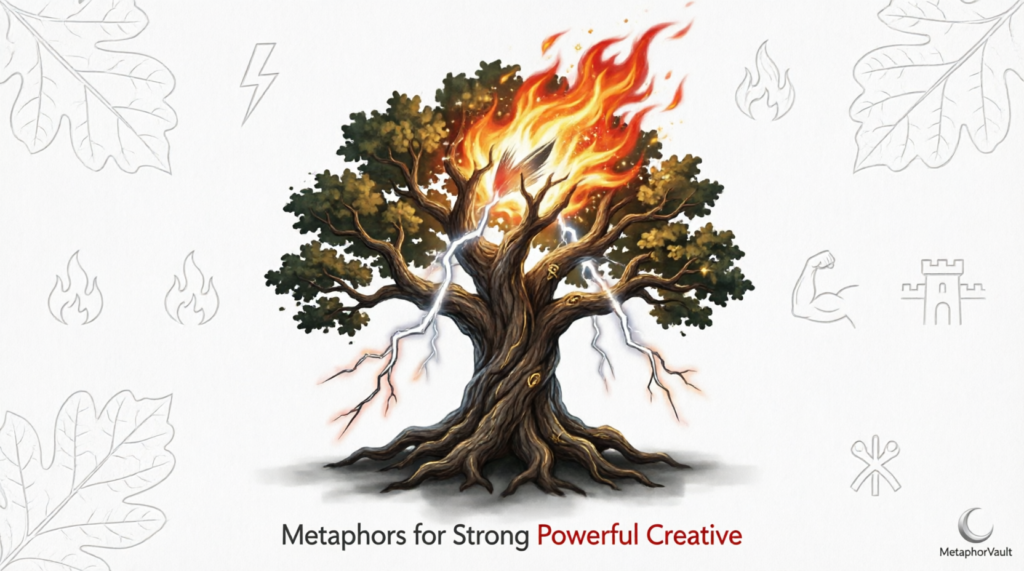
We use metaphors for strong because they make strength easier to picture, feel, and remember. They add emotion and detail to ordinary language, helping speakers and writers show physical power, courage, resilience, confidence, or determination in a more vivid way.
1. They Make Writing More Powerful
Compare these two sentences:
“Maria is strong.”
“Maria is an oak tree standing through every storm.”
The second sentence creates a picture. We can imagine wind, rain, pressure, and an oak that remains standing.
That makes the description more memorable.
2. They Help Describe Different Kinds of Strength
“Strong” does not always mean muscular.
Someone can be:
- mentally strong
- emotionally strong
- physically strong
- spiritually strong
- financially strong
- socially strong
- morally strong
- academically strong
- determined
- resilient
- brave
A good metaphor helps identify the kind of strength you mean.
3. They Improve School Writing
Metaphors are useful in:
- essays
- creative writing
- poetry
- personal narratives
- book reports
- speeches
- descriptive paragraphs
Instead of repeating “strong” several times, a student can use different images to make writing richer.
4. They Make Speeches More Memorable
A speaker might say:
“Our community is a bridge. Every person is another piece holding it together.”
That is more memorable than:
“Our community is strong.”
5. They Add Emotion to Social Media
A short metaphor can turn an ordinary caption into something more expressive:
“Still standing. Still growing. Still an oak.”
6. They Make Characters Feel Real
Writers often use metaphors to reveal personality.
For example:
“Her anger was a wildfire.”
This tells us that her anger is not mild. It spreads quickly and may be difficult to control.
60+ Metaphors for Strong
Below are 65 metaphors for strong, covering physical strength, emotional strength, courage, resilience, confidence, relationships, leadership, determination, and powerful ideas.
1. A Tower of Strength
Meaning: A person who gives others support, courage, and stability.
Real explanation:
A tower stands tall and can be seen from far away. Calling someone a “tower of strength” suggests that others depend on that person’s steady support.
Sample sentence:
“During the crisis, her mother became a tower of strength for the whole family.”
When to use it:
Use it for supportive parents, friends, leaders, teachers, or partners.
When NOT to use it:
Avoid it when you only mean physical strength.
Alternatives:
- pillar of strength
- strong support
- steady presence
Difficulty: Easy
Tone: Neutral
2. A Pillar of Strength
Meaning: Someone dependable who supports others during difficult times.
Real explanation:
A pillar holds up a structure. The metaphor suggests that a person provides emotional or practical support.
Sample sentence:
“Her brother was a pillar of strength after the family lost their home.”
When to use it:
Use it for dependable people.
When NOT to use it:
Do not use it when describing athletic ability alone.
Alternatives:
- tower of strength
- rock
- backbone
Difficulty: Easy
Tone: Neutral
3. An Oak Tree
Meaning: A person who is strong, stable, and resilient.
Real explanation:
Oak trees are associated with strength and long life. The image works especially well for someone who survives hardship.
Sample sentence:
“She stood like an oak tree while everyone around her panicked.”
When to use it:
Use it for emotional strength and stability.
When NOT to use it:
Avoid it if you need to emphasize speed or aggressive power.
Alternatives:
- mighty tree
- deep-rooted tree
- sturdy oak
Difficulty: Easy
Tone: Neutral
4. A Rock
Meaning: Someone reliable, stable, and emotionally strong.
Real explanation:
A rock does not easily move. The metaphor suggests that a person remains dependable when life becomes difficult.
Sample sentence:
“Through every problem, my best friend has been my rock.”
When to use it:
Excellent for friendship and emotional support.
When NOT to use it:
Avoid it if you want to describe flexibility or creativity.
Alternatives:
- anchor
- pillar
- foundation
Difficulty: Easy
Tone: Informal/Neutral
5. An Iron Fortress
Meaning: A person with powerful mental or emotional defenses.
Real explanation:
A fortress is built for protection, while iron suggests toughness. Together, they create an image of someone who is difficult to break.
Sample sentence:
“Years of hardship turned her into an iron fortress.”
When to use it:
Use it for mental toughness and emotional resilience.
When NOT to use it:
Avoid it for a gentle description of vulnerability.
Alternatives:
- steel fortress
- armored mind
- stronghold
Difficulty: Medium
Tone: Neutral
6. A Wall of Steel
Meaning: Something extremely difficult to break through or overcome.
Real explanation:
Steel is strong, while a wall blocks movement. Together, the image suggests powerful resistance.
Sample sentence:
“The team’s defense was a wall of steel.”
When to use it:
Great for sports, security, resistance, and determination.
When NOT to use it:
Avoid it when you want to emphasize kindness or warmth.
Alternatives:
- steel barrier
- iron wall
- solid defense
Difficulty: Easy
Tone: Neutral
7. Iron Will
Meaning: Extremely strong determination.
Real explanation:
The metaphor compares someone’s willpower to iron. It suggests that pressure cannot easily bend their decision.
Sample sentence:
“Her iron will carried her through months of training.”
When to use it:
Use it for discipline and persistence.
When NOT to use it:
Avoid it when someone is simply physically strong.
Alternatives:
- unbreakable determination
- powerful resolve
- fierce willpower
Difficulty: Easy
Tone: Neutral/Formal
8. A Lion
Meaning: Someone brave, powerful, and fearless.
Real explanation:
The lion is commonly associated with courage, dominance, and strength.
Sample sentence:
“On the field, the young athlete became a lion.”
When to use it:
Use it for courage, confidence, and bold action.
When NOT to use it:
Avoid it if the person is strong mainly because they are patient or gentle.
Alternatives:
- warrior
- brave heart
- fearless fighter
Difficulty: Easy
Tone: Neutral
9. A Mountain
Meaning: Someone or something extremely strong, stable, or difficult to overcome.
Real explanation:
A mountain represents size, stability, and endurance. It is especially useful for describing someone who remains firm under pressure.
Sample sentence:
“He stood like a mountain while criticism surrounded him.”
When to use it:
Use it for confidence and emotional stability.
When NOT to use it:
Avoid it when describing quick movement.
Alternatives:
- giant
- fortress
- immovable force
Difficulty: Easy
Tone: Neutral
10. A Steel Cable
Meaning: Someone capable of handling great pressure without breaking.
Real explanation:
A steel cable can hold heavy loads. The metaphor works well for people who carry responsibility.
Sample sentence:
“She was the steel cable holding the project together.”
When to use it:
Use it for responsibility and resilience.
When NOT to use it:
Avoid it for poetic descriptions of tenderness.
Alternatives:
- strong rope
- support beam
- backbone
Difficulty: Medium
Tone: Neutral
11. A Fortress
Meaning: A person or mind that is strongly protected and difficult to defeat.
Real explanation:
A fortress is designed to withstand attacks. Calling someone a fortress suggests strong emotional or mental defenses.
Sample sentence:
“His confidence became a fortress against criticism.”
When to use it:
Use it for mental strength and resistance.
When NOT to use it:
Avoid it if you mean that someone is open and emotionally vulnerable.
Alternatives:
- stronghold
- castle
- defensive wall
Difficulty: Easy
Tone: Neutral
12. A Stronghold
Meaning: A powerful source of protection or strength.
Real explanation:
A stronghold is a secure place that can resist attack. It works well for people, beliefs, communities, and institutions.
Sample sentence:
“Her faith became a stronghold during difficult years.”
When to use it:
Use it in serious, formal, or literary writing.
When NOT to use it:
Avoid it in very casual conversation.
Alternatives:
- fortress
- safe place
- source of strength
Difficulty: Medium
Tone: Formal/Literary
13. A Hammer
Meaning: Someone or something with powerful force.
Real explanation:
A hammer strikes with force. The metaphor suggests direct, physical, or decisive strength.
Sample sentence:
“The boxer fought like a hammer against the heavy bag.”
When to use it:
Use it for forceful action.
When NOT to use it:
Avoid it when describing calm strength.
Alternatives:
- powerhouse
- force
- heavy hitter
Difficulty: Easy
Tone: Informal
14. A Powerhouse
Meaning: A person, team, organization, or thing with exceptional strength or ability.
Real explanation:
A powerhouse produces or represents great energy. The expression is common in sports, business, and everyday speech.
Sample sentence:
“The small startup became a powerhouse in the industry.”
When to use it:
Excellent for teams, athletes, companies, and talented people.
When NOT to use it:
Avoid it if the strength is purely emotional and quiet.
Alternatives:
- giant
- force
- dominant player
Difficulty: Easy
Tone: Informal/Neutral
15. A Force of Nature
Meaning: Someone with extraordinary energy, influence, or determination.
Real explanation:
Natural forces such as storms and earthquakes can be difficult to stop. The metaphor suggests powerful energy that keeps moving.
Sample sentence:
“She is a force of nature when she sets her mind to something.”
When to use it:
Use it for energetic, determined, influential people.
When NOT to use it:
Avoid it if you need to describe quiet reliability.
Alternatives:
- unstoppable force
- powerhouse
- driving force
Difficulty: Easy
Tone: Neutral
16. An Unstoppable Train
Meaning: Someone who continues moving toward a goal despite obstacles.
Real explanation:
A train has momentum and follows its route. This metaphor emphasizes determination rather than physical strength.
Sample sentence:
“Once she started training, she became an unstoppable train.”
When to use it:
Use it for motivation and persistence.
When NOT to use it:
Avoid it when the person is calm and slow-moving.
Alternatives:
- unstoppable force
- moving engine
- relentless machine
Difficulty: Easy
Tone: Informal
17. A Steel Shield
Meaning: Strong protection against harm, pressure, or criticism.
Real explanation:
A shield protects someone from attack. Steel makes the image stronger and more durable.
Sample sentence:
“His confidence was a steel shield against negative comments.”
When to use it:
Use it for emotional protection and resilience.
When NOT to use it:
Avoid it if you mean that someone welcomes criticism openly.
Alternatives:
- protective wall
- armor
- strong defense
Difficulty: Medium
Tone: Neutral
18. Armor
Meaning: Emotional or mental protection against difficult experiences.
Real explanation:
Armor protects the body. In metaphorical language, it can represent confidence, experience, wisdom, or emotional defenses.
Sample sentence:
“Her years of experience became armor against failure.”
When to use it:
Use it for emotional toughness.
When NOT to use it:
Avoid it if you want to show emotional openness.
Alternatives:
- shield
- protection
- defense
Difficulty: Easy
Tone: Neutral
19. A Diamond
Meaning: Someone or something that remains valuable and strong under pressure.
Real explanation:
Diamonds are famous for hardness and value. This metaphor connects pressure with strength and worth.
Sample sentence:
“Pressure turned him into a diamond.”
When to use it:
Use it for growth through hardship.
When NOT to use it:
Avoid it when you need to describe physical strength specifically.
Alternatives:
- precious stone
- gem
- polished strength
Difficulty: Easy
Tone: Neutral
20. Tempered Steel
Meaning: Strength developed through hardship and experience.
Real explanation:
The image suggests that difficult experiences have made someone tougher and more capable.
Sample sentence:
“Her painful experiences left her with the strength of tempered steel.”
When to use it:
Use it for resilience and personal growth.
When NOT to use it:
Avoid it for young children or very casual descriptions.
Alternatives:
- hardened steel
- tested strength
- forged character
Difficulty: Medium
Tone: Literary/Formal
21. A Tree With Deep Roots
Meaning: Someone who is stable, grounded, and difficult to shake.
Real explanation:
Deep roots keep a tree standing during strong winds. The metaphor suggests strong values and emotional stability.
Sample sentence:
“She has deep roots in her family and refuses to let hardship move her.”
When to use it:
Use it for values, identity, and resilience.
When NOT to use it:
Avoid it when you need to describe fast action.
Alternatives:
- grounded person
- rooted tree
- steady oak
Difficulty: Easy
Tone: Neutral
22. A Backbone
Meaning: The main source of strength or support.
Real explanation:
The backbone supports the body. Figuratively, it describes someone who keeps a family, team, or organization functioning.
Sample sentence:
“Her dedication is the backbone of the organization.”
When to use it:
Excellent for teams, families, and workplaces.
When NOT to use it:
Avoid it if you mean only courage.
Alternatives:
- foundation
- pillar
- main support
Difficulty: Easy
Tone: Neutral
23. A Foundation of Stone
Meaning: A very stable and dependable base.
Real explanation:
A stone foundation can support a large structure. The metaphor works especially well for relationships, organizations, and beliefs.
Sample sentence:
“Trust became the foundation of stone beneath their friendship.”
When to use it:
Use it for long-term stability.
When NOT to use it:
Avoid it for temporary strength.
Alternatives:
- solid foundation
- bedrock
- firm base
Difficulty: Medium
Tone: Literary
24. Bedrock
Meaning: The strongest and most dependable foundation.
Real explanation:
Bedrock is solid rock beneath soil and other layers. Figuratively, it represents something deeply stable.
Sample sentence:
“Honesty is the bedrock of a healthy relationship.”
When to use it:
Use it for values, principles, and relationships.
When NOT to use it:
Avoid it when describing someone’s athletic strength.
Alternatives:
- foundation
- cornerstone
- solid base
Difficulty: Medium
Tone: Formal/Neutral
25. A Cornerstone
Meaning: A person or idea that provides essential support.
Real explanation:
A cornerstone is a foundational part of a building. Figuratively, it represents something necessary for stability.
Sample sentence:
“Her patience was a cornerstone of the team’s success.”
When to use it:
Use it in professional, academic, and formal writing.
When NOT to use it:
Avoid it when you need a vivid description of physical power.
Alternatives:
- foundation
- pillar
- key support
Difficulty: Medium
Tone: Formal
26. A Warrior
Meaning: Someone who faces difficulties with courage and determination.
Real explanation:
The metaphor focuses on bravery and the willingness to keep fighting through challenges.
Sample sentence:
“She faced every setback like a warrior.”
When to use it:
Use it for courage and resilience.
When NOT to use it:
Avoid it when describing ordinary physical strength without struggle.
Alternatives:
- fighter
- champion
- battle-tested person
Difficulty: Easy
Tone: Neutral
27. A Champion
Meaning: Someone who is powerful, successful, determined, or difficult to defeat.
Real explanation:
A champion represents achievement and persistence. It can describe both actual competitors and people facing life’s challenges.
Sample sentence:
“He carried himself like a champion even after losing.”
When to use it:
Use it for confidence, resilience, and achievement.
When NOT to use it:
Avoid it when the person has not shown any form of determination.
Alternatives:
- winner
- fighter
- leader
Difficulty: Easy
Tone: Positive
28. A Phoenix
Meaning: Someone who becomes strong again after hardship or failure.
Real explanation:
The phoenix is a traditional mythical bird associated with rising again after destruction. It represents recovery and renewal.
Sample sentence:
“After losing everything, she rose like a phoenix.”
When to use it:
Use it for dramatic recovery.
When NOT to use it:
Avoid it when you only mean physical strength.
Alternatives:
- reborn flame
- rising spirit
- survivor
Difficulty: Easy
Tone: Literary
29. A Spring That Bends but Does Not Break
Meaning: Someone who can handle pressure and recover without being destroyed.
Real explanation:
A spring can bend under pressure and return to its original shape. This makes it useful for describing flexible resilience.
Sample sentence:
“He bends under pressure, but like a spring, he always returns.”
When to use it:
Use it for emotional resilience.
When NOT to use it:
Avoid it when you need to emphasize stubbornness.
Alternatives:
- flexible steel
- resilient branch
- rubber band
Difficulty: Medium
Tone: Literary
30. A Storm-Proof Tree
Meaning: Someone who remains strong through severe challenges.
Real explanation:
A tree that survives storms represents endurance and stability.
Sample sentence:
“Years of hardship made her a storm-proof tree.”
When to use it:
Use it for emotional strength.
When NOT to use it:
Avoid it for short-term physical power.
Alternatives:
- storm survivor
- rooted oak
- steadfast tree
Difficulty: Easy
Tone: Literary
31. A Steel Spine
Meaning: Strong courage, discipline, and determination.
Real explanation:
The spine supports the body. Steel suggests strength and toughness.
Sample sentence:
“The leader showed a steel spine when everyone else wanted to quit.”
When to use it:
Use it for courage and firm decisions.
When NOT to use it:
Avoid it when describing kindness or flexibility.
Alternatives:
- backbone
- iron will
- strong character
Difficulty: Medium
Tone: Neutral
32. An Engine
Meaning: A person who provides energy and keeps progress moving.
Real explanation:
An engine creates movement. Calling someone an engine suggests that their effort drives a group forward.
Sample sentence:
“Jordan was the engine behind the team’s comeback.”
When to use it:
Excellent for sports, business, and teamwork.
When NOT to use it:
Avoid it when discussing quiet emotional strength.
Alternatives:
- driving force
- motor
- powerhouse
Difficulty: Easy
Tone: Neutral
33. A Driving Force
Meaning: Someone or something that strongly causes progress or change.
Real explanation:
The metaphor compares influence to a force that pushes something forward.
Sample sentence:
“Her determination was the driving force behind the project.”
When to use it:
Excellent for professional and academic writing.
When NOT to use it:
Avoid it when describing physical muscle strength.
Alternatives:
- catalyst
- engine
- motivating power
Difficulty: Medium
Tone: Formal/Neutral
34. A Heavyweight
Meaning: Someone with great power, influence, or importance.
Real explanation:
The word comes from boxing and is often used metaphorically for people or organizations with major influence.
Sample sentence:
“She has become a heavyweight in the technology industry.”
When to use it:
Use it for influence and power.
When NOT to use it:
Avoid it when describing emotional sensitivity.
Alternatives:
- major player
- powerhouse
- industry giant
Difficulty: Medium
Tone: Informal/Neutral
35. A Giant
Meaning: Someone or something exceptionally large, powerful, successful, or influential.
Real explanation:
Giants are traditionally imagined as enormous and powerful. The metaphor emphasizes scale.
Sample sentence:
“Despite its small beginnings, the company became a giant.”
When to use it:
Use it for organizations, athletes, ideas, or influential people.
When NOT to use it:
Avoid it when the strength is quiet and subtle.
Alternatives:
- titan
- powerhouse
- giant force
Difficulty: Easy
Tone: Neutral
36. A Titan
Meaning: A person or organization with extraordinary power, influence, or achievement.
Real explanation:
The word evokes the powerful Titans of Greek mythology.
Sample sentence:
“She became a titan of modern business.”
When to use it:
Best for achievements and major influence.
When NOT to use it:
Avoid it in very simple children’s writing unless explained.
Alternatives:
- giant
- powerhouse
- industry leader
Difficulty: Medium
Tone: Formal/Literary
37. A Steel Door
Meaning: Someone or something that is extremely difficult to overcome.
Real explanation:
A steel door creates a strong barrier. It suggests resistance and protection.
Sample sentence:
“His determination was a steel door against every distraction.”
When to use it:
Use it for resistance.
When NOT to use it:
Avoid it when you want to show adaptability.
Alternatives:
- iron wall
- fortress
- shield
Difficulty: Easy
Tone: Neutral
38. A Boulder
Meaning: Something massive, solid, and difficult to move.
Real explanation:
A boulder suggests physical stability and resistance.
Sample sentence:
“He stood like a boulder while the crowd pushed against him.”
When to use it:
Use it for physical or symbolic stability.
When NOT to use it:
Avoid it for a person who is supposed to be flexible.
Alternatives:
- rock
- stone wall
- mountain
Difficulty: Easy
Tone: Neutral
39. A Brick Wall
Meaning: A strong barrier that is difficult to overcome.
Real explanation:
A brick wall blocks movement and takes effort to break through.
Sample sentence:
“The opposing defense was a brick wall.”
When to use it:
Great for sports and obstacles.
When NOT to use it:
Avoid it when describing emotional openness.
Alternatives:
- stone wall
- barrier
- fortress
Difficulty: Easy
Tone: Informal
40. A Steel Bridge
Meaning: A strong connection that can carry heavy pressure.
Real explanation:
A bridge supports weight while connecting two places. The metaphor can describe people, relationships, or organizations.
Sample sentence:
“Her leadership became a steel bridge between the two teams.”
When to use it:
Use it for connection and dependable leadership.
When NOT to use it:
Avoid it when describing someone who works alone.
Alternatives:
- strong link
- solid connection
- sturdy bridge
Difficulty: Medium
Tone: Neutral
41. A Shield
Meaning: Someone or something that protects others.
Real explanation:
A shield absorbs attacks. The metaphor suggests protective strength.
Sample sentence:
“He became a shield for his younger sister.”
When to use it:
Use it for protective people.
When NOT to use it:
Avoid it when the person does not protect anyone.
Alternatives:
- armor
- defender
- guard
Difficulty: Easy
Tone: Neutral
42. A Guardian
Meaning: Someone who protects, supports, and watches over others.
Real explanation:
A guardian is associated with protection and responsibility.
Sample sentence:
“Her grandmother was a guardian of the family’s traditions.”
When to use it:
Use it for protective strength.
When NOT to use it:
Avoid it if you only mean physical power.
Alternatives:
- protector
- defender
- shield
Difficulty: Easy
Tone: Neutral
43. A Lighthouse
Meaning: A strong and steady source of guidance during difficult times.
Real explanation:
A lighthouse remains visible during storms and helps ships find their way.
Sample sentence:
“Her wisdom was a lighthouse during the darkest period of my life.”
When to use it:
Use it for guidance and emotional strength.
When NOT to use it:
Avoid it if you mean aggression or physical force.
Alternatives:
- guiding light
- beacon
- compass
Difficulty: Easy
Tone: Literary
44. A Beacon
Meaning: A powerful source of hope, direction, or inspiration.
Real explanation:
A beacon gives a signal that others can follow. It represents strength that helps other people.
Sample sentence:
“His courage became a beacon for younger athletes.”
When to use it:
Use it for inspirational people or ideas.
When NOT to use it:
Avoid it for simple physical strength.
Alternatives:
- lighthouse
- guiding light
- source of hope
Difficulty: Medium
Tone: Formal/Literary
45. A Flame That Will Not Die
Meaning: A strong spirit, hope, or determination that survives hardship.
Real explanation:
A flame can represent energy and hope. Saying it will not die emphasizes persistence.
Sample sentence:
“Her dream was a flame that would not die.”
When to use it:
Use it for dreams, hope, courage, and ambition.
When NOT to use it:
Avoid it when you need a literal description of physical strength.
Alternatives:
- burning spirit
- lasting fire
- inner flame
Difficulty: Easy
Tone: Literary
46. A Fire Inside
Meaning: Strong inner motivation, passion, or determination.
Real explanation:
Fire produces heat and energy. An inner fire represents powerful motivation that comes from within.
Sample sentence:
“You can hear the fire inside her whenever she talks about her goals.”
When to use it:
Use it for passion and ambition.
When NOT to use it:
Avoid it if the person is calm and has no strong emotional drive.
Alternatives:
- inner flame
- passion
- burning drive
Difficulty: Easy
Tone: Informal/Neutral
47. A Steel Heart
Meaning: Exceptional emotional toughness.
Real explanation:
The heart represents emotion, while steel suggests hardness. Together, they describe someone who remains strong during emotional pain.
Sample sentence:
“She needed a steel heart to survive those difficult years.”
When to use it:
Use it for emotional toughness.
When NOT to use it:
Avoid it when you want to emphasize kindness.
Alternatives:
- tough heart
- strong spirit
- hardened heart
Difficulty: Medium
Tone: Literary
48. A Lion’s Heart
Meaning: Great courage and bravery.
Real explanation:
The lion represents courage, while the heart represents inner character.
Sample sentence:
“The young firefighter showed a lion’s heart.”
When to use it:
Use it for bravery.
When NOT to use it:
Avoid it when strength comes from patience rather than courage.
Alternatives:
- brave heart
- fearless spirit
- warrior’s heart
Difficulty: Easy
Tone: Literary
49. A Quiet Giant
Meaning: Someone who has great strength or ability but does not show off.
Real explanation:
The phrase combines power with humility.
Sample sentence:
“Despite winning several awards, he remained a quiet giant.”
When to use it:
Use it for humble but highly capable people.
When NOT to use it:
Avoid it for someone who constantly seeks attention.
Alternatives:
- silent powerhouse
- humble giant
- understated force
Difficulty: Medium
Tone: Neutral
50. A Silent Force
Meaning: Someone who creates a strong impact without seeking attention.
Real explanation:
The metaphor focuses on influence rather than noise or aggression.
Sample sentence:
“She was a silent force behind the team’s success.”
When to use it:
Excellent for teachers, workers, parents, and leaders.
When NOT to use it:
Avoid it for loud or openly aggressive personalities.
Alternatives:
- quiet power
- hidden strength
- steady influence
Difficulty: Easy
Tone: Neutral
51. A Calm Sea Beneath a Storm
Meaning: Someone who remains emotionally controlled during difficult circumstances.
Real explanation:
The surface may be chaotic, but the metaphor focuses on inner calm and control.
Sample sentence:
“Although everyone was panicking, she was a calm sea beneath the storm.”
When to use it:
Use it for emotional control.
When NOT to use it:
Avoid it if the person is visibly overwhelmed.
Alternatives:
- calm center
- steady heart
- eye of the storm
Difficulty: Medium
Tone: Literary
52. The Eye of the Storm
Meaning: A calm, stable center during a chaotic situation.
Real explanation:
The center of a storm can be surprisingly calm. Figuratively, someone can remain composed while everything around them is difficult.
Sample sentence:
“During the crisis, the manager became the eye of the storm.”
When to use it:
Use it for calm leadership.
When NOT to use it:
Avoid it if you mean physical strength.
Alternatives:
- calm center
- steady anchor
- source of stability
Difficulty: Medium
Tone: Neutral
53. An Anchor
Meaning: Someone who keeps others stable and prevents them from losing direction.
Real explanation:
An anchor keeps a ship from drifting. The metaphor represents stability and emotional support.
Sample sentence:
“My father has always been the anchor of our family.”
When to use it:
Excellent for families, relationships, and teams.
When NOT to use it:
Avoid it when describing aggressive power.
Alternatives:
- rock
- pillar
- foundation
Difficulty: Easy
Tone: Neutral
54. A Compass
Meaning: A strong source of guidance and direction.
Real explanation:
A compass helps travelers know where to go. The metaphor works for mentors, values, and leaders.
Sample sentence:
“Her principles were a compass when the company faced a difficult choice.”
When to use it:
Use it for moral and intellectual strength.
When NOT to use it:
Avoid it when describing physical toughness.
Alternatives:
- guide
- beacon
- north star
Difficulty: Easy
Tone: Neutral
55. A North Star
Meaning: A reliable source of direction, purpose, or guidance.
Real explanation:
The North Star has long been used for navigation. Figuratively, it can represent a steady goal or principle.
Sample sentence:
“Honesty remained his North Star throughout his career.”
When to use it:
Use it for values, goals, and leadership.
When NOT to use it:
Avoid it for muscular strength.
Alternatives:
- guiding star
- compass
- beacon
Difficulty: Medium
Tone: Literary/Formal
56. A Steel Thread
Meaning: A small but extremely strong connection that survives pressure.
Real explanation:
A thread usually suggests something delicate, but steel changes the image into one of hidden strength.
Sample sentence:
“Hope was the steel thread that kept her connected to her dream.”
When to use it:
Use it for relationships, hope, or persistence.
When NOT to use it:
Avoid it for obvious physical power.
Alternatives:
- strong bond
- unbreakable link
- lasting connection
Difficulty: Advanced
Tone: Literary
57. A Rubber Band That Keeps Stretching
Meaning: Someone who can adapt to pressure without giving up.
Real explanation:
A rubber band stretches under force and can return to shape. This metaphor focuses on flexible resilience.
Sample sentence:
“Life kept stretching him, but he remained like a rubber band that refused to snap.”
When to use it:
Use it for adaptability and resilience.
When NOT to use it:
Avoid it in formal business writing unless the style allows creative language.
Alternatives:
- flexible strength
- spring
- resilient branch
Difficulty: Easy
Tone: Informal
58. A River Cutting Through Stone
Meaning: Persistent effort that eventually overcomes resistance.
Real explanation:
A river may look soft, but over a long period it can carve through hard rock. The metaphor shows the power of patience.
Sample sentence:
“Her persistence was a river cutting through stone.”
When to use it:
Use it for long-term determination.
When NOT to use it:
Avoid it when you need to show sudden power.
Alternatives:
- steady force
- patient power
- relentless current
Difficulty: Medium
Tone: Literary
59. A Hammer Against Stone
Meaning: Persistent force applied again and again until an obstacle gives way.
Real explanation:
The metaphor focuses on repeated effort rather than one powerful action.
Sample sentence:
“His discipline was a hammer against stone.”
When to use it:
Use it for persistence and hard work.
When NOT to use it:
Avoid it when describing gentle strength.
Alternatives:
- relentless force
- steady pressure
- determined effort
Difficulty: Medium
Tone: Literary
60. A Mountain Under Pressure
Meaning: Someone who remains stable despite intense pressure.
Real explanation:
The mountain represents something massive and difficult to move. Pressure does not easily change it.
Sample sentence:
“She remained a mountain under pressure during the investigation.”
When to use it:
Use it for confidence and emotional control.
When NOT to use it:
Avoid it for people who are flexible and quick to change.
Alternatives:
- immovable force
- solid rock
- steady mountain
Difficulty: Easy
Tone: Neutral
61. An Unbreakable Chain
Meaning: A bond or connection that is extremely strong.
Real explanation:
Chains are made to hold things together. An unbreakable chain represents lasting relationships, loyalty, or unity.
Sample sentence:
“Their friendship became an unbreakable chain.”
When to use it:
Use it for relationships and teamwork.
When NOT to use it:
Avoid it if the relationship is temporary.
Alternatives:
- unbreakable bond
- strong link
- lasting connection
Difficulty: Easy
Tone: Neutral
62. A Fortified Castle
Meaning: Someone with strong defenses, confidence, or emotional boundaries.
Real explanation:
A fortified castle is built to withstand attack. It creates a vivid image of protection and resistance.
Sample sentence:
“After years of criticism, he built a fortified castle around his confidence.”
When to use it:
Use it for emotional or mental defenses.
When NOT to use it:
Avoid it if you want to show openness.
Alternatives:
- fortress
- stronghold
- armored mind
Difficulty: Medium
Tone: Literary
63. A Torch in the Wind
Meaning: Strength that continues to shine even when circumstances try to extinguish it.
Real explanation:
A torch exposed to wind is vulnerable, yet it can continue burning. The image represents hope and resilience.
Sample sentence:
“Her courage was a torch in the wind.”
When to use it:
Use it for hope, courage, and emotional strength.
When NOT to use it:
Avoid it when you need to describe physical power.
Alternatives:
- lasting flame
- inner fire
- beacon
Difficulty: Medium
Tone: Literary
64. A Rooted Mountain
Meaning: Extreme stability and resistance to change.
Real explanation:
Both roots and mountains suggest stability. Together, they create an especially strong image.
Sample sentence:
“His principles made him a rooted mountain when others changed their positions.”
When to use it:
Use it for strong beliefs and principles.
When NOT to use it:
Avoid it when flexibility is a positive quality.
Alternatives:
- immovable rock
- deep-rooted oak
- solid foundation
Difficulty: Advanced
Tone: Literary
65. A Flame Forged in Fire
Meaning: Strength created through difficult experiences.
Real explanation:
Fire represents hardship and transformation. The metaphor suggests that challenges have made someone stronger.
Sample sentence:
“She became a flame forged in fire, brighter after every setback.”
When to use it:
Use it for resilience, growth, and overcoming hardship.
When NOT to use it:
Avoid it for simple physical strength.
Alternatives:
- tempered steel
- forged character
- survivor’s spirit
Difficulty: Advanced
Tone: Literary
Quick Reference Table
| # | Metaphor | Main Meaning | Best Use | Tone |
|---|---|---|---|---|
| 1 | Tower of strength | Support | Family, friendship | Neutral |
| 2 | Pillar of strength | Dependability | Support | Neutral |
| 3 | Oak tree | Stability | Emotional strength | Neutral |
| 4 | Rock | Reliability | Relationships | Informal |
| 5 | Iron fortress | Mental toughness | Resilience | Neutral |
| 6 | Wall of steel | Resistance | Defense | Neutral |
| 7 | Iron will | Determination | Goals | Formal |
| 8 | Lion | Courage | Bravery | Neutral |
| 9 | Mountain | Stability | Confidence | Neutral |
| 10 | Steel cable | Handling pressure | Responsibility | Neutral |
| 11 | Fortress | Protection | Mental strength | Neutral |
| 12 | Stronghold | Security | Beliefs | Formal |
| 13 | Hammer | Force | Physical power | Informal |
| 14 | Powerhouse | Exceptional ability | Sports/business | Neutral |
| 15 | Force of nature | Extraordinary energy | Personality | Neutral |
| 16 | Unstoppable train | Persistence | Goals | Informal |
| 17 | Steel shield | Protection | Emotional defense | Neutral |
| 18 | Armor | Emotional protection | Resilience | Neutral |
| 19 | Diamond | Strength under pressure | Growth | Neutral |
| 20 | Tempered steel | Tested strength | Character | Literary |
| 21 | Deep-rooted tree | Groundedness | Values | Neutral |
| 22 | Backbone | Main support | Teams/families | Neutral |
| 23 | Foundation of stone | Stability | Relationships | Literary |
| 24 | Bedrock | Fundamental strength | Values | Formal |
| 25 | Cornerstone | Essential support | Professional writing | Formal |
| 26 | Warrior | Courage | Hardship | Neutral |
| 27 | Champion | Achievement | Success | Positive |
| 28 | Phoenix | Recovery | Resilience | Literary |
| 29 | Spring | Flexible resilience | Pressure | Literary |
| 30 | Storm-proof tree | Endurance | Hardship | Literary |
| 31 | Steel spine | Courage | Leadership | Neutral |
| 32 | Engine | Driving energy | Teams | Neutral |
| 33 | Driving force | Influence | Business | Formal |
| 34 | Heavyweight | Influence | Industry/sports | Informal |
| 35 | Giant | Great power | Success | Neutral |
| 36 | Titan | Major influence | Achievement | Formal |
| 37 | Steel door | Resistance | Obstacles | Neutral |
| 38 | Boulder | Solidity | Stability | Neutral |
| 39 | Brick wall | Barrier | Sports/problems | Informal |
| 40 | Steel bridge | Strong connection | Leadership | Neutral |
| 41 | Shield | Protection | Family | Neutral |
| 42 | Guardian | Protection | People/values | Neutral |
| 43 | Lighthouse | Guidance | Leadership | Literary |
| 44 | Beacon | Inspiration | Leadership | Formal |
| 45 | Flame that will not die | Persistence | Dreams | Literary |
| 46 | Fire inside | Passion | Motivation | Informal |
| 47 | Steel heart | Emotional toughness | Hardship | Literary |
| 48 | Lion’s heart | Bravery | Courage | Literary |
| 49 | Quiet giant | Hidden ability | Humble people | Neutral |
| 50 | Silent force | Quiet influence | Work/teamwork | Neutral |
| 51 | Calm sea beneath a storm | Emotional control | Crisis | Literary |
| 52 | Eye of the storm | Calm leadership | Crisis | Neutral |
| 53 | Anchor | Stability | Relationships | Neutral |
| 54 | Compass | Guidance | Mentors | Neutral |
| 55 | North Star | Direction | Values | Literary |
| 56 | Steel thread | Strong connection | Hope/relationships | Literary |
| 57 | Rubber band | Adaptability | Pressure | Informal |
| 58 | River cutting through stone | Patience | Persistence | Literary |
| 59 | Hammer against stone | Repeated effort | Hard work | Literary |
| 60 | Mountain under pressure | Stability | Stress | Neutral |
| 61 | Unbreakable chain | Strong bond | Relationships | Neutral |
| 62 | Fortified castle | Strong defenses | Confidence | Literary |
| 63 | Torch in the wind | Resilient hope | Courage | Literary |
| 64 | Rooted mountain | Extreme stability | Principles | Literary |
| 65 | Flame forged in fire | Strength through hardship | Growth | Literary |
Metaphors for Strong in Conversation
In everyday speech, people usually choose short and familiar metaphors.
Common choices include:
- “He’s my rock.”
- “She’s a powerhouse.”
- “She’s the backbone of the team.”
- “He’s got an iron will.”
- “She’s a force of nature.”
- “He’s a quiet giant.”
- “She’s a tower of strength.”
These sound natural because people hear them often.
For casual conversation, avoid making every sentence highly poetic. A simple metaphor often sounds more authentic.
Metaphors for Strong in Writing
Writers have more freedom to use unusual comparisons.
For example:
“The old woman stood like an oak tree against the winter wind.”
This creates a visual scene.
A writer could also say:
“His courage was a flame forged in fire.”
This focuses on how hardship created strength.
Metaphors for Strong in Books
Fiction writers use metaphors to reveal character without explaining everything directly.
Instead of writing:
“The character was emotionally strong.”
A novelist might write:
“Her heart had become a fortress.”
That tells readers that painful experiences changed the character.
Metaphors for Strong in Poetry
Poetry often allows more imaginative comparisons.
Examples:
“I am a mountain beneath the storm.”
“My heart is a torch in the wind.”
“Hope is a river cutting through stone.”
Poetry does not need every metaphor to sound like normal conversation. The goal is often emotional impact.
Metaphors for Strong in Emails
Professional emails usually need clearer language.
Good choices include:
- “a strong foundation”
- “a driving force”
- “the backbone of the project”
- “a cornerstone of our strategy”
- “a pillar of support”
Example:
“Your leadership has been a cornerstone of the team’s success.”
This sounds professional without becoming overly poetic.
Metaphors for Strong in Text Messages
Text messages can be shorter and more personal.
Examples:
“You were my rock through all of this ❤️”
“You’ve got an iron will.”
“You’re a powerhouse!”
“Still standing like an oak.”
The best choice depends on the relationship and mood.
Metaphors for Strong on Instagram
Instagram captions often favor short, emotional language.
Examples:
“Rooted like an oak. Still growing.”
“Pressure made diamonds.”
“A flame that refuses to die.”
“Built like a mountain. Moving like a river.”
“Strong heart. Quiet power.”
These work because they create a quick image without needing a long explanation.
Metaphors for Strong on Facebook
Facebook posts often allow more personal storytelling.
Example:
“My mother has always been the backbone of our family. She has faced storms that would have broken many people, yet she keeps standing.”
This combines a familiar metaphor with a real emotional explanation.
Metaphors for Strong on X
Short metaphors work especially well when space and attention are limited.
Examples:
“Be the oak. Let the storm come.”
“Iron will. Quiet mind. Keep moving.”
“You don’t need to be loud to be a force of nature.”
Metaphors for Strong on LinkedIn
Professional platforms usually favor metaphors connected to leadership, teamwork, growth, and resilience.
Examples:
“Trust is the bedrock of strong teams.”
“Great leaders become anchors when pressure rises.”
“A strong culture is the foundation on which lasting growth is built.”
“Every successful team needs a driving force.”
Metaphors for Strong in School Assignments
For school writing, choose metaphors that clearly connect to the topic.
Physical strength
“The athlete was a wall of steel.”
Emotional strength
“She was an oak tree in a storm.”
Courage
“His heart was a lion.”
Determination
“Her iron will pushed her toward the finish line.”
Resilience
“He rose like a phoenix after failure.”
Always explain the metaphor if your teacher asks for analysis.
For example:
“The author compares the character to an oak tree because she remains stable and strong despite the problems around her.”
That shows you understand both the image and the meaning.
How to Choose the Best Metaphor for Strong
The best metaphor depends on what kind of strength you want to show.
If you mean emotional strength
Choose:
- oak tree
- rock
- anchor
- fortress
- steel heart
- mountain
If you mean courage
Choose:
- lion
- warrior
- lion’s heart
- steel spine
- champion
If you mean determination
Choose:
- iron will
- unstoppable train
- hammer against stone
- river cutting through stone
- driving force
If you mean resilience
Choose:
- phoenix
- diamond
- tempered steel
- storm-proof tree
- flame forged in fire
If you mean leadership
Choose:
- anchor
- lighthouse
- beacon
- pillar of strength
- driving force
If you mean physical strength
Choose:
- wall of steel
- hammer
- powerhouse
- heavyweight
- giant
- mountain
If you mean quiet strength
Choose:
- quiet giant
- silent force
- oak tree
- deep-rooted tree
- rock
Strong Metaphors vs. Similes
A metaphor says one thing is another thing for comparison.
“She is an oak tree.”
A simile uses words such as like or as.
“She is like an oak tree.”
Both create images, but they work differently.
| Metaphor | Simile |
|---|---|
| “He is a mountain.” | “He is like a mountain.” |
| “She is a lion.” | “She is like a lion.” |
| “His mind is a fortress.” | “His mind is like a fortress.” |
| “She has an iron will.” | “Her will is like iron.” |
Metaphors often sound stronger and more direct.
Common Mistakes When Using Metaphors for Strong
1. Using Too Many Metaphors
A paragraph filled with five or six unrelated metaphors can become confusing.
Instead of:
“He was a lion, mountain, river, hammer, fortress, and engine.”
Choose the image that best matches the kind of strength you mean.
2. Choosing a Metaphor That Does Not Fit
A lighthouse suggests guidance.
A hammer suggests force.
An anchor suggests stability.
A phoenix suggests recovery.
Using the wrong one can change the meaning.
3. Making the Metaphor Too Complicated
Simple metaphors are often more powerful.
“She is a rock.”
can be stronger than a long sentence containing several mixed comparisons.
4. Mixing Metaphors
Avoid sentences such as:
“He was a mountain that sailed through the storm on an iron train.”
The images compete with one another.
A cleaner version is:
“He was a mountain that stood firm through the storm.”
Final Takeaway
Metaphors for strong help you show strength instead of simply naming it. A rock can represent reliability, an oak tree can represent resilience, a lion can represent courage, an iron will can represent determination, and a phoenix can represent recovery after hardship.
The strongest metaphor is not always the most dramatic one. It is the one that matches the exact kind of strength you want your reader to understand.
For everyday communication, familiar expressions such as “my rock,” “a powerhouse,” “the backbone,” “an anchor,” and “a pillar of strength” usually sound natural. For poetry and creative writing, more imaginative choices such as “a river cutting through stone,” “a flame forged in fire,” or “a torch in the wind” can create a deeper emotional image.
The key is simple: choose the image that makes the kind of strength visible.
descover more post
25+Personal Metaphors Ways to Describe Yourself 2026
60+ Clock Metaphors Meaning Examples and How to Use …
60+ Eye Metaphors Powerful Metaphors About Eyes 2026

Celorita is a professional language writer and the creative voice behind MetaphorVault.com, where she transforms complex language concepts into engaging and easy-to-understand content. With over 6 years of experience in content writing, figurative language, and educational publishing, she specializes in metaphors, idioms, similes, and modern English expressions. Her mission is to help students, writers, educators, and English learners communicate with greater confidence through practical, well-researched resources. Every article she publishes is crafted with accuracy, clarity, and real value for readers. Through MetaphorVault.com, Celorita is dedicated to making language learning both enjoyable and accessible for a global audience.
