
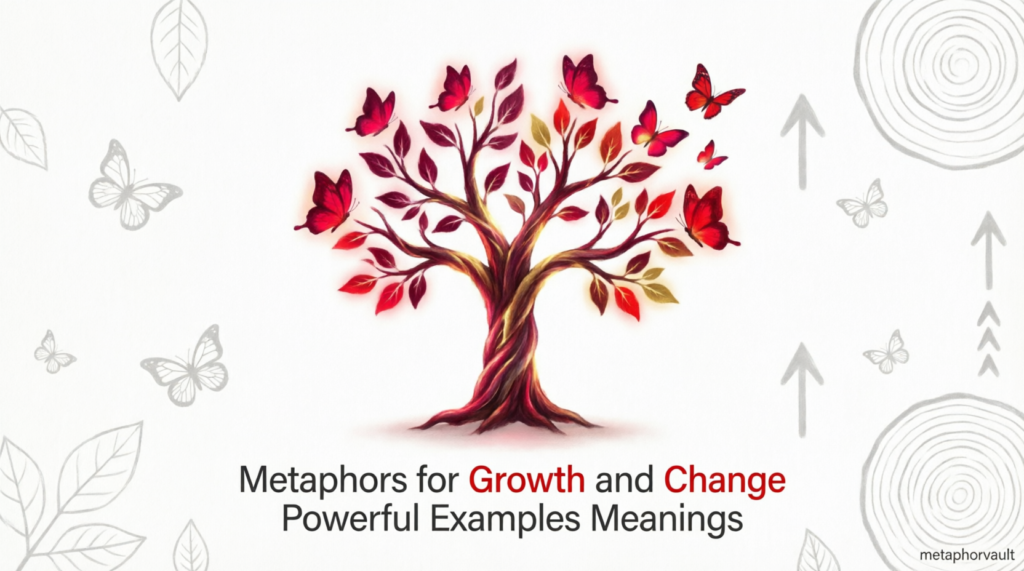
Growth and change are part of everyday life, but talking about them can be hard. A person may improve, start over, face a new stage, or slowly become stronger without knowing the best words to describe that journey. Metaphors for growth and change make these ideas easier to understand by comparing personal progress to familiar things such as plants, journeys, seasons, rivers, mountains, and butterflies.
People search for these metaphors because they want meaningful language for school assignments, speeches, books, poems, social media posts, conversations, or personal reflections. They can also help explain emotional growth, career progress, relationships, learning, healing, and major life transitions.
You may see these expressions in novels, movies, motivational writing, classroom lessons, Instagram captions, and everyday conversations. A phrase such as “I am planting new seeds” can say much more than simply “I am starting something new.”
This guide, for 2026, gives you more than 60 useful metaphors for growth and change. Each example includes its meaning, explanation, sample sentence, best use, situations to avoid, alternatives, difficulty, and tone.
Definition & Meaning
Metaphors for growth and change are expressions that compare development, improvement, transformation, or a new beginning to something familiar. They help readers and listeners picture an abstract process, making ideas such as personal growth, emotional change, learning, and life transitions easier to understand and remember.
Simple Definition
A metaphor says one thing is another thing to create a deeper comparison.
For example:
“She is spreading her wings.”
The person is not literally a bird. The metaphor means she is becoming more independent, confident, or ready for a new experience.
Another example is:
“He is planting the seeds of a better future.”
This means he is taking small actions now that may create positive results later.
What Makes a Growth Metaphor Powerful?
A strong growth metaphor usually has three parts:
- An image — such as a seed, tree, road, river, or butterfly.
- A growth idea — such as learning, improving, changing, or becoming stronger.
- A connection — the image helps people understand the growth process.
Quick Summary Table
| Term | Simple Meaning | Example |
|---|---|---|
| Growth metaphor | A comparison that explains development | “She is putting down roots.” |
| Change metaphor | A comparison that explains transformation | “He turned a new page.” |
| Personal growth | Becoming wiser, stronger, or more capable | “I am climbing a new mountain.” |
| Emotional growth | Developing emotional strength or understanding | “Her wounds became scars.” |
| Career growth | Progressing in work or professional life | “His career is taking off.” |
| Learning growth | Gaining knowledge or skills | “Her mind is opening like a flower.” |
| Transformation | Becoming noticeably different | “He emerged from his shell.” |
| New beginning | Starting a fresh stage | “She is opening a new door.” |
Why We Use Metaphors for Growth and Change
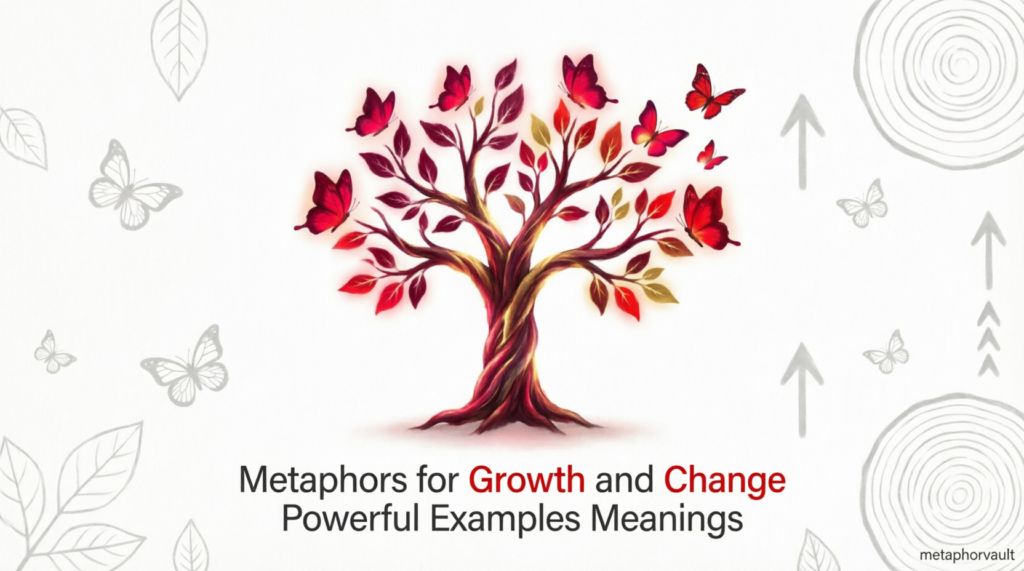
We use metaphors for growth and change because they turn abstract experiences into clear pictures. Instead of simply saying someone has improved, a metaphor can show that person as a seed becoming a tree, a traveler reaching a new road, or a butterfly leaving its cocoon. This makes communication more memorable and emotional.
Practical Purpose
Growth is often invisible.
You cannot easily see confidence, wisdom, emotional maturity, or increased knowledge. Metaphors give these invisible changes a physical image.
Compare:
“I have become more confident.”
with:
“I finally stepped out of my shadow.”
The second sentence creates a picture. It also gives the feeling of overcoming fear.
Everyday Usage
People naturally use growth metaphors when they talk about:
- Personal development
- Education
- Careers
- Relationships
- Recovery from difficult experiences
- New opportunities
- Moving to a new place
- Building confidence
- Starting a business
- Learning from mistakes
- Becoming independent
Writing
Writers use these metaphors to make characters and ideas more vivid.
For example:
“After years of doubt, Maya finally spread her wings.”
This tells readers that Maya has become more confident without explaining every detail.
Speaking
A speaker might say:
“Every mistake was another stone in the path.”
This makes a speech about failure and learning more memorable.
School
Students can use growth metaphors in:
- Essays
- Personal narratives
- Graduation speeches
- Book reports
- Creative writing
- Reflection papers
- Poetry
- Journal entries
A metaphor can help a simple idea sound more thoughtful without using complicated vocabulary.
Social Media
Metaphors are also useful for short posts and captions:
“New season. New roots. New growth.”
The message is brief but communicates personal change.
Professional Communication
In the workplace, metaphors can describe:
- Career development
- Team progress
- Leadership
- Business growth
- Organizational change
- Learning new skills
For example:
“This project gave our team a chance to build stronger roots.”
The phrase suggests that the experience created a stronger foundation.
1. A Seed Becoming a Tree
Meaning: Small beginnings can develop into something strong and valuable.
Real explanation: A seed looks tiny and ordinary, but with time, care, water, and sunlight, it can become a large tree. This makes it an excellent metaphor for slow personal growth.
Sample sentence: “My first small step was a seed that eventually grew into a new career.”
When to use it: Use it for long-term goals, learning, careers, and personal development.
When NOT to use it: Avoid it when you need to describe very sudden change.
Alternatives: “Starting small,” “building over time,” “growing from a beginning.”
Difficulty: Easy
Tone: Neutral
2. Putting Down Roots
Meaning: Becoming stable, settled, or deeply connected to a place, person, or purpose.
Real explanation: Plants grow roots to become secure in the ground. People can also “put down roots” when they build a home, career, relationship, or community.
Sample sentence: “After years of moving around, she finally put down roots.”
When to use it: Use it for homes, communities, careers, relationships, and stability.
When NOT to use it: Avoid it when describing a temporary situation.
Alternatives: “Settling in,” “building a foundation,” “becoming established.”
Difficulty: Easy
Tone: Neutral
3. Spreading Your Wings
Meaning: Becoming independent and ready for new experiences.
Real explanation: A young bird eventually spreads its wings and leaves the safety of its nest. The image works well for someone becoming confident or independent.
Sample sentence: “College gave him the chance to spread his wings.”
When to use it: Use it for independence, confidence, travel, education, and new experiences.
When NOT to use it: Avoid it for very formal technical writing.
Alternatives: “Becoming independent,” “stepping out,” “finding your freedom.”
Difficulty: Easy
Tone: Informal/Neutral
4. Turning a New Page
Meaning: Beginning a new stage of life.
Real explanation: A book page represents one part of a larger story. Turning the page suggests leaving an old chapter behind and moving forward.
Sample sentence: “After graduation, I felt ready to turn a new page.”
When to use it: Use it for new jobs, relationships, moving, graduation, or major life changes.
When NOT to use it: Avoid repeating it many times in the same piece.
Alternatives: “Starting fresh,” “beginning a new chapter,” “moving forward.”
Difficulty: Easy
Tone: Neutral
5. Opening a New Door
Meaning: Discovering or accepting a new opportunity.
Real explanation: A closed door can represent an opportunity that has not yet been explored. Opening it suggests taking a step into something new.
Sample sentence: “Learning a new skill opened a new door for her.”
When to use it: Use it for opportunities, careers, education, and life changes.
When NOT to use it: Avoid it when you mean gradual growth rather than opportunity.
Alternatives: “Finding an opportunity,” “entering a new path,” “unlocking a possibility.”
Difficulty: Easy
Tone: Neutral
6. Climbing a Mountain
Meaning: Working through challenges to reach a goal.
Real explanation: Mountains require effort, patience, preparation, and persistence. The metaphor shows that meaningful growth can involve struggle.
Sample sentence: “Learning to trust myself was like climbing a mountain.”
When to use it: Use it for difficult goals and major challenges.
When NOT to use it: Avoid it when describing effortless change.
Alternatives: “Overcoming obstacles,” “rising to a challenge,” “reaching a peak.”
Difficulty: Easy
Tone: Neutral
7. Crossing a Bridge
Meaning: Moving from one stage or situation to another.
Real explanation: A bridge connects two places. It therefore works well for transitions between different stages of life.
Sample sentence: “Moving away from home felt like crossing a bridge into adulthood.”
When to use it: Use it for transitions, education, relationships, and major decisions.
When NOT to use it: Avoid it if there is no clear transition.
Alternatives: “Making a transition,” “moving across,” “entering a new stage.”
Difficulty: Easy
Tone: Neutral
8. A Butterfly Leaving Its Cocoon
Meaning: Transforming into a more confident or developed version of yourself.
Real explanation: The butterfly metaphor is powerful because the change is dramatic. The creature emerges looking and living very differently.
Sample sentence: “After years of self-doubt, she felt like a butterfly leaving its cocoon.”
When to use it: Use it for major personal transformation.
When NOT to use it: Avoid it when the change is very small or temporary.
Alternatives: “Emerging from a shell,” “transforming,” “becoming a new self.”
Difficulty: Easy
Tone: Inspirational
9. Emerging From a Shell
Meaning: Becoming more open, confident, or social.
Real explanation: A shell suggests protection and isolation. Leaving it suggests that a person feels safe enough to show more of their personality.
Sample sentence: “Joining the drama club helped him emerge from his shell.”
When to use it: Use it for social confidence and emotional openness.
When NOT to use it: Avoid it for purely professional technical writing.
Alternatives: “Opening up,” “becoming more confident,” “coming out of hiding.”
Difficulty: Easy
Tone: Informal/Neutral
10. A Flower Blooming
Meaning: Developing into your full potential.
Real explanation: A flower begins as a bud and slowly opens. This makes blooming a natural metaphor for confidence, talent, beauty, or maturity.
Sample sentence: “Her creativity began to bloom after she found the right teacher.”
When to use it: Use it for talent, confidence, creativity, and emotional development.
When NOT to use it: Avoid overusing it in formal business writing.
Alternatives: “Coming into your own,” “flourishing,” “reaching your potential.”
Difficulty: Easy
Tone: Warm
11. Watering Your Garden
Meaning: Giving regular care to something you want to grow.
Real explanation: A garden needs consistent attention. The metaphor suggests that relationships, skills, goals, and personal development also require regular effort.
Sample sentence: “Reading every day is how I water my garden of knowledge.”
When to use it: Use it for habits, relationships, learning, and self-improvement.
When NOT to use it: Avoid it when discussing a sudden transformation.
Alternatives: “Nurturing growth,” “giving it care,” “investing in yourself.”
Difficulty: Moderate
Tone: Inspirational
12. Planting Seeds
Meaning: Taking an action now that may create future results.
Real explanation: Seeds need time before their growth becomes visible. This metaphor is useful when the results of today’s actions may appear much later.
Sample sentence: “Every book I read is planting a seed for my future.”
When to use it: Use it for education, ideas, habits, relationships, and goals.
When NOT to use it: Avoid promising immediate results with this metaphor.
Alternatives: “Laying groundwork,” “starting something,” “creating future possibilities.”
Difficulty: Easy
Tone: Neutral
13. A River Changing Course
Meaning: Changing direction while continuing to move forward.
Real explanation: Rivers can change their paths because of nature, obstacles, or changes in the landscape. People can also adjust their plans without giving up.
Sample sentence: “My career changed course, but I never stopped moving forward.”
When to use it: Use it for career changes, life decisions, and unexpected transitions.
When NOT to use it: Avoid it if you mean complete transformation.
Alternatives: “Changing direction,” “taking another path,” “redirecting your life.”
Difficulty: Moderate
Tone: Reflective
14. A River Finding Its Way
Meaning: Gradually discovering the right direction.
Real explanation: Water moves around rocks and other obstacles until it finds a path. This creates a hopeful image of adapting instead of giving up.
Sample sentence: “I did not know my purpose at first, but I slowly found my way.”
When to use it: Use it for uncertainty and personal discovery.
When NOT to use it: Avoid it when discussing a carefully planned process.
Alternatives: “Finding your path,” “discovering your direction,” “working it out.”
Difficulty: Moderate
Tone: Reflective
15. Climbing the Ladder
Meaning: Progressing toward higher levels of success or responsibility.
Real explanation: A ladder has separate steps, making it useful for describing gradual career or achievement-based progress.
Sample sentence: “She has been climbing the career ladder for years.”
When to use it: Use it for careers, promotions, education, and achievement.
When NOT to use it: Avoid it when success is not hierarchical.
Alternatives: “Moving up,” “advancing,” “progressing.”
Difficulty: Easy
Tone: Professional
16. Building a Stronger Foundation
Meaning: Developing basic skills or habits that support future growth.
Real explanation: A building needs a strong foundation before it can safely become taller. Personal development works in a similar way.
Sample sentence: “The first year of training helped me build a stronger foundation.”
When to use it: Use it for education, careers, relationships, and skills.
When NOT to use it: Avoid it for sudden emotional change.
Alternatives: “Creating a base,” “building strong habits,” “laying groundwork.”
Difficulty: Easy
Tone: Professional
17. Breaking Out of a Mold
Meaning: Rejecting old expectations and becoming more independent.
Real explanation: A mold gives something a fixed shape. Breaking out of it suggests refusing to remain limited by old ideas.
Sample sentence: “She broke out of the mold and created her own career path.”
When to use it: Use it for individuality and major changes in identity or direction.
When NOT to use it: Avoid it when conformity is not part of the situation.
Alternatives: “Breaking free,” “challenging expectations,” “doing things differently.”
Difficulty: Moderate
Tone: Neutral
18. Breaking Out of a Cage
Meaning: Becoming free from restrictions.
Real explanation: A cage limits movement. The metaphor describes leaving behind fear, unhealthy expectations, or restrictive circumstances.
Sample sentence: “Writing helped him break out of the cage of self-doubt.”
When to use it: Use it for freedom and overcoming limitations.
When NOT to use it: Avoid language that makes a minor inconvenience sound extreme.
Alternatives: “Breaking free,” “escaping limitations,” “finding freedom.”
Difficulty: Easy
Tone: Strong
19. Shedding Old Skin
Meaning: Letting go of an old identity, habit, or way of living.
Real explanation: Snakes shed old skin as they grow. The image naturally connects physical growth with leaving something old behind.
Sample sentence: “Moving to a new city felt like shedding my old skin.”
When to use it: Use it for deep personal change.
When NOT to use it: Avoid it when the change is superficial.
Alternatives: “Letting go of the old self,” “reinventing yourself,” “starting over.”
Difficulty: Moderate
Tone: Reflective
20. A Phoenix Rising
Meaning: Recovering and becoming stronger after a major setback.
Real explanation: The phoenix is traditionally associated with renewal and rising again after destruction. It is especially powerful for stories of recovery.
Sample sentence: “After losing everything, she rose like a phoenix.”
When to use it: Use it for powerful recovery and renewal.
When NOT to use it: Avoid it for ordinary small improvements.
Alternatives: “Rising again,” “starting anew,” “reborn.”
Difficulty: Moderate
Tone: Dramatic
21. A New Season
Meaning: Entering a different period of life.
Real explanation: Seasons naturally change. Calling a new stage a “new season” suggests that life has moved into a different period with new experiences.
Sample sentence: “Marriage began a new season in their lives.”
When to use it: Use it for life stages and emotional transitions.
When NOT to use it: Avoid it when you need an exact technical description.
Alternatives: “New chapter,” “new phase,” “new period.”
Difficulty: Easy
Tone: Warm
22. Winter Turning Into Spring
Meaning: Moving from a difficult period into a hopeful one.
Real explanation: Winter can represent hardship or stillness, while spring suggests renewal, warmth, and fresh growth.
Sample sentence: “After a difficult year, life finally felt like winter turning into spring.”
When to use it: Use it for recovery, hope, and emotional renewal.
When NOT to use it: Avoid it if the situation has not improved.
Alternatives: “Darkness giving way to light,” “a fresh beginning,” “renewal.”
Difficulty: Easy
Tone: Poetic
23. Dawn After the Night
Meaning: Hope appearing after a difficult period.
Real explanation: Night eventually gives way to dawn. The metaphor suggests that hardship does not last forever.
Sample sentence: “Her new opportunity felt like dawn after a long night.”
When to use it: Use it for hope and recovery.
When NOT to use it: Avoid promising that every problem will quickly disappear.
Alternatives: “Light after darkness,” “a new beginning,” “hope after hardship.”
Difficulty: Easy
Tone: Poetic
24. Turning the Corner
Meaning: Reaching a point where a difficult situation begins to improve.
Real explanation: When you turn a physical corner, you cannot see what lies ahead until you move forward. The expression often suggests that better circumstances are beginning.
Sample sentence: “After months of practice, I think I am finally turning the corner.”
When to use it: Use it for gradual improvement.
When NOT to use it: Avoid it when no improvement has happened yet.
Alternatives: “Making progress,” “seeing improvement,” “moving into better times.”
Difficulty: Easy
Tone: Conversational
25. Taking Root
Meaning: Becoming established and strong.
Real explanation: A plant becomes stable once its roots grow into the soil. Ideas, relationships, habits, and careers can also take root.
Sample sentence: “Her new habit is finally taking root.”
When to use it: Use it for habits, ideas, relationships, and careers.
When NOT to use it: Avoid it for very short-lived situations.
Alternatives: “Becoming established,” “gaining strength,” “settling in.”
Difficulty: Easy
Tone: Neutral
26. Growing Stronger Muscles
Meaning: Developing strength through repeated effort.
Real explanation: Muscles become stronger through regular training. The metaphor shows that mental skills, confidence, discipline, and resilience can also develop through practice.
Sample sentence: “Every difficult conversation helped me build stronger emotional muscles.”
When to use it: Use it for resilience, discipline, and practice.
When NOT to use it: Avoid it if your audience may find the comparison too casual.
Alternatives: “Building strength,” “developing resilience,” “training your mind.”
Difficulty: Moderate
Tone: Informal/Neutral
27. Sharpening the Blade
Meaning: Improving a skill through practice and preparation.
Real explanation: A dull blade becomes useful again when sharpened. The metaphor suggests that abilities can become stronger when we continue learning.
Sample sentence: “Every writing exercise is sharpening the blade.”
When to use it: Use it for skills, education, and professional development.
When NOT to use it: Avoid it with very young audiences if the blade image may distract.
Alternatives: “Improving your skills,” “honing your craft,” “getting better.”
Difficulty: Moderate
Tone: Professional
28. Polishing a Rough Stone
Meaning: Improving something gradually until its strengths become clear.
Real explanation: A rough stone can become smooth through repeated polishing. The metaphor works well for developing talent or refining character.
Sample sentence: “Years of practice polished her natural talent.”
When to use it: Use it for skills, art, writing, and character development.
When NOT to use it: Avoid suggesting that a person is “unfinished” in a negative way.
Alternatives: “Refining yourself,” “developing your talent,” “honing your abilities.”
Difficulty: Moderate
Tone: Neutral
29. From Caterpillar to Butterfly
Meaning: Going through a major transformation.
Real explanation: The caterpillar and butterfly look and behave very differently. The metaphor is useful when someone has changed dramatically.
Sample sentence: “Her confidence journey was a true caterpillar-to-butterfly transformation.”
When to use it: Use it for visible personal transformation.
When NOT to use it: Avoid it for small improvements.
Alternatives: “Complete transformation,” “becoming a new version,” “reinvention.”
Difficulty: Easy
Tone: Inspirational
30. Building a Bridge to the Future
Meaning: Taking actions today that connect you to future goals.
Real explanation: A bridge creates a route between two points. The metaphor emphasizes preparation and deliberate progress.
Sample sentence: “Learning technology is helping me build a bridge to the future.”
When to use it: Use it for education, career planning, and long-term goals.
When NOT to use it: Avoid it when discussing purely emotional changes.
Alternatives: “Preparing for the future,” “creating a pathway,” “laying the groundwork.”
Difficulty: Moderate
Tone: Professional
31. Walking a New Path
Meaning: Choosing a different direction in life.
Real explanation: A path represents direction and choice. Walking a new path suggests that someone has decided to live or work differently.
Sample sentence: “After leaving my old job, I began walking a new path.”
When to use it: Use it for career and life decisions.
When NOT to use it: Avoid it if the person is not actually changing direction.
Alternatives: “Choosing a new direction,” “taking another road,” “starting a different journey.”
Difficulty: Easy
Tone: Neutral
32. Leaving the Nest
Meaning: Becoming independent.
Real explanation: Young birds eventually leave the nest to live independently. Humans use the image for moving away from family or becoming self-sufficient.
Sample sentence: “Moving into her first apartment was her way of leaving the nest.”
When to use it: Use it for young adults becoming independent.
When NOT to use it: Avoid it when discussing someone who is not gaining independence.
Alternatives: “Becoming independent,” “standing on your own,” “starting out alone.”
Difficulty: Easy
Tone: Informal
33. Stepping Into the Light
Meaning: Becoming visible, confident, or willing to face something.
Real explanation: Light can represent awareness, confidence, truth, or visibility. Stepping into it suggests leaving fear or hiding behind.
Sample sentence: “She finally stepped into the light and shared her ideas.”
When to use it: Use it for confidence, honesty, and self-expression.
When NOT to use it: Avoid it when visibility is not relevant.
Alternatives: “Speaking up,” “becoming visible,” “showing your true self.”
Difficulty: Moderate
Tone: Poetic
34. Unlocking Your Potential
Meaning: Discovering and using abilities that were previously limited.
Real explanation: A locked door suggests hidden possibilities. Unlocking it suggests that practice, education, or confidence allows potential to emerge.
Sample sentence: “The course helped me unlock my potential.”
When to use it: Use it for education, work, sports, and personal development.
When NOT to use it: Avoid vague motivational claims without explaining the actual skill.
Alternatives: “Reaching your potential,” “developing your abilities,” “discovering your strengths.”
Difficulty: Easy
Tone: Professional
35. Breaking the Ice
Meaning: Making a new situation more comfortable so growth or connection can begin.
Real explanation: Ice represents emotional distance or awkwardness. Breaking it allows communication to begin.
Sample sentence: “The first conversation broke the ice and helped our friendship grow.”
When to use it: Use it for new relationships and social situations.
When NOT to use it: Avoid using it as a direct synonym for long-term personal growth.
Alternatives: “Starting a conversation,” “opening up,” “creating a connection.”
Difficulty: Easy
Tone: Informal
36. Opening Your Mind
Meaning: Becoming willing to consider new ideas.
Real explanation: A closed mind rejects unfamiliar ideas, while an open mind considers them. The metaphor describes intellectual and emotional growth.
Sample sentence: “Travel helped me open my mind to different ways of living.”
When to use it: Use it for learning and perspective.
When NOT to use it: Avoid implying that disagreement automatically means someone is closed-minded.
Alternatives: “Broadening your perspective,” “becoming more receptive,” “seeing new possibilities.”
Difficulty: Easy
Tone: Neutral
37. Expanding Your Horizons
Meaning: Experiencing more of the world and developing a broader perspective.
Real explanation: A horizon marks the edge of what you can see. Expanding it suggests discovering things beyond your previous experience.
Sample sentence: “Studying abroad expanded her horizons.”
When to use it: Use it for travel, education, culture, and new experiences.
When NOT to use it: Avoid it for very specific technical progress.
Alternatives: “Broadening your perspective,” “exploring new possibilities,” “widening your experience.”
Difficulty: Easy
Tone: Neutral
38. Moving the Needle
Meaning: Creating measurable progress.
Real explanation: The metaphor comes from instruments where a needle moves when a measurement changes. It is common in business and professional communication.
Sample sentence: “This training program is finally moving the needle on employee performance.”
When to use it: Use it for measurable goals and workplace progress.
When NOT to use it: Avoid it in highly emotional or poetic writing.
Alternatives: “Making progress,” “creating an impact,” “improving results.”
Difficulty: Moderate
Tone: Professional
39. Gaining Momentum
Meaning: Becoming increasingly successful or making progress more easily.
Real explanation: Momentum describes movement that becomes difficult to stop once it builds. The metaphor works for habits, projects, careers, and personal goals.
Sample sentence: “Once I started practicing every morning, I gained momentum.”
When to use it: Use it for ongoing progress.
When NOT to use it: Avoid suggesting momentum exists when there is no evidence of progress.
Alternatives: “Building speed,” “making progress,” “picking up pace.”
Difficulty: Easy
Tone: Neutral
40. Riding a Wave
Meaning: Taking advantage of a period of opportunity or positive change.
Real explanation: A wave carries a surfer forward. The metaphor suggests using favorable conditions rather than fighting against them.
Sample sentence: “The small business is riding a wave of growing interest.”
When to use it: Use it for trends, opportunities, careers, and business.
When NOT to use it: Avoid it when discussing steady, slow growth.
Alternatives: “Taking advantage of momentum,” “using an opportunity,” “moving with the trend.”
Difficulty: Easy
Tone: Informal
41. Reaching New Heights
Meaning: Achieving a higher level of success.
Real explanation: Height often represents achievement. Reaching a new height suggests going beyond previous accomplishments.
Sample sentence: “Her latest project helped the company reach new heights.”
When to use it: Use it for achievements and milestones.
When NOT to use it: Avoid it when progress is still uncertain.
Alternatives: “Achieving more,” “rising higher,” “breaking new ground.”
Difficulty: Easy
Tone: Neutral
42. Breaking Through a Ceiling
Meaning: Overcoming a limit that has prevented further progress.
Real explanation: A ceiling is a physical barrier above you. Breaking through it creates a vivid image of surpassing an invisible limit.
Sample sentence: “With more training, she finally broke through her performance ceiling.”
When to use it: Use it for barriers, careers, skills, and achievement.
When NOT to use it: Avoid it if no real limitation exists.
Alternatives: “Breaking a barrier,” “surpassing a limit,” “moving beyond constraints.”
Difficulty: Moderate
Tone: Professional
43. Removing Layers
Meaning: Understanding yourself more deeply by letting go of old defenses or beliefs.
Real explanation: Layers can hide what lies underneath. Removing them suggests discovering a deeper part of yourself.
Sample sentence: “Therapy and reflection helped him remove layers of old fear.”
When to use it: Use it for emotional and personal development.
When NOT to use it: Avoid it when discussing simple skill improvement.
Alternatives: “Looking deeper,” “uncovering yourself,” “letting defenses fall.”
Difficulty: Moderate
Tone: Reflective
44. Rewriting Your Story
Meaning: Changing the way you live or understand your past.
Real explanation: Life can be viewed as a story. Rewriting it means refusing to let old experiences completely determine what happens next.
Sample sentence: “She stopped seeing herself as a failure and began rewriting her story.”
When to use it: Use it for personal transformation and new beginnings.
When NOT to use it: Avoid implying that painful events can simply be erased.
Alternatives: “Creating a new chapter,” “changing your narrative,” “starting a new story.”
Difficulty: Easy
Tone: Inspirational
45. Turning the Page
Meaning: Leaving one stage behind and moving forward.
Real explanation: This metaphor is closely connected to books. Each page represents part of a larger story, so turning the page means continuing the journey.
Sample sentence: “I learned from the mistake and turned the page.”
When to use it: Use it for moving forward.
When NOT to use it: Avoid it if the past still needs active attention.
Alternatives: “Moving on,” “starting fresh,” “beginning another chapter.”
Difficulty: Easy
Tone: Neutral
46. Building Wings
Meaning: Developing the skills or confidence needed to become independent.
Real explanation: Wings allow birds to fly, so building wings represents preparing yourself to go further.
Sample sentence: “College helped her build wings for the next stage of life.”
When to use it: Use it for preparation and independence.
When NOT to use it: Avoid it in highly technical communication.
Alternatives: “Preparing to fly,” “building confidence,” “developing independence.”
Difficulty: Moderate
Tone: Inspirational
47. Learning to Fly
Meaning: Becoming capable of handling life independently.
Real explanation: Flying requires practice and courage. The metaphor shows the process of gaining confidence through experience.
Sample sentence: “My first year alone was difficult, but I was learning to fly.”
When to use it: Use it for independence and new experiences.
When NOT to use it: Avoid it when the person has not gained independence yet.
Alternatives: “Finding independence,” “learning to stand alone,” “gaining confidence.”
Difficulty: Easy
Tone: Warm
48. Growing Into Yourself
Meaning: Becoming comfortable with your identity, abilities, and values.
Real explanation: Growth is not always about becoming someone completely different. Sometimes it means becoming more fully yourself.
Sample sentence: “As I got older, I slowly grew into myself.”
When to use it: Use it for personal identity and maturity.
When NOT to use it: Avoid it when describing a measurable technical skill.
Alternatives: “Coming into your own,” “becoming more self-aware,” “finding yourself.”
Difficulty: Moderate
Tone: Reflective
49. Finding Your Voice
Meaning: Becoming confident enough to express your own ideas and feelings.
Real explanation: A person’s voice represents expression and identity. Finding it suggests developing confidence and authenticity.
Sample sentence: “Writing helped me find my voice.”
When to use it: Use it for writing, speaking, creativity, and confidence.
When NOT to use it: Avoid using it literally when discussing vocal training.
Alternatives: “Speaking up,” “expressing yourself,” “developing your style.”
Difficulty: Easy
Tone: Neutral
50. Building Your Backbone
Meaning: Developing courage, strength, and the ability to stand up for yourself.
Real explanation: The backbone physically supports the body. Figuratively, it can represent inner strength and courage.
Sample sentence: “Those difficult experiences helped her build a stronger backbone.”
When to use it: Use it for courage and resilience.
When NOT to use it: Avoid it in very formal academic writing.
Alternatives: “Building courage,” “developing strength,” “standing firm.”
Difficulty: Moderate
Tone: Informal
51. Forging a New Path
Meaning: Creating a new direction rather than following an existing one.
Real explanation: “Forge” suggests shaping something through effort. The metaphor emphasizes determination and originality.
Sample sentence: “She forged a new path in a field where few people like her had worked.”
When to use it: Use it for leadership, innovation, and unusual choices.
When NOT to use it: Avoid it when the person is simply following a common route.
Alternatives: “Creating a new direction,” “pioneering,” “carving your own path.”
Difficulty: Moderate
Tone: Professional
52. Carving a Path
Meaning: Creating a way forward despite obstacles.
Real explanation: Carving something requires effort. The metaphor suggests that the route may not already exist.
Sample sentence: “He carved a path from a small idea to a successful company.”
When to use it: Use it for entrepreneurship, leadership, and personal achievement.
When NOT to use it: Avoid it when the path is already clearly established.
Alternatives: “Creating a route,” “making your way,” “forging ahead.”
Difficulty: Moderate
Tone: Neutral
53. Planting New Roots
Meaning: Creating a new sense of belonging after a major change.
Real explanation: New roots represent rebuilding stability somewhere new or after leaving an old situation.
Sample sentence: “After moving across the country, they began planting new roots.”
When to use it: Use it for relocation, relationships, and new life stages.
When NOT to use it: Avoid it for short visits.
Alternatives: “Building a new home,” “settling into a new life,” “creating stability.”
Difficulty: Easy
Tone: Warm
54. Weathering the Storm
Meaning: Surviving a difficult period without giving up.
Real explanation: A storm represents hardship, while staying through it represents endurance and resilience.
Sample sentence: “Our family weathered the storm and came out stronger.”
When to use it: Use it for challenges and difficult periods.
When NOT to use it: Avoid suggesting that serious problems are easy to endure.
Alternatives: “Getting through hard times,” “enduring hardship,” “standing strong.”
Difficulty: Easy
Tone: Neutral
55. Coming Out Stronger
Meaning: Becoming more capable or resilient after difficulty.
Real explanation: This metaphor focuses on what happens after a challenge. The experience may change someone without destroying their ability to move forward.
Sample sentence: “The failure was painful, but I came out stronger.”
When to use it: Use it for resilience and learning from setbacks.
When NOT to use it: Avoid assuming every difficult experience automatically makes someone stronger.
Alternatives: “Growing through hardship,” “becoming more resilient,” “learning from adversity.”
Difficulty: Easy
Tone: Neutral
56. A Rough Draft Becoming a Final Copy
Meaning: Improving gradually through revision and experience.
Real explanation: A rough draft is incomplete and can be changed. A final copy represents refinement, making this a useful metaphor for learning and self-development.
Sample sentence: “I am still a rough draft, but I improve with every lesson.”
When to use it: Use it for writing, learning, identity, and gradual development.
When NOT to use it: Avoid suggesting that people must become “perfect.”
Alternatives: “Refining yourself,” “developing over time,” “becoming more polished.”
Difficulty: Easy
Tone: Modern
57. A Work in Progress
Meaning: Someone or something is still developing.
Real explanation: This common expression reminds us that growth does not need to be complete to be meaningful.
Sample sentence: “I am a work in progress, and I am proud of that.”
When to use it: Use it for personal development and learning.
When NOT to use it: Avoid using it to excuse repeated harmful behavior.
Alternatives: “Still developing,” “still learning,” “growing every day.”
Difficulty: Easy
Tone: Neutral
58. Adding Another Brick
Meaning: Making another small contribution toward a larger goal.
Real explanation: A wall is built one brick at a time. The metaphor emphasizes consistency rather than dramatic change.
Sample sentence: “Every day of practice adds another brick to my future.”
When to use it: Use it for long-term goals and habits.
When NOT to use it: Avoid it when speed is the central idea.
Alternatives: “Taking another step,” “building gradually,” “making steady progress.”
Difficulty: Easy
Tone: Neutral
59. Lighting a New Fire
Meaning: Developing new passion, motivation, or energy.
Real explanation: Fire can represent energy and enthusiasm. Lighting a new fire suggests that interest or motivation has returned.
Sample sentence: “That class lit a new fire in me.”
When to use it: Use it for motivation, creativity, careers, and hobbies.
When NOT to use it: Avoid it when you mean calm, slow growth.
Alternatives: “Finding new passion,” “rekindling motivation,” “discovering enthusiasm.”
Difficulty: Easy
Tone: Informal
60. Rekindling the Flame
Meaning: Bringing back motivation, love, interest, or passion.
Real explanation: A flame can become weak and then burn brightly again. This makes it useful for renewed interest after a period of inactivity.
Sample sentence: “Returning to music rekindled the flame.”
When to use it: Use it for hobbies, relationships, careers, and creativity.
When NOT to use it: Avoid it if there was never an earlier passion.
Alternatives: “Renewing your passion,” “bringing back the spark,” “reviving interest.”
Difficulty: Moderate
Tone: Poetic
61. The First Step on a Long Journey
Meaning: A small beginning that starts a larger process.
Real explanation: Long journeys begin with individual steps. The metaphor helps people see that progress does not require completing the entire goal at once.
Sample sentence: “Submitting my first application was the first step on a long journey.”
When to use it: Use it for education, careers, fitness, and personal goals.
When NOT to use it: Avoid it when the process is already near completion.
Alternatives: “A small beginning,” “the start of the journey,” “taking the first step.”
Difficulty: Easy
Tone: Neutral
62. Moving From a Small Spark to a Flame
Meaning: Developing a small idea, interest, or opportunity into something powerful.
Real explanation: A spark is tiny, but it can become a flame. The metaphor shows how a small beginning can grow when given attention.
Sample sentence: “Her weekend hobby grew from a small spark into a full-time career.”
When to use it: Use it for ideas, businesses, hobbies, relationships, and creativity.
When NOT to use it: Avoid it if there has been no development.
Alternatives: “Growing an idea,” “building momentum,” “turning interest into passion.”
Difficulty: Easy
Tone: Inspirational
63. Stretching Beyond Your Limits
Meaning: Challenging yourself to develop new abilities.
Real explanation: Physical stretching increases flexibility over time. The metaphor applies this idea to mental, emotional, academic, and professional development.
Sample sentence: “Taking on the project pushed me to stretch beyond my limits.”
When to use it: Use it for challenges and skill development.
When NOT to use it: Avoid encouraging unhealthy overwork.
Alternatives: “Pushing yourself,” “challenging yourself,” “expanding your abilities.”
Difficulty: Easy
Tone: Neutral
64. A Tree Growing New Branches
Meaning: Expanding into new areas while keeping the same foundation.
Real explanation: A mature tree can grow new branches without losing its roots. This is useful for describing businesses, careers, skills, or identities that expand over time.
Sample sentence: “Her career grew new branches when she began teaching.”
When to use it: Use it for expansion and diversification.
When NOT to use it: Avoid it when the change involves completely abandoning the past.
Alternatives: “Expanding,” “branching out,” “developing new directions.”
Difficulty: Easy
Tone: Neutral
65. Branching Out
Meaning: Trying new activities, areas, or opportunities.
Real explanation: A tree grows branches in different directions. People use the expression when they expand beyond what they usually do.
Sample sentence: “I am branching out and learning photography.”
When to use it: Use it for hobbies, careers, business, and experiences.
When NOT to use it: Avoid it if the person remains focused on one narrow area.
Alternatives: “Trying something new,” “expanding,” “exploring new areas.”
Difficulty: Easy
Tone: Conversational
66. Building a Staircase
Meaning: Reaching a major goal through smaller steps.
Real explanation: A staircase is made of individual steps. Each step may seem small, but together they allow you to reach a higher level.
Sample sentence: “Each new skill is another step in the staircase toward my goal.”
When to use it: Use it for education, careers, and long-term goals.
When NOT to use it: Avoid it when the journey is unpredictable rather than gradual.
Alternatives: “Taking it step by step,” “building progress,” “moving upward.”
Difficulty: Easy
Tone: Neutral
67. Breaking Free From Old Chains
Meaning: Leaving behind beliefs, habits, or situations that limit growth.
Real explanation: Chains symbolize restriction. Breaking them suggests gaining freedom and making a meaningful change.
Sample sentence: “She broke free from the old beliefs that had limited her.”
When to use it: Use it for powerful personal transformation.
When NOT to use it: Avoid overly dramatic language for ordinary changes.
Alternatives: “Letting go,” “breaking free,” “releasing old limitations.”
Difficulty: Moderate
Tone: Dramatic
68. Becoming a Different Version of Yourself
Meaning: Changing your habits, thinking, values, or behavior over time.
Real explanation: The metaphor does not mean becoming a completely different person. It suggests developing qualities that were less visible before.
Sample sentence: “After years of learning, I became a stronger version of myself.”
When to use it: Use it for broad personal development.
When NOT to use it: Avoid it when you need to describe one specific change.
Alternatives: “Growing into yourself,” “becoming stronger,” “reinventing yourself.”
Difficulty: Easy
Tone: Neutral
Quick Reference Table
| # | Metaphor | Main Idea | Best For | Tone |
|---|---|---|---|---|
| 1 | A seed becoming a tree | Long-term growth | Goals, learning | Neutral |
| 2 | Putting down roots | Stability | Home, career | Neutral |
| 3 | Spreading your wings | Independence | Confidence | Informal |
| 4 | Turning a new page | New stage | Life changes | Neutral |
| 5 | Opening a new door | Opportunity | Careers | Neutral |
| 6 | Climbing a mountain | Overcoming challenges | Goals | Neutral |
| 7 | Crossing a bridge | Transition | Life stages | Neutral |
| 8 | Butterfly leaving its cocoon | Transformation | Personal growth | Inspirational |
| 9 | Emerging from a shell | Becoming confident | Social growth | Neutral |
| 10 | A flower blooming | Reaching potential | Creativity | Warm |
| 11 | Watering your garden | Consistent care | Habits | Inspirational |
| 12 | Planting seeds | Future results | Goals | Neutral |
| 13 | River changing course | Changing direction | Career | Reflective |
| 14 | River finding its way | Finding direction | Life choices | Reflective |
| 15 | Climbing the ladder | Advancement | Career | Professional |
| 16 | Stronger foundation | Preparation | Education | Professional |
| 17 | Breaking out of a mold | Individuality | Identity | Neutral |
| 18 | Breaking out of a cage | Freedom | Personal change | Strong |
| 19 | Shedding old skin | Leaving the past | Transformation | Reflective |
| 20 | Phoenix rising | Recovery | Setbacks | Dramatic |
| 21 | A new season | New period | Life stages | Warm |
| 22 | Winter into spring | Renewal | Recovery | Poetic |
| 23 | Dawn after night | Hope | Hard times | Poetic |
| 24 | Turning the corner | Improvement | Challenges | Conversational |
| 25 | Taking root | Becoming established | Habits | Neutral |
| 26 | Stronger muscles | Developing strength | Resilience | Informal |
| 27 | Sharpening the blade | Skill improvement | Learning | Professional |
| 28 | Polishing a rough stone | Refinement | Talent | Neutral |
| 29 | Caterpillar to butterfly | Major transformation | Personal change | Inspirational |
| 30 | Bridge to the future | Preparation | Career | Professional |
| 31 | Walking a new path | New direction | Life choices | Neutral |
| 32 | Leaving the nest | Independence | Young adults | Informal |
| 33 | Stepping into the light | Confidence | Self-expression | Poetic |
| 34 | Unlocking potential | Developing ability | Education | Professional |
| 35 | Breaking the ice | Starting connection | Relationships | Informal |
| 36 | Opening your mind | Learning | Perspective | Neutral |
| 37 | Expanding horizons | Broader experience | Travel, education | Neutral |
| 38 | Moving the needle | Measurable progress | Business | Professional |
| 39 | Gaining momentum | Increasing progress | Goals | Neutral |
| 40 | Riding a wave | Using opportunity | Trends | Informal |
| 41 | Reaching new heights | Greater achievement | Success | Neutral |
| 42 | Breaking through a ceiling | Surpassing limits | Career | Professional |
| 43 | Removing layers | Deeper self-understanding | Personal growth | Reflective |
| 44 | Rewriting your story | Changing your narrative | Reinvention | Inspirational |
| 45 | Turning the page | Moving forward | Life changes | Neutral |
| 46 | Building wings | Preparing for independence | Growth | Inspirational |
| 47 | Learning to fly | Becoming capable | Independence | Warm |
| 48 | Growing into yourself | Self-development | Identity | Reflective |
| 49 | Finding your voice | Self-expression | Writing, confidence | Neutral |
| 50 | Building your backbone | Courage | Resilience | Informal |
| 51 | Forging a new path | Creating direction | Leadership | Professional |
| 52 | Carving a path | Overcoming obstacles | Achievement | Neutral |
| 53 | Planting new roots | New stability | Relocation | Warm |
| 54 | Weathering the storm | Endurance | Hard times | Neutral |
| 55 | Coming out stronger | Resilience | Setbacks | Neutral |
| 56 | Rough draft to final copy | Refinement | Learning | Modern |
| 57 | Work in progress | Ongoing development | Self-growth | Neutral |
| 58 | Adding another brick | Small progress | Long goals | Neutral |
| 59 | Lighting a new fire | New motivation | Passion | Informal |
| 60 | Rekindling the flame | Renewed passion | Relationships, hobbies | Poetic |
| 61 | First step on a journey | Beginning | Goals | Neutral |
| 62 | Spark to flame | Developing an idea | Creativity | Inspirational |
| 63 | Stretching beyond limits | Challenge | Skills | Neutral |
| 64 | Tree growing branches | Expansion | Careers | Neutral |
| 65 | Branching out | Trying new things | Hobbies | Conversational |
| 66 | Building a staircase | Step-by-step growth | Goals | Neutral |
| 67 | Breaking old chains | Freedom | Transformation | Dramatic |
| 68 | Different version of yourself | Personal change | Identity | Neutral |
Real-Life Conversations
The metaphors people use for growth depend on the situation. Friends may use simple phrases such as “turning the page,” while teachers may talk about “building a foundation.” At work, “gaining momentum” may sound natural. In personal conversations, “spreading your wings” or “finding your voice” can make emotional growth easier to express.
Conversation 1: Friends
Mia: You seem different lately.
Jordan: In a good way?
Mia: Definitely. You seem more confident.
Jordan: I think I am finally spreading my wings a little.
Mia: What changed?
Jordan: I stopped waiting for everyone else to approve of my choices.
Mia: That sounds like real growth.
Jordan: It feels that way. I am still figuring things out, though.
Mia: Nobody has it all figured out.
Jordan: True. I guess I am still a work in progress.
Conversation 2: Family
Mom: How do you feel about moving to your own apartment?
Alex: Nervous, but excited.
Mom: You are ready.
Alex: It feels strange. I guess I am finally leaving the nest.
Mom: You have been preparing for this for years.
Alex: I know. I just hope I can handle everything.
Mom: You will learn as you go.
Alex: Maybe this is the first step on a long journey.
Mom: Exactly.
Conversation 3: Student and Teacher
Student: I still feel like I am bad at writing.
Teacher: I do not think that is true.
Student: My first essay was terrible.
Teacher: Your first essay was a starting point. Look at what you can do now.
Student: I guess I have improved.
Teacher: You have built a stronger foundation. Now you can sharpen your skills.
Student: So I should not compare my first draft with my current work?
Teacher: Exactly. Think of yourself as a work in progress.
Conversation 4: Office
Manager: How is the new team doing?
Employee: We struggled at first, but we are gaining momentum.
Manager: What changed?
Employee: We finally built a stronger foundation. Everyone understands their role now.
Manager: Good. Where do we go next?
Employee: I think we can start branching out into new projects.
Manager: That sounds like the right next step.
Conversation 5: Personal Relationship
Sam: You have been quieter than usual.
Taylor: I have been thinking about some old habits.
Sam: Anything you want to talk about?
Taylor: I think I am shedding some old skin. I do not want to keep reacting the same way I always have.
Sam: That sounds healthy.
Taylor: I hope so. I am trying to grow into myself instead of trying to become someone else.
Sam: That is a pretty big change.
Taylor: It is. But it feels like the right one.
Everyday Usage
Metaphors for growth and change appear in everyday speech, books, movies, poetry, emails, text messages, social media, and school writing. The best metaphor depends on the audience and purpose: casual expressions work well in conversation, while reflective or precise metaphors often fit essays, speeches, professional writing, and creative work better.
In Conversation
Everyday speech usually favors familiar metaphors.
Examples:
- “I am turning a new page.”
- “She is spreading her wings.”
- “We are finally gaining momentum.”
- “He is coming out of his shell.”
- “I think I am finding my voice.”
- “This feels like a new season of my life.”
These expressions sound natural because people already understand their basic meanings.
In Writing
A writer can use a metaphor to show change without explaining it directly.
Instead of:
“The character became more confident.”
You could write:
“For the first time, she stepped into the light.”
The metaphor allows the reader to feel the change.
In Books
Fiction writers often use images of journeys, seasons, plants, weather, and transformation to show character development.
A character may begin with “deep roots” in one community, later “cross a bridge,” and eventually “walk a new path.”
These images can create a consistent theme throughout a story.
In Movies
Movies often communicate growth visually.
A character may leave home, travel somewhere new, change clothing, enter a new environment, or physically move from darkness into light. These visual choices can work alongside spoken metaphors.
Common movie-style expressions include:
- “This is a new beginning.”
- “I need to find my own path.”
- “It is time to spread my wings.”
- “I have to turn the page.”
In Poetry
Poetry gives metaphors more freedom.
A poet might compare growth to:
- A seed breaking through soil
- A river changing course
- A winter becoming spring
- A bird learning to fly
- A tree reaching toward the sky
- A flame becoming brighter
Poetry does not need to explain every comparison. The image itself can carry the emotion.
In Emails
Professional emails usually benefit from simple, clear metaphors.
For example:
“This training gives our team a stronger foundation for the next stage.”
Another example:
“The project has gained momentum over the past few weeks.”
Avoid overly dramatic metaphors in formal workplace communication.
In Text Messages
Text messages can be more relaxed:
“New job, new city, new season 😂”
Or:
“I think I’m finally spreading my wings.”
Short metaphors work especially well because they communicate an idea without requiring a long explanation.
On Instagram
Instagram captions often favor emotional and poetic growth metaphors.
Examples:
“Planting new roots. Growing at my own pace.”
“A new season is beginning.”
“Still a work in progress.”
“Learning to spread my wings.”
“From surviving to blooming.”
On Facebook
Facebook posts can use slightly longer reflections:
“The past few years taught me that growth is not always about becoming someone new. Sometimes it is about growing into yourself.”
This style works well for life updates and milestone posts.
On X
Short, direct metaphors usually work best:
“Growth is rarely a straight road.”
“Some seasons are for roots, not flowers.”
“Keep taking the next step.”
The shorter the post, the more important it is that the metaphor be easy to understand.
On LinkedIn
Professional metaphors should connect clearly to measurable development.
Examples:
“Every new skill becomes another brick in the foundation of a stronger career.”
“Our team has moved from building the foundation to gaining momentum.”
“Leadership growth is less about climbing alone and more about building bridges for others.”
These expressions can make professional writing more engaging without becoming overly poetic.
In School Assignments
Students can use metaphors to make essays more vivid.
For example:
“My first year of high school was a mountain. Each challenge became another step toward the top.”
Or:
“Education planted seeds that I will continue to grow throughout my life.”
A good school metaphor should support the main idea rather than simply decorate the paragraph.
Choosing the Right Growth Metaphor
Use the seed or tree image when you want to show slow development.
Use spreading your wings when you want to show independence.
Use a journey or path when you want to show direction.
Use a mountain when you want to emphasize difficulty.
Use a butterfly when the transformation is dramatic.
Use spring when you want to show renewal and hope.
Use roots when you want to show stability.
Use fire when you want to show passion or renewed motivation.
Use a bridge when you want to show transition.
Use a foundation when you want to show preparation for future success.
Use a river when you want to show adaptation or a change in direction.
Final Tip
The strongest metaphor is not always the most beautiful one. It is the one that fits the exact kind of growth you want to describe.
If someone is becoming independent, say they are spreading their wings.
If someone is developing slowly, compare them to a seed becoming a tree.
If someone is recovering after hardship, rising like a phoenix may fit better.
If someone is learning from experience, they may be building a stronger foundation.
Good metaphor writing works because the comparison feels natural. Choose an image your reader already understands, connect it clearly to the change, and let the metaphor add meaning instead of replacing clear communication.
descover more post
30+Quiet Metaphors Powerful Examples and How to Use Them …
60+ Kid Metaphors Easy Metaphors for Kids With …
60+Learning Metaphors Powerful Metaphors About …

Kovien is an experienced English language researcher, editor, and digital content strategist at MetaphorVault.com. He earned a Bachelor’s degree in English Language and Literature and has spent more than 5 years creating educational resources that simplify figurative language, metaphors, idioms, and modern English usage. His expertise combines linguistic knowledge with practical SEO writing, allowing him to produce content that is both informative and engaging. Kovien enjoys transforming complex language concepts into clear, relatable explanations supported by real-world examples. His work is driven by a commitment to accuracy, originality, and continuous learning. Through MetaphorVault.com, he aims to help readers build stronger communication skills and gain greater confidence in understanding and using the English language.