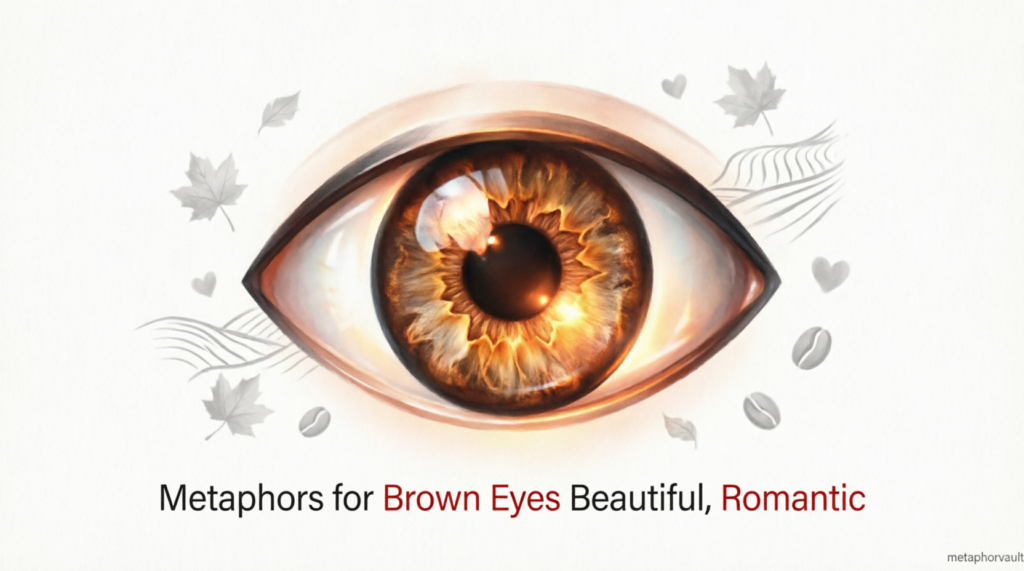
Brown eyes are easy to describe badly and surprisingly beautiful to describe well. The right metaphor can make them sound warm, mysterious, rich, gentle, or unforgettable without simply saying “brown.”
People search for metaphors for brown eyes when they need better words for a poem, love letter, story, Instagram caption, school assignment, or heartfelt compliment. A simple color can suggest much more than appearance. Brown eyes may remind us of coffee, chocolate, earth, autumn leaves, amber, honey, wood, or a quiet forest.
The challenge is choosing a metaphor that matches the feeling you want to create. A romantic metaphor should feel different from a mysterious one. A playful compliment should not sound like a line from a fantasy novel.
This guide gives you more than 60 original ways to describe brown eyes, with the meaning behind each one, sample sentences, usage advice, tone, and difficulty level. You will also see how these metaphors work in conversations, stories, poetry, captions, school writing, and professional communication.
This guide is for 2026, so you can choose an expression that sounds natural rather than forced.
Definition & Meaning
Metaphors for brown eyes are imaginative comparisons that describe brown eyes as something else without using “like” or “as.” They connect the eye color or the feeling it creates with familiar things such as coffee, chocolate, earth, amber, forests, sunsets, or warm wood.
For example, “Her eyes were pools of warm chocolate” does not mean her eyes literally contain chocolate. It creates a picture of deep, rich brown eyes and gives the description a warm, sweet feeling.
Simple Definition
A metaphor says one thing is another thing to create a stronger image.
- “Her eyes are coffee.” → metaphor
- “Her eyes are like coffee.” → simile
- “Her brown eyes held the warmth of coffee.” → metaphorical description
The goal is not scientific accuracy. The goal is imagery.
A good metaphor helps the reader see the eyes, but it can also make them feel something.
Quick Summary Table
| Metaphor type | Example | Feeling |
|---|---|---|
| Romantic | Her eyes were warm amber | Loving |
| Sweet | Her eyes were melted chocolate | Affectionate |
| Natural | Her eyes were rich earth | Grounded |
| Mysterious | Her eyes were hidden forests | Secretive |
| Warm | Her eyes were autumn sunlight | Comforting |
| Elegant | Her eyes were polished mahogany | Sophisticated |
| Soft | Her eyes were pools of honey | Gentle |
| Deep | Her eyes were bottomless coffee | Intense |
| Poetic | Her eyes were pieces of sunset | Dreamy |
| Playful | Her eyes were two cups of cocoa | Cute |
Why We Use Metaphors for Brown Eyes
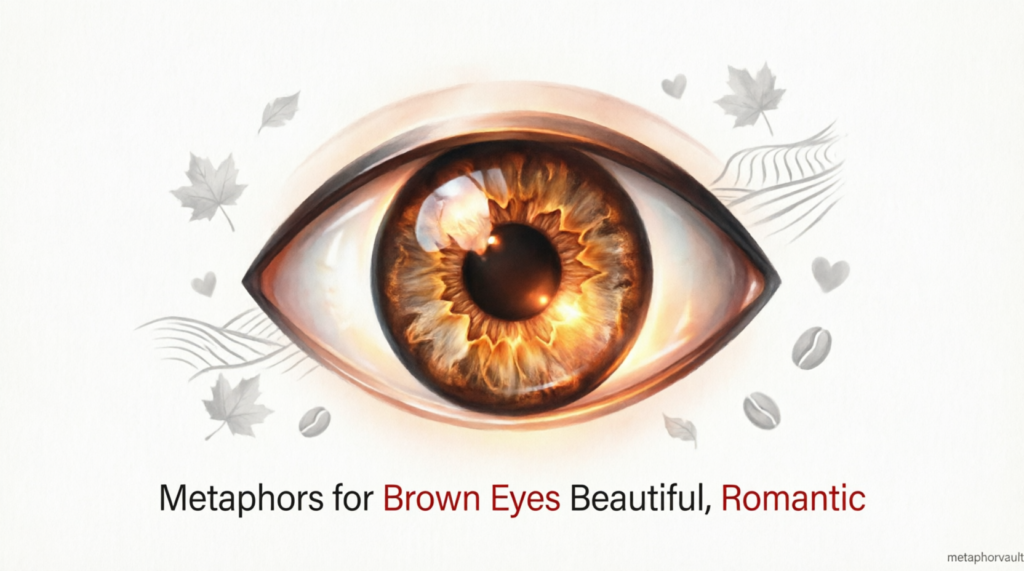
We use metaphors for brown eyes because they turn a simple color description into a vivid emotional image. Instead of only telling readers that someone’s eyes are brown, a metaphor can show warmth, depth, beauty, mystery, sweetness, confidence, or affection. This makes descriptions more memorable in writing and conversation.
Practical Purpose
“Brown eyes” tells the reader a fact.
“Her eyes were warm amber” gives the reader an image.
“His eyes were dark forests after rain” gives the reader an image and a mood.
That extra layer is why metaphors are so useful.
Everyday Usage
People use these descriptions when giving compliments, writing captions, describing someone in a story, or trying to express attraction without repeating the same adjectives.
Instead of:
“She has beautiful brown eyes.”
You might write:
“Her eyes were two quiet pools of honey.”
The second sentence gives the reader something to picture.
In Writing
Metaphors are especially useful in:
- Creative writing
- Short stories
- Novels
- Poetry
- Personal essays
- Love letters
- Character descriptions
- Speeches
- Journaling
- School assignments
- Social media captions
They can also help writers avoid repeating words such as beautiful, pretty, dark, and brown.
In Speaking
A metaphor can make a compliment feel more personal.
Instead of:
“Your eyes are really pretty.”
Try:
“Your eyes are the color of warm coffee.”
That sounds more specific and thoughtful.
In School
Students often use metaphors when studying figurative language.
For example:
“Her brown eyes were two windows into a quiet forest.”
This works because the eyes are being compared directly to windows.
On Social Media
Short metaphors work particularly well in captions.
Examples:
- “Eyes made of honey.”
- “Two cups of midnight coffee.”
- “Brown eyes, golden stories.”
- “A little autumn hiding in her eyes.”
- “Her eyes carry the color of home.”
In Professional Communication
Metaphors for someone’s physical appearance should be used carefully at work. A poetic description may be appropriate in a creative project, advertisement, story, or artistic profile, but it can sound too personal in an ordinary workplace email.
For example, avoid telling a coworker:
“Your eyes are pools of chocolate.”
A professional conversation usually needs clear, direct language.
1. Her Eyes Were Pools of Chocolate
Meaning: Her eyes are deep, rich, warm, and inviting.
Real explanation: Chocolate is associated with richness and sweetness. This metaphor works especially well for romantic descriptions.
Sample sentence:
“Her eyes were pools of dark chocolate, warm enough to make him forget what he was saying.”
When to use it: Romance, poetry, love notes, fiction.
When NOT to use it: Formal writing or serious professional communication.
Alternatives:
- Her eyes were melted chocolate.
- Her gaze was rich cocoa.
- Her eyes held the warmth of chocolate.
Difficulty: Easy
Tone: Romantic, warm
2. His Eyes Were Cups of Coffee
Meaning: His brown eyes look warm, familiar, and comforting.
Real explanation: Coffee creates an everyday image that most readers understand immediately.
Sample sentence:
“His eyes were two cups of strong coffee on a cold morning.”
When to use it: Casual writing, captions, romance, character descriptions.
When NOT to use it: When you want a highly elegant or formal metaphor.
Alternatives:
- His eyes were dark coffee.
- His gaze was a morning brew.
- His eyes held the color of roasted coffee.
Difficulty: Easy
Tone: Warm, casual
3. Her Eyes Were Pools of Honey
Meaning: Her brown eyes are soft, golden, warm, and sweet.
Real explanation: Honey works particularly well for light brown, golden-brown, or hazel-brown eyes.
Sample sentence:
“Her eyes were pools of honey beneath the afternoon sun.”
When to use it: Romance, poetry, affectionate descriptions.
When NOT to use it: For very dark brown eyes if the color comparison feels inaccurate.
Alternatives:
- Her eyes were golden honey.
- Her gaze was sweet amber.
- Honey seemed to glow behind her eyes.
Difficulty: Easy
Tone: Romantic, gentle
4. His Eyes Were Dark Forests
Meaning: His eyes seem deep, mysterious, and difficult to fully understand.
Real explanation: A forest suggests hidden paths, shadows, depth, and mystery.
Sample sentence:
“His eyes were dark forests, full of paths she wanted to explore.”
When to use it: Fiction, poetry, romance, mysterious characters.
When NOT to use it: Simple everyday compliments.
Alternatives:
- His eyes were wooded shadows.
- His gaze was a hidden forest.
- His eyes held a wilderness.
Difficulty: Medium
Tone: Mysterious, poetic
5. Her Eyes Were Autumn Leaves
Meaning: Her brown eyes have warm, earthy, golden, or reddish tones.
Real explanation: Autumn leaves provide a rich image for brown eyes with warm undertones.
Sample sentence:
“Her eyes were autumn leaves caught in a beam of sunlight.”
When to use it: Poetry, romantic writing, seasonal descriptions.
When NOT to use it: If you need to emphasize very dark brown eyes.
Alternatives:
- Her eyes were fall colors.
- Her gaze carried autumn.
- Autumn seemed to live in her eyes.
Difficulty: Easy
Tone: Poetic, warm
6. His Eyes Were Polished Mahogany
Meaning: His eyes are dark brown, rich, smooth, and elegant.
Real explanation: Mahogany is a deep reddish-brown wood often associated with richness and beauty.
Sample sentence:
“His eyes were polished mahogany beneath the soft room light.”
When to use it: Sophisticated character descriptions, fiction, poetry.
When NOT to use it: Very casual conversation.
Alternatives:
- His eyes were dark mahogany.
- His gaze was rich walnut.
- His eyes were carved from warm wood.
Difficulty: Medium
Tone: Elegant
7. Her Eyes Were Amber Lamps
Meaning: Her eyes seemed to glow with warm golden-brown light.
Real explanation: Amber is useful for brown eyes that appear lighter in sunlight.
Sample sentence:
“Her eyes were amber lamps glowing in the fading light.”
When to use it: Poetry, fantasy, romance.
When NOT to use it: When the eyes are nearly black-brown.
Alternatives:
- Her eyes were glowing amber.
- Her gaze was golden light.
- Amber burned softly in her eyes.
Difficulty: Medium
Tone: Poetic, mysterious
8. His Eyes Were Rich Earth
Meaning: His brown eyes suggest warmth, stability, and a connection to nature.
Real explanation: Earth gives brown a natural, grounded quality.
Sample sentence:
“His eyes were rich earth after rain—dark, calm, and alive.”
When to use it: Nature writing, poetry, reflective descriptions.
When NOT to use it: Lighthearted romantic captions where a sweeter image is better.
Alternatives:
- His eyes were rain-soaked earth.
- His gaze was warm soil.
- Earth seemed to rest in his eyes.
Difficulty: Medium
Tone: Natural, thoughtful
9. Her Eyes Were Melted Caramel
Meaning: Her eyes are warm, golden-brown, soft, and attractive.
Real explanation: Caramel creates a sweet image and works best for medium or light brown eyes.
Sample sentence:
“Her eyes were melted caramel beneath the golden lights.”
When to use it: Romance, captions, creative descriptions.
When NOT to use it: For very dark eyes.
Alternatives:
- Her eyes were caramel glass.
- Her gaze was warm caramel.
- Caramel seemed to shine in her eyes.
Difficulty: Easy
Tone: Sweet, romantic
10. His Eyes Were Two Quiet Windows
Meaning: His eyes reveal something private or emotional beneath the surface.
Real explanation: Windows are often used as metaphors for seeing someone’s inner feelings.
Sample sentence:
“His brown eyes were two quiet windows into a heart he rarely opened.”
When to use it: Character descriptions, emotional writing, poetry.
When NOT to use it: If the goal is only to describe color.
Alternatives:
- His eyes were windows to his soul.
- His gaze opened a hidden room.
- His eyes revealed what his words concealed.
Difficulty: Easy
Tone: Emotional, poetic
11. Her Eyes Were Two Pieces of Night
Meaning: Her eyes are very dark brown and mysterious.
Real explanation: Night suggests darkness, beauty, silence, and mystery.
Sample sentence:
“Her eyes were two pieces of night beneath her lashes.”
When to use it: Poetry, romance, dramatic fiction.
When NOT to use it: When her eyes are light brown.
Alternatives:
- Her eyes were midnight pools.
- Night rested in her gaze.
- Her eyes held the darkness of midnight.
Difficulty: Easy
Tone: Mysterious, romantic
12. His Eyes Were Walnut Shells
Meaning: His eyes are naturally dark, earthy brown.
Real explanation: Walnut gives a specific brown color while keeping the image natural.
Sample sentence:
“His eyes were smooth walnut shells, dark beneath his thick lashes.”
When to use it: Character descriptions and nature-inspired writing.
When NOT to use it: Highly romantic writing, where walnut may feel less emotional.
Alternatives:
- His eyes were walnut wood.
- His gaze was dark walnut.
- Warm walnut lived in his eyes.
Difficulty: Medium
Tone: Natural, descriptive
13. Her Eyes Were Two Drops of Espresso
Meaning: Her eyes are dark, rich, intense, and warm.
Real explanation: Espresso provides a vivid comparison for deep brown eyes.
Sample sentence:
“Her eyes were two drops of espresso, dark and impossible to ignore.”
When to use it: Modern captions, romance, casual creative writing.
When NOT to use it: Formal academic writing.
Alternatives:
- Her eyes were dark espresso.
- Her gaze was strong coffee.
- Espresso-colored eyes followed him across the room.
Difficulty: Easy
Tone: Modern, playful
14. His Eyes Were Chocolate Truffles
Meaning: His eyes are dark, rich, smooth, and appealing.
Real explanation: Truffles add a luxurious feeling to the basic chocolate metaphor.
Sample sentence:
“His eyes were chocolate truffles—dark, smooth, and dangerously tempting.”
When to use it: Romance, playful writing, captions.
When NOT to use it: Serious or formal contexts.
Alternatives:
- His eyes were dark cocoa.
- His gaze was rich chocolate.
- His eyes were sweet darkness.
Difficulty: Easy
Tone: Flirty, playful
15. Her Eyes Were Golden Coins
Meaning: Her brown eyes have bright golden or amber highlights.
Real explanation: This metaphor works when sunlight makes brown eyes appear golden.
Sample sentence:
“Her eyes were golden coins catching every ray of afternoon light.”
When to use it: Poetry, descriptions, fantasy writing.
When NOT to use it: For flat, very dark brown eyes.
Alternatives:
- Her eyes were drops of gold.
- Gold shimmered in her gaze.
- Her eyes carried golden light.
Difficulty: Medium
Tone: Bright, poetic
16. His Eyes Were Rain-Soaked Soil
Meaning: His eyes have deep, earthy brown tones and a quiet natural beauty.
Real explanation: The image of wet earth creates a darker and richer brown.
Sample sentence:
“His eyes were rain-soaked soil, deep and quietly alive.”
When to use it: Nature poetry and literary descriptions.
When NOT to use it: Casual compliments.
Alternatives:
- His eyes were wet earth.
- His gaze was dark soil after rain.
- Rain seemed to deepen the brown of his eyes.
Difficulty: Medium
Tone: Literary, earthy
17. Her Eyes Were Cinnamon
Meaning: Her eyes have warm brown or reddish-brown tones.
Real explanation: Cinnamon adds warmth and a subtle reddish quality.
Sample sentence:
“Her eyes were cinnamon, warm and bright beneath the winter sun.”
When to use it: Descriptions of warm brown eyes.
When NOT to use it: For very cool, dark brown eyes.
Alternatives:
- Her gaze was spiced brown.
- Her eyes were warm cinnamon.
- Cinnamon warmth colored her eyes.
Difficulty: Easy
Tone: Warm, gentle
18. His Eyes Were Burnt Sugar
Meaning: His eyes are deep golden-brown with a darker edge.
Real explanation: Burnt sugar gives a richer and darker version of the caramel image.
Sample sentence:
“His eyes were burnt sugar, dark at the edges and golden in the light.”
When to use it: Romantic or artistic writing.
When NOT to use it: Simple factual descriptions.
Alternatives:
- His eyes were caramelized gold.
- His gaze was dark caramel.
- Golden brown burned softly in his eyes.
Difficulty: Medium
Tone: Artistic, romantic
19. Her Eyes Were Old Books
Meaning: Her eyes seem wise, thoughtful, mysterious, or full of stories.
Real explanation: The metaphor focuses less on color and more on emotional depth.
Sample sentence:
“Her brown eyes were old books, each glance hiding another story.”
When to use it: Literary writing and character descriptions.
When NOT to use it: When you only need a quick color comparison.
Alternatives:
- Her eyes held untold stories.
- Her gaze was a forgotten book.
- Every look seemed to turn a new page.
Difficulty: Medium
Tone: Thoughtful, literary
20. His Eyes Were Quiet Rivers
Meaning: His brown eyes appear calm, deep, and reflective.
Real explanation: A river suggests movement beneath a peaceful surface.
Sample sentence:
“His eyes were quiet rivers, calm above and deep below.”
When to use it: Poetry, emotional writing, romance.
When NOT to use it: Very straightforward writing.
Alternatives:
- His gaze was a still river.
- His eyes carried a deep current.
- A quiet current lived behind his eyes.
Difficulty: Medium
Tone: Calm, poetic
21. Her Eyes Were Forest Floors
Meaning: Her eyes are earthy, dark, warm, and layered with natural color.
Real explanation: A forest floor contains browns, golds, shadows, and small flashes of light.
Sample sentence:
“Her eyes were forest floors scattered with tiny flecks of gold.”
When to use it: Eyes with brown and golden variations.
When NOT to use it: Simple romantic compliments.
Alternatives:
- Her eyes were woodland shadows.
- Her gaze was an autumn forest.
- The colors of the forest lived in her eyes.
Difficulty: Medium
Tone: Natural, poetic
22. His Eyes Were Bronze
Meaning: His eyes are brown with warm metallic or golden undertones.
Real explanation: Bronze works well when brown eyes look lighter in bright light.
Sample sentence:
“His eyes turned bronze whenever the sun touched them.”
When to use it: Character descriptions.
When NOT to use it: If the eyes are plain dark brown.
Alternatives:
- His eyes were warm bronze.
- Bronze light lived in his gaze.
- His gaze carried a copper-brown glow.
Difficulty: Easy
Tone: Strong, elegant
23. Her Eyes Were Warm Windows
Meaning: Her eyes make people feel welcomed, safe, or understood.
Real explanation: The metaphor focuses on emotional warmth rather than color alone.
Sample sentence:
“Her brown eyes were warm windows in a cold room.”
When to use it: Emotional writing, friendship, family, romance.
When NOT to use it: Purely visual descriptions.
Alternatives:
- Her eyes were open doors.
- Her gaze was a welcoming light.
- Warmth shone through her eyes.
Difficulty: Easy
Tone: Comforting
24. His Eyes Were Hidden Caves
Meaning: His eyes seem mysterious and contain feelings that are hard to read.
Real explanation: Caves suggest darkness, depth, secrets, and unexplored places.
Sample sentence:
“His eyes were hidden caves she could never quite understand.”
When to use it: Mystery, fantasy, emotional fiction.
When NOT to use it: Sweet or cheerful descriptions.
Alternatives:
- His eyes were secret chambers.
- His gaze hid a thousand secrets.
- Darkness guarded his eyes.
Difficulty: Medium
Tone: Mysterious
25. Her Eyes Were Cocoa Clouds
Meaning: Her eyes look soft, warm, and inviting.
Real explanation: Cocoa gives the brown color while clouds soften the image.
Sample sentence:
“Her eyes were cocoa clouds beneath the soft evening light.”
When to use it: Poetry and romantic captions.
When NOT to use it: Formal writing.
Alternatives:
- Her eyes were soft cocoa.
- Her gaze was a cloud of chocolate.
- Cocoa warmth softened her eyes.
Difficulty: Medium
Tone: Soft, romantic
26. His Eyes Were Pieces of Earth
Meaning: His eyes have a natural, grounded beauty.
Sample sentence:
“His eyes were pieces of earth, steady and warm.”
When to use it: Nature writing and thoughtful descriptions.
When NOT to use it: Flirty everyday conversation.
Alternatives:
- Earth lived in his eyes.
- His gaze carried the color of soil.
- His eyes were grounded in warm brown.
Difficulty: Easy
Tone: Natural
27. Her Eyes Were Amber Seas
Meaning: Her eyes are golden-brown, deep, and luminous.
Sample sentence:
“Her eyes were amber seas, glowing beneath the sunset.”
When to use it: Poetry and romance.
When NOT to use it: Very dark brown eyes.
Alternatives:
- Her eyes were amber oceans.
- Her gaze was golden water.
- Amber waves seemed to move in her eyes.
Difficulty: Medium
Tone: Dreamy
28. His Eyes Were Dark Honey
Meaning: His eyes are deep brown but still warm and golden.
Sample sentence:
“His eyes were dark honey, rich and warm beneath his lashes.”
When to use it: Romantic descriptions.
When NOT to use it: If there are no warm or golden tones.
Alternatives:
- His gaze was golden brown.
- His eyes were thick honey.
- Warm honey colored his gaze.
Difficulty: Easy
Tone: Romantic
29. Her Eyes Were Golden Hour
Meaning: Her brown eyes have a warm, glowing beauty that feels peaceful and magical.
Sample sentence:
“Her eyes were golden hour, soft enough to make the whole room feel warmer.”
When to use it: Modern poetry, captions, romance.
When NOT to use it: Formal school writing unless the assignment welcomes creative language.
Alternatives:
- Golden light lived in her eyes.
- Her gaze was sunset warmth.
- Her eyes carried the last light of day.
Difficulty: Medium
Tone: Romantic, modern
30. His Eyes Were Smoldering Embers
Meaning: His dark brown eyes seem intense and full of hidden emotion.
Sample sentence:
“His eyes were smoldering embers, quiet but impossible to ignore.”
When to use it: Romance, dramatic fiction.
When NOT to use it: Friendly or innocent descriptions.
Alternatives:
- His eyes were glowing coals.
- Heat lived in his gaze.
- His gaze carried a quiet fire.
Difficulty: Medium
Tone: Intense, romantic
31. Her Eyes Were Brown Silk
Meaning: Her eyes appear smooth, soft, rich, and elegant.
Sample sentence:
“Her eyes were brown silk, soft and impossible to look away from.”
When to use it: Elegant romantic writing.
When NOT to use it: Highly casual speech.
Alternatives:
- Her gaze was soft silk.
- Her eyes were velvet brown.
- Her gaze had a silky warmth.
Difficulty: Medium
Tone: Elegant
32. His Eyes Were Velvet Night
Meaning: His eyes are dark, soft, mysterious, and attractive.
Sample sentence:
“His eyes were velvet night, dark without ever seeming cold.”
When to use it: Romance and poetry.
When NOT to use it: Bright light-brown eyes.
Alternatives:
- His eyes were soft midnight.
- His gaze was dark velvet.
- Night softened his brown eyes.
Difficulty: Medium
Tone: Romantic, mysterious
33. Her Eyes Were Roasted Coffee Beans
Meaning: Her eyes are deep, warm, dark brown.
Sample sentence:
“Her eyes were roasted coffee beans, rich and dark beneath her lashes.”
When to use it: Casual creative writing and captions.
When NOT to use it: Serious emotional poetry.
Alternatives:
- Her eyes were dark coffee.
- Her gaze was roasted espresso.
- Coffee-brown warmth filled her eyes.
Difficulty: Easy
Tone: Casual
34. His Eyes Were Chestnut Trees
Meaning: His eyes are warm reddish-brown and natural.
Sample sentence:
“His eyes were chestnut trees standing quietly in the autumn sun.”
When to use it: Nature-inspired writing.
When NOT to use it: Short compliments.
Alternatives:
- His eyes were chestnut brown.
- His gaze was warm wood.
- Autumn chestnut lived in his eyes.
Difficulty: Medium
Tone: Natural, poetic
35. Her Eyes Were Maple Wood
Meaning: Her eyes are warm, reddish-brown, and glowing.
Sample sentence:
“Her eyes were maple wood polished by years of sunlight.”
When to use it: Literary descriptions.
When NOT to use it: Very dark brown eyes.
Alternatives:
- Her eyes were warm maple.
- Her gaze was polished wood.
- Maple warmth colored her eyes.
Difficulty: Medium
Tone: Literary
36. His Eyes Were Two Brown Stars
Meaning: His eyes are beautiful and stand out despite their brown color.
Sample sentence:
“His eyes were two brown stars in the quiet darkness of his face.”
When to use it: Romantic poetry and captions.
When NOT to use it: Strictly realistic descriptions.
Alternatives:
- His eyes were stars in the night.
- Two warm stars lived in his gaze.
- His brown eyes shone like distant stars.
Difficulty: Easy
Tone: Romantic
37. Her Eyes Were Tiny Universes
Meaning: Her eyes seem deep, fascinating, and full of stories.
Sample sentence:
“Her brown eyes were tiny universes, each glance revealing something new.”
When to use it: Romance, poetry, creative writing.
When NOT to use it: Formal communication.
Alternatives:
- Her eyes held whole worlds.
- Her gaze was its own universe.
- Worlds seemed to live behind her eyes.
Difficulty: Easy
Tone: Romantic, imaginative
38. His Eyes Were Sleeping Fires
Meaning: His eyes look calm but contain strong hidden emotions.
Sample sentence:
“His eyes were sleeping fires, quiet until someone came close enough to wake them.”
When to use it: Dramatic romance and fiction.
When NOT to use it: Lighthearted descriptions.
Alternatives:
- His gaze was a quiet flame.
- Fire slept behind his eyes.
- His eyes held hidden heat.
Difficulty: Medium
Tone: Intense
39. Her Eyes Were Quiet Evenings
Meaning: Her eyes create a calm, peaceful feeling.
Sample sentence:
“Her brown eyes were quiet evenings after a long day.”
When to use it: Emotional writing, romance, friendship.
When NOT to use it: When color is the only focus.
Alternatives:
- Her gaze was a peaceful evening.
- Her eyes felt like sunset.
- Evening calm rested in her eyes.
Difficulty: Medium
Tone: Gentle
40. His Eyes Were Old Oak
Meaning: His brown eyes suggest strength, age, wisdom, and stability.
Sample sentence:
“His eyes were old oak—dark, steady, and marked by stories.”
When to use it: Character descriptions.
When NOT to use it: Young, playful characters unless intentionally symbolic.
Alternatives:
- His eyes were ancient wood.
- His gaze was sturdy oak.
- Wisdom seemed rooted in his eyes.
Difficulty: Medium
Tone: Strong, thoughtful
41. Her Eyes Were Brown Diamonds
Meaning: Her brown eyes are rare, valuable, and beautiful.
Sample sentence:
“Her eyes were brown diamonds catching the light.”
When to use it: Compliments, romance, captions.
When NOT to use it: Very casual conversation if it feels overly poetic.
Alternatives:
- Her eyes were polished gems.
- Her gaze was a rare jewel.
- Her brown eyes sparkled like gems.
Difficulty: Easy
Tone: Admiring
42. His Eyes Were Warm Coffee Shops
Meaning: His eyes create a cozy, safe, welcoming feeling.
Sample sentence:
“His eyes were warm coffee shops on rainy afternoons.”
When to use it: Creative captions, cozy writing, romance.
When NOT to use it: Formal writing.
Alternatives:
- His gaze was a rainy-day café.
- His eyes felt like a warm room.
- Comfort lived in his gaze.
Difficulty: Medium
Tone: Cozy
43. Her Eyes Were Sunset Soil
Meaning: Her eyes combine earthy brown with warm orange or golden light.
Sample sentence:
“Her eyes were sunset soil, dark beneath a wash of gold.”
When to use it: Artistic writing.
When NOT to use it: If the eyes have a cool brown shade.
Alternatives:
- Her eyes were earth beneath sunset.
- Gold warmed her brown gaze.
- Her eyes carried sunset colors.
Difficulty: Hard
Tone: Artistic
44. His Eyes Were Chocolate Rivers
Meaning: His eyes are deep brown and full of emotional movement.
Sample sentence:
“His eyes were chocolate rivers flowing quietly beneath his lashes.”
When to use it: Poetry and romance.
When NOT to use it: Naturalistic or formal descriptions.
Alternatives:
- His eyes were rivers of cocoa.
- Chocolate flowed through his gaze.
- His gaze carried a dark sweetness.
Difficulty: Medium
Tone: Romantic
45. Her Eyes Were Golden Forest Paths
Meaning: Her brown eyes contain warmth, mystery, and golden highlights.
Sample sentence:
“Her eyes were golden forest paths, inviting but never fully revealing where they led.”
When to use it: Literary fiction and romance.
When NOT to use it: Quick captions.
Alternatives:
- Her gaze was a sunlit forest.
- Her eyes were woodland paths.
- Golden trails seemed hidden in her eyes.
Difficulty: Hard
Tone: Literary
46. His Eyes Were Cocoa at Midnight
Meaning: His eyes are very dark, rich brown, and mysterious.
Sample sentence:
“His eyes were cocoa at midnight, deep and quietly magnetic.”
When to use it: Romantic or poetic writing.
When NOT to use it: Formal contexts.
Alternatives:
- His eyes were midnight cocoa.
- His gaze was dark chocolate.
- Midnight seemed to deepen his brown eyes.
Difficulty: Easy
Tone: Romantic
47. Her Eyes Were Earth After Rain
Meaning: Her brown eyes have a deep, natural, refreshing beauty.
Sample sentence:
“Her eyes were earth after rain, dark, rich, and full of life.”
When to use it: Nature poetry and thoughtful writing.
When NOT to use it: Flirty casual conversation.
Alternatives:
- Her eyes were wet earth.
- Her gaze carried the scent of rain-soaked ground.
- Rain seemed to deepen her eyes.
Difficulty: Medium
Tone: Natural
48. His Eyes Were Bronze Doorways
Meaning: His eyes seem warm but mysterious, as if they lead somewhere unknown.
Sample sentence:
“His eyes were bronze doorways to thoughts he rarely shared.”
When to use it: Literary character descriptions.
When NOT to use it: Simple compliments.
Alternatives:
- His gaze was an open doorway.
- His eyes hid another world.
- Bronze seemed to frame his gaze.
Difficulty: Hard
Tone: Mysterious
49. Her Eyes Were Honeyed Sunlight
Meaning: Her eyes are golden-brown, bright, and warm.
Sample sentence:
“Her eyes were honeyed sunlight spilling across a quiet room.”
When to use it: Romantic writing and poetry.
When NOT to use it: Very dark brown eyes.
Alternatives:
- Her gaze was golden light.
- Sunlight lived in her eyes.
- Her eyes glowed with honeyed warmth.
Difficulty: Medium
Tone: Romantic
50. His Eyes Were Two Pieces of Warm Wood
Meaning: His eyes have a rich, natural brown color.
Sample sentence:
“His eyes were two pieces of warm wood, simple and quietly beautiful.”
When to use it: Natural descriptions.
When NOT to use it: Strong romantic writing.
Alternatives:
- His eyes were warm walnut.
- His gaze was polished wood.
- Wood-toned warmth filled his eyes.
Difficulty: Easy
Tone: Natural
51. Her Eyes Were Cinnamon Candles
Meaning: Her brown eyes seem warm, glowing, and comforting.
Sample sentence:
“Her eyes were cinnamon candles glowing softly in the dark.”
When to use it: Poetry, romance, cozy captions.
When NOT to use it: Formal writing.
Alternatives:
- Her eyes were warm flames.
- Cinnamon light lived in her gaze.
- Her eyes glowed with soft warmth.
Difficulty: Medium
Tone: Cozy, romantic
52. His Eyes Were Deep Brown Oceans
Meaning: His eyes seem vast, deep, and emotionally powerful.
Sample sentence:
“His eyes were deep brown oceans, calm on the surface and endless underneath.”
When to use it: Romance, poetry, emotional fiction.
When NOT to use it: Very short practical writing.
Alternatives:
- His gaze was an endless sea.
- His eyes held deep waters.
- Brown oceans moved behind his eyes.
Difficulty: Easy
Tone: Deep, emotional
53. Her Eyes Were Two Hidden Gardens
Meaning: Her eyes seem beautiful, private, peaceful, and full of life.
Sample sentence:
“Her eyes were two hidden gardens, beautiful places few people were allowed to enter.”
When to use it: Romantic and literary writing.
When NOT to use it: Straightforward descriptions.
Alternatives:
- Her eyes were secret gardens.
- Her gaze hid a garden of memories.
- Something beautiful grew behind her eyes.
Difficulty: Medium
Tone: Romantic, mysterious
54. His Eyes Were Midnight Walnut
Meaning: His eyes are extremely dark brown with a rich natural tone.
Sample sentence:
“His eyes were midnight walnut beneath the dim restaurant lights.”
When to use it: Character descriptions and romance.
When NOT to use it: Light brown eyes.
Alternatives:
- His eyes were dark walnut.
- His gaze was black-brown wood.
- Midnight deepened the brown of his eyes.
Difficulty: Medium
Tone: Dark, elegant
55. Her Eyes Were Little Cups of Cocoa
Meaning: Her eyes look warm, sweet, and inviting.
Sample sentence:
“Her eyes were little cups of cocoa, bright with quiet happiness.”
When to use it: Cute captions, affectionate writing.
When NOT to use it: Serious literary writing.
Alternatives:
- Her eyes were cocoa cups.
- Warm cocoa lived in her gaze.
- Her gaze was sweet and brown.
Difficulty: Easy
Tone: Cute, playful
56. His Eyes Were Sunlit Soil
Meaning: His brown eyes have warm golden highlights.
Sample sentence:
“His eyes were sunlit soil, brown with streaks of gold.”
When to use it: Nature descriptions and poetry.
When NOT to use it: Formal writing.
Alternatives:
- His eyes were golden earth.
- Sunlight warmed his gaze.
- Gold flickered across his brown eyes.
Difficulty: Medium
Tone: Natural, poetic
57. Her Eyes Were Quiet Mountains
Meaning: Her eyes suggest strength, calmness, depth, and hidden emotion.
Sample sentence:
“Her brown eyes were quiet mountains, still on the surface and powerful underneath.”
When to use it: Character descriptions and emotional poetry.
When NOT to use it: When you only want a color metaphor.
Alternatives:
- Her gaze was a mountain range.
- Strength rested in her eyes.
- Her eyes held silent peaks.
Difficulty: Medium
Tone: Strong, thoughtful
58. His Eyes Were Dark Caramel
Meaning: His eyes are rich brown with warm golden undertones.
Sample sentence:
“His eyes were dark caramel, especially bright when he smiled.”
When to use it: Romantic compliments and character descriptions.
When NOT to use it: Eyes with a cool gray-brown appearance.
Alternatives:
- His eyes were caramel brown.
- His gaze was warm sugar.
- Golden brown softened his eyes.
Difficulty: Easy
Tone: Warm, romantic
59. Her Eyes Were Autumn at Dusk
Meaning: Her eyes are dark, warm, earthy, and slightly mysterious.
Sample sentence:
“Her eyes were autumn at dusk, glowing with brown, gold, and fading light.”
When to use it: Poetry and romantic fiction.
When NOT to use it: Everyday conversation.
Alternatives:
- Her gaze was a fall evening.
- Dusk lived in her brown eyes.
- Her eyes carried the colors of late autumn.
Difficulty: Medium
Tone: Poetic, mysterious
60. His Eyes Were Two Quiet Fires
Meaning: His eyes look calm but contain passion or strong feeling.
Sample sentence:
“His eyes were two quiet fires, burning without a sound.”
When to use it: Romance, poetry, dramatic fiction.
When NOT to use it: Innocent or playful descriptions.
Alternatives:
- His gaze was a silent flame.
- Fire glowed behind his eyes.
- His eyes held a hidden heat.
Difficulty: Easy
Tone: Intense, romantic
61. Her Eyes Were Golden-Rimmed Coffee
Meaning: Her brown eyes are dark but contain bright golden edges or flecks.
Sample sentence:
“Her eyes were golden-rimmed coffee, dark at the center and glowing around the edges.”
When to use it: Detailed descriptions of brown eyes.
When NOT to use it: Very simple writing.
Alternatives:
- Her eyes were coffee with a golden glow.
- Gold edged her brown gaze.
- Her eyes were dark coffee touched by sunlight.
Difficulty: Medium
Tone: Descriptive
62. His Eyes Were Stories Written in Brown Ink
Meaning: His eyes seem full of memories, experiences, or hidden emotions.
Sample sentence:
“His eyes were stories written in brown ink, and she wanted to read every page.”
When to use it: Poetry, romance, character descriptions.
When NOT to use it: Professional communication.
Alternatives:
- His gaze was an unwritten story.
- His eyes carried old memories.
- Every glance seemed to tell a story.
Difficulty: Medium
Tone: Literary, romantic
63. Her Eyes Were Little Pieces of Home
Meaning: Her eyes create a feeling of comfort, familiarity, safety, and belonging.
Sample sentence:
“Her brown eyes were little pieces of home, warm enough to make him stay.”
When to use it: Love writing, friendship, emotional captions.
When NOT to use it: Purely visual descriptions.
Alternatives:
- Home lived in her eyes.
- Her gaze felt like coming home.
- Her eyes carried a familiar warmth.
Difficulty: Easy
Tone: Emotional, warm
Quick Reference Table
| # | Metaphor | Best meaning | Tone |
|---|---|---|---|
| 1 | Pools of chocolate | Rich and warm | Romantic |
| 2 | Cups of coffee | Cozy and familiar | Casual |
| 3 | Pools of honey | Soft and golden | Romantic |
| 4 | Dark forests | Deep and mysterious | Poetic |
| 5 | Autumn leaves | Warm and earthy | Poetic |
| 6 | Polished mahogany | Rich and elegant | Sophisticated |
| 7 | Amber lamps | Glowing and warm | Poetic |
| 8 | Rich earth | Natural and grounded | Thoughtful |
| 9 | Melted caramel | Sweet and golden | Romantic |
| 10 | Quiet windows | Emotionally revealing | Poetic |
| 11 | Pieces of night | Dark and mysterious | Romantic |
| 12 | Walnut shells | Deep natural brown | Descriptive |
| 13 | Drops of espresso | Dark and intense | Modern |
| 14 | Chocolate truffles | Sweet and tempting | Flirty |
| 15 | Golden coins | Bright and valuable | Poetic |
| 16 | Rain-soaked soil | Deep and earthy | Literary |
| 17 | Cinnamon | Warm reddish-brown | Gentle |
| 18 | Burnt sugar | Dark golden-brown | Artistic |
| 19 | Old books | Wise and mysterious | Literary |
| 20 | Quiet rivers | Calm and deep | Poetic |
| 21 | Forest floors | Earthy and layered | Natural |
| 22 | Bronze | Warm metallic brown | Elegant |
| 23 | Warm windows | Welcoming | Comforting |
| 24 | Hidden caves | Secretive and deep | Mysterious |
| 25 | Cocoa clouds | Soft and warm | Romantic |
| 26 | Pieces of earth | Grounded | Natural |
| 27 | Amber seas | Golden and deep | Dreamy |
| 28 | Dark honey | Deep but warm | Romantic |
| 29 | Golden hour | Glowing and peaceful | Modern |
| 30 | Smoldering embers | Intense and passionate | Romantic |
| 31 | Brown silk | Soft and elegant | Elegant |
| 32 | Velvet night | Dark and soft | Mysterious |
| 33 | Coffee beans | Dark and rich | Casual |
| 34 | Chestnut trees | Warm and natural | Poetic |
| 35 | Maple wood | Warm reddish-brown | Literary |
| 36 | Brown stars | Beautiful and striking | Romantic |
| 37 | Tiny universes | Deep and fascinating | Imaginative |
| 38 | Sleeping fires | Hidden passion | Intense |
| 39 | Quiet evenings | Peaceful and comforting | Gentle |
| 40 | Old oak | Strong and wise | Thoughtful |
| 41 | Brown diamonds | Rare and valuable | Admiring |
| 42 | Warm coffee shops | Cozy and safe | Cozy |
| 43 | Sunset soil | Earthy with golden warmth | Artistic |
| 44 | Chocolate rivers | Deep and emotional | Romantic |
| 45 | Golden forest paths | Warm and mysterious | Literary |
| 46 | Cocoa at midnight | Very dark and rich | Romantic |
| 47 | Earth after rain | Natural and rich | Earthy |
| 48 | Bronze doorways | Warm and mysterious | Literary |
| 49 | Honeyed sunlight | Golden and bright | Romantic |
| 50 | Warm wood | Natural and rich | Simple |
| 51 | Cinnamon candles | Warm and glowing | Cozy |
| 52 | Brown oceans | Deep and emotional | Poetic |
| 53 | Hidden gardens | Beautiful and private | Romantic |
| 54 | Midnight walnut | Extremely dark brown | Elegant |
| 55 | Cups of cocoa | Cute and sweet | Playful |
| 56 | Sunlit soil | Brown with gold | Natural |
| 57 | Quiet mountains | Strong and calm | Thoughtful |
| 58 | Dark caramel | Rich and warm | Romantic |
| 59 | Autumn at dusk | Warm and mysterious | Poetic |
| 60 | Quiet fires | Calm passion | Romantic |
| 61 | Golden-rimmed coffee | Brown with gold | Detailed |
| 62 | Brown-ink stories | Full of memories | Literary |
| 63 | Pieces of home | Comforting and familiar | Emotional |
Real-Life Conversations
Metaphors sound best when they fit the situation. A line that works beautifully in a poem may sound strange in an everyday conversation.
Here are natural examples.
Conversation 1: Friends
Maya: What color are her eyes? I couldn’t tell.
Sara: Brown, I think. But they get really golden in sunlight.
Maya: So, like honey?
Sara: Exactly. Her eyes are basically pools of honey.
Maya: That’s actually a really good description.
Here, the metaphor sounds natural because the friends are casually trying to describe eye color.
Conversation 2: Dating
Alex: You know what I noticed about you?
Jordan: What?
Alex: Your eyes change in different light.
Jordan: They do?
Alex: Yeah. They look dark brown inside, but outside they look almost like amber.
Jordan: That’s a much nicer way to describe them than “brown.”
Alex: Brown is accurate. Amber is just more interesting.
This works because the metaphor adds detail without becoming overly dramatic.
Conversation 3: Student and Teacher
Student: Can I use “Her eyes were dark forests” in my essay?
Teacher: Yes, if you’re using it to show mystery or emotional depth.
Student: So it’s a metaphor because her eyes aren’t actually forests?
Teacher: Correct. You’re directly connecting her eyes with a forest to create an image.
Student: And if I wrote “Her eyes were like dark forests,” that would be a simile?
Teacher: Exactly.
This is a useful classroom example because it shows the difference between a metaphor and a simile.
Conversation 4: Family
Sister: Mom, what color are my eyes?
Mom: Brown.
Sister: Just brown?
Mom: Fine. Warm chocolate brown.
Sister: Better.
Mom: They also look golden in the sun.
Sister: So I’m officially honey and chocolate?
Mom: Apparently.
This type of metaphor works because it stays playful.
Conversation 5: Text Message
Friend 1: What should I write for her birthday caption?
Friend 2: Something personal.
Friend 1: Like what?
Friend 2: “Brown eyes, golden heart.”
Friend 1: That’s cute.
Friend 2: Short is better. Don’t turn Instagram into a novel.
Friend 1: Fair.
Short metaphors often work better in social posts than complicated ones.
Everyday Usage
Metaphors for brown eyes work best when they match the setting, relationship, and emotion. In conversation, simple comparisons such as coffee, honey, or chocolate sound natural. In poetry and fiction, richer images such as forests, rivers, sunsets, and hidden gardens can create mood and character.
In Conversation
Keep spoken metaphors short.
Natural:
“Your eyes look like honey in this light.”
More dramatic:
“Your eyes are golden forests filled with forgotten dreams.”
The second line may work in poetry, but it could sound unusual during lunch with a friend.
In Writing
Creative writing gives you more freedom.
Instead of:
“She had brown eyes.”
Try:
“Her eyes were dark forests, quiet at first glance but full of hidden paths.”
The metaphor adds character, not just color.
In Books
Authors often use metaphors to describe more than appearance.
A character’s eyes can represent:
- Personality
- Emotional state
- Memories
- Mystery
- Attraction
- Fear
- Confidence
- Sadness
- Warmth
For example:
“His eyes were old books, worn by stories he never told.”
The brown color becomes secondary. The metaphor now tells us something about the character.
In Movies
Visual storytelling often makes direct color descriptions unnecessary. A character’s brown eyes may be described through dialogue, narration, or poetic imagery.
A romantic scene might use:
“Her eyes were golden in the evening light.”
A mystery scene could use:
“His eyes were dark forests.”
The same brown color can create completely different moods.
In Poetry
Poetry allows more imaginative comparisons.
For example:
“Your eyes are autumn at dusk,
two quiet fires beneath the falling light.”
The metaphor does not simply identify brown. It creates an emotional atmosphere.
In Emails
Be careful.
A metaphor about someone’s eyes is usually inappropriate in a normal business email.
Instead of:
“Your eyes are pools of honey.”
Use direct, professional language when discussing work.
Creative businesses such as publishing, fashion, photography, advertising, and entertainment may use figurative language when the project calls for it.
In Text Messages
Short metaphors work well.
Examples:
- “Your eyes are pure honey.”
- “Those coffee-colored eyes 😍”
- “Brown eyes + golden sunlight = unfair.”
- “Your eyes look like chocolate in this light.”
Texting usually rewards brevity.
On Instagram
Captions can be poetic without becoming complicated.
Examples:
“Brown eyes, golden light.”
“A little autumn in her eyes.”
“Coffee-colored eyes and a head full of dreams.”
“Her eyes carry the warmth of home.”
On Facebook
Facebook posts can be slightly longer.
“Some people have brown eyes. Hers look different in every kind of light—sometimes coffee, sometimes honey, sometimes a little bit of autumn.”
This feels personal while remaining easy to understand.
On X
Short metaphors are strongest because the format favors concise writing.
Examples:
“Brown eyes are just tiny forests.”
“Some eyes are brown. Some carry entire sunsets.”
“Her eyes were coffee with a little sunlight.”
On LinkedIn
Avoid romantic metaphors when talking about coworkers or professional contacts.
However, metaphors can be useful in creative professional writing, branding, storytelling, or marketing.
For example:
“The campaign uses warm brown and amber imagery to create a feeling of trust and comfort.”
That is a professional use of figurative language without making the description personal.
In School Assignments
If the assignment asks for a metaphor, make sure the comparison is direct.
Metaphor:
“Her brown eyes were two quiet forests.”
Simile:
“Her brown eyes were like two quiet forests.”
Both create imagery, but the grammatical structure is different.
How to Choose the Best Metaphor for Brown Eyes
Choose a metaphor by matching the eye’s shade and the emotion you want the reader to feel. Honey, amber, and caramel suit light or golden brown eyes. Coffee, cocoa, walnut, and midnight suit darker brown eyes. Forests, oceans, and hidden gardens work best when you want to suggest depth, mystery, or personality.
For Light Brown Eyes
Try:
- Honey
- Amber
- Caramel
- Golden hour
- Bronze
- Sunlit earth
Example:
“Her eyes were warm amber in the afternoon light.”
For Dark Brown Eyes
Try:
- Espresso
- Cocoa
- Dark chocolate
- Walnut
- Midnight
- Mahogany
Example:
“His eyes were dark walnut beneath his lashes.”
For Warm Brown Eyes
Try:
- Cinnamon
- Autumn leaves
- Caramel
- Honey
- Maple wood
- Sunset
Example:
“Her eyes were autumn leaves glowing in the last sunlight.”
For Mysterious Brown Eyes
Try:
- Dark forests
- Hidden caves
- Secret gardens
- Quiet mountains
- Midnight
- Deep oceans
Example:
“His eyes were hidden forests she could never fully understand.”
For Romantic Brown Eyes
Try:
- Melted chocolate
- Honey
- Golden sunlight
- Tiny universes
- Quiet fires
- Pieces of home
Example:
“Her eyes were tiny universes, and he kept getting lost in them.”
For Cute Brown Eyes
Try:
- Cocoa
- Coffee
- Chocolate
- Honey
- Brown stars
Example:
“Your eyes are basically two cups of cocoa.”
Romantic Metaphors for Brown Eyes
Romantic metaphors for brown eyes usually focus on warmth, depth, sweetness, attraction, or emotional connection. Chocolate, honey, golden sunlight, quiet fires, oceans, and tiny universes are especially useful because they make brown eyes feel more personal than a simple color description.
Here are some short romantic options:
- “Your eyes are warm honey.”
- “Your eyes are two quiet fires.”
- “I could get lost in your brown oceans.”
- “Your eyes are pieces of sunset.”
- “Your eyes are tiny universes.”
- “Your gaze feels like coming home.”
- “Your eyes are melted chocolate.”
- “Golden light lives in your eyes.”
- “Your brown eyes hold whole stories.”
- “Your eyes are my favorite kind of autumn.”
Cute Metaphors for Brown Eyes
Cute metaphors for brown eyes should sound light, affectionate, and easy to understand. Food-based images such as cocoa, coffee, chocolate, caramel, and honey are especially effective because they create a warm and playful feeling without sounding too serious.
Examples:
- “Two little cups of cocoa.”
- “Chocolate buttons.”
- “Tiny brown stars.”
- “Little pools of honey.”
- “Two cups of morning coffee.”
- “Caramel candies.”
- “Warm cocoa under the sun.”
- “Two pieces of autumn.”
Deep Metaphors for Brown Eyes
Deep metaphors describe the emotional or mysterious quality of brown eyes rather than focusing only on their color. Forests, oceans, books, caves, mountains, and hidden gardens work well because they suggest depth, memories, secrets, strength, and feelings beneath the surface.
Examples:
- “Her eyes were old books.”
- “His eyes were hidden caves.”
- “Her eyes were quiet mountains.”
- “His gaze was a deep brown ocean.”
- “Her eyes were secret gardens.”
- “His eyes were dark forests.”
- “Her eyes were stories written in brown ink.”
Funny Metaphors for Brown Eyes
Funny metaphors for brown eyes use familiar objects in an unexpected way. They work best with close friends, casual captions, or playful messages. The goal is humor rather than serious beauty, so simple comparisons usually work better than elaborate poetry.
Examples:
- “Your eyes are two cups of coffee that forgot to cool down.”
- “Your eyes look like someone spilled cocoa on your face.”
- “Those eyes are basically chocolate with Wi-Fi.”
- “Your eyes are coffee, but somehow more distracting.”
- “Your eyes look like they were designed by a chocolate company.”
- “Your eyes are two tiny mugs of chaos.”
Metaphors for Brown Eyes in Poetry
Poetry gives you the most freedom to make unusual comparisons because the purpose is emotional imagery rather than literal description. A poetic metaphor can connect brown eyes with weather, seasons, landscapes, memories, light, or music to create a stronger emotional atmosphere.
Example:
Her eyes were autumn at dusk,
brown leaves holding the last gold of day.
I looked once,
then forgot where I was going.
Another:
His eyes were quiet forests,
deep beneath the noise of the world,
keeping paths
only trust could find.
Metaphors for Brown Eyes in Love Letters
A love-letter metaphor should feel personal rather than copied or overly dramatic. Choose an image that connects to a real memory, such as coffee on a morning together, sunlight during a walk, autumn leaves, or a familiar place. Personal details make a simple metaphor feel genuine.
Examples:
“Your eyes remind me of warm coffee on a cold morning. Every time I look into them, I feel a little more at home.”
Or:
“I used to think brown was just a color. Then I met you and learned that brown can look like honey, autumn, coffee, and home all at once.”
Metaphors for Brown Eyes in a Story
In fiction, the strongest metaphor for brown eyes does more than describe appearance; it also reveals character or mood. A forest can suggest mystery, coffee can suggest comfort, fire can suggest passion, and old books can suggest wisdom or hidden history.
For example:
“Mara’s eyes were old books. You could spend years looking at them and still find pages she had never shown you.”
This tells the reader something about Mara’s personality.
Common Mistakes When Writing Metaphors for Brown Eyes
The most common mistake is choosing a beautiful metaphor that does not fit the eye color, scene, or tone. Writers also weaken metaphors by mixing too many images, explaining the comparison too much, or repeating familiar phrases. A strong metaphor should create a clear picture without making the sentence difficult to understand.
1. Using Too Many Metaphors
Weak:
“Her eyes were chocolate oceans, golden forests, amber stars, and coffee rivers.”
There are too many unrelated images.
Better:
“Her eyes were dark forests touched by gold.”
One clear image is stronger.
2. Ignoring the Actual Shade
Honey works beautifully for golden-brown eyes.
If the eyes are almost black-brown, “pools of honey” may create the wrong picture.
Choose a metaphor that matches reality.
3. Making Every Description Romantic
Not every brown-eyed character needs to sound like the subject of a love poem.
Sometimes:
“His eyes were the color of old walnut.”
is better than:
“His eyes were two galaxies where my heart lost its way.”
Match the metaphor to the scene.
4. Explaining the Metaphor Too Much
If you write:
“Her eyes were dark forests, meaning they were mysterious like forests because forests are mysterious.”
the image loses its power.
Let the reader understand the comparison naturally.
5. Repeating “Chocolate” Too Often
Chocolate is a popular metaphor for brown eyes, but it becomes predictable if used repeatedly.
Try:
- Walnut
- Mahogany
- Earth
- Amber
- Coffee
- Autumn
- Bronze
- Forest
- Caramel
- Cocoa
Variety makes your writing fresher.
Metaphor vs. Simile for Brown Eyes
A metaphor directly identifies brown eyes with another thing, while a simile compares them using words such as “like” or “as.” Both create imagery, but metaphors are usually more direct and poetic, while similes often sound more conversational and explicit.
| Metaphor | Simile |
|---|---|
| Her eyes were honey. | Her eyes were like honey. |
| His eyes were dark forests. | His eyes were like dark forests. |
| Her eyes were coffee. | Her eyes were like coffee. |
| His eyes were two quiet fires. | His eyes were like two quiet fires. |
| Her eyes were amber seas. | Her eyes were like amber seas. |
Easy Rule
If you say:
“Her eyes were honey.”
you have a metaphor.
If you say:
“Her eyes were like honey.”
you have a simile.
Best Metaphors for Brown Eyes by Mood
The best metaphor changes with the mood you want to create. Use honey, caramel, and sunlight for warmth; forests, caves, and midnight for mystery; chocolate and cocoa for sweetness; oceans and rivers for depth; and home, coffee shops, or quiet evenings for comfort.
| Mood | Best metaphors |
|---|---|
| Romantic | Honey, chocolate, golden sunlight |
| Mysterious | Forests, caves, midnight |
| Sweet | Cocoa, caramel, chocolate |
| Deep | Oceans, rivers, universes |
| Calm | Quiet evenings, warm windows |
| Strong | Mountains, old oak |
| Elegant | Mahogany, bronze, silk |
| Natural | Earth, soil, forest floor |
| Cozy | Coffee, cocoa, warm rooms |
| Playful | Chocolate, coffee, cocoa cups |
| Emotional | Home, old books, stories |
| Dramatic | Fire, embers, midnight |
How to Make Your Own Metaphors for Brown Eyes
You can create original metaphors by first noticing the eye’s exact shade, then choosing an object, place, season, or feeling with a similar color or emotional quality. After that, connect the two directly and remove unnecessary explanation. The strongest original metaphors usually come from specific details rather than random poetic words.
Use this simple process:
Step 1: Notice the Shade
Ask:
- Is the brown light?
- Is it dark?
- Is it reddish?
- Is it golden?
- Does it change in sunlight?
- Are there darker edges?
- Are there golden flecks?
Step 2: Choose a Related Image
For light brown:
- Honey
- Amber
- Caramel
- Bronze
For dark brown:
- Espresso
- Cocoa
- Walnut
- Mahogany
For warm brown:
- Autumn
- Cinnamon
- Maple
- Sunset
Step 3: Add an Emotion
Ask what the eyes make you feel.
Maybe they seem:
- Safe
- Mysterious
- Calm
- Exciting
- Loving
- Serious
- Playful
- Sad
- Confident
Step 4: Combine the Ideas
For example:
Dark brown + mystery + nature
becomes:
“His eyes were dark forests.”
Light brown + warmth + sweetness
becomes:
“Her eyes were pools of honey.”
Brown + memories + literature
becomes:
“Her eyes were stories written in brown ink.”
This method helps you create metaphors that feel personal rather than copied
Frequently Asked Questions
What is a good metaphor for brown eyes?
A good metaphor depends on the shade and mood. Popular choices include honey, chocolate, coffee, amber, caramel, forests, walnut, mahogany, autumn leaves, and golden sunlight. For a romantic description, “Her eyes were pools of honey” works well. For mystery, “His eyes were dark forests” is stronger.
What is a romantic metaphor for brown eyes?
Romantic options include “Your eyes are warm honey,” “Her eyes were melted chocolate,” “His eyes were two quiet fires,” and “Her eyes were tiny universes.” The best choice depends on whether you want the feeling to be sweet, passionate, mysterious, or emotional.
What is a metaphor for dark brown eyes?
Good metaphors for dark brown eyes include espresso, dark chocolate, cocoa at midnight, walnut, mahogany, midnight, and quiet fires. For example: “His eyes were dark walnut beneath his lashes.”
What is a metaphor for light brown eyes?
Light brown eyes can be described as honey, amber, caramel, bronze, golden sunlight, maple, or golden hour. For example: “Her eyes were warm amber in the afternoon light.”
How do you describe brown eyes poetically?
Use an image that connects color with emotion or nature. For example: “Her eyes were autumn at dusk,” “His eyes were quiet forests,” or “Her eyes were stories written in brown ink.” The metaphor becomes more poetic when it suggests something beyond color.
Can brown eyes be compared to chocolate?
Yes. Chocolate is one of the most familiar metaphors for brown eyes. You can use dark chocolate, melted chocolate, cocoa, chocolate truffles, or midnight cocoa depending on the shade and mood. However, avoid repeating the chocolate comparison too often.
Are “brown eyes like chocolate” a metaphor?
No. “Brown eyes like chocolate” is a simile because it uses an implied comparison. A direct metaphor would be “Her eyes were chocolate.”
What are some unique metaphors for brown eyes?
Less common options include “stories written in brown ink,” “sunlit soil,” “quiet mountains,” “hidden gardens,” “warm windows,” “autumn at dusk,” and “pieces of home.” These can describe emotional qualities as well as appearance.
What is the best metaphor for brown eyes?
There is no single best metaphor. Honey works well for golden-brown eyes, coffee or espresso for darker brown eyes, amber for glowing brown eyes, and forests or oceans for eyes that feel deep or mysterious. The best metaphor is the one that fits the person and the context.
How can I describe brown eyes in a love poem?
Focus on both appearance and emotion. Instead of only writing “brown eyes,” connect them to something meaningful:
“Your eyes are autumn at dusk,
warm enough to make me stay.”
This gives the reader a color, image, and feeling at the same time.
Final Takeaway
Brown eyes may seem simple to describe, but they offer a huge range of creative possibilities. They can become honey, coffee, chocolate, amber, forests, autumn leaves, quiet rivers, hidden gardens, old books, warm sunlight, or tiny universes depending on the story you want to tell.
The key is not to make every description complicated. A metaphor works because it gives the reader a clear image and an emotion.
For everyday compliments, keep it simple:
“Your eyes are warm honey.”
For romance:
“Her eyes were tiny universes.”
For mystery:
“His eyes were dark forests.”
For comfort:
“Her eyes were little pieces of home.”
For poetry:
“Her eyes were autumn at dusk, holding the last gold of the day.”
And when you want your writing to feel truly personal, look closely at the person you are describing. Notice the shade, the light, the expression, and most importantly, what those eyes make you feel. That is where the strongest metaphor usually begins.
descover more post
27+Metaphors Describing Yourself Creative Examples 2026
28+Metaphors in Art Examples That Reveal Hidden …
29+ River Metaphors and What They Really Mean 2026

Kovien is an experienced English language researcher, editor, and digital content strategist at MetaphorVault.com. He earned a Bachelor’s degree in English Language and Literature and has spent more than 5 years creating educational resources that simplify figurative language, metaphors, idioms, and modern English usage. His expertise combines linguistic knowledge with practical SEO writing, allowing him to produce content that is both informative and engaging. Kovien enjoys transforming complex language concepts into clear, relatable explanations supported by real-world examples. His work is driven by a commitment to accuracy, originality, and continuous learning. Through MetaphorVault.com, he aims to help readers build stronger communication skills and gain greater confidence in understanding and using the English language.