
Writing is often hard to explain because it is more than putting words on a page. Writing can feel like a journey, a window, a bridge, a mirror, a seed, or even a key. Metaphors about writing use one thing to describe another, helping readers see writing in a more vivid and emotional way.
People search for metaphors about writing when they need creative ways to describe the writing process, the power of words, storytelling, writers, books, essays, poetry, or the feelings that come with putting thoughts into words. You may see these metaphors in novels, poems, school assignments, speeches, social media posts, book reviews, and everyday conversations.
The right metaphor can turn a plain sentence into an image the reader can almost see. Instead of saying, “Writing helps me express myself,” you might say, “Writing is a window into my mind.”
This guide, for 2026, explains what writing metaphors mean and gives you more than 60 practical examples. You will learn what each metaphor means, how it works, when to use it, when to avoid it, and what simple alternatives you can choose.
Definition & Meaning
Metaphors about writing are creative comparisons that describe writing, words, stories, or the writing process as something else. They do not use “like” or “as” in the same way a simile does. A writing metaphor can make an abstract idea easier to picture, feel, and remember.
For example, saying “Writing is a bridge” does not mean that writing is literally made of concrete or wood. It means writing can connect people, ideas, cultures, or experiences.
Simple Definition
A metaphor about writing is a comparison that gives writing a new image or identity.
Instead of:
Writing helps people connect.
You could write:
Writing is a bridge between minds.
The second sentence creates a picture. Readers can imagine a bridge carrying ideas from one person to another.
Quick Summary Table
| Term | Simple Meaning | Example |
|---|---|---|
| Writing metaphor | A creative comparison about writing | Writing is a journey. |
| Metaphorical language | Language that creates an image or deeper meaning | Words are seeds. |
| Writing process | The steps used to create and improve writing | Editing is polishing a stone. |
| Writer metaphor | A comparison describing a writer | A writer is a gardener. |
| Word metaphor | A comparison describing words | Words are arrows. |
| Story metaphor | A comparison describing a story | A story is a doorway. |
| Creativity metaphor | A comparison describing creative thought | Creativity is a river. |
Metaphor vs. Simile
A metaphor says one thing is another thing in an imaginative sense.
Metaphor:
Writing is a journey.
A simile usually uses like or as.
Simile:
Writing is like a journey.
Both create a comparison, but the metaphor is usually more direct and vivid.
Why We Use Metaphors About Writing
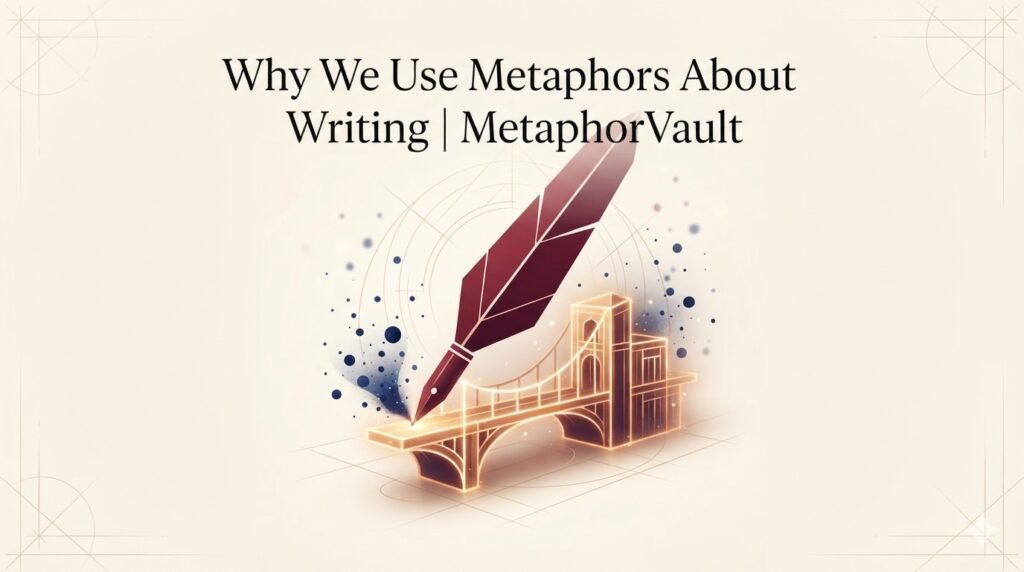
We use metaphors about writing to make ideas about words, creativity, storytelling, and communication easier to understand and more memorable. They add emotion and imagery while helping writers explain experiences that are difficult to describe with plain language.
Writing is an abstract activity. You cannot physically hold an idea, inspiration, or a sentence before it reaches the page.
Metaphors give these invisible things a shape.
1. To Make Writing More Vivid
Compare these two sentences:
Writing can be difficult.
Writing is a mountain with a new path every morning.
The second sentence gives the reader something to picture.
2. To Explain Creativity
Creativity can feel mysterious. A metaphor makes it easier to describe.
Creativity is a spark in a dark room.
The spark represents an idea.
3. To Describe the Writing Process
Writing does not always happen in a straight line.
You might begin with one idea, change direction, delete half the page, and discover a better idea near the end.
A useful metaphor is:
Writing is a winding road.
4. To Express Emotion
Writers often use metaphors when emotions are too complex for simple statements.
Her words were a light in a difficult season.
This suggests that her writing gave comfort or hope.
5. In School
Students can use writing metaphors in:
- Essays
- Creative writing
- Book reports
- Poetry
- Personal narratives
- Speeches
- Literary analysis
For example:
The author’s words became a mirror that showed the character’s fear.
6. In Professional Communication
Metaphors can make presentations, articles, speeches, and brand messages more memorable.
For example:
Good writing is a bridge between an expert and a beginner.
This works because it explains the purpose of clear communication.
7. In Social Media
Short metaphors work well in captions and posts.
Words are tiny doors.
Every sentence leaves a footprint.
These are short enough to remember and share.
1. Writing Is a Journey
Meaning: Writing is a process of moving from an idea to a finished piece.
Real explanation: A journey has a starting point, unexpected turns, difficult sections, and a destination. Writing can work the same way. You may begin with a rough idea and discover the final message while writing.
Sample sentence:
Writing is a journey, and every draft takes me somewhere new.
When to use it: Use it for essays, blogs, personal writing, and discussions about the creative process.
When NOT to use it: Avoid it when you need a highly precise technical statement.
Alternatives: Writing is a road; Writing is an adventure; Writing is a path.
Difficulty: Easy
Tone: Neutral
2. Writing Is a Window
Meaning: Writing gives readers a view into someone’s thoughts, feelings, or experiences.
Real explanation: A window lets you see something beyond yourself. Writing can do the same by showing readers another person’s mind or world.
Sample sentence:
Her journal was a window into her private thoughts.
When to use it: Personal essays, memoirs, literary analysis, and emotional writing.
When NOT to use it: Avoid it if the writing has no personal or revealing quality.
Alternatives: Writing is a doorway; Writing is a lens; Writing is a view.
Difficulty: Easy
Tone: Neutral
3. Writing Is a Bridge
Meaning: Writing connects people, ideas, cultures, and experiences.
Real explanation: A bridge joins two places that would otherwise be separated. Writing can connect a writer with a reader or one idea with another.
Sample sentence:
Good writing is a bridge between the writer’s experience and the reader’s imagination.
When to use it: Professional communication, education, speeches, and essays.
When NOT to use it: Avoid repeating it several times in the same piece.
Alternatives: Writing is a connection; Writing joins minds; Words build bridges.
Difficulty: Easy
Tone: Formal
4. Writing Is a Mirror
Meaning: Writing can reflect a person’s thoughts, feelings, values, or experiences.
Real explanation: A mirror shows an image. Writing can reveal parts of a person’s inner world.
Sample sentence:
Her poetry was a mirror of her changing emotions.
When to use it: Poetry, journals, memoirs, and literary analysis.
When NOT to use it: Do not use it if you are describing purely factual writing.
Alternatives: Writing reflects the mind; Writing reveals the self; Words reflect experience.
Difficulty: Easy
Tone: Neutral
5. Words Are Seeds
Meaning: Words can grow into ideas, emotions, actions, or change.
Real explanation: A seed starts small but can become something much larger. A single sentence can have a similar effect on a reader.
Sample sentence:
The teacher planted seeds of curiosity through her writing.
When to use it: Education, inspirational writing, speeches, and personal development.
When NOT to use it: Avoid it when you need literal, technical language.
Alternatives: Words are sparks; Words plant ideas; Words grow in the mind.
Difficulty: Easy
Tone: Formal
6. Writing Is a Garden
Meaning: Writing needs care, patience, growth, and editing.
Real explanation: A garden does not become beautiful instantly. A writer develops ideas, removes weak parts, and gives strong ideas room to grow.
Sample sentence:
My first draft was a wild garden that needed careful trimming.
When to use it: Creative writing, writing advice, and discussions of revision.
When NOT to use it: Avoid it when discussing a simple factual message.
Alternatives: Writing is a growing field; A draft is a garden; Ideas are plants.
Difficulty: Easy
Tone: Neutral
7. A Writer Is a Gardener
Meaning: A writer grows and shapes ideas.
Real explanation: A gardener chooses what to plant, removes weeds, and cares for healthy growth. A writer chooses ideas, removes unnecessary words, and develops strong thoughts.
Sample sentence:
A careful writer is a gardener who knows which ideas need room to grow.
When to use it: Writing instruction, creative writing, and essays.
When NOT to use it: Avoid using it as the only way to describe every writer.
Alternatives: A writer is a builder; A writer is a sculptor; A writer is a craftsman.
Difficulty: Easy
Tone: Neutral
8. Writing Is Painting With Words
Meaning: Writers create mental pictures through language.
Real explanation: A painter uses color and shape. A writer uses nouns, verbs, details, rhythm, and description.
Sample sentence:
The novelist painted the rainy city with words.
When to use it: Descriptive writing, poetry, fiction, and book reviews.
When NOT to use it: Avoid it when discussing plain data or instructions.
Alternatives: Words create pictures; Writing draws pictures; Language creates images.
Difficulty: Easy
Tone: Creative
9. Words Are Colors
Meaning: Different words create different moods and shades of meaning.
Real explanation: Just as colors can change the feeling of a painting, word choice can change the feeling of a sentence.
Sample sentence:
The poet chose dark words to color the poem with sadness.
When to use it: Poetry, creative writing, and discussions of word choice.
When NOT to use it: Avoid it in highly technical explanations.
Alternatives: Words create shades; Words add color; Language has tones.
Difficulty: Easy
Tone: Creative
10. Writing Is a Puzzle
Meaning: Writing involves putting different pieces together to create a complete idea.
Real explanation: Writers often arrange facts, examples, sentences, and ideas until they form a clear message.
Sample sentence:
Building the essay was like solving a puzzle one paragraph at a time.
When to use it: Essays, research, editing, and learning to organize ideas.
When NOT to use it: Avoid it if you want to emphasize emotional expression instead of structure.
Alternatives: Writing is assembling pieces; Writing is a blueprint; Writing is a structure.
Difficulty: Easy
Tone: Neutral
11. Writing Is a Doorway
Meaning: Writing can lead readers into another world, idea, or experience.
Real explanation: A doorway separates one space from another. A story can perform the same function by taking readers somewhere new.
Sample sentence:
The first paragraph was a doorway into the character’s strange world.
When to use it: Fiction, books, poetry, and literary analysis.
When NOT to use it: Avoid it for routine business messages.
Alternatives: Writing opens a door; Stories are entrances; Words are gateways.
Difficulty: Easy
Tone: Creative
12. A Book Is a Ship
Meaning: A book can carry readers to another place or time.
Real explanation: A ship carries people across physical distances. A book can carry the mind across cultures, centuries, and imagined worlds.
Sample sentence:
The old novel was a ship that carried me into another century.
When to use it: Book reviews, reading discussions, and creative writing.
When NOT to use it: Avoid it in a simple book summary.
Alternatives: A book is a vehicle; A story carries us; Reading is a voyage.
Difficulty: Medium
Tone: Creative
13. Reading Is Traveling
Meaning: Reading lets people experience places and lives beyond their own.
Real explanation: A reader can visit a fictional city, historical period, or another person’s experience without physically going there.
Sample sentence:
Reading is traveling without leaving your chair.
When to use it: Essays, book reviews, school assignments, and social media.
When NOT to use it: Avoid it when discussing reading only as a technical skill.
Alternatives: Reading is a voyage; Books take us places; Reading opens worlds.
Difficulty: Easy
Tone: Informal
14. Ideas Are Sparks
Meaning: Small ideas can start larger creative work.
Real explanation: A spark is tiny, but it can start a fire. A short thought can become a story, poem, article, or book.
Sample sentence:
That strange dream was the spark for my new story.
When to use it: Creative writing, brainstorming, and interviews with writers.
When NOT to use it: Avoid it if an idea developed through a long, formal process.
Alternatives: Ideas are seeds; Ideas ignite creativity; Thoughts light the way.
Difficulty: Easy
Tone: Neutral
15. Inspiration Is a River
Meaning: Inspiration can flow continuously or change direction.
Real explanation: A river moves, bends, slows, and sometimes becomes powerful. Inspiration can behave in similar ways.
Sample sentence:
When inspiration becomes a river, I can write for hours.
When to use it: Creative writing and personal reflection.
When NOT to use it: Do not imply that inspiration always flows easily.
Alternatives: Inspiration flows; Ideas stream; Creativity moves.
Difficulty: Easy
Tone: Creative
16. Writer’s Block Is a Wall
Meaning: Writer’s block can feel like an obstacle stopping ideas from moving forward.
Real explanation: A wall physically blocks movement. Writer’s block can create a similar mental barrier.
Sample sentence:
Writer’s block felt like a wall between my thoughts and the page.
When to use it: Personal essays, writing blogs, and conversations about creative struggles.
When NOT to use it: Avoid treating every difficult writing session as writer’s block.
Alternatives: A creative wall; A mental barrier; A blank road.
Difficulty: Easy
Tone: Neutral
17. Editing Is Polishing a Stone
Meaning: Editing improves rough writing until it becomes clearer and stronger.
Real explanation: A rough stone can become smooth through patient work. A rough draft can become polished through revision.
Sample sentence:
Editing is polishing a stone until its shape becomes clear.
When to use it: Writing instruction, essays, and professional writing.
When NOT to use it: Avoid suggesting that editing changes only surface details.
Alternatives: Editing is refining; Editing is sharpening; Revision is polishing.
Difficulty: Easy
Tone: Formal
18. A Draft Is a Skeleton
Meaning: A first draft provides the basic structure of a piece.
Real explanation: A skeleton gives a body its basic structure. A draft gives writing its initial structure before details are added.
Sample sentence:
My first draft was only a skeleton, but revision gave it life.
When to use it: Writing classes and discussions about drafting.
When NOT to use it: Avoid calling every draft incomplete if it is already polished.
Alternatives: A draft is a framework; A draft is a blueprint; A draft is a foundation.
Difficulty: Medium
Tone: Neutral
19. A Sentence Is a Brushstroke
Meaning: Each sentence contributes to the larger picture of a piece.
Real explanation: One brushstroke may seem small, but many create a painting. In writing, sentences work together to create an image, argument, or mood.
Sample sentence:
Each sentence was a brushstroke in the portrait of her childhood.
When to use it: Poetry, fiction, and descriptive writing.
When NOT to use it: Avoid it in basic grammar explanations.
Alternatives: Sentences build pictures; Each sentence adds detail; Words form the image.
Difficulty: Medium
Tone: Creative
20. Paragraphs Are Building Blocks
Meaning: Paragraphs combine to create the structure of a larger piece of writing.
Real explanation: Building blocks are small pieces used to create something larger. Good paragraphs perform a similar role in essays and articles.
Sample sentence:
Strong paragraphs are the building blocks of a clear essay.
When to use it: School writing, professional writing, and teaching.
When NOT to use it: Avoid it if discussing poetry where paragraph structure may not apply.
Alternatives: Paragraphs form the structure; Paragraphs are pieces; Paragraphs build the argument.
Difficulty: Easy
Tone: Formal
21. A Story Is a Thread
Meaning: A story can connect events, characters, and ideas.
Real explanation: A thread can run through many separate pieces of cloth. A story can connect separate moments into one meaningful whole.
Sample sentence:
A thread of hope runs through the entire novel.
When to use it: Literary analysis and storytelling.
When NOT to use it: Avoid confusing a story thread with a literal thread.
Alternatives: A story connects moments; A theme runs through the story; Events are woven together.
Difficulty: Medium
Tone: Formal
22. A Story Is a Tapestry
Meaning: A story contains many connected parts that create one larger picture.
Real explanation: A tapestry is made from many threads and colors. Stories can combine characters, events, emotions, settings, and themes in the same way.
Sample sentence:
The novel is a rich tapestry of family, loss, and hope.
When to use it: Book reviews, essays, and literary analysis.
When NOT to use it: Avoid it for a very short, simple story.
Alternatives: A story is a mosaic; A story is woven together; A story is a picture.
Difficulty: Medium
Tone: Formal
23. Words Are Keys
Meaning: Words can unlock ideas, feelings, memories, or understanding.
Real explanation: A key opens a locked door. Words can open mental and emotional doors for readers.
Sample sentence:
Her words were keys that unlocked memories I had forgotten.
When to use it: Poetry, speeches, essays, and inspirational writing.
When NOT to use it: Avoid overusing the image of locked doors and keys.
Alternatives: Words unlock ideas; Language opens doors; Words reveal hidden thoughts.
Difficulty: Easy
Tone: Formal
24. Words Are Arrows
Meaning: Words can move directly toward a target and create a strong effect.
Real explanation: An arrow travels toward a target. Carefully chosen words can hit an emotional, logical, or persuasive target.
Sample sentence:
Her final sentence was an arrow aimed straight at the reader’s heart.
When to use it: Persuasive writing, speeches, poetry, and dramatic writing.
When NOT to use it: Avoid it when the writing is gentle or purely informative.
Alternatives: Words strike; Words hit home; Language reaches the heart.
Difficulty: Medium
Tone: Creative
25. Words Are Tools
Meaning: Writers use words to build, explain, persuade, describe, and create.
Real explanation: Different tools perform different jobs. Writers also choose different words depending on their purpose.
Sample sentence:
Every word is a tool, so I choose the one that does the job best.
When to use it: Writing education, professional communication, and grammar lessons.
When NOT to use it: Avoid it if you want to emphasize the emotional side of language.
Alternatives: Words are instruments; Language is a toolbox; Words help us build ideas.
Difficulty: Easy
Tone: Formal
26. Writing Is Architecture
Meaning: Writing requires structure, balance, and careful design.
Real explanation: A building needs a strong foundation and organized parts. An essay or article also needs a clear beginning, middle, and ending.
Sample sentence:
Good writing is architecture: every paragraph needs a purpose.
When to use it: Essays, articles, reports, and writing instruction.
When NOT to use it: Avoid making writing sound too rigid when discussing spontaneous poetry.
Alternatives: Writing is construction; Writing is design; Writing has a framework.
Difficulty: Medium
Tone: Formal
27. An Essay Is a House
Meaning: An essay needs a foundation, structure, rooms, and a clear entrance and exit.
Real explanation: The introduction can act like an entrance, body paragraphs like rooms, and the conclusion like an exit.
Sample sentence:
My thesis was the foundation of the essay house.
When to use it: Teaching essay structure.
When NOT to use it: Avoid forcing the comparison into every type of writing.
Alternatives: An essay is a structure; An essay is a building; An essay has a framework.
Difficulty: Easy
Tone: Educational
28. The Introduction Is a Door
Meaning: The opening gives readers access to the main idea.
Real explanation: A door is the first point of entry into a building. An introduction serves a similar role in an article, essay, or story.
Sample sentence:
The introduction is the door that invites readers into the argument.
When to use it: Essays, articles, speeches, and storytelling.
When NOT to use it: Avoid it if discussing a very short message.
Alternatives: The introduction is an entrance; The opening welcomes readers; The first paragraph opens the story.
Difficulty: Easy
Tone: Neutral
29. The Conclusion Is an Anchor
Meaning: A conclusion gives the piece a firm ending.
Real explanation: An anchor keeps a ship from drifting away. A strong conclusion keeps the main message from fading into unrelated ideas.
Sample sentence:
The conclusion was the anchor that held the essay together.
When to use it: Essays, reports, and persuasive writing.
When NOT to use it: Avoid it when describing an intentionally open-ended poem.
Alternatives: The conclusion grounds the piece; The ending ties things together; The final paragraph closes the argument.
Difficulty: Medium
Tone: Formal
30. Writing Is a Conversation
Meaning: Writing allows a writer to communicate with a reader across time and distance.
Real explanation: A conversation involves sending ideas and receiving meaning. Writing can create the same exchange, even when the writer and reader never meet.
Sample sentence:
A good essay feels less like a lecture and more like a conversation.
When to use it: Blogs, essays, social media, and communication advice.
When NOT to use it: Avoid it when discussing highly formal documents that are not conversational.
Alternatives: Writing speaks to readers; Writing creates dialogue; Writing connects minds.
Difficulty: Easy
Tone: Neutral
31. A Writer Is a Sculptor
Meaning: A writer shapes raw ideas into a finished piece.
Real explanation: A sculptor starts with raw material and removes or changes parts to reveal a form. Writers revise and shape rough ideas in a similar way.
Sample sentence:
The writer was a sculptor, cutting away every sentence that weakened the story.
When to use it: Editing, creative writing, and literary discussions.
When NOT to use it: Avoid suggesting that all writing works by removing material.
Alternatives: A writer is a craftsman; A writer shapes ideas; A writer carves language.
Difficulty: Medium
Tone: Creative
32. Editing Is Cutting Away the Weeds
Meaning: Editing removes unnecessary words and weak ideas.
Real explanation: Weeds can crowd a garden. Unnecessary phrases can crowd a sentence and make the main idea harder to see.
Sample sentence:
Good editing cuts away the weeds so the strongest ideas can breathe.
When to use it: Writing instruction and revision advice.
When NOT to use it: Do not call every creative detail a weed.
Alternatives: Remove clutter; Trim weak phrases; Clear away unnecessary words.
Difficulty: Easy
Tone: Neutral
33. Writing Is a Craft
Meaning: Good writing develops through practice, skill, patience, and revision.
Real explanation: Craftspeople improve through repeated work. Writers also become stronger by practicing and learning from revision.
Sample sentence:
Writing is a craft that becomes stronger with practice.
When to use it: Professional writing, education, and discussions about writing skills.
When NOT to use it: Avoid implying that natural talent has no role at all.
Alternatives: Writing is a skill; Writing is an art; Writing takes practice.
Difficulty: Easy
Tone: Formal
34. Writing Is a Muscle
Meaning: Writing ability can become stronger through regular practice.
Real explanation: Muscles grow stronger when they are used and trained. Writing skills can also improve through repeated practice.
Sample sentence:
I write every morning because writing is a muscle that needs exercise.
When to use it: Writing motivation and education.
When NOT to use it: Avoid treating the comparison as literal science.
Alternatives: Writing needs practice; Writing skills grow; Practice strengthens writing.
Difficulty: Easy
Tone: Informal
35. Creativity Is a Fire
Meaning: Creativity can begin small and grow into powerful energy.
Real explanation: Fire can start with one spark and become larger. Creative work can begin with one small thought.
Sample sentence:
One strange question started a fire of ideas in my mind.
When to use it: Creative writing, speeches, and motivational content.
When NOT to use it: Avoid it when you need a calm image.
Alternatives: Creativity is a spark; Ideas burn brightly; Creativity ignites.
Difficulty: Easy
Tone: Creative
36. Creativity Is a Playground
Meaning: Creative writing gives the mind room to experiment.
Real explanation: A playground is a place for movement, discovery, and play. Creative writing can offer the same freedom.
Sample sentence:
Poetry is a playground where words can break ordinary rules.
When to use it: Poetry, creative writing, and teaching children.
When NOT to use it: Avoid it for highly controlled technical writing.
Alternatives: Creativity is a workshop; Writing is a creative space; Words are toys.
Difficulty: Easy
Tone: Informal
37. The Blank Page Is a Blank Canvas
Meaning: An empty page gives the writer a place to create something new.
Real explanation: A blank canvas has no finished image. A blank page similarly holds endless possibilities before writing begins.
Sample sentence:
I stared at the blank page as if it were a blank canvas waiting for color.
When to use it: Creative writing and personal reflection.
When NOT to use it: Avoid it if the blank page feels more like pressure than possibility.
Alternatives: The page is an open field; The page is an empty stage; The page is fresh ground.
Difficulty: Easy
Tone: Creative
38. The Blank Page Is an Empty Stage
Meaning: The page is a space where ideas, characters, and events can appear.
Real explanation: A stage begins empty and becomes a place for a performance. A page can similarly become a world once the writer begins.
Sample sentence:
The blank page was an empty stage waiting for its characters.
When to use it: Fiction, scripts, storytelling, and poetry.
When NOT to use it: Avoid it for strictly factual writing.
Alternatives: The page is a stage; Words perform on the page; The page is a theater.
Difficulty: Medium
Tone: Creative
39. A Story Is a Map
Meaning: A story can guide readers through events, places, ideas, or emotions.
Real explanation: A map helps people understand where they are going. A story can guide readers through a character’s experiences.
Sample sentence:
The novel was a map through grief and recovery.
When to use it: Literary analysis and personal writing.
When NOT to use it: Avoid it if the story is deliberately confusing without a clear path.
Alternatives: A story guides us; A story is a path; A narrative charts a course.
Difficulty: Medium
Tone: Neutral
40. A Plot Is a Road
Meaning: A plot carries characters and readers from one event to another.
Real explanation: Roads connect places. A plot connects events and creates movement in a story.
Sample sentence:
The plot was a twisting road full of unexpected turns.
When to use it: Fiction and literary analysis.
When NOT to use it: Avoid it for poems without a traditional plot.
Alternatives: The plot is a path; The story moves forward; Events form a route.
Difficulty: Easy
Tone: Neutral
41. Conflict Is a Storm
Meaning: Conflict creates tension, danger, or emotional pressure in a story.
Real explanation: A storm can disturb an otherwise calm environment. Conflict can disturb a character’s life and push the story forward.
Sample sentence:
The family argument became a storm that changed everyone.
When to use it: Fiction, literary analysis, and dramatic writing.
When NOT to use it: Avoid it when the conflict is extremely mild.
Alternatives: Conflict is a battle; Trouble is a storm; Tension is a dark cloud.
Difficulty: Easy
Tone: Creative
42. A Character Is a Window
Meaning: A character allows readers to experience another life or viewpoint.
Real explanation: Readers often understand unfamiliar experiences through characters.
Sample sentence:
The young character became a window into a world I had never known.
When to use it: Literary analysis and book reviews.
When NOT to use it: Avoid reducing complex characters to only one function.
Alternatives: Characters reveal worlds; Characters offer new viewpoints; A character is a lens.
Difficulty: Medium
Tone: Formal
43. Dialogue Is Music
Meaning: Good dialogue has rhythm, pauses, tone, and movement.
Real explanation: Music depends on timing and sound. Natural dialogue also depends on rhythm, silence, and word choice.
Sample sentence:
Their dialogue was music, with every pause adding meaning.
When to use it: Fiction and creative writing.
When NOT to use it: Avoid it when analyzing dialogue only for factual content.
Alternatives: Dialogue has rhythm; Conversation has a beat; Speech flows.
Difficulty: Medium
Tone: Creative
44. Poetry Is a Mirror of the Soul
Meaning: Poetry can express deep emotions and private thoughts.
Real explanation: This metaphor treats poetry as a reflection of inner life.
Sample sentence:
Her poems became mirrors of the soul after the loss of her friend.
When to use it: Poetry discussions and personal writing.
When NOT to use it: Avoid it when discussing poetry that is mainly political, humorous, or technical.
Alternatives: Poetry reveals emotion; Poetry reflects the inner self; Poems reveal the heart.
Difficulty: Easy
Tone: Formal
45. A Poem Is a Photograph
Meaning: A poem can capture a moment, feeling, image, or memory.
Real explanation: A photograph freezes one moment. A poem can preserve a similar emotional or mental snapshot.
Sample sentence:
The poem was a photograph of one quiet summer afternoon.
When to use it: Poetry analysis and creative writing.
When NOT to use it: Avoid it if the poem focuses heavily on movement or a long narrative.
Alternatives: A poem captures a moment; Poetry freezes memory; A poem is a snapshot.
Difficulty: Medium
Tone: Creative
46. A Metaphor Is a Shortcut to Meaning
Meaning: A metaphor can communicate a complex idea quickly.
Real explanation: Instead of explaining every part of an abstract idea, a familiar image can help readers understand it immediately.
Sample sentence:
Calling grief a heavy coat was a shortcut to meaning.
When to use it: Literary analysis and writing instruction.
When NOT to use it: Avoid relying on metaphors when exact technical meaning is required.
Alternatives: Metaphors clarify ideas; Metaphors compress meaning; Images explain complex thoughts.
Difficulty: Medium
Tone: Formal
47. Writing Is a Lighthouse
Meaning: Writing can guide people through confusion or uncertainty.
Real explanation: A lighthouse helps ships navigate safely. Clear writing can help readers understand difficult information.
Sample sentence:
Her clear explanation was a lighthouse in a sea of confusing information.
When to use it: Educational writing, professional communication, and inspirational content.
When NOT to use it: Avoid it if the writing does not provide guidance.
Alternatives: Writing provides direction; Words guide readers; Writing lights the way.
Difficulty: Easy
Tone: Formal
48. Good Writing Is a Light
Meaning: Clear writing can reveal ideas and make confusion easier to understand.
Real explanation: Light allows people to see. Clear words can help readers see an idea more clearly.
Sample sentence:
Good writing is a light that makes difficult ideas easier to see.
When to use it: Educational and professional writing.
When NOT to use it: Avoid using it for every piece of writing.
Alternatives: Writing illuminates; Words clarify; Clear writing reveals.
Difficulty: Easy
Tone: Formal
49. Words Are Footprints
Meaning: Words can leave lasting effects on readers.
Real explanation: Footprints remain after someone has walked away. A memorable sentence can remain in a reader’s mind long after reading.
Sample sentence:
Her final words left footprints in my memory.
When to use it: Poetry, speeches, personal writing, and social media.
When NOT to use it: Avoid it when discussing temporary, practical instructions.
Alternatives: Words leave marks; Words linger; Language leaves an impression.
Difficulty: Easy
Tone: Creative
50. Writing Is a Time Machine
Meaning: Writing can preserve the past and allow readers to experience other periods.
Real explanation: A time machine would transport someone through history. Books and written records can mentally transport readers to another time.
Sample sentence:
Her diary became a time machine that carried me back to her childhood.
When to use it: History, memoirs, diaries, and book reviews.
When NOT to use it: Avoid it for writing that has no connection to time or memory.
Alternatives: Writing preserves time; Books carry us backward; Words preserve the past.
Difficulty: Easy
Tone: Creative
51. Writing Is a Treasure Chest
Meaning: Writing can contain valuable ideas, memories, knowledge, and emotions.
Real explanation: A treasure chest stores valuable objects. Writing can store things that are valuable to individuals or communities.
Sample sentence:
Her old letters were a treasure chest of family memories.
When to use it: Memoirs, archives, history, and personal writing.
When NOT to use it: Avoid it for ordinary instructions.
Alternatives: Writing stores memories; Books hold treasures; Words preserve valuable ideas.
Difficulty: Easy
Tone: Creative
52. A Library Is a Forest of Ideas
Meaning: A library contains countless ideas that readers can explore.
Real explanation: A forest has many paths and living things. A library contains many books, subjects, voices, and possible paths for learning.
Sample sentence:
The library was a forest of ideas, and every shelf offered a new path.
When to use it: School writing, speeches, essays, and literary descriptions.
When NOT to use it: Avoid it in a simple library notice.
Alternatives: A library is a world of ideas; Books form an ocean of knowledge; A library is an idea garden.
Difficulty: Medium
Tone: Creative
53. Writing Is a Seed of Change
Meaning: Writing can begin ideas that later lead to action or social change.
Real explanation: A seed starts small but may grow. A written idea can also influence readers and spread over time.
Sample sentence:
That short article became a seed of change in the community.
When to use it: Essays, speeches, activism-related historical analysis, and inspirational writing.
When NOT to use it: Avoid claiming that writing will always create change.
Alternatives: Words inspire change; Writing starts conversations; Ideas grow through language.
Difficulty: Medium
Tone: Formal
54. A Writer Is a Traveler
Meaning: Writers explore ideas, experiences, places, and emotions.
Real explanation: Travelers discover unfamiliar places. Writers can explore unfamiliar ideas or worlds through their work.
Sample sentence:
Every story made the writer a traveler through another human experience.
When to use it: Creative writing and literary discussion.
When NOT to use it: Avoid it if discussing writing that requires no exploration.
Alternatives: A writer is an explorer; A writer travels through ideas; Writing explores new ground.
Difficulty: Easy
Tone: Creative
55. Writing Is Exploration
Meaning: Writing can help people discover ideas they did not fully understand before.
Real explanation: Exploration involves entering unfamiliar territory. Writers sometimes discover their own ideas while writing.
Sample sentence:
For me, writing is exploration because I often discover what I think while I write.
When to use it: Journaling, essays, creative writing, and education.
When NOT to use it: Avoid it when describing a document with a fixed purpose and format.
Alternatives: Writing is discovery; Writing is investigation; Writing is a search.
Difficulty: Easy
Tone: Neutral
56. The First Draft Is Raw Clay
Meaning: A first draft is material that still needs shaping.
Real explanation: Clay can be shaped into many forms. A first draft can be revised, rearranged, shortened, expanded, and improved.
Sample sentence:
My first draft was raw clay, waiting for revision to give it shape.
When to use it: Writing workshops and creative writing.
When NOT to use it: Avoid implying that every first draft must be heavily changed.
Alternatives: A draft is raw material; A draft is unfinished clay; Revision shapes the work.
Difficulty: Easy
Tone: Creative
57. Revision Is Sharpening a Blade
Meaning: Revision makes writing clearer, stronger, and more precise.
Real explanation: A sharp blade cuts cleanly. Clear writing can communicate ideas with less confusion.
Sample sentence:
Revision sharpened the article until every sentence had a clear purpose.
When to use it: Editing advice and professional writing.
When NOT to use it: Avoid the image if a softer creative tone is needed.
Alternatives: Revision sharpens ideas; Editing strengthens writing; Editing removes dullness.
Difficulty: Medium
Tone: Formal
58. A Strong Sentence Is a Nail
Meaning: A strong sentence can hold an important part of an argument together.
Real explanation: A nail joins pieces of wood. A strong sentence can connect ideas and support a larger paragraph.
Sample sentence:
That final sentence was the nail that held the argument together.
When to use it: Essays and persuasive writing.
When NOT to use it: Avoid it in poetic descriptions where the image may feel too mechanical.
Alternatives: A sentence supports the argument; Words hold ideas together; A sentence is a support.
Difficulty: Medium
Tone: Neutral
59. A Story Is a Seed
Meaning: A small story can grow into a larger idea in the reader’s mind.
Real explanation: Seeds grow over time. A story may continue to affect a reader long after the final page.
Sample sentence:
That little story planted a seed of courage in me.
When to use it: Inspirational writing, fiction, and book reviews.
When NOT to use it: Avoid it when discussing an instantly forgotten piece of writing.
Alternatives: Stories plant ideas; Stories grow in the mind; Narratives take root.
Difficulty: Easy
Tone: Creative
60. Writing Is a Conversation Across Time
Meaning: Writing allows people from different periods to communicate through their ideas.
Real explanation: A modern reader can encounter the thoughts of someone who lived hundreds of years ago.
Sample sentence:
Reading old letters feels like having a conversation across time.
When to use it: History, literature, philosophy, and book reviews.
When NOT to use it: Avoid it for very short practical messages.
Alternatives: Writing connects generations; Books speak across time; Words outlive their writers.
Difficulty: Medium
Tone: Formal
61. Words Are Bridges Between Hearts
Meaning: Words can create emotional connection between people.
Real explanation: A bridge connects separate places. Language can connect people who have different experiences or emotions.
Sample sentence:
Her honest words became bridges between hearts.
When to use it: Personal writing, poetry, speeches, and emotional messages.
When NOT to use it: Avoid it in formal technical documents.
Alternatives: Words connect people; Language builds understanding; Words bring hearts together.
Difficulty: Easy
Tone: Emotional
62. Writing Is a Compass
Meaning: Writing can help people find direction in their thoughts.
Real explanation: A compass provides direction. Journaling and reflective writing can help a person organize thoughts and decide what matters.
Sample sentence:
Writing became a compass when I did not know what to do next.
When to use it: Personal essays, journaling, and reflective writing.
When NOT to use it: Avoid suggesting that writing always provides answers.
Alternatives: Writing gives direction; Words guide us; Writing helps us navigate.
Difficulty: Easy
Tone: Neutral
63. A Writer Is an Explorer of the Mind
Meaning: Writers examine thoughts, emotions, memories, and ideas.
Real explanation: An explorer studies unfamiliar territory. Writers can explore parts of human experience that are difficult to see directly.
Sample sentence:
The novelist was an explorer of the human mind.
When to use it: Literary analysis and creative writing.
When NOT to use it: Avoid it when describing purely technical writing.
Alternatives: A writer explores human experience; A writer studies the mind; Writers uncover ideas.
Difficulty: Medium
Tone: Formal
64. Writing Is a Net
Meaning: Writing can gather scattered thoughts and hold them together.
Real explanation: A net catches and holds separate objects. Writing can collect memories, facts, feelings, and ideas in one place.
Sample sentence:
My journal became a net for thoughts that kept slipping away.
When to use it: Journaling, poetry, and reflective writing.
When NOT to use it: Avoid it if the writing is already highly structured.
Alternatives: Writing gathers ideas; A journal holds thoughts; Words collect memories.
Difficulty: Medium
Tone: Creative
65. A Good Paragraph Is a Stepping-Stone
Meaning: Each paragraph should help readers move toward the main point.
Real explanation: Stepping-stones help someone cross water one step at a time. Paragraphs can guide readers through an argument in a similar way.
Sample sentence:
Each paragraph was a stepping-stone toward the final conclusion.
When to use it: Essays, articles, reports, and writing instruction.
When NOT to use it: Avoid it if the paragraphs are intentionally independent.
Alternatives: Paragraphs guide readers; Each paragraph moves the argument forward; Paragraphs form a path.
Difficulty: Medium
Tone: Formal
66. Writing Is a Recipe
Meaning: Good writing often combines different elements in a deliberate way.
Real explanation: A recipe combines ingredients in a particular order. Writing combines ideas, words, structure, examples, and tone.
Sample sentence:
Good writing is a recipe of clear ideas, strong details, and careful revision.
When to use it: Teaching beginners and explaining writing structure.
When NOT to use it: Avoid implying that creativity always follows fixed instructions.
Alternatives: Writing is a formula; Writing combines ingredients; Words create a mixture.
Difficulty: Easy
Tone: Informal
67. A Writer Is a Chef
Meaning: A writer chooses and combines words carefully to create an enjoyable result.
Real explanation: A chef selects ingredients and balances flavors. A writer selects language and balances tone, rhythm, detail, and meaning.
Sample sentence:
The writer was a chef, mixing simple words into a powerful story.
When to use it: Creative writing lessons and informal discussions.
When NOT to use it: Avoid it for technical writing where creativity is not the main concern.
Alternatives: A writer mixes language; Words are ingredients; Writing is language cooking.
Difficulty: Easy
Tone: Informal
68. A Book Is a Friend
Meaning: Books can provide comfort, companionship, knowledge, or guidance.
Real explanation: A good book can feel familiar and supportive, especially when readers return to it during difficult moments.
Sample sentence:
That old novel has been a friend to me for years.
When to use it: Book reviews, personal writing, and social media.
When NOT to use it: Avoid presenting the metaphor as a literal relationship.
Alternatives: Books keep us company; A book is a companion; Reading offers company.
Difficulty: Easy
Tone: Informal
69. Words Are Seeds in the Reader’s Mind
Meaning: Ideas planted through writing may continue to grow after reading.
Real explanation: Readers may remember a sentence, think about it later, or change their view because of it.
Sample sentence:
Great teachers plant words that become seeds in the minds of their students.
When to use it: Education, speeches, essays, and inspirational writing.
When NOT to use it: Avoid promising that every sentence will have a lasting effect.
Alternatives: Words plant ideas; Ideas take root; Language grows in the mind.
Difficulty: Easy
Tone: Formal
70. Writing Is a Lantern
Meaning: Writing can illuminate thoughts, memories, problems, or experiences.
Real explanation: A lantern provides light in darkness. Writing can make something that feels unclear easier to see.
Sample sentence:
Journaling was a lantern that helped me see my thoughts clearly.
When to use it: Personal writing, poetry, essays, and reflective pieces.
When NOT to use it: Avoid it when writing is intentionally mysterious.
Alternatives: Writing sheds light; Words illuminate; Writing reveals hidden thoughts.
Difficulty: Easy
Tone: Creative
Quick Reference Table
| # | Metaphor | Main Meaning | Best Use | Tone |
|---|---|---|---|---|
| 1 | Writing is a journey | Writing is a process | Essays, reflection | Neutral |
| 2 | Writing is a window | Writing reveals thoughts | Memoir, literature | Neutral |
| 3 | Writing is a bridge | Writing connects people | Communication | Formal |
| 4 | Writing is a mirror | Writing reflects the self | Poetry | Neutral |
| 5 | Words are seeds | Words can grow ideas | Education | Formal |
| 6 | Writing is a garden | Writing needs care | Revision | Neutral |
| 7 | Writer is a gardener | Writers develop ideas | Writing lessons | Neutral |
| 8 | Writing is painting with words | Writing creates images | Creative writing | Creative |
| 9 | Words are colors | Word choice creates mood | Poetry | Creative |
| 10 | Writing is a puzzle | Parts form a whole | Essays | Neutral |
| 11 | Writing is a doorway | Writing opens another world | Fiction | Creative |
| 12 | A book is a ship | Books transport readers | Book reviews | Creative |
| 13 | Reading is traveling | Reading explores worlds | Education | Informal |
| 14 | Ideas are sparks | Small ideas start creativity | Brainstorming | Neutral |
| 15 | Inspiration is a river | Ideas can flow | Creative writing | Creative |
| 16 | Writer’s block is a wall | Creative obstacle | Writing struggles | Neutral |
| 17 | Editing is polishing a stone | Revision improves writing | Editing | Formal |
| 18 | A draft is a skeleton | Draft gives basic structure | Writing lessons | Neutral |
| 19 | Sentence is a brushstroke | Sentences create larger pictures | Fiction | Creative |
| 20 | Paragraphs are building blocks | Paragraphs form structure | Essays | Formal |
| 21 | Story is a thread | Events connect | Literature | Formal |
| 22 | Story is a tapestry | Many parts form a whole | Literary analysis | Formal |
| 23 | Words are keys | Words unlock meaning | Poetry | Formal |
| 24 | Words are arrows | Words can hit a target | Persuasion | Creative |
| 25 | Words are tools | Words perform different jobs | Education | Formal |
| 26 | Writing is architecture | Writing needs structure | Essays | Formal |
| 27 | Essay is a house | Essay needs a foundation | School | Educational |
| 28 | Introduction is a door | Opening invites readers | Articles | Neutral |
| 29 | Conclusion is an anchor | Ending holds ideas together | Essays | Formal |
| 30 | Writing is a conversation | Writing connects writer and reader | Blogs | Neutral |
| 31 | Writer is a sculptor | Writer shapes ideas | Editing | Creative |
| 32 | Editing cuts weeds | Editing removes clutter | Revision | Neutral |
| 33 | Writing is a craft | Skill grows with practice | Education | Formal |
| 34 | Writing is a muscle | Practice improves skill | Motivation | Informal |
| 35 | Creativity is a fire | Ideas can grow | Creative writing | Creative |
| 36 | Creativity is a playground | Creativity allows freedom | Poetry | Informal |
| 37 | Blank page is a canvas | Page offers creative possibility | Creative writing | Creative |
| 38 | Blank page is an empty stage | Page becomes a place for stories | Fiction | Creative |
| 39 | Story is a map | Story guides readers | Literature | Neutral |
| 40 | Plot is a road | Plot moves events | Fiction | Neutral |
| 41 | Conflict is a storm | Conflict creates tension | Fiction | Creative |
| 42 | Character is a window | Character reveals viewpoints | Literature | Formal |
| 43 | Dialogue is music | Dialogue has rhythm | Fiction | Creative |
| 44 | Poetry is a mirror of the soul | Poetry reveals emotion | Poetry | Formal |
| 45 | Poem is a photograph | Poem captures a moment | Poetry | Creative |
| 46 | Metaphor is a shortcut to meaning | Metaphors simplify complex ideas | Analysis | Formal |
| 47 | Writing is a lighthouse | Writing provides guidance | Education | Formal |
| 48 | Good writing is a light | Writing clarifies | Communication | Formal |
| 49 | Words are footprints | Words leave lasting effects | Speeches | Creative |
| 50 | Writing is a time machine | Writing preserves time | History | Creative |
| 51 | Writing is a treasure chest | Writing stores value | Memoir | Creative |
| 52 | Library is a forest of ideas | Libraries offer many paths | Education | Creative |
| 53 | Writing is a seed of change | Writing can start ideas | Essays | Formal |
| 54 | Writer is a traveler | Writers explore | Creative writing | Creative |
| 55 | Writing is exploration | Writing helps discover ideas | Journaling | Neutral |
| 56 | First draft is raw clay | Draft needs shaping | Revision | Creative |
| 57 | Revision is sharpening a blade | Revision makes writing precise | Editing | Formal |
| 58 | Strong sentence is a nail | Sentences support arguments | Essays | Neutral |
| 59 | Story is a seed | Stories can grow in readers | Fiction | Creative |
| 60 | Writing is a conversation across time | Writing connects generations | History | Formal |
| 61 | Words are bridges between hearts | Words create emotional connection | Personal writing | Emotional |
| 62 | Writing is a compass | Writing provides direction | Journaling | Neutral |
| 63 | Writer is an explorer of the mind | Writers examine experience | Literature | Formal |
| 64 | Writing is a net | Writing gathers thoughts | Journaling | Creative |
| 65 | Paragraph is a stepping-stone | Paragraphs guide readers | Essays | Formal |
| 66 | Writing is a recipe | Writing combines elements | Teaching | Informal |
| 67 | Writer is a chef | Writer combines language | Creative writing | Informal |
| 68 | Book is a friend | Books offer companionship | Book reviews | Informal |
| 69 | Words are seeds in the reader’s mind | Ideas continue after reading | Education | Formal |
| 70 | Writing is a lantern | Writing reveals thoughts | Reflection | Creative |
Real-Life Conversations
Metaphors sound most useful when they fit the situation naturally. Here are five everyday conversations showing how people might actually use them.
Conversation 1: Two Friends Talking About Writing
Maya: I deleted my whole story last night.
Sam: Seriously? Why?
Maya: It just felt terrible.
Sam: That’s normal. A first draft isn’t supposed to be perfect.
Maya: I know, but mine was a mess.
Sam: Think of it as raw clay. You can shape it later.
Maya: That’s actually a good way to think about it.
Sam: Exactly. Don’t throw away the clay just because it isn’t a statue yet.
Maya: Okay. I’ll give it another try.
Conversation 2: Student and Teacher
Student: I don’t know how to start my essay.
Teacher: What is your main idea?
Student: I know what I want to say, but I can’t organize it.
Teacher: Think of your essay as a house.
Student: A house?
Teacher: Yes. Your main idea is the foundation. Each paragraph is another part of the house.
Student: So I shouldn’t start writing random paragraphs?
Teacher: Right. Build the foundation first.
Student: That makes much more sense.
Conversation 3: Friends Discussing a Book
Alex: I finished the novel.
Jordan: Did you like it?
Alex: More than I expected. It felt like traveling.
Jordan: Traveling?
Alex: Yeah. I started in my bedroom and ended up in another country, another family, and another time.
Jordan: That’s what I love about books.
Alex: Same. A good book is almost a ship.
Jordan: One that doesn’t need a ticket.
Conversation 4: Office Conversation
Nina: Can you look at my report?
Daniel: Sure. What’s wrong with it?
Nina: My manager says it’s difficult to follow.
Daniel: The information is good. I think the structure needs work.
Nina: So what should I change?
Daniel: Think of the report as a building. Your ideas are strong, but some of the rooms are in strange places.
Nina: So I should rearrange the sections?
Daniel: Exactly. Make the path easier for the reader.
Nina: I’ll try that.
Conversation 5: Social Media Conversation
Lena: I want to write something about my grandmother.
Sara: What do you want people to remember?
Lena: How she always made everyone feel welcome.
Sara: Then maybe don’t just list what she did.
Lena: What should I do?
Sara: Turn the memory into a picture. Think of your words as colors.
Lena: I like that.
Sara: Instead of saying, “She was kind,” show the reader what her kindness looked like.
Lena: So the story becomes something people can see.
Sara: Exactly.
Everyday Usage
Metaphors about writing appear in everyday speech, books, poetry, schoolwork, emails, social media, and professional communication. People use them to explain creativity, describe stories, make writing more emotional, and turn abstract ideas into clear mental pictures.
Metaphors in Conversation
People often use simple writing metaphors without thinking about them.
For example:
“I need to get my thoughts on paper.”
“That sentence really hit me.”
“I can’t find the right words.”
“Her story opened my eyes.”
These expressions help people describe mental and emotional experiences.
Metaphors in Writing
Metaphors are especially useful when plain language feels too flat.
Plain:
Writing helped me understand my feelings.
Metaphorical:
Writing became a mirror that helped me see my feelings clearly.
The second sentence gives the reader a visual image.
Metaphors in Books
Novelists often use metaphors to describe writing, storytelling, memory, and imagination.
A book might be described as:
A doorway into another world.
A character might be:
A window into another life.
A story might be:
A thread connecting generations.
These comparisons can make book reviews more interesting.
Metaphors in Poetry
Poetry often depends on metaphor because poets want to communicate more than literal facts.
For example:
My words are birds released into the morning.
The words are not literally birds. The image may suggest freedom, movement, hope, or expression.
Poetry gives metaphors more room to be unusual and emotional.
Metaphors in Emails
Professional emails should usually be clear first and creative second.
A mild metaphor can work:
I believe this proposal can serve as a bridge between our two teams.
But a complicated metaphor may make the email harder to understand.
For workplace writing, choose metaphors that are:
- Short
- Familiar
- Clear
- Relevant
- Easy to understand
Metaphors in Text Messages
Text messages usually work best with short metaphors.
Examples:
“That book was a time machine.”
“My brain is a blank page today.”
“Your message was a little light in a rough day.”
These expressions sound natural because they are short and emotionally clear.
Metaphors on Instagram
Instagram captions often use short, memorable metaphors.
Examples:
Words are seeds. Choose what you plant.
Writing is my quiet corner of the world.
A blank page is a new beginning.
Stories are little doors to other lives.
Short metaphors work especially well when the image already supports the idea.
Metaphors on Facebook
Facebook posts often allow slightly longer reflections.
Example:
Writing is a bridge. Sometimes we build it to reach another person, and sometimes we build it to reach a part of ourselves we have never understood.
This works because the metaphor supports a personal reflection.
Metaphors on X
Short, sharp metaphors are useful when space and attention are limited.
Examples:
A sentence is a small boat carrying a large idea.
Writer’s block is a locked door. Curiosity is often the key.
Good writing leaves footprints.
The shorter the post, the more important clarity becomes.
Metaphors on LinkedIn
Professional platforms usually benefit from practical metaphors rather than highly poetic ones.
For example:
Good business writing is a bridge between expertise and understanding.
Another example:
A clear report is a map: it helps readers know where they are and where they need to go.
These metaphors support professional ideas without becoming overly dramatic.
Metaphors in School Assignments
Students can use writing metaphors to make essays and creative assignments stronger.
For example:
The author’s words became a window into the character’s fear.
Or:
The story was a journey through loss and hope.
The key is to explain the metaphor afterward when the assignment requires analysis.
A strong literary analysis might say:
The metaphor “a window into the character’s fear” suggests that the author’s description allows readers to see the character’s private emotions.
That is stronger than simply inserting a metaphor without explaining it.
How to Create Your Own Metaphors About Writing
You can create original writing metaphors by choosing one part of writing, identifying what it does, and comparing that function with a familiar object or experience. The strongest metaphors usually share a clear connection with the idea they describe instead of simply sounding poetic.
Use this simple process.
Tips for Using Writing Metaphors Effectively
The best writing metaphors are clear, relevant, fresh, and easy to understand. Use them to strengthen an idea rather than decorate every sentence. A single strong metaphor often works better than several unrelated metaphors competing for the reader’s attention.
1. Choose a Clear Image
A familiar image usually works better for beginners.
Good:
Writing is a bridge.
Harder:
Writing is an invisible constellation of linguistic gravity.
The second sentence may sound impressive, but the meaning is less immediate.
2. Match the Metaphor to the Tone
For a school essay:
Writing is a bridge between ideas.
For a poem:
My words are birds escaping the cage of silence.
For a business report:
The introduction is the doorway to the main argument.
Different situations need different levels of creativity.
3. Do Not Mix Too Many Metaphors
Avoid writing something like:
Writing is a ship, a garden, a rocket, a battlefield, and a musical instrument that builds a bridge.
Each image pulls the reader in a different direction.
Choose one main image and develop it.
4. Avoid Dead or Overused Metaphors When Possible
Some metaphors have become so common that readers barely notice them.
Examples include:
- A sea of information
- A mountain of work
- A journey of discovery
- A ray of hope
These are not automatically bad. They can still work when they fit the context. But a fresh image can make your writing more memorable.
5. Do Not Force a Metaphor
If a metaphor makes the sentence harder to understand, remove it.
Clear writing is more important than decorative writing.
6. Explain Unusual Metaphors
If readers may misunderstand your image, add a short explanation.
For example:
The first draft was raw clay. It had potential, but it needed revision before the final shape could appear.
The explanation makes the comparison easy to understand.
Common Questions About Metaphors About Writing
What Is a Good Metaphor for Writing?
A strong metaphor for writing is “writing is a bridge” because it clearly shows how words connect a writer’s thoughts with a reader’s mind. Other useful choices include “writing is a journey,” “writing is a window,” “writing is a mirror,” and “writing is painting with words.”
What Is a Metaphor for a Writer?
A writer can be described as a gardener, sculptor, builder, explorer, chef, traveler, or painter. Each metaphor highlights a different part of writing, such as growing ideas, shaping language, building structure, exploring experience, or creating images.
What Is a Metaphor for Words?
Words can be described as seeds, keys, tools, arrows, colors, footprints, bridges, or lanterns. Each image highlights a different effect words can have, from planting ideas to creating emotional connections and revealing meaning.
What Is a Metaphor for a Book?
A book can be described as a ship, doorway, friend, time machine, treasure chest, map, or window. These metaphors show how books can transport readers, preserve memories, provide companionship, reveal other lives, and open new ideas.
What Is a Metaphor for a First Draft?
A first draft can be described as raw clay, a skeleton, a rough blueprint, or an unfinished garden. These metaphors show that the first version provides material or structure that can be developed through revision.
What Is a Metaphor for Editing?
Editing can be described as polishing a stone, cutting away weeds, sharpening a blade, or sculpting clay. These metaphors show that editing improves writing by removing weak material, clarifying ideas, and strengthening the final piece.
What Is a Metaphor for Writer’s Block?
Writer’s block can be described as a wall, locked door, frozen river, empty road, or fog. These images describe the feeling that ideas are difficult to reach or move forward, although the exact experience differs from writer to writer.
What Is a Metaphor for Creativity?
Creativity can be described as a spark, fire, river, playground, garden, or open sky. Each metaphor emphasizes a different part of creative work, such as energy, movement, freedom, growth, or possibility.
Final Thoughts
Metaphors about writing help turn an invisible process into something readers can see and feel. Writing can become a bridge when it connects people, a window when it reveals a mind, a mirror when it reflects emotion, or a journey when it describes the path from a first idea to a finished piece.
There is no single perfect metaphor for writing.
The best choice depends on what you want to emphasize.
If you want to describe connection, try:
Writing is a bridge.
If you want to describe self-expression, try:
Writing is a mirror.
If you want to describe discovery, try:
Writing is exploration.
If you want to describe revision, try:
Editing is polishing a stone.
If you want to describe creativity, try:
Ideas are sparks.
And if you want to describe the simple wonder of reading, try:
A book is a ship that carries the mind to places the body cannot reach.
The strongest metaphor is not always the most complicated one. It is the one that makes the reader understand your idea a little faster, picture it a little more clearly, or feel it a little more deeply.
Use metaphors with purpose, keep the image clear, and let the rest of your writing do its job.
discover more post
60+ Marriage Metaphors Meaning Examples and How to …
60+ Metaphors for Jesus Powerful Biblical Images …
64+Sylvia Plath Metaphors Poem Analysis Meaning …

Celorita is a professional language writer and the creative voice behind MetaphorVault.com, where she transforms complex language concepts into engaging and easy-to-understand content. With over 6 years of experience in content writing, figurative language, and educational publishing, she specializes in metaphors, idioms, similes, and modern English expressions. Her mission is to help students, writers, educators, and English learners communicate with greater confidence through practical, well-researched resources. Every article she publishes is crafted with accuracy, clarity, and real value for readers. Through MetaphorVault.com, Celorita is dedicated to making language learning both enjoyable and accessible for a global audience.