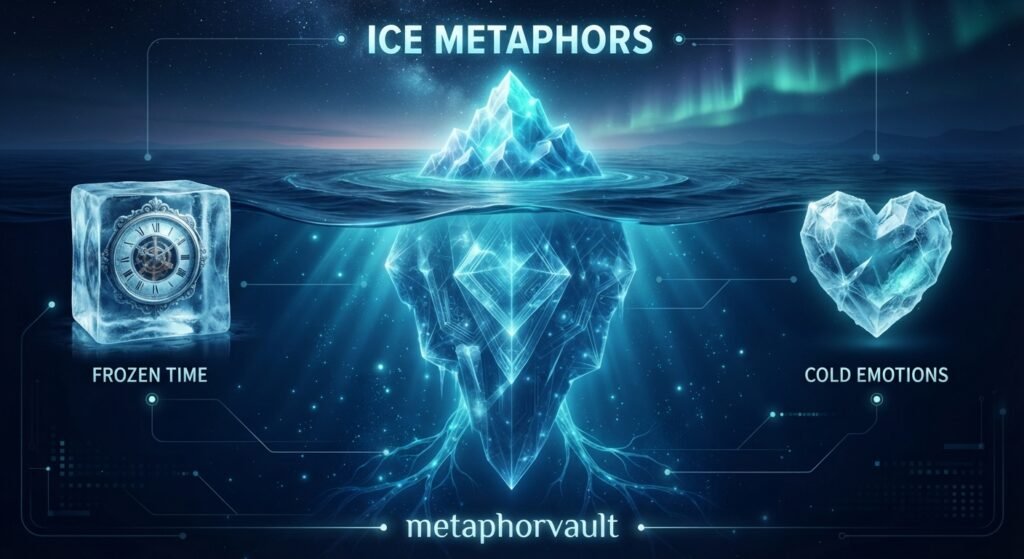
Ice is cold, hard, and often beautiful. It can also suggest feelings that are hard to express. A person with a cold heart may seem unkind. A frozen smile may hide sadness. A relationship on thin ice may be close to trouble. These images turn a simple piece of ice into a powerful way to describe human life.
Ice metaphors compare people, feelings, relationships, or situations to ice without using words such as like or as. Writers use them to show emotional distance, fear, silence, danger, beauty, and change. You may find them in poems, novels, songs, movie scenes, text messages, and everyday speech.
But not every ice metaphor means something negative. Ice can represent calm, strength, purity, stillness, or beauty. Melting ice may suggest trust returning, while a frozen heart can show someone who struggles to express love.
This guide, for 2026, explains more than 65 ice metaphors in simple English. You will learn their meanings, see natural example sentences, and discover when to use each expression. You will also find comparison tables, real-life conversations, and practical tips for writing your own ice metaphors. By the end, you will have plenty of fresh ways to describe cold feelings, difficult relationships, dangerous situations, and the quiet beauty of ice.
Definition & Meaning of Ice Metaphors
Ice metaphors are expressions that use ice to describe something beyond its literal meaning. They often represent cold emotions, emotional distance, danger, silence, or beauty. For example, “Her heart is ice” suggests that she seems emotionally distant, while “Their friendship is on thin ice” means it is at risk.
Ice is a useful image because it has many qualities that people can connect with human experiences. It can be hard, fragile, slippery, clear, freezing, or slowly melting. Each quality creates a different meaning.
Quick summary table
| Ice metaphor | Simple meaning | Example |
|---|---|---|
| A heart of ice | Lack of warmth or compassion | He has a heart of ice. |
| On thin ice | In a risky situation | You’re on thin ice with your teacher. |
| A frozen heart | Difficulty showing love | Her frozen heart began to soften. |
| Ice-cold silence | A very unfriendly silence | Ice-cold silence filled the room. |
| A melting wall of ice | Barriers beginning to fade | Their laughter melted the wall of ice. |
| A slippery sheet of ice | A situation that is hard to control | The debate became a slippery sheet of ice. |
| A crystal palace of ice | Fragile beauty | Her dream was a crystal palace of ice. |
| Frozen in fear | Unable to act because of fear | He was frozen in fear. |
Ice metaphor vs. simile
A metaphor makes a direct comparison. A simile uses like or as to compare two things.
- Metaphor: Her heart is ice.
- Simile: Her heart is like ice.
- Literal statement: She seems unwilling to show affection.
Both the metaphor and simile express emotional coldness, but the metaphor sounds more direct.
Some common ice expressions, such as “on thin ice” and “break the ice,” are also idioms. They have established meanings in English, even when the speaker is not thinking about real ice.
Why We Use Ice Metaphors
Ice metaphors help us describe feelings and situations in a vivid, memorable way. They can show that someone seems unkind, a relationship feels fragile, or a difficult situation could go wrong. Writers also use ice to create images of beauty, silence, isolation, and change in stories, poems, speeches, and everyday conversations.
Here are six common reasons to use them.
1. To describe cold emotions
Instead of saying someone is distant, you might say, “He has built a wall of ice around himself.” The image helps readers picture how hard it is to get close to him.
2. To explain danger
“On thin ice” warns that a person is close to trouble. It is useful in conversation because it expresses risk in just three words.
3. To make creative writing stronger
Ice creates clear pictures in the reader’s mind. A line such as “Her words were frozen knives” feels sharper and more emotional than “Her words were cruel.”
4. To express silence and loneliness
A frozen room, an icy silence, or a world of ice can suggest that people feel cut off from one another.
5. To show change and healing
Ice can melt. That makes it a useful image for trust returning, anger fading, or a person becoming more open.
6. To describe beauty and fragility
Ice can sparkle, shine, and form delicate shapes. It can represent beauty that may not last, such as “a palace of ice.”
65 Ice Metaphors With Meanings and Examples
The following examples cover emotional coldness, relationships, danger, fear, beauty, silence, and change. Some are familiar English expressions; others are creative metaphors you can use in poems, stories, captions, or school assignments.
For each expression, the guide explains its meaning, gives an example, and shows when it works best.
Ice Metaphors for Cold Feelings and Emotions
1. A Heart of Ice
Meaning: A person seems unkind or lacks compassion.
Explanation: Ice suggests a heart that does not respond warmly to other people’s pain.
Example: “He had a heart of ice and ignored everyone who needed help.”
Use when: Describing a character who seems cruel or uncaring.
Avoid when: You do not know the person’s feelings or reasons.
Alternatives: A cold heart; a heart of stone; an icy soul.
Difficulty: Easy. Tone: Neutral, often critical.
2. A Frozen Heart
Meaning: Someone has difficulty showing love or trust.
Explanation: A frozen heart suggests emotions that have been held back, perhaps after hurt or loss.
Example: “Years of disappointment had left him with a frozen heart.”
Use when: Writing about emotional distance or a character’s struggle to trust.
Avoid when: You want to label a real person without understanding their situation.
Alternatives: A guarded heart; a closed heart; a heart locked in winter.
Difficulty: Easy. Tone: Neutral, often sad.
3. Ice-Cold Words
Meaning: Words that sound cruel, harsh, or uncaring.
Explanation: The cold image makes a speaker’s lack of warmth feel clear.
Example: “Her ice-cold words ended the argument.”
Use when: Describing a sharp reply or an unfriendly conversation.
Avoid when: The person is being firm but respectful.
Alternatives: Chilling words; cold remarks; cutting words.
Difficulty: Easy. Tone: Neutral, often negative.
4. An Icy Stare
Meaning: A look that shows anger, dislike, or disapproval.
Explanation: The image suggests that a person’s eyes feel cold rather than welcoming.
Example: “The coach gave him an icy stare after he ignored the rules.”
Use when: Describing tension in a story or conversation.
Avoid when: A neutral facial expression could be misread.
Alternatives: A cold look; a frosty glare; a freezing gaze.
Difficulty: Easy. Tone: Neutral.
5. An Ice-Cold Welcome
Meaning: A greeting that feels unfriendly.
Explanation: Instead of warmth and kindness, the visitor receives silence, sharp looks, or distant behavior.
Example: “I received an ice-cold welcome when I walked into the meeting.”
Use when: Describing an awkward visit or tense social setting.
Avoid when: The host is simply quiet or distracted.
Alternatives: A frosty reception; a cold greeting; an unfriendly welcome.
Difficulty: Easy. Tone: Neutral.
6. Frozen Emotions
Meaning: Feelings that seem blocked or hard to express.
Explanation: The image suggests that sadness, fear, or love cannot easily come out.
Example: “He spoke about the loss with frozen emotions.”
Use when: Describing a character who struggles to express feelings.
Avoid when: Assuming that a quiet person feels nothing.
Alternatives: Buried feelings; locked emotions; feelings trapped in ice.
Difficulty: Medium. Tone: Neutral.
7. An Icy Soul
Meaning: A person seems distant or lacking in warmth.
Explanation: The soul represents a person’s inner nature, while ice suggests emotional coldness.
Example: “Behind his icy soul was a man afraid of being hurt.”
Use when: Creating a vivid character in fiction or poetry.
Avoid when: Making a harsh judgment about a real person’s character.
Alternatives: A cold spirit; a guarded soul; a heart of ice.
Difficulty: Medium. Tone: Literary, often negative.
8. An Ice-Cold Smile
Meaning: A smile that appears forced, unfriendly, or insincere.
Explanation: The contrast between a smile and coldness suggests that the person is hiding their true feelings.
Example: “She gave him an ice-cold smile and turned away.”
Use when: Describing tension or hidden anger in a scene.
Avoid when: A person’s smile may simply be nervous.
Alternatives: A forced smile; a frosty smile; a thin smile.
Difficulty: Easy. Tone: Neutral.
9. A Glacier of Anger
Meaning: Anger that is deep, slow, and difficult to shift.
Explanation: A glacier moves slowly but carries great force, making it a strong image for anger that builds over time.
Example: “A glacier of anger moved through him as he remembered the betrayal.”
Use when: Writing about long-held resentment.
Avoid when: Describing a brief burst of anger.
Alternatives: Frozen rage; a slow-burning anger; a mountain of resentment.
Difficulty: Advanced. Tone: Literary, intense.
10. A Winter Inside the Heart
Meaning: Deep sadness, loneliness, or emotional emptiness.
Explanation: Winter’s cold and stillness represent a period when warmth and joy feel far away.
Example: “After the breakup, she carried a winter inside her heart.”
Use when: Writing poetry or describing grief and loneliness.
Avoid when: A simple, direct description would be clearer.
Alternatives: An emotional winter; a frozen heart; a season of sadness.
Difficulty: Medium. Tone: Literary, sad.
Ice Metaphors for Relationships and Social Situations
11. A Wall of Ice
Meaning: A strong barrier between people.
Explanation: The wall suggests that someone is hard to reach emotionally.
Example: “A wall of ice stood between the two sisters after their argument.”
Use when: Describing distance between friends, partners, or family members.
Avoid when: The disagreement is small and easily resolved.
Alternatives: An icy barrier; a wall of silence; a frozen divide.
Difficulty: Easy. Tone: Neutral.
12. A Relationship on Thin Ice
Meaning: A relationship is in danger of breaking down.
Explanation: Thin ice may crack under too much weight, just as trust can fail under repeated strain.
Example: “Their relationship was on thin ice after another broken promise.”
Use when: Trust is weak or conflict keeps growing.
Avoid when: The relationship is stable and you only want to describe a minor disagreement.
Alternatives: Their bond is fragile; their relationship is at risk; their trust is cracking.
Difficulty: Easy. Tone: Neutral.
13. Breaking the Ice
Meaning: Making people feel more relaxed when they first meet.
Explanation: This common idiom imagines breaking a cold barrier so people can talk freely.
Example: “A quick joke helped break the ice at the new-student meeting.”
Use when: Starting conversations in a group or meeting new people.
Avoid when: The setting is serious or a joke may seem disrespectful.
Alternatives: Ease the tension; get the conversation started; warm things up.
Difficulty: Easy. Tone: Informal, neutral.
14. Melting the Ice Between Us
Meaning: Reducing tension and becoming friendlier.
Explanation: Melting ice represents the gradual return of warmth and trust.
Example: “Our honest talk began melting the ice between us.”
Use when: People are slowly rebuilding a connection.
Avoid when: The other person has asked for space or does not want contact.
Alternatives: Rebuilding trust; easing the distance; warming up to each other.
Difficulty: Easy. Tone: Neutral.
15. An Ice-Cold Silence
Meaning: A silence filled with tension or disapproval.
Explanation: The silence feels unfriendly, as if nobody wants to speak or connect.
Example: “An ice-cold silence followed his rude comment.”
Use when: Describing an awkward or tense moment.
Avoid when: Silence simply means people are thinking or listening.
Alternatives: A frosty silence; a tense pause; a wall of silence.
Difficulty: Easy. Tone: Neutral.
16. Frozen Trust
Meaning: Trust that has stopped growing because of hurt or fear.
Explanation: The ice suggests a bond that can no longer move forward easily.
Example: “After the lie, their trust was frozen.”
Use when: Describing a friendship or relationship damaged by dishonesty.
Avoid when: Trust has not actually been harmed.
Alternatives: Broken trust; damaged faith; a bond locked in place.
Difficulty: Easy. Tone: Neutral.
17. An Icy Distance
Meaning: A cold emotional gap between people.
Explanation: The distance is not physical; it is a lack of warmth, openness, or closeness.
Example: “An icy distance grew between the old friends.”
Use when: Describing a friendship that is fading.
Avoid when: The people are simply busy or living far apart.
Alternatives: Emotional distance; a widening gap; a cold divide.
Difficulty: Easy. Tone: Neutral.
18. A Frozen Friendship
Meaning: A friendship that has stopped growing or communicating.
Explanation: The image suggests that the bond is stuck in one place, often because of an unresolved problem.
Example: “Their friendship froze after the misunderstanding.”
Use when: Writing about a friendship that has become distant.
Avoid when: The friends are simply taking a short break from contact.
Alternatives: A stalled friendship; a fading bond; a friendship in cold storage.
Difficulty: Easy. Tone: Neutral.
19. Ice Between Two People
Meaning: Unspoken tension or distance between people.
Explanation: Ice becomes a barrier that keeps people from feeling close.
Example: “There was ice between them after the meeting.”
Use when: Describing tension that neither person has discussed.
Avoid when: You have no reason to assume tension exists.
Alternatives: A cold gap; unspoken tension; a frozen divide.
Difficulty: Easy. Tone: Neutral.
20. A Love Locked in Ice
Meaning: Love that cannot be expressed or acted upon.
Explanation: The image suggests that affection exists but is held back by fear, distance, or past hurt.
Example: “Their love was locked in ice by years of silence.”
Use when: Writing about hidden love or emotional barriers.
Avoid when: Suggesting that someone secretly loves another person without evidence.
Alternatives: Frozen love; love behind a wall; affection trapped in winter.
Difficulty: Medium. Tone: Literary, sad.
Ice Metaphors for Danger, Risk, and Fear
21. Walking on Thin Ice
Meaning: Acting in a way that could lead to trouble.
Explanation: Thin ice may break under a person’s weight, just as a risky choice may cause problems.
Example: “You’re walking on thin ice by ignoring your manager’s warnings.”
Use when: Warning someone about risky behavior.
Avoid when: You want to give feedback without making a threat.
Alternatives: Taking a big risk; pushing your luck; getting close to trouble.
Difficulty: Easy. Tone: Informal, cautionary.
22. A Slippery Slope of Ice
Meaning: A situation where one mistake may lead to more problems.
Explanation: Slippery ice makes it hard to stay in control, suggesting that a situation could worsen quickly.
Example: “Lying to cover one mistake can become a slippery slope of ice.”
Use when: Discussing choices that may create further trouble.
Avoid when: Claiming that one small action must lead to disaster.
Alternatives: A dangerous path; a chain of mistakes; a slide toward trouble.
Difficulty: Medium. Tone: Neutral, cautionary.
23. A Crack in the Ice
Meaning: An early sign that a situation is becoming unstable.
Explanation: A crack shows that a surface may no longer be safe or strong.
Example: “The first missed payment was a crack in the ice beneath their business.”
Use when: Describing a warning sign in a plan or relationship.
Avoid when: The problem is already severe and needs direct wording.
Alternatives: A warning sign; the first sign of trouble; a weakness in the foundation.
Difficulty: Easy. Tone: Neutral.
24. A House Built on Ice
Meaning: A plan or success built on an unstable base.
Explanation: A house needs firm ground. Ice suggests a foundation that may melt, shift, or break.
Example: “Their business was a house built on ice because it depended on false promises.”
Use when: Explaining why a plan is unreliable.
Avoid when: You have not checked whether the foundation is truly weak.
Alternatives: A shaky foundation; a fragile plan; a castle built on sand.
Difficulty: Medium. Tone: Neutral.
25. Frozen in Fear
Meaning: Being unable to act because of fear.
Explanation: The person feels as if their body or mind has stopped moving.
Example: “I was frozen in fear when I heard the crash.”
Use when: Describing a sudden shock or frightening moment.
Avoid when: The person is calm and making a deliberate choice not to act.
Alternatives: Paralyzed by fear; rooted to the spot; too scared to move.
Difficulty: Easy. Tone: Neutral.
26. A Glacier of Fear
Meaning: A deep, slow-growing fear that is hard to overcome.
Explanation: A glacier suggests something large and powerful that moves slowly.
Example: “A glacier of fear grew inside him as the deadline approached.”
Use when: Writing about long-lasting anxiety or dread.
Avoid when: Describing a brief scare.
Alternatives: A mountain of fear; frozen dread; a growing wave of worry.
Difficulty: Advanced. Tone: Literary, serious.
27. An Ice Trap
Meaning: A dangerous situation that is difficult to escape.
Explanation: The image suggests that a person has become stuck in conditions that keep making things worse.
Example: “The debt became an ice trap that was harder to escape each month.”
Use when: Describing a difficult cycle or a problem that keeps growing.
Avoid when: The person has clear, easy ways out.
Alternatives: A frozen trap; a cycle of trouble; a situation with no easy exit.
Difficulty: Easy. Tone: Neutral.
28. A Frozen Road Ahead
Meaning: A future that seems difficult or uncertain.
Explanation: An icy road is hard to travel safely, just as an uncertain future may require care.
Example: “With no job offers yet, the road ahead felt frozen.”
Use when: Describing an uncertain career or life change.
Avoid when: You want to suggest that the future is hopeless.
Alternatives: A rough road ahead; an uncertain path; a difficult journey.
Difficulty: Easy. Tone: Neutral.
29. A Frozen Warning
Meaning: A warning that feels harsh, final, or impossible to ignore.
Explanation: The image gives a warning a cold, firm quality.
Example: “The final letter was a frozen warning that the deal could end.”
Use when: Writing a tense scene or describing a firm notice.
Avoid when: The warning is friendly or meant to reassure.
Alternatives: A cold warning; a stern message; a chilling notice.
Difficulty: Medium. Tone: Literary, serious.
30. A Sea of Ice
Meaning: A large, overwhelming obstacle or a place of isolation.
Explanation: A wide frozen sea can suggest a huge barrier with no easy way through.
Example: “Between the two teams lay a sea of ice made of mistrust.”
Use when: Describing a large emotional or practical divide.
Avoid when: A small obstacle needs only a simple description.
Alternatives: An ocean of barriers; a frozen wasteland; a vast icy divide.
Difficulty: Medium. Tone: Literary.
Ice Metaphors for Silence, Isolation, and Loneliness
31. A Frozen Room
Meaning: A room that feels tense, quiet, or emotionally lifeless.
Explanation: The image suggests that the people in the room are too uncomfortable to speak freely.
Example: “After the accusation, the meeting room became frozen.”
Use when: Describing a tense scene.
Avoid when: The room is simply cold in temperature.
Alternatives: A room full of tension; a silent room; a room with a cold atmosphere.
Difficulty: Easy. Tone: Neutral.
32. A Frozen World
Meaning: A life or setting that feels still, empty, or cut off.
Explanation: A world covered in ice can represent isolation or a lack of emotional warmth.
Example: “After his friends moved away, his world felt frozen.”
Use when: Writing about loneliness or a sudden loss of connection.
Avoid when: You want to describe a lively, changing environment.
Alternatives: A cold world; a world without warmth; a silent landscape.
Difficulty: Easy. Tone: Literary, often sad.
33. A Frozen Voice
Meaning: A voice that sounds stiff, distant, or without emotion.
Explanation: The image makes the speaker seem unable or unwilling to express warmth.
Example: “She answered in a frozen voice that ended the discussion.”
Use when: Describing tense dialogue in a story.
Avoid when: The person is simply speaking quietly.
Alternatives: A cold voice; a flat tone; a voice without warmth.
Difficulty: Easy. Tone: Neutral.
34. An Ice-Bound Heart
Meaning: A heart held back by pain, fear, or loneliness.
Explanation: The image suggests that difficult experiences have made love or trust hard to express.
Example: “His ice-bound heart needed time before he could trust again.”
Use when: Writing about emotional healing.
Avoid when: Suggesting that someone is incapable of love.
Alternatives: A guarded heart; a frozen heart; a heart trapped in winter.
Difficulty: Advanced. Tone: Literary.
35. A Glacier Between Us
Meaning: A huge emotional distance between two people.
Explanation: A glacier is large and slow-moving, so it suggests a divide that will take time to cross.
Example: “Years of silence left a glacier between the brothers.”
Use when: Describing a long-running family or relationship conflict.
Avoid when: The distance is temporary or easily fixed.
Alternatives: A mountain between us; an icy divide; a widening emotional gap.
Difficulty: Medium. Tone: Literary, sad.
36. A Frozen Clock
Meaning: Time that seems to stand still.
Explanation: A stopped clock can represent waiting, shock, or a moment someone cannot move beyond.
Example: “As she waited for the news, the afternoon became a frozen clock.”
Use when: Describing a long, tense wait.
Avoid when: You need to state the actual length of time.
Alternatives: Time stood still; a moment trapped in ice; a day that would not move.
Difficulty: Medium. Tone: Literary.
37. A Frozen Memory
Meaning: A memory that remains vivid or painful over time.
Explanation: The image suggests that a past moment has been preserved and is hard to move beyond.
Example: “The accident stayed in her mind as a frozen memory.”
Use when: Writing about the past or a powerful experience.
Avoid when: Making assumptions about how another person remembers an event.
Alternatives: A memory locked in time; a moment preserved in ice; a memory that will not fade.
Difficulty: Medium. Tone: Neutral, often sad.
38. A Desert of Ice
Meaning: A place or life that feels empty and lonely.
Explanation: A desert suggests a lack of life, while ice adds a sense of coldness and distance.
Example: “Without friendship, the city felt like a desert of ice.”
Use when: Creating a strong image of isolation in fiction or poetry.
Avoid when: Describing an actual desert or a place that is warm and lively.
Alternatives: A frozen wasteland; a lonely wilderness; a world stripped of warmth.
Difficulty: Advanced. Tone: Literary, bleak.
Ice Metaphors for Beauty, Purity, and Fragility
39. A Crystal Palace of Ice
Meaning: Something beautiful but fragile.
Explanation: A palace made of ice may shine brilliantly, yet it can melt or break.
Example: “Their perfect life was a crystal palace of ice, lovely but easy to lose.”
Use when: Describing beauty that may not last.
Avoid when: You want to suggest lasting strength and stability.
Alternatives: A fragile dream; a glass castle; a beautiful but delicate world.
Difficulty: Medium. Tone: Literary.
40. A Diamond of Ice
Meaning: A small, bright, and precious form of beauty.
Explanation: The clear shine of ice can resemble a diamond, suggesting brilliance and rarity.
Example: “A diamond of ice glittered on the edge of the leaf.”
Use when: Describing a beautiful natural scene.
Avoid when: You need to describe a large or rough object rather than a tiny detail.
Alternatives: An icy jewel; a crystal spark; a frozen gem.
Difficulty: Easy. Tone: Poetic.
41. A Glass Garden of Ice
Meaning: A delicate place of cold beauty.
Explanation: Glass-like ice suggests fragile shapes that may break with a small touch.
Example: “The winter trees formed a glass garden of ice.”
Use when: Writing about winter landscapes or delicate beauty.
Avoid when: Describing a warm or rugged setting.
Alternatives: A frozen garden; a crystal forest; a palace of frost.
Difficulty: Medium. Tone: Poetic.
42. A Crown of Ice
Meaning: Cold beauty, power, or pride.
Explanation: A crown suggests status, while ice makes that status seem distant, sharp, or fragile.
Example: “The queen wore a crown of ice that glittered beneath the moon.”
Use when: Creating a fantasy character or a vivid winter image.
Avoid when: The intended meaning is kindness or warmth.
Alternatives: A frozen crown; a crown of frost; a crystal crown.
Difficulty: Medium. Tone: Poetic, dramatic.
43. A Sculpture of Ice
Meaning: Beauty shaped into a delicate form.
Explanation: An ice sculpture is carefully formed but can melt, so it represents skill and temporary beauty.
Example: “Her childhood dream was a sculpture of ice, beautiful but not built to last.”
Use when: Describing delicate art, dreams, or fragile success.
Avoid when: You want to emphasize permanence.
Alternatives: A frozen work of art; a crystal figure; a fragile masterpiece.
Difficulty: Easy. Tone: Neutral, poetic.
44. A Blanket of Ice
Meaning: A wide layer of ice covering something.
Explanation: The blanket suggests that ice hides or covers a surface, changing its look and feel.
Example: “A blanket of ice covered the quiet lake.”
Use when: Describing a winter scene or a still, covered landscape.
Avoid when: The image needs to show a small, separate piece of ice.
Alternatives: A sheet of ice; a frozen cover; a layer of frost.
Difficulty: Easy. Tone: Neutral, descriptive.
45. A Mirror of Ice
Meaning: A surface that reflects images clearly and beautifully.
Explanation: Smooth ice can reflect the sky, trees, or lights like a mirror.
Example: “The frozen lake became a mirror of ice beneath the stars.”
Use when: Describing a still winter scene.
Avoid when: The surface is rough or does not reflect light.
Alternatives: A frozen mirror; a glassy lake; a sheet of shining ice.
Difficulty: Easy. Tone: Poetic.
46. A Lacework of Ice
Meaning: Delicate, detailed patterns of ice.
Explanation: Ice crystals can form thin, lace-like shapes on windows and branches.
Example: “Lacework of ice decorated the window at dawn.”
Use when: Writing about winter beauty and fine detail.
Avoid when: The ice is thick, heavy, or rough.
Alternatives: Frost lace; a web of frost; delicate crystal patterns.
Difficulty: Medium. Tone: Poetic.
47. A Frozen Jewel
Meaning: Something that looks precious and bright in the cold.
Explanation: The image connects the shine of ice with the value and beauty of a jewel.
Example: “The snow-covered garden was a frozen jewel in the morning light.”
Use when: Praising a beautiful winter scene.
Avoid when: The description needs to be plain and factual.
Alternatives: An icy gem; a crystal treasure; a winter jewel.
Difficulty: Easy. Tone: Poetic.
Ice Metaphors for Change, Healing, and New Beginnings
48. A Melting Heart of Ice
Meaning: A person is beginning to show warmth or kindness.
Explanation: The ice stands for emotional barriers, and melting suggests that those barriers are fading.
Example: “Her kindness slowly melted his heart of ice.”
Use when: Describing forgiveness, love, or growing trust.
Avoid when: The person has not shown any change in behavior.
Alternatives: A thawing heart; a softened heart; a heart warming up.
Difficulty: Easy. Tone: Neutral, hopeful.
49. Ice Turning to Water
Meaning: A hard or fixed situation is beginning to change.
Explanation: Solid ice becoming water gives a clear image of something rigid becoming more flexible.
Example: “After their honest talk, the tension felt like ice turning to water.”
Use when: Describing progress after conflict.
Avoid when: Nothing has changed or the problem remains firm.
Alternatives: A thaw beginning; tension easing; a rigid situation softening.
Difficulty: Easy. Tone: Neutral.
50. A Thaw After Winter
Meaning: A period of hardship is giving way to hope.
Explanation: The end of winter suggests a return of warmth, movement, and new growth.
Example: “After months of silence, their friendship entered a thaw after winter.”
Use when: Describing recovery or a fresh start.
Avoid when: The problem is still severe and needs practical action.
Alternatives: A new spring; a thawing season; warmth returning.
Difficulty: Easy. Tone: Hopeful, literary.
51. Cracks in a Frozen Wall
Meaning: The first signs that a barrier is breaking down.
Explanation: Small cracks suggest that a once-solid emotional wall is no longer complete.
Example: “His willingness to talk showed cracks in the frozen wall around him.”
Use when: Describing slow progress in a relationship.
Avoid when: The person is simply being polite and no deeper change is clear.
Alternatives: The first signs of trust; a wall beginning to crumble; a barrier starting to melt.
Difficulty: Medium. Tone: Neutral, hopeful.
52. An Ice Bridge Breaking
Meaning: A fragile connection is falling apart.
Explanation: An ice bridge may look solid but can break under pressure, making it a strong image for a weak bond.
Example: “Their final argument was the sound of an ice bridge breaking.”
Use when: Writing about a relationship or agreement that is ending.
Avoid when: The connection is still strong and repair is possible.
Alternatives: A fragile bond snapping; a bridge collapsing; a connection breaking apart.
Difficulty: Medium. Tone: Literary, sad.
53. A Frozen River Breaking Free
Meaning: Something held back is finally moving again.
Explanation: A river breaking through ice suggests renewed energy, freedom, or a release of emotion.
Example: “After years of doubt, her creativity was a frozen river breaking free.”
Use when: Describing a new beginning or a return of confidence.
Avoid when: The situation is still blocked.
Alternatives: A thawing river; a dam of feelings breaking; a new flow of energy.
Difficulty: Medium. Tone: Poetic, hopeful.
54. Winter Ice Giving Way to Spring
Meaning: A difficult stage is making room for renewal.
Explanation: The change from ice to spring suggests that growth can follow a cold or painful period.
Example: “Her life felt like winter ice giving way to spring after she found a new purpose.”
Use when: Writing about healing or a positive change.
Avoid when: Promising that every hardship will end soon.
Alternatives: Winter turning to spring; darkness giving way to light; a new season of hope.
Difficulty: Easy. Tone: Hopeful.
Ice Metaphors for Power, Control, and Stillness
55. Ice in the Veins
Meaning: Someone remains calm or shows little emotion under pressure.
Explanation: The phrase suggests a person whose feelings do not seem to affect their actions.
Example: “The surgeon had ice in her veins during the emergency.”
Use when: Describing calm behavior in a high-pressure situation.
Avoid when: Calmness is being confused with cruelty or a lack of care.
Alternatives: Nerves of steel; a cool head; unshaken composure.
Difficulty: Easy. Tone: Informal.
56. An Ice-Cold Mind
Meaning: A mind that stays clear and controlled.
Explanation: Here, coldness suggests a lack of panic rather than a lack of kindness.
Example: “She kept an ice-cold mind and solved the problem step by step.”
Use when: Praising calm thinking during a crisis.
Avoid when: You mean that someone is uncaring or cruel.
Alternatives: A cool head; a clear mind; a steady mind.
Difficulty: Easy. Tone: Neutral.
57. An Ice Fortress
Meaning: A strong barrier that protects someone but keeps others away.
Explanation: A fortress suggests defense, while ice adds a cold and distant feeling.
Example: “He built an ice fortress around his feelings after the betrayal.”
Use when: Describing self-protection or emotional isolation.
Avoid when: The person is simply setting healthy boundaries.
Alternatives: A wall of ice; a frozen shield; an emotional fortress.
Difficulty: Medium. Tone: Literary.
58. A Frozen Kingdom
Meaning: A place or world ruled by coldness and stillness.
Explanation: The kingdom image creates a complete setting where warmth and change seem absent.
Example: “The lonely ruler turned his palace into a frozen kingdom.”
Use when: Writing fantasy, fiction, or poetry.
Avoid when: You need a simple description of an ordinary place.
Alternatives: An icy realm; a kingdom of frost; a land locked in winter.
Difficulty: Medium. Tone: Literary, dramatic.
59. An Ice-Cold Grip
Meaning: A strong, frightening hold on someone or something.
Explanation: The grip may represent fear, control, or pressure that is difficult to escape.
Example: “Fear held the town in an ice-cold grip after the storm.”
Use when: Describing widespread fear or strict control.
Avoid when: The situation is not actually restrictive or frightening.
Alternatives: A frozen grip; a tight hold; a chilling hold.
Difficulty: Easy. Tone: Neutral, dramatic.
60. A Frozen Mask
Meaning: A fixed expression that hides real feelings.
Explanation: The mask suggests a person is keeping their emotions hidden, while frozen suggests that the expression never changes.
Example: “He wore a frozen mask throughout the interview.”
Use when: Describing hidden feelings in a character.
Avoid when: You cannot tell what a real person’s expression means.
Alternatives: A blank mask; a fixed expression; a face without warmth.
Difficulty: Medium. Tone: Literary, neutral.
Creative Ice Metaphors for Poetry and Stories
61. A Thousand Needles of Ice
Meaning: A sharp, painful sensation or a set of harsh feelings.
Explanation: The image makes coldness feel sharp, almost like tiny points pressing against the skin.
Example: “A thousand needles of ice ran through her as she heard the news.”
Use when: Writing an intense scene of shock, fear, or physical cold.
Avoid when: You want a calm or gentle mood.
Alternatives: A sting of cold; icy needles; a sharp chill.
Difficulty: Advanced. Tone: Dramatic, literary.
62. An Ice-Covered Dream
Meaning: A hope or goal that has been delayed or neglected.
Explanation: The ice suggests that a dream has become inactive, though it may still be possible to revive it.
Example: “Her dream of becoming a painter lay beneath an ice-covered silence.”
Use when: Writing about lost ambition or postponed plans.
Avoid when: The dream is still active and growing.
Alternatives: A frozen dream; a dream buried in winter; a hope locked in ice.
Difficulty: Medium. Tone: Literary, sad.
63. An Ice-Colored Sky
Meaning: A pale, cold-looking sky that creates a mood of distance or stillness.
Explanation: The color of ice suggests a clear, chilly atmosphere that may feel peaceful or lonely.
Example: “An ice-colored sky stretched above the silent fields.”
Use when: Describing winter scenery in a poem or story.
Avoid when: The sky is warm and brightly colored.
Alternatives: A frost-blue sky; a pale winter sky; a sky of frozen silver.
Difficulty: Medium. Tone: Poetic.
64. A River of Melted Memories
Meaning: Memories returning or feelings from the past becoming easier to express.
Explanation: Melting ice suggests that what was held back can now move and flow.
Example: “The old photograph opened a river of melted memories.”
Use when: Writing about nostalgia, family, or healing.
Avoid when: The memories have no connection to the situation.
Alternatives: A flood of memories; a stream of recollections; the past flowing back.
Difficulty: Advanced. Tone: Poetic, reflective.
65. A Heart Thawing in the Sun
Meaning: A person is slowly becoming more open, loving, or trusting.
Explanation: The sun represents care or kindness, while the thaw suggests that emotional barriers are fading.
Example: “With each act of kindness, her heart began thawing in the sun.”
Use when: Writing about healing, friendship, or love.
Avoid when: Assuming that kindness alone will resolve deep emotional pain.
Alternatives: A heart warming again; ice melting from the soul; a heart opening to love.
Difficulty: Easy. Tone: Hopeful, poetic.
Quick Reference Table: 65 Ice Metaphors
Use this table to find the right ice metaphor for your topic. Some expressions are common idioms, while others are creative comparisons designed for poetry, stories, and descriptive writing.
| # | Ice metaphor | Main meaning | Best use |
|---|---|---|---|
| 1 | A heart of ice | Lack of compassion | Character description |
| 2 | A frozen heart | Difficulty showing love | Emotional writing |
| 3 | Ice-cold words | Harsh speech | Dialogue |
| 4 | An icy stare | Anger or disapproval | Fiction |
| 5 | An ice-cold welcome | An unfriendly greeting | Social situations |
| 6 | Frozen emotions | Feelings held back | Personal reflection |
| 7 | An icy soul | Emotional distance | Poetry |
| 8 | An ice-cold smile | An unfriendly smile | Stories |
| 9 | A glacier of anger | Deep, slow anger | Dramatic writing |
| 10 | A winter inside the heart | Deep sadness | Poetry |
| 11 | A wall of ice | Emotional barriers | Relationships |
| 12 | A relationship on thin ice | A relationship at risk | Conversation |
| 13 | Breaking the ice | Easing social tension | Introductions |
| 14 | Melting the ice between us | Growing closer | Reconciliation |
| 15 | An ice-cold silence | Tense silence | Dialogue |
| 16 | Frozen trust | Damaged trust | Relationships |
| 17 | An icy distance | Emotional separation | Friendship |
| 18 | A frozen friendship | A stalled friendship | Personal writing |
| 19 | Ice between two people | Unspoken tension | Conversation |
| 20 | A love locked in ice | Unexpressed love | Romance |
| 21 | Walking on thin ice | Risky behavior | Warnings |
| 22 | A slippery slope of ice | A risk that may worsen | Advice |
| 23 | A crack in the ice | An early warning sign | Analysis |
| 24 | A house built on ice | An unstable foundation | Planning |
| 25 | Frozen in fear | Unable to act from fear | Stories |
| 26 | A glacier of fear | Deep, lasting fear | Poetry |
| 27 | An ice trap | A difficult situation to escape | Problem-solving |
| 28 | A frozen road ahead | An uncertain future | Reflection |
| 29 | A frozen warning | A harsh warning | Dramatic scenes |
| 30 | A sea of ice | A huge barrier | Descriptive writing |
| 31 | A frozen room | A tense setting | Stories |
| 32 | A frozen world | Isolation and stillness | Fiction |
| 33 | A frozen voice | A distant tone | Dialogue |
| 34 | An ice-bound heart | Feelings held back | Poetry |
| 35 | A glacier between us | A large emotional gap | Relationships |
| 36 | A frozen clock | Time seeming to stop | Suspense |
| 37 | A frozen memory | A vivid or painful memory | Reflection |
| 38 | A desert of ice | Emptiness and loneliness | Poetry |
| 39 | A crystal palace of ice | Fragile beauty | Fantasy |
| 40 | A diamond of ice | Bright, precious beauty | Nature writing |
| 41 | A glass garden of ice | Delicate beauty | Winter scenes |
| 42 | A crown of ice | Cold power or beauty | Fantasy |
| 43 | A sculpture of ice | Temporary beauty | Art and poetry |
| 44 | A blanket of ice | A wide covering of ice | Nature description |
| 45 | A mirror of ice | A reflective surface | Winter scenery |
| 46 | A lacework of ice | Delicate ice patterns | Descriptive writing |
| 47 | A frozen jewel | Shining winter beauty | Poetry |
| 48 | A melting heart of ice | Growing warmth | Healing |
| 49 | Ice turning to water | A rigid situation changing | Reconciliation |
| 50 | A thaw after winter | Hope after hardship | Encouragement |
| 51 | Cracks in a frozen wall | Barriers starting to fade | Relationships |
| 52 | An ice bridge breaking | A fragile connection ending | Drama |
| 53 | A frozen river breaking free | Renewed movement | Fresh starts |
| 54 | Winter ice giving way to spring | Renewal after hardship | Hopeful writing |
| 55 | Ice in the veins | Calmness under pressure | Sports and work |
| 56 | An ice-cold mind | Controlled thinking | Decision-making |
| 57 | An ice fortress | Emotional protection | Fiction |
| 58 | A frozen kingdom | A cold, still world | Fantasy |
| 59 | An ice-cold grip | Strong, frightening control | Suspense |
| 60 | A frozen mask | Hidden feelings | Character writing |
| 61 | A thousand needles of ice | Sharp pain or fear | Dramatic poetry |
| 62 | An ice-covered dream | A delayed hope | Reflection |
| 63 | An ice-colored sky | A pale, cold sky | Nature poetry |
| 64 | A river of melted memories | Memories returning | Nostalgia |
| 65 | A heart thawing in the sun | Growing trust and warmth | Healing and love |
Real-Life Conversations Using Ice Metaphors
Ice metaphors work best when they sound natural in context. These conversations show how people might use familiar expressions to talk about friendship, family, school, work, and dating.
1. Friends talking after an argument
Maya: Are you and Sara still not talking?
Lena: Not really. There’s a wall of ice between us.
Maya: What happened?
Lena: I said something hurtful, and now she barely looks at me.
Maya: Maybe you should talk to her. You could start by apologizing.
Lena: I hope that helps melt the ice between us.
Metaphors: “A wall of ice” and “melt the ice between us.”
2. A parent warning a teenager
Dad: You missed your curfew again last night.
Ethan: I know. I’m sorry.
Dad: You’re walking on thin ice. We agreed on the rules.
Ethan: I understand. It won’t happen again.
Dad: I hope so. Trust takes time to build, and one more broken promise could damage it.
Metaphor: “Walking on thin ice.”
3. A student writing a poem
Nina: My poem is about winter and loneliness.
Omar: What image are you using?
Nina: A frozen heart. I want to show someone who cannot talk about their feelings.
Omar: You could describe a frozen river, too. It looks still on the surface, but water is underneath.
Nina: That’s a good idea. It could show that the person still has feelings, even if they hide them.
Metaphors: “A frozen heart” and “a frozen river.”
4. Coworkers after a tense meeting
Jordan: That meeting was uncomfortable.
Priya: I know. The room went silent after the manager’s comment.
Jordan: It was an ice-cold silence.
Priya: We should clear up the misunderstanding before it gets worse.
Jordan: Agreed. A quick, honest conversation might break the ice.
Metaphors: “An ice-cold silence” and “break the ice.”
5. Two people getting to know each other
Alex: You seemed quiet when we first met.
Taylor: I was nervous. I tend to build a wall of ice around myself.
Alex: I get that. It takes time to feel comfortable with someone.
Taylor: Exactly. But talking with you has helped melt some of that ice.
Alex: I’m glad. We don’t have to rush anything.
Metaphors: “A wall of ice” and “melt some of that ice.”
These conversations show an important point: an ice metaphor can sound negative, hopeful, or neutral depending on the situation.
Everyday Usage of Ice Metaphors
Ice metaphors appear in everyday speech, creative writing, books, movies, poems, social media, and professional communication. They help people express cold feelings, danger, beauty, or change in a few words. The best expression depends on your audience, the mood, and what you want the reader to understand.
1. In everyday conversation
People use familiar ice expressions to describe relationships and behavior.
Examples:
- “You’re on thin ice with me.”
- “That joke helped break the ice.”
- “He gave me an icy stare.”
- “Things are finally starting to thaw between us.”
Use these expressions when you want to communicate a feeling or situation quickly.
2. In school assignments
Ice metaphors are useful in essays about emotions, winter, relationships, and human behavior.
For example:
A frozen heart can represent a person who struggles to trust others. Past hurt may have built an emotional wall that keeps friends away. With patience and kindness, that wall may begin to melt.
When explaining a metaphor in an essay, identify the comparison, describe its meaning, and support your explanation with an example.
3. In books and short stories
Writers use ice to create mood and show a character’s emotions.
Example:
An icy silence filled the house. Every word they had left unsaid seemed to freeze the air between them.
This image suggests tension without directly stating that the family members are angry.
Writing tip: Keep a central image consistent. If you begin with a frozen heart, you can develop the idea through ice walls, cracks, and melting to show emotional change.
4. In movies and screenplays
Ice can create a visual symbol of fear, isolation, power, or beauty. A frozen lake may suggest stillness or danger, while melting ice may represent a character becoming more open.
For example, a character standing alone in a frozen landscape can suggest loneliness. If sunlight later melts the ice, the change may reflect renewed hope.
These meanings depend on the story. Ice does not always symbolize sadness or emotional coldness.
5. In poetry
Ice metaphors work well in poems because they connect physical images with feelings.
Example:
Her heart was winter, her words were ice, yet one small act of kindness brought spring into her eyes.
The poem uses winter and ice to represent emotional distance, then introduces spring to suggest change.
Poetry tip: Choose images that support the same feeling. A few connected images often create a stronger poem than many unrelated metaphors.
6. In emails and professional communication
Ice metaphors can describe tension or the need to improve communication. Familiar expressions work best in professional settings.
Hi Team,
Our last meeting showed that there is still some ice between us on a few key issues.
I’d like us to make time for an open discussion, clear up any misunderstandings, and agree on our next steps.
My goal is to break the ice, build trust, and help everyone move forward together.
Thank you,
[Your Name]
For formal writing, avoid overly dramatic expressions such as “a glacier of anger” unless the context is creative or deliberately expressive.
7. In text messages
Short ice expressions are useful when you want to describe a mood or relationship.
Examples:
- “That was awkward. Glad we broke the ice!”
- “I think we’re still on thin ice after yesterday.”
- “Things are finally thawing between us.”
- “His reply was ice-cold.”
Remember that messages can be misunderstood without facial expressions or tone. If the situation is sensitive, explain what you mean rather than relying on a metaphor alone.
8. On Instagram and Facebook
Ice metaphors can create thoughtful captions about personal growth, loneliness, winter scenery, or relationships.

Winter beauty
“The world wore a crown of ice this morning, and every branch looked like a work of art.”
Possible hashtags: #WinterBeauty #Frost #NaturePhotography

Healing and hope
“Even the coldest heart can begin to thaw when kindness finds its way in.”
Possible hashtags: #Healing #Kindness #PersonalGrowth

Stillness and reflection
“Some days, my mind is a frozen lake—quiet on the surface, with a world of thoughts underneath.”
Possible hashtags: #Reflection #QuietMoments #Poetry
9. On X
Short metaphors can make a message memorable.
Examples:
- “A cold reply can freeze a warm conversation.”
- “A crack in the ice is still a sign of change.”
- “You can’t build lasting trust on thin ice.”
Keep the point clear and avoid using a metaphor that could make a serious personal situation sound like a joke.
10. On LinkedIn
Ice metaphors can describe trust, teamwork, and difficult workplace conversations.
Example:
“Trust can be fragile. When communication breaks down, even a strong team can find itself on thin ice. Honest feedback and clear expectations help rebuild that trust.”
For professional posts, explain the practical lesson behind the metaphor. This gives readers something useful to take away.
How to Create Your Own Ice Metaphors
You can create an original ice metaphor by choosing a quality of ice and connecting it to an emotion, person, or situation. Think about whether ice is hard, fragile, slippery, clear, still, or melting. Then use that quality to express your idea.
- Choose a feeling or situation. For example, loneliness, fear, trust, or hope.
- Pick an ice-related quality. Ice can crack, melt, freeze, reflect light, or cover a surface.
- Connect the image to your idea. A crack may suggest a weakness, while melting may suggest change.
- Write a clear comparison. For example, “My fear was a sheet of ice covering every new opportunity.”
- Add context. Explain what happened and why the image fits.
Here are a few original examples:
| Feeling or situation | Original ice metaphor | Meaning |
|---|---|---|
| Fear of change | My courage was trapped beneath a lake of ice. | Fear held me back. |
| Recovering trust | Her honesty placed the first crack in our wall of ice. | Trust began to return. |
| Loneliness | I lived in a house where every room was winter. | I felt alone and emotionally distant. |
| Hidden sadness | His smile was a thin layer of ice over deep water. | He hid difficult feelings. |
| Hope | A small sun began melting the winter inside me. | Hope helped me feel better. |
| Fragile success | Our success was a bridge made of ice. | Our position was not secure. |
These are creative comparisons rather than fixed English idioms. Use them when you want to develop a personal style in poetry, stories, or descriptive writing.
Frequently Asked Questions About Ice Metaphors
What is a metaphor for ice?
An ice metaphor uses ice to describe something beyond its literal meaning. For example, “Her heart is ice” suggests emotional coldness, while “their friendship is on thin ice” means their relationship is at risk.
What is the most common ice metaphor?
“On thin ice” and “break the ice” are two widely used expressions. “On thin ice” means being close to trouble, while “break the ice” means making people feel more comfortable in a social situation.
What does ice symbolize in literature?
Ice can symbolize emotional distance, fear, isolation, danger, purity, beauty, or stillness. Its meaning depends on the story. Melting ice often suggests change or renewed warmth, while cracking ice may suggest weakness or the start of a breakdown.
What is a metaphor for a cold person?
“A heart of ice” is a common metaphor for someone who seems unkind or lacks compassion. “An icy soul” is a more poetic alternative, while “a frozen heart” can suggest someone who struggles to express love or trust.
What is a metaphor for a difficult relationship?
“A relationship on thin ice” suggests that a relationship is at risk of breaking down. “A wall of ice between us” suggests emotional distance, while “frozen trust” describes a bond damaged by dishonesty or hurt.
What is a positive ice metaphor?
“A melting heart of ice” is a positive metaphor because it suggests that someone is becoming kinder or more open. “A thaw after winter” can represent hope and recovery after a difficult period.
Are ice metaphors the same as ice idioms?
No. An ice metaphor is a comparison that uses ice to express an idea. An ice idiom is an established expression whose meaning may differ from its literal words. Some expressions, such as “on thin ice,” function as both a figurative image and an idiom.
Can I use ice metaphors in an essay?
Yes. Ice metaphors can make an essay more vivid, especially when discussing feelings, relationships, literature, or nature. Explain the metaphor clearly and connect it to your main point. For formal essays, familiar expressions are usually easier to understand than highly elaborate images.
Conclusion
Ice metaphors give us a vivid way to describe feelings and situations that may be hard to explain directly. A heart of ice can represent emotional distance, thin ice can warn of danger, and melting ice can suggest that trust or kindness is returning.
These expressions also show that ice is not always a symbol of something bad. It can be beautiful, clear, calm, and delicate. A crown of ice may suggest power, while a mirror of ice can create an image of peace and stillness.
When choosing an ice metaphor, think about the feeling you want to express and the effect you want the reader to experience. Use familiar phrases in daily conversation and explore more original images in poetry, stories, and creative writing.
The strongest ice metaphor is one that helps readers see an idea, feel its meaning, and remember it after they have finished reading.
discover more post
60+ Patience Metaphors Powerful Ways to Describe 2026
60+ Thanksgiving Metaphors Meaningful Creative Examples 2026
60+Confidence Metaphors Powerful Examples Meanings …

Anderson is the founder and lead content writer at MetaphorVault.com, where he specializes in creating engaging, easy-to-understand content about metaphors, idioms, figurative language, and modern English expressions. With over 8 years of experience in content writing and language education, he is passionate about making complex language concepts simple and practical for readers of all levels. His work focuses on delivering accurate, well-researched, and reader-friendly articles that help students, writers, educators, and English learners improve their communication skills. Through MetaphorVault.com, Anderson is committed to publishing high-quality, informative content that is both engaging and trustworthy.